
In the realm of modern mechanical engineering, particularly with the rapid advancement of robotics and mechatronics, there is an escalating demand for high-reduction ratio gear transmissions. The hyperboloid gear, an evolution from the hypoid gear, stands out as a conical worm gear form that not only retains the advantageous transmission characteristics of hypoid gears but also achieves high reduction ratios while facilitating motion transfer between spatially intersecting axes. This gear type is pivotal in applications requiring compact design, high torque, and efficient power transmission. However, due to technical barriers, research on high-reduction ratio hyperboloid gears remains limited, especially concerning wear analysis and optimization. Wear in such gears is often severe, with the pinion frequently failing before the gear reaches its service life, underscoring the necessity for in-depth studies on sliding mechanisms and wear patterns. Sliding rate, a critical parameter reflecting relative motion between gear tooth surfaces, is intrinsically linked to wear and scuffing. Therefore, developing accurate methods for calculating sliding rates in high-reduction ratio hyperboloid gears is essential for enhancing their durability and performance.
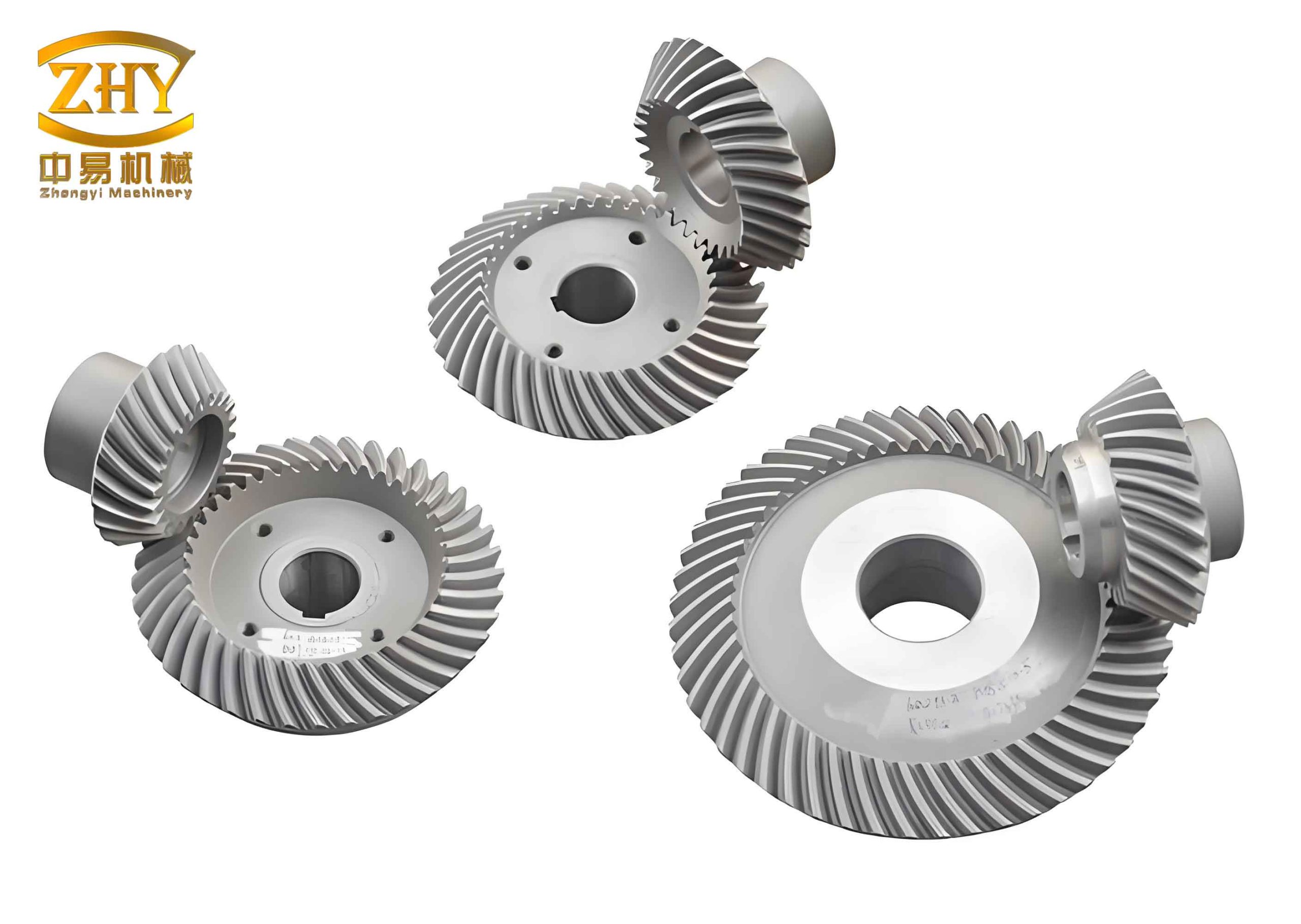
This article presents a comprehensive investigation into the calculation of sliding rates for high-reduction ratio hyperboloid gears. A novel iterative method for determining tooth blank parameters is proposed, derived from the gear’s parameters, which serves as the foundation for subsequent analysis. Based on spatial gear meshing principles, the motion state of point-contact gear pairs is analyzed to derive fundamental sliding rate equations. Subsequently, by integrating the basic principles of high-reduction ratio hyperboloid gear transmission, the sliding rate formulas are expressed in terms of design parameters. The validity of these formulas is demonstrated through computational examples involving two gear pairs with different reduction ratios. This research not only provides a new methodology for designing high-reduction ratio hyperboloid gear tooth blanks but also establishes a theoretical framework for wear analysis and optimization, contributing to the broader understanding of hyperboloid gear dynamics.
The hyperboloid gear, characterized by its hyperbolic tooth geometry, enables efficient power transmission under high reduction ratios. Its design complexity necessitates precise parameter calculation to ensure optimal meshing and minimal wear. Traditional methods often rely on established hypoid gear design principles, but for high-reduction ratios, specialized approaches are required. In this study, we introduce a calculation method that starts from the gear’s parameters to iteratively derive the pinion’s tooth blank parameters, ensuring compatibility and performance. This method is crucial as accurate tooth blank parameters directly influence the gear’s contact patterns, stress distribution, and sliding behavior.
To elucidate the sliding phenomena in hyperboloid gears, we first analyze the spatial meshing motion. Consider two gears in point contact, represented in coordinate systems S, S1, and S2, where S is a fixed coordinate system, and S1 and S2 are attached to gear 1 and gear 2, respectively. The angular velocities are denoted as \(\boldsymbol{\omega}^{(1)}\) and \(\boldsymbol{\omega}^{(2)}\), and translational velocities as \(\boldsymbol{v}_0^{(1)}\) and \(\boldsymbol{v}_0^{(2)}\). For a point M on the tooth surface, the relative velocity \(\boldsymbol{v}^{(12)}\) between the gears is derived from the motion equations. The sliding rates \(\sigma_1\) and \(\sigma_2\) are defined as:
$$
\sigma_1 = \frac{|d_1\boldsymbol{r}^{(1)} – d_2\boldsymbol{r}^{(2)}|}{|d_1\boldsymbol{r}^{(1)}|}, \quad \sigma_2 = \frac{|d_1\boldsymbol{r}^{(1)} – d_2\boldsymbol{r}^{(2)}|}{|d_2\boldsymbol{r}^{(2)}|}
$$
where \(d_1\boldsymbol{r}^{(1)}\) and \(d_2\boldsymbol{r}^{(2)}\) are differential movements along the tooth surfaces of gear 1 and gear 2, respectively. This formulation captures the essence of sliding in point-contact gear pairs, providing a basis for further derivation specific to hyperboloid gears.
For high-reduction ratio hyperboloid gears, the tooth blank parameters must be meticulously calculated to achieve desired performance. The proposed method begins by defining the shaft angle \(\Sigma\), number of teeth for gear and pinion \(Z_2\) and \(Z_1\), hand of spiral, and offset distance \(E\). The gear pitch diameter \(d_2\) is selected based on load capacity requirements. The gear face width \(b_2\) is limited to \(10 \times \frac{d_2}{Z_2}\) or one-third of the outer cone distance of an equivalent spiral bevel gear. The gear pitch angle \(\delta_2’\) is approximated as:
$$
\tan \delta_2′ = \frac{\sin \Sigma}{1.2(Z_2 / Z_1 + \cos \Sigma)}
$$
The gear pitch radius \(r_2\) is then:
$$
r_2 = \frac{1}{2}(d_2 – b_2 \sin \delta_2′)
$$
The gear axial offset angle \(\epsilon_0’\) is:
$$
\sin \epsilon_0′ = \frac{E \sin \delta_2′}{r_2}
$$
An initial pinion spiral angle \(\beta_{20} \approx 35^\circ\) is assumed, leading to the initial enlargement factor \(k’\):
$$
k’ = \frac{1}{\cos \epsilon_0′ – \tan \beta_{20} \sin \epsilon_0′}
$$
The initial pinion pitch radius \(r_1’\) is:
$$
r_1′ = k’ i_{12} r_2
$$
where \(i_{12} = Z_1 / Z_2\) is the gear ratio. The pinion axial offset angle \(\eta_1’\) is obtained iteratively:
$$
\tan \eta_1′ = \frac{r_2 \tan \delta_2′}{E + r_2 \tan \delta_2′ \sin \Sigma + r_1′ \cos \Sigma}
$$
If \(|\tan \eta_1’| \leq 0.01\), set \(\tan \eta_1′ = \pm 0.011\), with the sign matching that of the equation. Subsequently, the gear axial offset angle \(\epsilon\), pinion pitch angle \(\delta_1\), offset angle \(\epsilon’\), and pinion spiral angle \(\beta_1\) are approximated as:
$$
\begin{aligned}
\sin \epsilon &= \sin \epsilon_0′ – (r_1′ \sin \eta_1′) / r_2 \\
\tan \delta_1 &= \tan \eta_1′ / (\cot \Sigma – \cos \eta_1′) \\
\sin \epsilon’ &= \tan \delta_1 \sin \Sigma / \cos \eta_1′ \\
\cos \beta_1 &= \cos \epsilon’ / \sqrt{1 – \sin^2 \epsilon’}
\end{aligned}
$$
The gear spiral angle \(\beta_2’\) is:
$$
\sin \beta_2′ = \frac{\cos \epsilon’ – 1/k’}{\sin \epsilon’}
$$
If \(\beta_2’\) does not equal the desired spiral angle \(\beta_{20}\), the enlargement factor is adjusted. The corrected enlargement factor \(k\) is:
$$
k = \frac{1}{\cos \epsilon – \tan \beta_{20} \sin \epsilon}
$$
leading to a new pinion pitch radius \(r_1 = k i_{12} r_2\). The parameters are recalculated as:
$$
\begin{aligned}
\sin \epsilon &= \sin \epsilon_0′ – (i_{12}(k – k’) r_2 \sin \eta_1′) / r_2 \\
\tan \delta_1 &= \tan \eta_1′ / (\cot \Sigma – \cos \eta_1′) \\
\cos \beta_1 &= \cos \epsilon / \sqrt{1 – \sin^2 \epsilon} \\
\tan \beta_2 &= \tan \beta_{20} + (\cos \epsilon – 1/k) / \sin \epsilon
\end{aligned}
$$
The gear pitch angle \(\delta_2\) is:
$$
\tan \delta_2 = \frac{\sin \epsilon}{\cos \epsilon \cot \Sigma – \tan \eta_1′ \sin \Sigma}
$$
The gear pitch distance \(R_2 = r_2 / \sin \delta_2\), and the pinion pitch distance \(R_1\) is:
$$
R_1 = \frac{r_1 + i_{12}(k – k’) r_2}{\sin \delta_1}
$$
Thus, the pinion pitch radius \(r_1 = R_1 \sin \delta_1\). The limit pressure angle \(\alpha^*\) and limit curvature radius \(r^*\) are determined through iterative processes to ensure design feasibility. This method provides a systematic approach for calculating tooth blank parameters for high-reduction ratio hyperboloid gears, essential for subsequent sliding rate analysis.
Building on the tooth blank parameters, we derive the sliding rate formulas for high-reduction ratio hyperboloid gears. Consider the pitch cone node M, established based on the spatial geometry of the gear pair. A coordinate system (M-i, j, k) is defined with origin at M, where i and j lie on the pitch plane, and k is perpendicular to it. The angular velocity vectors \(\boldsymbol{\omega}^{(1)}\) and \(\boldsymbol{\omega}^{(2)}\) align with the gear axes. The relative velocity \(\boldsymbol{v}^{(12)}\) lies in the pitch plane. The position vectors from the gear axes to M are:
$$
\boldsymbol{O’M} = L_1 (-\sin \beta_1 \boldsymbol{i} – \cos \beta_1 \boldsymbol{j}), \quad \boldsymbol{O”M} = L_2 (-\sin \beta_2 \boldsymbol{i} – \cos \beta_2 \boldsymbol{j})
$$
where \(L_1\) and \(L_2\) are the distances from M to the gear axes along the pitch cone generators. The angular velocities are expressed as:
$$
\begin{aligned}
\boldsymbol{\omega}^{(1)} &= \omega_1 (-\cos \delta_1 \sin \beta_1 \boldsymbol{i} – \cos \delta_1 \cos \beta_1 \boldsymbol{j} + \sin \delta_1 \boldsymbol{k}) \\
\boldsymbol{\omega}^{(2)} &= \omega_2 (\cos \delta_2 \sin \beta_2 \boldsymbol{i} + \cos \delta_2 \cos \beta_2 \boldsymbol{j} – \sin \delta_2 \boldsymbol{k})
\end{aligned}
$$
The relative angular velocity \(\boldsymbol{\omega}^{(12)} = \boldsymbol{\omega}^{(1)} – \boldsymbol{\omega}^{(2)}\) is:
$$
\begin{aligned}
\boldsymbol{\omega}^{(12)} &= (\omega_1 \cos \delta_1 \sin \beta_1 + \omega_2 \cos \delta_2 \sin \beta_2) \boldsymbol{i} \\
&+ (\omega_1 \cos \delta_1 \cos \beta_1 + \omega_2 \cos \delta_2 \cos \beta_2) \boldsymbol{j} \\
&+ (-\omega_1 \sin \delta_1 – \omega_2 \sin \delta_2) \boldsymbol{k}
\end{aligned}
$$
The velocities of M due to rotation are:
$$
\begin{aligned}
\boldsymbol{v}^{(1)} &= \boldsymbol{\omega}^{(1)} \times \boldsymbol{O’M} = L_1 \omega_1 (\sin \delta_1 \sin \beta_1 \boldsymbol{i} + \sin \delta_1 \cos \beta_1 \boldsymbol{j}) \\
\boldsymbol{v}^{(2)} &= \boldsymbol{\omega}^{(2)} \times \boldsymbol{O”M} = L_2 \omega_2 (\sin \delta_2 \sin \beta_2 \boldsymbol{i} + \sin \delta_2 \cos \beta_2 \boldsymbol{j})
\end{aligned}
$$
By setting the i-component of \(\boldsymbol{v}^{(12)}\) to zero, the relative velocity simplifies to:
$$
\boldsymbol{v}^{(12)} = (L_1 \omega_1 \sin \delta_1 \sin \beta_1 – L_2 \omega_2 \sin \delta_2 \sin \beta_2) \boldsymbol{j}
$$
Using the relationship between tooth blank parameters, this can be rewritten as:
$$
v^{(12)} = L_1 \omega_1 \sin \delta_1 \frac{\sin \epsilon}{\cos \beta_2}
$$
The characteristic vector \(\boldsymbol{q}\) is derived as:
$$
\begin{aligned}
\boldsymbol{q} &= \omega_1 \omega_2 [L_1 \sin \delta_1 \sin \delta_2 (\sin \beta_2 – \sin \beta_1) \boldsymbol{i} \\
&- (L_1 \sin \delta_1 \sin \delta_2 (\cos \beta_1 + \cos \beta_2) + L_2 \cos \epsilon (\sin \delta_1 \cos \delta_2 + \cos \delta_1 \sin \delta_2)) \boldsymbol{j} \\
&+ L_2 \cos \epsilon (L_1 \sin \delta_1 \cos \delta_2 + \cos \delta_1 \sin \delta_2) \boldsymbol{k}]
\end{aligned}
$$
The unit normal vector \(\boldsymbol{n}\) to the tooth surface at the pitch point is \(\boldsymbol{n} = \pm \cos \alpha \boldsymbol{i} + \sin \alpha \boldsymbol{k}\), where \(\alpha\) is the pressure angle. The limit pressure angle \(\alpha_0\) is given by:
$$
\tan \alpha_0 = \pm \frac{L_1 \sin \beta_1 – L_2 \sin \beta_2}{L_1 \tan \delta_1 + L_2 \tan \delta_2}
$$
with the limit normal vector \(\boldsymbol{n}_0 = \pm \cos \alpha_0 \boldsymbol{i} + \sin \alpha_0 \boldsymbol{k}\). The dot product \(\boldsymbol{n} \cdot \boldsymbol{q}\) is:
$$
\boldsymbol{n} \cdot \boldsymbol{q} = \omega_1 \omega_2 \frac{\sin(\alpha – \alpha_0)}{\cos \alpha_0} [L_2 \cos \epsilon (\sin \delta_1 \cos \delta_2 + \cos \delta_1 \sin \delta_2) + L_1 \sin \delta_1 \sin \delta_2 (\cos \beta_1 + \cos \beta_2)]
$$
The triple product \((\boldsymbol{v}^{(12)}, \boldsymbol{\omega}^{(12)}, \boldsymbol{n})\) is calculated as the determinant:
$$
(\boldsymbol{v}^{(12)}, \boldsymbol{\omega}^{(12)}, \boldsymbol{n}) = \begin{vmatrix}
0 & v^{(12)} & 0 \\
\omega^{(12)}_i & \omega^{(12)}_j & \omega^{(12)}_k \\
\cos \alpha & 0 & \sin \alpha
\end{vmatrix}
$$
where \(\omega^{(12)}_i, \omega^{(12)}_j, \omega^{(12)}_k\) are the components of \(\boldsymbol{\omega}^{(12)}\). Substituting these into the general sliding rate formula:
$$
\sigma_1 = \frac{v^{(12)} + (\boldsymbol{v}^{(12)}, \boldsymbol{\omega}^{(12)}, \boldsymbol{n}) k_v^{(1)}}{\boldsymbol{n} \cdot \boldsymbol{q} + (\boldsymbol{v}^{(12)}, \boldsymbol{\omega}^{(12)}, \boldsymbol{n}) k_v^{(1)}}
$$
where \(k_v^{(1)}\) is the normal curvature of the tooth surface at the pitch point, derived from gear geometry. Similarly, \(\sigma_2\) can be expressed. For high-reduction ratio hyperboloid gears, these formulas are simplified using design parameters. The sliding rate for the gear (surface 1) is:
$$
\sigma_1 = \frac{ v^{(12)} + \begin{vmatrix} 0 & L_1 \omega_1 \sin \delta_1 \sin \beta_1 – L_2 \omega_2 \sin \delta_2 \sin \beta_2 & 0 \\ \omega_1 \cos \delta_1 \sin \beta_1 + \omega_2 \cos \delta_2 \sin \beta_2 & \omega_1 \cos \delta_1 \cos \beta_1 + \omega_2 \cos \delta_2 \cos \beta_2 & -\omega_1 \sin \delta_1 – \omega_2 \sin \delta_2 \\ \cos \alpha & 0 & \sin \alpha \end{vmatrix} k_v^{(1)} }{ \omega_1 \omega_2 \frac{\sin(\alpha – \alpha_0)}{\cos \alpha_0} [L_2 \cos \epsilon (\sin \delta_1 \cos \delta_2 + \cos \delta_1 \sin \delta_2) + L_1 \sin \delta_1 \sin \delta_2 (\cos \beta_1 + \cos \beta_2)] + \begin{vmatrix} 0 & L_1 \omega_1 \sin \delta_1 \sin \beta_1 – L_2 \omega_2 \sin \delta_2 \sin \beta_2 & 0 \\ \omega_1 \cos \delta_1 \sin \beta_1 + \omega_2 \cos \delta_2 \sin \beta_2 & \omega_1 \cos \delta_1 \cos \beta_1 + \omega_2 \cos \delta_2 \cos \beta_2 & -\omega_1 \sin \delta_1 – \omega_2 \sin \delta_2 \\ \cos \alpha & 0 & \sin \alpha \end{vmatrix} k_v^{(1)} }
$$
This expression, though complex, encapsulates the dependency of sliding rate on design parameters such as pitch angles, spiral angles, offset distance, and pressure angle. For practical application, numerical computation is employed.
To validate the derived formulas, two high-reduction ratio hyperboloid gear pairs are analyzed: one with a gear ratio of 3:45 and another with 5:60. The tooth blank parameters are calculated using the proposed iterative method, as summarized in the following tables.
| Parameter | Pinion (3:45) | Gear (3:45) |
|---|---|---|
| Number of Teeth (z) | 3 | 45 |
| Module (m_n) | 1.067 | |
| Offset Distance E (mm) | 10 | |
| Pressure Angle α (°) | 20 | |
| Shaft Angle Σ (°) | 90 | |
| Face Width b (mm) | 9.24 | 5.76 |
| Spiral Angle β (°) | 67.10 | 39.00 |
| Pitch Angle δ (°) | 10.99 | 77.60 |
| Outer Diameter (mm) | 10.41 | 48.01 |
| Parameter | Gear (5:60) | Pinion (5:60) |
|---|---|---|
| Number of Teeth (z) | 60 | 5 |
| Module (m_n) | 1.360 | |
| Offset Distance E (mm) | 14 | |
| Pressure Angle α (°) | 19 | |
| Shaft Angle Σ (°) | 90 | |
| Face Width b (mm) | 16.08 | 13.50 |
| Spiral Angle β (°) | 55.15 | 31.12 |
| Pitch Angle δ (°) | 5.33 | 84.17 |
| Outer Diameter (mm) | 14.10 | 81.65 |
Focusing on the gear concave surface and pinion convex surface, with the gear as the first surface, the sliding rates at the pitch point are computed using the derived formulas. The results are as follows:
| Gear Pair | |σ₁| (Gear) | |σ₂| (Pinion) |
|---|---|---|
| 3:45 | 1.2381 | 5.1999 |
| 5:60 | 0.6364 | 1.7505 |
The absolute sliding rate for the gear is lower than that for the pinion in both cases, aligning with practical observations where the pinion experiences more severe wear. To further verify the formulas, the 5:60 gear pair is analyzed using an alternative algebraic method based on spatial coordinate systems. The pitch point coordinates and related data are substituted into the general sliding rate algebraic expressions, yielding |σ₁’| = 0.6176 and |σ₂’| = 1.7613. These values are consistent with the results from the derived formulas, confirming their accuracy. The minor discrepancies are attributable to numerical approximations and rounding errors, but the overall trend validates the methodology.
The sliding rate calculations reveal that for high-reduction ratio hyperboloid gears, the sliding rate at the pitch point is non-zero, indicating inherent relative sliding even at the theoretical point of pure rolling. This sliding contributes to wear and necessitates design optimizations. The higher sliding rates in the pinion underscore the importance of material selection, lubrication, and surface treatments to enhance durability. Furthermore, the derived formulas provide a tool for designers to predict sliding behavior and adjust parameters such as spiral angle, pressure angle, and offset distance to minimize sliding rates. For instance, increasing the pressure angle or optimizing the spiral angle can reduce sliding, thereby improving gear life.
In conclusion, this study advances the understanding of sliding mechanisms in high-reduction ratio hyperboloid gears. The proposed iterative method for tooth blank parameter calculation offers a novel approach for designing such gears, ensuring accurate geometry for optimal meshing. The derivation of sliding rate formulas in terms of design parameters establishes a direct link between gear geometry and sliding behavior, facilitating predictive analysis. The computational examples demonstrate the applicability of the formulas and highlight the higher sliding rates in pinions, which correlates with observed wear patterns. Future work could explore the integration of these sliding rate models with wear prediction algorithms, enabling comprehensive lifecycle analysis. Additionally, experimental validation through dynamometer testing or field applications would further corroborate the theoretical findings. Ultimately, this research contributes to the development of more reliable and efficient high-reduction ratio hyperboloid gears, supporting their expanding role in advanced mechanical systems.
The hyperboloid gear, with its unique geometry and high-reduction capability, continues to be a critical component in power transmission. By mastering the calculation of sliding rates, engineers can better design and maintain these gears, reducing downtime and costs. The methodologies presented here not only apply to hyperboloid gears but also offer insights into other types of gear systems with point contact or high sliding conditions. As technology progresses, the demand for precision in gear design will only increase, making such theoretical foundations indispensable. Therefore, ongoing research in this domain is essential for pushing the boundaries of mechanical engineering and meeting the challenges of modern industry.