
In the realm of automotive manufacturing, the precision and performance of drivetrain components are paramount. Among these, the axle bevel gear, specifically the drive pinion within the rear axle assembly, stands as a critical element. As a key component for transmitting power and motion between intersecting axes, its manufacturing quality directly influences the vehicle’s driving performance, noise levels, vibration, harshness (NVH), and ultimately, its service life. The production of such a bevel gear typically involves several stages, with turning being the most material-intensive and contour-defining operation. This initial machining phase removes nearly 90% of the raw material and establishes the foundational geometry, directly dictating the final dimensional accuracy, form, and positional tolerances of the bevel gear shaft. Any imperfection introduced here propagates through subsequent processes like gear hobbing or grinding, affecting final assembly and user experience. Therefore, optimizing the turning process for axle bevel gears is a crucial engineering pursuit to enhance quality, efficiency, and reliability.
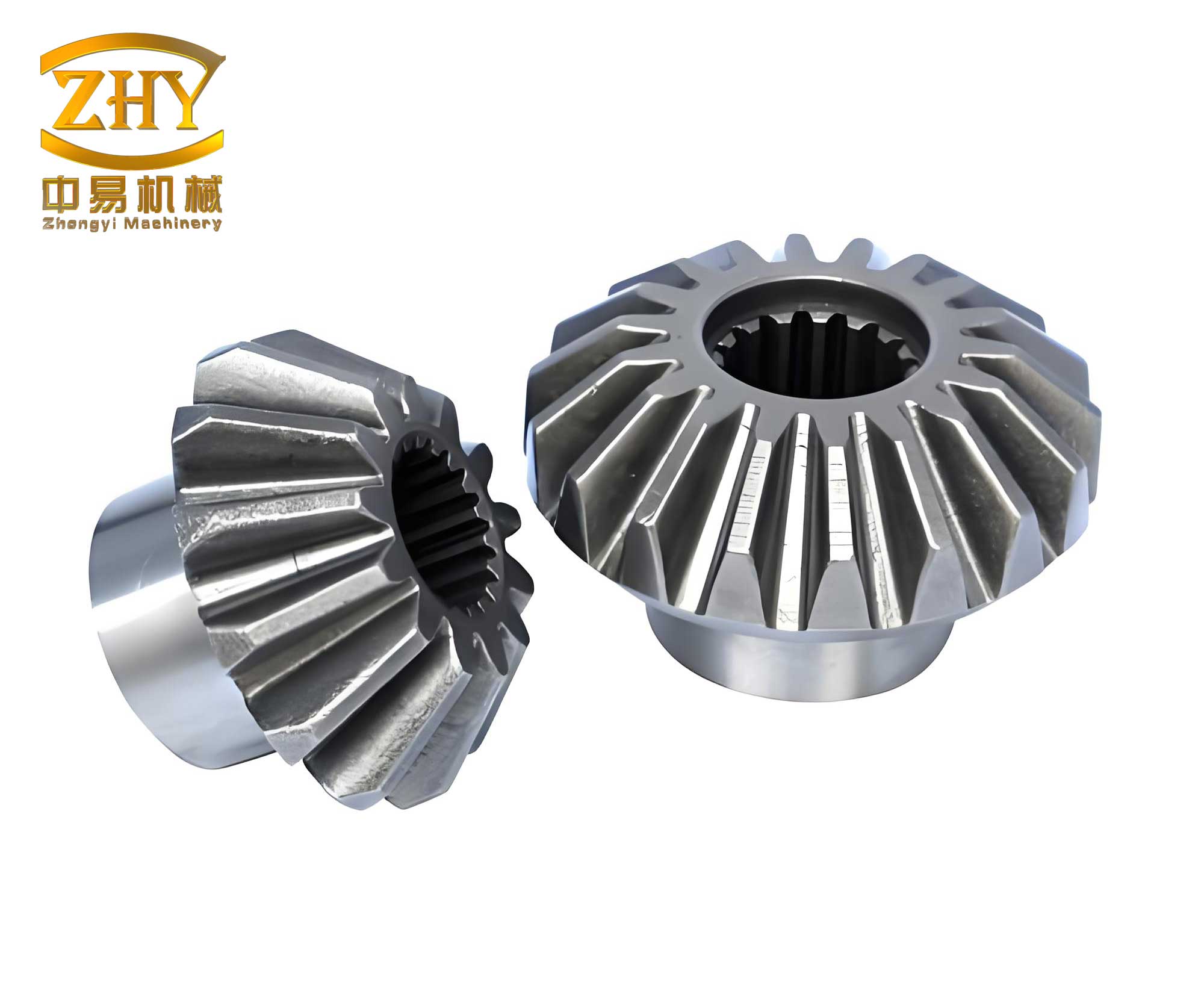
The challenge in turning axle bevel gears, particularly the drive pinion, stems from its distinctive geometry. This bevel gear component is essentially a stepped shaft where one end features the conical gear teeth (the bevel gear itself), and the opposite end often has features like splines or another bearing journal. The primary turning operations are performed on the cylindrical journals and the conical back face. The bevel gear end, due to its protruding conical form, complicates conventional fixturing methods. Achieving high concentricity and runout tolerances (often required to be within 0.02 mm) between the two ends is non-negotiable for proper meshing and bearing life. The material is typically case-hardening steel such as 20CrMnTi, which, after heat treatment, reaches a hardness of 58-62 HRC. Even during soft turning prior to hardening, cutting forces can be substantial, ranging from 150N to 400N depending on the bevel gear size (typically 50-300mm in major cone diameter) and cutting parameters. This combination of demanding geometry, stringent tolerances, and significant cutting forces necessitates a fixturing solution that is simultaneously precise, rigid, and reliable for high-volume production.
Traditional turning processes for such axle bevel gears generally rely on three fundamental workholding methods, each with significant drawbacks for this specific application.
- Between Centers with a Dog (Carrier) Plate: The workpiece is located between a live center in the headstock and a dead or live center in the tailstock. Rotation is transmitted via a dog plate clamped to one end of the shaft, which engages with a driving pin on the headstock faceplate. For a bevel gear shaft, the driving end is often a small-diameter journal. This creates a weak point. The high cutting forces, especially when machining the larger diameters of the bevel gear body, can cause slippage or complete disengagement, leading to scrapped parts and damaged machine centers. Furthermore, the dog plate obstructs the end face, preventing it from being machined in the same setup, which compromises perpendicularity and total runout.
- Chucking (One End) and a Center (One End): The workpiece is held in a multi-jaw chuck on one end and supported by a center on the other. This offers good rigidity but poor concentricity between operations if the part is reversed. More critically for a bevel gear shaft, the chuck jaws cannot effectively grip the conical or large-diameter bevel gear end without specialized soft jaws and excessive force, which may distort the part.
- Between Centers with a Face Driver: This method uses a headstock-mounted face driver whose sharp, hardened pins bite into the workpiece end face under tailstock pressure, providing rotary drive. While efficient and allowing complete machining of the outer diameters, it has critical flaws for precision bevel gears. The pins permanently mar the end face, potentially affecting length dimensions and creating stress concentration points. More importantly, the driving force is uneven and can induce lateral forces that disrupt the precise alignment established by the two centers, degrading the concentricity of the machined features. It is also unsuitable for high cutting forces as the pins may tear through the material.
The core problem is the lack of a fixturing method that combines the high locating accuracy of “between centers” mounting with the driving rigidity of a chuck, without damaging the critical surfaces of the bevel gear component.
To bridge this gap, our team designed and developed a novel, universal turning fixture specifically tailored for axle bevel gear shafts. The design philosophy is elegantly simple: utilize the unmatched locating accuracy of dual centers while incorporating an internal, mechanically-actuated clamping mechanism that grips the workpiece’s non-critical conical surface (the back cone of the bevel gear) or a cylindrical journal, providing positive drive without compromising location.
The fixture assembly consists of several key components mounted onto the machine spindle nose:
- Base Plate: Interfaces with the machine spindle via a precision taper and locking bolts, ensuring alignment.
- Spring & Spring Slider: Housed within the base, these provide a controlled pre-load and allow axial movement.
- Spring Retainer Plate: Secures the assembly and houses the main fixture body.
- Fixture Body (Main Housing): The central structure that contains the expanding mechanism.
- Expanding Sleeve (Collet): A slotted, tapered sleeve that converts axial motion into radial expansion.
- Left-Side (Integrated) Center: Fixed to the spring slider and the expanding sleeve. It acts as one of the two locating centers.
- Clamping Blocks: Typically three, made from a wear-resistant, non-marring material like reinforced polymer (e.g., POM). They are mounted on the expanding sleeve via dove-tail slides.
- Right-Side (Machine Tailstock) Center: The standard machine center, providing the opposing locating point and the actuation force.
The operational principle is a sequence of kinematic motions:
- The raw bevel gear shaft, with pre-machined center holes, is placed between the fixture’s integrated left center and the machine’s right tailstock center.
- The tailstock is advanced. The right center contacts the workpiece and begins to push it axially.
- This axial force is transmitted through the workpiece to the left center, pushing it and the connected spring slider backward against the spring force.
- The left center is threaded into the expanding sleeve. As the sleeve is pulled back axially, its external taper interacts with a matching internal taper in the fixture body.
- This interaction forces the slotted expanding sleeve to contract radially. However, because the clamping blocks are attached to it via angled slides, this radial contraction is translated into a controlled inward radial motion of the blocks.
- The three clamping blocks move uniformly inward until they make solid contact with the workpiece’s conical surface (or designated cylindrical surface).
- At this point, a state of force equilibrium is achieved. The tailstock force (Ftailstock) is balanced by the spring force (Fspring) and the reaction force from the clamping. The friction force (Ffriction) generated at the clamp-workpiece interface, proportional to the normal clamping force (Fclamp) and the coefficient of friction (μ), becomes the driving torque to counteract the cutting force (Fcutting).
$$ \sum F_x = F_{tailstock} – F_{spring} – F_{clamp} \cdot \sin(\alpha) \approx 0 $$
$$ T_{drive} = F_{friction} \cdot r = \mu \cdot F_{clamp} \cdot r > T_{cutting} = F_{cutting} \cdot r_{work} $$
Where $\alpha$ is the cone half-angle, $r$ is the effective clamping radius, and $r_{work}$ is the machining radius. - Upon machining completion, the tailstock retracts. The compressed spring pushes the slider and left center forward, releasing the taper on the expanding sleeve, allowing it to expand radially, and retracting the clamping blocks. The bevel gear shaft can be removed effortlessly.
This design offers significant advantages: It preserves perfect center alignment, provides extremely high and repeatable locating accuracy, offers immense driving rigidity through large-area friction grip, protects finished surfaces with soft clamping blocks, and enables rapid loading/unloading. It is a modular system where wear parts like clamping blocks can be replaced individually.
To quantitatively validate the superiority of this novel fixture against traditional methods, a comprehensive machining trial was conducted. The test piece was a drive pinion bevel gear (Part No. 2402036-K08) made from 20CrNiMo steel. Three process setups were compared:
- Process A (Traditional): Between Centers with Dog Plate.
- Process B (Traditional): Between Centers with Face Driver.
- Process C (Optimized): Between Centers with the Novel Fixture.
The evaluation focused on three critical metrics: Clamping Speed, Process Stability (via cutting force analysis), and Achieved Machining Precision.
1. Clamping Speed Trial:
The goal was to measure pure workhandling efficiency. A single operator performed 10 clamping cycles for each method on the same CNC lathe, with consistent tailstock advance speed. The average time was recorded.
| Workholding Method | Average Clamping Time (s) | Ranking |
|---|---|---|
| Process A: Centers + Dog Plate | 88.6 | 3 (Slowest) |
| Process B: Centers + Face Driver | 14.7 | 1 (Fastest) |
| Process C: Centers + Novel Fixture | 16.3 | 2 |
The Face Driver (Process B) was marginally faster (by 1.6s) than our novel fixture due to its simpler “push-and-bite” action. However, both modern methods were drastically faster than the traditional dog plate method, which is cumbersome and involves manual tightening. For high-volume production of axle bevel gears, both B and C offer excellent efficiency.
2. Cutting Force Stability Trial:
Process stability was assessed by monitoring cutting force variations during a finishing operation. A piezo-electric dynamometer was installed on a tool holder on a CA6140 lathe. A consistent finish turning cut was performed on ten parts per process (ap=0.3 mm, f=0.1 mm/rev, n=900 rpm). The three orthogonal force components (Fx: radial, Fy: tangential/main cutting force, Fz: axial) were recorded. A stable process exhibits low force variability, indicating consistent chip formation and absence of chatter or slip.
| Process | Fx Fluctuation (N) | Fy Fluctuation (N) | Fz Fluctuation (N) | Overall Stability Assessment |
|---|---|---|---|---|
| A: Dog Plate | High, Irregular | High, Irregular | High, Irregular | Poor. Frequent spikes indicate intermittent slip/grab. |
| B: Face Driver | Moderate | Moderate | Moderate | Good. Some variability likely from uneven pin engagement. |
| C: Novel Fixture | Low | Low | Low | Excellent. Very smooth, consistent force signals. |
The analysis clearly shows that the novel fixture (Process C) provides the most stable clamping. The large-area, uniform friction grip of the polymer blocks dampens vibrations and prevents any rotational slip, leading to predictable and steady cutting forces. This is crucial for achieving consistent surface finish and tool life when machining precision bevel gear components.
3. Machining Precision Trial:
The ultimate test of any fixturing system is the geometric accuracy it imparts to the bevel gear shaft. Ten parts were finish-turned for each process on a high-precision WFL turn-mill center under identical cutting conditions (ap=0.3 mm, f=0.15 mm/rev, n=1800 rpm). Key positional tolerances were measured on a Zeiss coordinate measuring machine (CMM).
| Geometric Tolerance | Process A: Dog Plate | Process B: Face Driver | Process C: Novel Fixture |
|---|---|---|---|
| Total Runout (spec: <0.03 mm typical) | Range: 0.015 – 0.030 mm Band: 0.015 mm |
Range: 0.017 – 0.033 mm Band: 0.016 mm |
Range: 0.014 – 0.022 mm Band: 0.008 mm |
| Concentricity (between journals) | Range: 0.012 – 0.025 mm Band: 0.013 mm |
Range: 0.016 – 0.025 mm Band: 0.009 mm |
Range: 0.015 – 0.023 mm Band: 0.008 mm |
| Circular Runout (per journal) | Range: 0.015 – 0.020 mm Band: 0.005 mm |
Range: 0.018 – 0.031 mm Band: 0.013 mm |
Range: 0.015 – 0.022 mm Band: 0.007 mm |
The results are decisive. While all processes could produce parts within a typical specification window, the novel fixture (Process C) consistently yielded the smallest range and the tightest grouping (smallest band) for all measured tolerances. This demonstrates exceptional repeatability and minimal process variation. The Face Driver (Process B), while fast, showed a wider dispersion in runout values, likely due to the variable and potentially distorting nature of its pin-driven clamping. The Dog Plate method (Process A), though sometimes showing a tight band for a single feature, suffers from systematic errors like end-face obstruction, making it unreliable for achieving comprehensive geometric accuracy on a complex bevel gear shaft.
In summary, the development and implementation of this purpose-built turning fixture represent a significant optimization for the machining of axle bevel gears. The fixture ingeniously synthesizes the best attributes of traditional methods: the flawless, repeatable location of a between-centers setup and the robust, high-torque driving capability of a chuck. This synthesis directly addresses the unique fixturing challenges posed by the bevel gear’s conical end geometry.
The comparative trials provide empirical evidence of its superiority. While its clamping speed is virtually on par with the fastest modern alternative (face driver), it surpasses all others in the two most critical categories for quality manufacturing: process stability and achievable precision. The smooth, damped clamping action leads to consistent cutting forces, promoting better surface integrity and tool life. Most importantly, it delivers the highest and most repeatable geometric accuracy for the bevel gear shaft’s critical journals and faces, which is the foundational requirement for its successful performance in the vehicle’s final drivetrain assembly. This optimization ensures that the high-performance bevel gear is manufactured not only efficiently but with the utmost fidelity to its demanding design intent.