
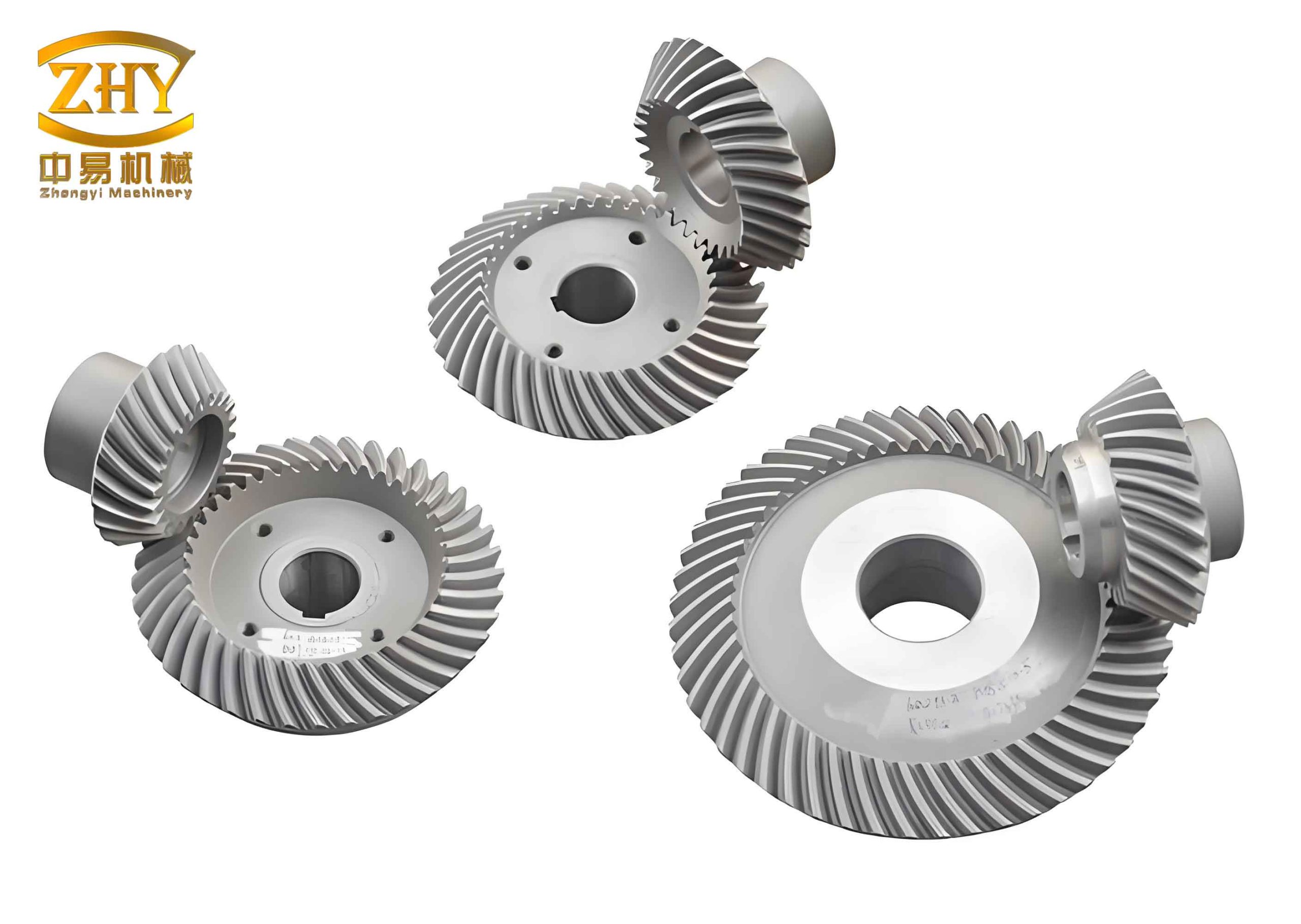
The precise and reliable transmission of motion and power in drive systems is a cornerstone of modern machinery. Among various gear types, the hyperboloid gear stands out for its ability to transmit power between non-intersecting, non-parallel axes with high torque capacity and smooth operation, making it indispensable in automotive differentials and other heavy-duty applications. The exceptional performance of a hyperboloid gear set is not inherent but is meticulously engineered through sophisticated design and manufacturing processes. However, even a perfectly manufactured hyperboloid gear pair can exhibit poor operational characteristics if not assembled correctly. Assembly misalignments are inevitable in real-world applications due to manufacturing tolerances, deflections under load, and mounting inaccuracies. These misalignments are a critical factor influencing the meshing performance, potentially leading to adverse effects such as improper contact patterns, elevated vibration and noise, reduced transmission smoothness, and accelerated wear. Therefore, understanding and quantifying the impact of these errors is paramount for ensuring reliability and longevity.
Traditionally, the adjustment of hyperboloid gear assemblies in the field has relied heavily on the skill and experience of technicians. This trial-and-error approach is time-consuming and often fails to achieve optimal, repeatable results. A more scientific approach involves using simulation tools to predict meshing behavior under misaligned conditions. Key performance indicators for gears under no-load or light-load conditions are the contact pattern (or contact imprint) and the transmission error (TE). The contact pattern visualizes the area of tooth surface interaction, while the transmission error quantifies deviations from perfectly conjugate motion. This study focuses on analyzing the influence of specific assembly errors—axial misalignment, offset distance error, and shaft angle error—on these two critical indicators for a hyperboloid gear pair manufactured using the prevalent HFT (Hypoid Formate Tilt) method.
Hyperboloid Gear Manufacturing Principles: The HFT Method
The complex geometry of a hyperboloid gear is generated through specialized machining processes. The HFT method is a high-productivity, widely adopted technique, particularly in the automotive industry. It employs a two-step process: the gear (often the larger wheel) is cut using a formate (non-generating) method, while the pinion (the smaller wheel) is cut using a generating method with a tilted cutter head. In the formate process for the gear, the tooth profile is essentially copied from the cutter, and there is no relative rolling motion between the imaginary crown gear and the workpiece. Conversely, for the pinion, a generating roll motion is introduced between the tilted cutter head (representing an imaginary conical generating gear) and the pinion blank to create the conjugate tooth flanks. This method allows for localized bearing contact and controlled motion transmission. The geometric complexity arises from the spatial relationship between the tool and the workpiece, defined by numerous machine settings such as cutter radius, blade angles, machine root angle, sliding base setting, and the tilt and rotation of the cutter head.
Geometric Modeling of Hyperboloid Gear Tooth Surfaces
To analyze meshing performance, a precise mathematical model of the tooth surfaces is essential. This model is derived from the kinematic relationship between the cutting tool and the gear blank during machining.
Mathematical Model for the Gear (Formate Cutting)
The cutting edge of the gear cutter is typically a circular blade with a specified pressure angle. In the cutter coordinate system \( S_G(O_G-X_GY_GZ_G) \), the surface of the blade cone can be expressed using parameters \( S_G \) (distance along the blade) and \( \theta_G \) (rotation angle around the cutter axis). The position vector \( \mathbf{r}_G \) and unit normal vector \( \mathbf{n}_G \) are:
$$
\mathbf{r}_G(S_G, \theta_G) = \begin{bmatrix}
-S_G \cos\alpha_G \\
(r_{c2} – S_G \sin\alpha_G) \sin\theta_G \\
(r_{c2} – S_G \sin\alpha_G) \cos\theta_G \\
1
\end{bmatrix}, \quad \mathbf{n}_G(\theta_G) = \begin{bmatrix}
\sin\alpha_G \\
-\cos\alpha_G \sin\theta_G \\
-\cos\alpha_G \cos\theta_G
\end{bmatrix}
$$
where \( r_{c2} \) is the cutter point radius and \( \alpha_G \) is the blade pressure angle. To obtain the gear tooth surface, this vector is transformed through a series of coordinate systems: from the cutter \( S_G \) to the machine cradle \( S_{c2} \), and finally to the coordinate system \( S_2 \) rigidly connected to the gear. The transformation involves settings like the machine center to back (\( X_{G2} \)), vertical offset (\( V_2 \)), and horizontal offset (\( H_2 \)).
$$
\mathbf{r}_2(S_G, \theta_G) = \mathbf{M}_{2c2} \mathbf{M}_{c2G} \mathbf{r}_G(S_G, \theta_G)
$$
$$
\mathbf{n}_2(S_G, \theta_G) = \mathbf{L}_{2c2} \mathbf{L}_{c2G} \mathbf{n}_G(\theta_G)
$$
Here, \( \mathbf{M}_{ij} \) denotes a 4×4 homogeneous transformation matrix from system \( j \) to system \( i \), and \( \mathbf{L}_{ij} \) is the 3×3 rotational sub-matrix of \( \mathbf{M}_{ij} \). Equation (2) directly represents the theoretical tooth surface of the formate-cut gear.
Mathematical Model for the Pinion (Generating Cutting with Tilt)
The modeling for the pinion is more complex due to the generating motion. The cutter blade surface in its coordinate system \( S_F(O_F-X_FY_FZ_F) \) is given by:
$$
\mathbf{r}_F(S_F, \theta_F) = \begin{bmatrix}
(r_{c1} + S_F \sin\alpha_F) \cos\theta_F \\
(r_{c1} + S_F \sin\alpha_F) \sin\theta_F \\
-S_F \cos\alpha_F \\
1
\end{bmatrix}, \quad \mathbf{n}_F(\theta_F) = \begin{bmatrix}
-\cos\alpha_F \cos\theta_F \\
-\cos\alpha_F \sin\theta_F \\
-\sin\alpha_F
\end{bmatrix}
$$
where \( r_{c1} \) and \( \alpha_F \) are the pinion cutter radius and pressure angle, respectively. The pinion tooth surface is the envelope of the family of cutter surfaces generated during the rolling motion between the imaginary generating gear (cradle) and the pinion blank. The transformation chain involves the tilt and rotation of the cutter head (parameters \( i \) and \( j \)), the radial distance \( S_R \), the cradle rotation angle \( \psi_c \), and the pinion rotation angle \( \psi_1 \), linked by the machine ratio \( m_{1c} \).
$$
\mathbf{r}_1(S_F, \theta_F, \psi_c, \psi_1) = \mathbf{M}_{1p}(\psi_1) \mathbf{M}_{pc1} \mathbf{M}_{c1c}(\psi_c) \mathbf{M}_{cb} \mathbf{M}_{bF} \mathbf{r}_F(S_F, \theta_F)
$$
$$
\mathbf{n}_1(S_F, \theta_F, \psi_c, \psi_1) = \mathbf{L}_{1p}(\psi_1) \mathbf{L}_{pc1} \mathbf{L}_{c1c}(\psi_c) \mathbf{L}_{cb} \mathbf{L}_{bF} \mathbf{n}_F(\theta_F)
$$
Additionally, the meshing condition between the cutter and the pinion must be satisfied. This condition states that the relative velocity at the contact point is orthogonal to the common normal vector:
$$
f(S_F, \theta_F, \psi_c, \psi_1) = \mathbf{n}_1 \cdot \mathbf{v}_1^{(c1)} = 0
$$
where \( \mathbf{v}_1^{(c1)} \) is the relative velocity vector. The pinion tooth surface is defined by the system of equations (4) and (5). By solving this system numerically (e.g., via iteration), a point cloud representing the pinion tooth flank can be generated.
Tooth Contact Analysis (TCA) Methodology
Tooth Contact Analysis is a computational simulation technique used to predict the meshing behavior of a gear pair. For a hyperboloid gear pair in mesh, the fundamental conditions are that the position vectors and the unit normal vectors of both tooth surfaces coincide at any point of contact within the fixed assembly coordinate system \( S_h(O_h-X_hY_hZ_h) \).
$$
\mathbf{r}_h^{(1)}(S_F, \theta_F, \psi_c, \phi_1) = \mathbf{r}_h^{(2)}(S_G, \theta_G, \phi_2)
$$
$$
\mathbf{n}_h^{(1)}(S_F, \theta_F, \psi_c, \phi_1) = \mathbf{n}_h^{(2)}(S_G, \theta_G, \phi_2)
$$
The vectors are obtained by transforming \( \mathbf{r}_1, \mathbf{n}_1, \mathbf{r}_2, \mathbf{n}_2 \) into \( S_h \), incorporating the assembly parameters: shaft angle \( \Sigma \), pinion axial position \( H \), and offset distance \( E \).
$$
\mathbf{r}_h^{(1)} = \mathbf{M}_{h1}(\phi_1) \mathbf{r}_1, \quad \mathbf{n}_h^{(1)} = \mathbf{L}_{h1}(\phi_1) \mathbf{n}_1
$$
$$
\mathbf{r}_h^{(2)} = \mathbf{M}_{h2}(\phi_2) \mathbf{r}_2, \quad \mathbf{n}_h^{(2)} = \mathbf{L}_{h2}(\phi_2) \mathbf{n}_2
$$
The system of equations (6) and (7) contains five independent scalar equations. With the pinion rotation angle \( \phi_1 \) as the input parameter, the six unknowns \( (S_F, \theta_F, \psi_c, S_G, \theta_G, \phi_2) \) can be solved. By iterating \( \phi_1 \) through the mesh cycle, the line of contact or the path of contact on the tooth surface is obtained.
The transmission error (TE) is a critical output of TCA, defined as the deviation of the driven gear’s actual position from its theoretical position if the gears were perfectly conjugate:
$$
\Delta \phi_2(\phi_1) = \left( \phi_2(\phi_1) – \phi_2^{(0)} \right) – \frac{N_1}{N_2} \left( \phi_1 – \phi_1^{(0)} \right)
$$
where \( N_1, N_2 \) are the numbers of teeth, and \( \phi_1^{(0)}, \phi_2^{(0)} \) are the initial contact angles at a reference point (usually the design mean point).
The contact pattern is simulated by considering a small separation \( \delta \) (typically 6.35 µm or 0.00025 inches) between the two theoretical surfaces. The set of points satisfying \( | \mathbf{r}_h^{(1)} – \mathbf{r}_h^{(2)} | = \delta \) under the condition of parallel normals forms an instantaneous contact ellipse. The accumulation of these ellipses over the mesh cycle constitutes the bearing contact pattern.
Analysis of Assembly Misalignment Effects
Using the developed TCA model, the impact of individual assembly errors on a sample Gleason-type hyperboloid gear pair is investigated. The primary gear design and manufacturing settings are summarized below.
| Parameter | Gear (Wheel) | Pinion |
|---|---|---|
| Number of Teeth | 39 | 7 |
| Shaft Angle | 90° | |
| Offset Distance (E) | 35 mm | |
| Mean Spiral Angle | 34.42° | 45.00° |
| Hand of Spiral | Right | Left |
| Setting | Value |
|---|---|
| Cutter Radius (rc1) | 149.99 mm |
| Blade Pressure Angle (αF) | -35° |
| Cutter Tilt Angle (i) | 9.78° |
| Machine Root Angle | 3° |
| Sliding Base (Xb1) | 39.51 mm |
Assembly misalignments are introduced as variations from the nominal design values in the TCA equations. The three primary linear/angular errors considered are:
- Pinion Axial Error (ΔH): Displacement of the pinion along its own axis.
- Offset Distance Error (ΔV): Change in the shortest distance between the gear and pinion axes.
- Shaft Angle Error (ΔΣ): Deviation from the nominal perpendicular (90°) shaft angle.
The results of the TCA simulations for these individual errors are analyzed below.
Effect on Contact Pattern
The contact pattern is highly sensitive to assembly errors. For the sample hyperboloid gear pair:
- Axial Error (ΔH): A positive ΔH (pinion moved outwards) shifts the contact pattern towards the toe (inner end) of the gear tooth. A negative ΔH shifts it towards the heel (outer end). Furthermore, a negative ΔH increases the inclination of the contact path across the tooth face. This increased inclination effectively raises the contact ratio (overlap ratio), which can lead to a more favorable load distribution, reduced contact stress, and potentially higher bending strength.
- Offset Error (ΔV): A positive ΔV (increased offset) shifts the pattern towards the toe, while a negative ΔV shifts it towards the heel. A negative ΔV also tends to reduce the overall contact area, concentrating stress and potentially increasing wear.
- Shaft Angle Error (ΔΣ): The pattern shift follows a similar trend: positive error (shaft angle > 90°) moves the pattern towards the toe, negative error moves it towards the heel. The magnitude of the shift is generally less pronounced compared to axial and offset errors for the same magnitude of linear/angular deviation.
In summary, both ΔH and ΔV have a more significant influence on the contact pattern location and shape than ΔΣ. The direction of the shift (toe/heel) is consistent for the defined sign convention of errors. Crucially, the hyperboloid gear design demonstrates a notable ability to maintain a coherent, non-edge-bearing contact pattern even in the presence of these misalignments, indicating a degree of inherent error-absorption capability not found in simpler gear types like straight bevel gears.
Effect on Transmission Error
Transmission error is a direct measure of kinematic precision and a major excitation source for gear noise. The analysis shows:
- Axial Error (ΔH): Induces a change in the amplitude and the parabolic profile of the TE curve. A negative ΔH can sometimes reduce the peak-to-peak TE amplitude, contributing to smoother meshing.
- Offset Error (ΔV): Similarly alters the TE amplitude and waveform. A negative ΔV often increases the TE amplitude, which is detrimental for noise and vibration.
- Shaft Angle Error (ΔΣ): Has the least impact on the magnitude and shape of the TE curve among the three errors studied.
The governing equation for TE under misalignment can be conceptually extended from Eq. (9). The functional relationship becomes \( \Delta \phi_2 = \mathcal{F}(\phi_1, \Delta H, \Delta V, \Delta \Sigma) \). The sensitivity coefficients \( \frac{\partial (\Delta \phi_2)}{\partial (\Delta H)} \), \( \frac{\partial (\Delta \phi_2)}{\partial (\Delta V)} \), and \( \frac{\partial (\Delta \phi_2)}{\partial (\Delta \Sigma)} \) are non-zero, with the first two typically being larger. This confirms that axial and offset errors are the dominant factors affecting the kinematic accuracy of the hyperboloid gear transmission.
Discussion on Combined Misalignment and Sensitivity
In practical assemblies, multiple errors occur simultaneously. Their effects are superimposed, often in a non-linear manner. The combined misalignment vector can be represented as \( \mathbf{E} = [\Delta H, \Delta V, \Delta \Sigma]^T \). The resulting contact path \( \mathbf{C} \) and TE function are complex outcomes: \( \mathbf{C} = \mathcal{G}(\mathbf{E}) \) and \( \Delta \phi_2 = \mathcal{H}(\phi_1, \mathbf{E}) \). Advanced TCA software solves the system of equations (6,7) iteratively for any given \( \mathbf{E} \).
A key finding is the relatively low sensitivity of the hyperboloid gear to installation errors compared to other gear types. This robustness is a direct consequence of its localized bearing contact design and the inherent alignment flexibility provided by the curvilinear tooth geometry. The offset configuration allows for some “self-adjustment” of the meshing zone in response to misalignment, preventing immediate edge contact or severe load concentration that would occur in a more sensitive design. This property is highly valuable in automotive applications where precise housing alignment is challenging to maintain under dynamic loads.
Conclusion
This investigation into the effect of assembly misalignment on hyperboloid gear meshing performance underscores the critical role of precise mounting in realizing the designed performance of these complex components. Through the development of a rigorous mathematical model based on HFT manufacturing principles and subsequent Tooth Contact Analysis, the following conclusions are drawn:
- The tooth surfaces of a hyperboloid gear pair can be accurately modeled using coordinate transformation techniques and the theory of gearing, incorporating both formate and generating cutting kinematics.
- Assembly errors—specifically pinion axial error (ΔH), offset distance error (ΔV), and shaft angle error (ΔΣ)—systematically alter the contact pattern and transmission error. ΔH and ΔV exert a more pronounced influence on both the contact location (toe-heel shift) and the amplitude of transmission error than ΔΣ.
- Notably, hyperboloid gears exhibit a degree of inherent tolerance to misalignment. The contact pattern remains largely contained within the tooth boundaries under reasonable error magnitudes, demonstrating an error-absorption capability that contributes to operational reliability.
- The analysis provides a scientific, simulation-based methodology to predict meshing behavior, moving beyond traditional experience-based adjustment. By understanding the sensitivity to each error type, assembly tolerances can be rationally specified, and corrective measures (e.g., selective shimming) can be applied more effectively during final drive assembly to optimize contact pattern position and minimize transmission error.
Future work should focus on extending the TCA model to include the effects of combined multi-axis misalignments, as well as integrating load-deflection analysis to simulate performance under actual operating conditions, providing an even more comprehensive tool for the design and application of high-performance hyperboloid gear drives.