
In the precise world of power transmission, the straight bevel gear is a fundamental component for transferring motion and power between intersecting shafts, typically at a 90-degree angle. Among the critical quality parameters for these gears, Tooth Alignment Radial Runout (TARR) stands out as a paramount inspection item. My extensive experience in gear manufacturing and metrology confirms that TARR is a primary influencing factor for both cumulative pitch error and individual pitch error. Controlling TARR within specified tolerances is often a reliable predictor that other related pitch accuracy metrics will also be satisfactory. This article delves into a comprehensive analysis of TARR in straight bevel gears, exploring its manifestations, root causes, mathematical relationships, and practical adjustment methodologies from a first-person engineering perspective.
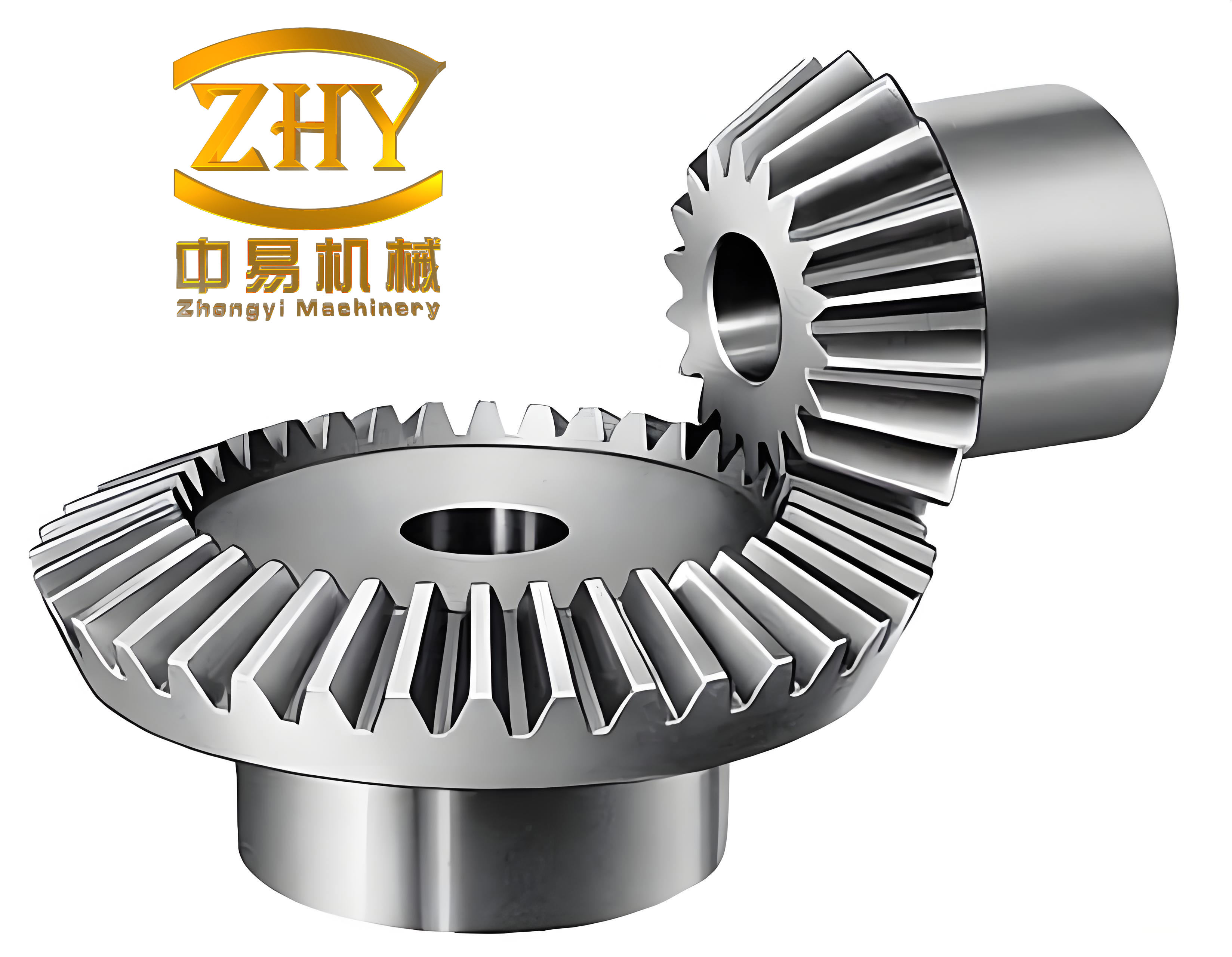
The performance of a straight bevel gear assembly is heavily dependent on the geometric accuracy of its teeth. Radial runout refers to the variation in the distance from the gear’s axis of rotation to a datum surface on the teeth as the gear is rotated through one complete revolution. For a straight bevel gear, this measurement is taken in a specific direction—normal to the pitch cone surface. This runout directly translates into non-uniform motion transmission, increased noise, vibration, and accelerated wear. Understanding and minimizing this error is therefore crucial in the manufacturing process of any high-quality straight bevel gear.
Manifestations and Classification of Tooth Alignment Radial Runout
In practice, TARR errors in a straight bevel gear do not manifest uniformly. Through systematic measurement and analysis, I have categorized these errors into three primary patterns, each pointing to different underlying issues in the manufacturing or setup process.
| Error Pattern | Typical Chart Signature | Primary Suspect Causes | Key Characteristics |
|---|---|---|---|
| Regular Eccentricity | Sinusoidal wave over one revolution. | Workpiece mounting eccentricity, fixture errors, blank datum errors. | Error repeats periodically per revolution. Adjacent teeth often show progressive error. |
| Irregular/Non-Uniform Variation | Random peaks and valleys with no clear periodicity. | Machine tool indexing error, worn or loose components (e.g., tool head, arbor keys), tool wear, machine motion inaccuracies. | Error pattern is chaotic. High and low points are not predictably spaced. |
| Single Low Tooth (Localized Dip) | One pronounced dip in an otherwise acceptable runout chart. | Improper initial tool engagement, inadequate rigidity during first cut, improper feed sequence or stock distribution. | One specific tooth space is significantly wider or the tooth is thinner, creating a localized radial inward deviation. |
Mathematical Modeling of Error Propagation
The relationship between a mounting eccentricity and the resulting TARR in a straight bevel gear can be derived geometrically. Consider a gear blank with a mounting eccentricity \( e \) relative to the machine tool’s rotational axis. This eccentricity causes the pitch cone to wobble.
The resulting Tooth Alignment Radial Runout error \( F_r \) is not simply equal to \( 2e \) as in a spur gear, but is modified by the geometry of the bevel gear, specifically the pitch cone angle \( \delta \). The error is measured in the direction normal to the pitch cone. The relationship is given by:
$$ F_r = 2e \cdot \sin(\delta) $$
Where:
\( F_r \) = Tooth Alignment Radial Runout error.
\( e \) = Mounting eccentricity of the gear blank.
\( \delta \) = Pitch cone angle (half of the shaft angle for a 90° set).
This formula highlights a critical insight: for a given eccentricity \( e \), the apparent TARR error \( F_r \) is smaller for straight bevel gears with smaller cone angles. This geometric attenuation must be considered when setting tolerance limits. Conversely, to achieve a tight TARR specification, the allowable mounting eccentricity \( e \) becomes more stringent.
Root Cause Analysis and Corrective Actions
Diagnosing and correcting TARR issues requires a methodical approach. Based on the error pattern, one can target specific areas of the process.
1. Addressing Regular Eccentricity
This is the most systematic error. The following table outlines potential causes and corresponding corrective actions I typically implement:
| Root Cause | Effect on Straight Bevel Gear | Corrective & Preventive Actions |
|---|---|---|
| Clearance between blank bore and arbor | Directly introduces eccentricity \( e \), amplified by \( 2\sin(\delta) \). | Use selective or tapered mandrels for batch production. For single pieces, indicate and adjust using the gear’s outer back cone as a datum, keeping its runout below 0.01 mm for precision gears. |
| Excessive face runout of blank locating surface | Tilts the blank, inducing an effective eccentricity when clamped. | Ensure the face runout of the blank’s mounting surface is less than half the specified TARR tolerance before machining. |
| Arbor/manufacturing and mounting errors | Arbor whip or misalignment transfers directly to the workpiece. | Inspect and qualify arbors before use. Total indicated runout (TIR) of the arbor’s mounting surfaces should be within 0.005 mm. Avoid excessive clamping force on slender arbors. |
| Poor bore geometry (e.g., bell-mouth) | Prevents positive location, allowing the blank to shift. | Improve blank machining process to ensure cylindrical bores with proper size and finish. |
2. Mitigating Irregular Runout
Irregular errors point to process instability or component wear. The index plate (dividing head) is often the prime suspect. Its own cumulative pitch error is directly transferred to the straight bevel gear being cut. For manufacturing gears of medium to high precision, the index plate’s accuracy must be controlled to within a few arc-seconds. Other causes include backlash in drive keys, looseness in the cutter head assembly, non-uniform feed of the tool carriage, and general machine tool wear. A rigorous preventive maintenance schedule and periodic machine tool calibration are essential.
3. Eliminating the Single Low Tooth
This specific fault is a process signature. It commonly occurs during the initial plunge cut of the first tooth slot. If the machine tool lacks rigidity or has excessive slideway clearance, the cutting forces from the tool’s negative-rake side can cause a slight deflection, resulting in a marginally wider first space. If subsequent finishing cuts do not remove enough material from the opposing flanks of the adjacent teeth, this space remains wider, manifesting as a single low point in the radial runout check. The solution lies in process design: employing an adequate number of roughing and finishing passes with carefully allocated stock removal ensures that initial errors are corrected in later stages.
Interrelationship with Pitch Errors
TARR does not exist in isolation. It is intrinsically linked to two other critical gear accuracy parameters: Cumulative Pitch Error \( F_p \) and Single Pitch Error \( f_p \).
Cumulative Pitch Error (\( F_p \))
This error, affecting the motion accuracy of the gear, is largely driven by base circle eccentricity—the same root cause as systematic TARR. If we model the base circle eccentricity as \( e_b \), the cumulative pitch error as a function of rotation angle \( \theta \) is approximately: $$ F_p(\theta) \approx 2 e_b \sin(\theta) $$ The maximum value of \( F_p \) over one revolution will be \( 2 e_b \). Therefore, the methods used to reduce systematic TARR (eliminating eccentricity) are directly effective in controlling \( F_p \). The quality of the index plate also has a first-order impact on \( F_p \), as its own pitch errors are imprinted onto the workpiece.
Single Pitch Error (\( f_p \))
This periodic error influences the smoothness and quietness of gear operation. While influenced by TARR and \( F_p \), its most direct cause in the context of machining a straight bevel gear is often the inherent single pitch error of the index plate. Additionally, non-uniform motion of the cutter head during its generating roll, or variations in tool feed, can introduce cyclical variations in tooth spacing. Ensuring a high-precision index plate and stable, well-adjusted machine tool kinematics are the primary corrective measures.
The relationship between these errors for a straight bevel gear can be summarized by the following inequalities, which are useful for diagnostic purposes: $$ f_p \leq \frac{F_p}{z} $$ and a strong correlation exists where: $$ F_p \propto F_r $$ where \( z \) is the number of teeth. While not absolute equalities, a significant violation of these relationships often points to a specific problem, such as a damaged tooth (affecting \( f_p \) but not \( F_r \)) or an indexing error (affecting \( F_p \) disproportionately).
Quality Control and Process Flow
To consistently produce high-quality straight bevel gears with minimal TARR, a controlled process is vital. The following workflow table outlines key steps from blank preparation to final inspection:
| Process Stage | Critical Control Parameters for TARR | Measurement / Verification Method |
|---|---|---|
| 1. Blank Machining | Bore diameter & cylindricity, face runout of mounting surface. | Coordinate Measuring Machine (CMM) or precision bore gages; dial indicator on face. |
| 2. Workholding Setup | Arbor TIR, cleanliness of interfaces, clamping force uniformity. | Dial indicator on arbor reference surfaces; visual and torque check. |
| 3. Machine Tool Preparation | Index plate accuracy, cutter head rigidity, slideway backlash. | Laser interferometer or precision polygons for indexing; dial indicator tests for backlash. |
| 4. Cutting Process | Number of passes, stock distribution, cutting fluid application. | Process audit; monitoring of cutting forces and tool wear. |
| 5. In-Process Inspection | Tooth Alignment Radial Runout (TARR) on first-off part. | Gear runout tester with appropriate cone-angle compensated probe. |
| 6. Final Inspection | TARR, Cumulative Pitch Error \( F_p \), Single Pitch Error \( f_p \). | Gear rolling tester, pitch measuring instrument, or dedicated gear metrology system. |
Mastering the control of Tooth Alignment Radial Runout is fundamental to the successful manufacture of any precision straight bevel gear. It acts as a keystone metric, influencing and indicating the state of other critical errors. By understanding its geometric origins—captured in relationships like \( F_r = 2e \cdot \sin(\delta) \)—and systematically diagnosing its manifestations—regular, irregular, or localized—manufacturing engineers can implement targeted corrections. This involves stringent control over blanks, fixtures, and machine tool condition, as well as a well-designed cutting process. Ultimately, a disciplined focus on minimizing TARR in the straight bevel gear not only ensures compliance with drawing specifications but also guarantees the reliable, smooth, and quiet performance that is essential in advanced mechanical systems. The production of a high-precision straight bevel gear remains a testament to the meticulous integration of mechanical design, machining art, and precise metrology.