
In the field of automotive engineering, the dynamic behavior of drive axle systems is critical for vehicle performance and noise vibration harshness (NVH) characteristics. Among the components, hyperboloid gears, often referred to as hypoid gears, play a pivotal role in transmitting torque between non-intersecting axes, commonly used in rear-wheel drive axles. However, the complex geometry and meshing process of hyperboloid gears pose significant challenges in accurately predicting their dynamic responses. One key parameter influencing these dynamics is the time-varying mesh stiffness, which fluctuates during gear rotation due to changes in contact conditions, load distribution, and geometric deformations. Traditional methods for calculating mesh stiffness, such as empirical formulas or simplified analytical models, are inadequate for hyperboloid gears because they ignore the spatial variation of meshing forces and the non-linear contact behavior. In this study, I propose a comprehensive finite element method (FEM)-based approach to compute the time-varying mesh stiffness of hyperboloid gears, enabling more accurate dynamic modeling of automotive drive axles. This method leverages advanced numerical tools to capture the intricate meshing characteristics, and I will detail the mathematical framework, model validation, and application to a practical hyperboloid gear pair.
The importance of hyperboloid gears in automotive applications cannot be overstated. These gears allow for offset axes, providing design flexibility and improved vehicle packaging. However, their complex tooth geometry, characterized by curved surfaces and varying pressure angles along the tooth profile, leads to a meshing process that is inherently dynamic and non-linear. The time-varying mesh stiffness is a primary excitation source for gear vibrations, contributing to noise and fatigue issues. Inaccurate stiffness estimation can result in suboptimal design, leading to premature failure or unacceptable NVH levels. Therefore, developing a robust method to compute this stiffness is essential for advancing hyperboloid gear technology. Previous studies have often relied on simplified assumptions, such as constant stiffness or trigonometric approximations, but these fail to account for the full meshing behavior. My approach addresses this gap by employing a detailed FEM model that simulates the quasi-static meshing process under various loads, extracting stiffness values from post-processing results. This allows for a more realistic representation of the hyperboloid gear meshing dynamics.
To begin, I establish the mathematical model for calculating gear mesh stiffness using finite element analysis. The core idea is to model the gear pair as a system of interacting surfaces, where the mesh stiffness at any given time is a function of the gear geometry, meshing position, and applied torque. Consider a hyperboloid gear pair consisting of a pinion and a gear, with coordinate systems attached to each component. Let \( S_1 \) and \( S_2 \) be the coordinate systems fixed to the pinion and gear, respectively, and \( S_0 \) be the global coordinate system aligned with \( S_2 \). The meshing process involves multiple contact points between the teeth, each contributing to the overall stiffness. I discretize the contact area into small finite elements, and the mesh stiffness \( k_{ij} \) for each element depends on spatial parameters. The total meshing force at time \( t \) can be expressed as:
$$F^{(l)}_t = \sum_{i=1}^{N_{\text{tooth}}} \sum_{j=1}^{N_{\text{point}}} \mathbf{n}^{(l)}_{ij} k_{ij} \delta_{ij} = \mathbf{n}^{(l)}_t k_t \delta_t$$
Here, \( N_{\text{tooth}} \) is the number of simultaneously contacting teeth, \( N_{\text{point}} \) is the number of discrete elements per tooth pair, \( \mathbf{n}^{(l)}_{ij} \) is the normal vector at each contact element, \( \mathbf{n}^{(l)}_t \) is the equivalent normal direction at time \( t \), \( k_t \) is the equivalent stiffness, \( \delta_t \) is the equivalent deformation, and \( F^{(l)}_t \) is the equivalent meshing force vector. By defining \( W_t = k_t \delta_t \) as the magnitude of the normal force, we have:
$$F^{(l)}_t = \mathbf{n}^{(l)}_t W_t$$
The equivalent meshing point position \( \mathbf{r}^{(l)}_t \) is calculated as the weighted average of all contact points:
$$\mathbf{r}^{(l)}_t = \frac{\sum_{i=1}^{N_{\text{tooth}}} \sum_{j=1}^{N_{\text{point}}} \mathbf{r}^{(l)}_{ij} k_{ij} \delta_{ij}}{\sum_{i=1}^{N_{\text{tooth}}} \sum_{j=1}^{N_{\text{point}}} k_{ij} \delta_{ij}}$$
where \( \mathbf{r}^{(l)}_{ij} \) is the position vector of each contact point. The moment due to meshing forces is:
$$\mathbf{M}^{(l)}_t = \sum_{i=1}^{N_{\text{tooth}}} \sum_{j=1}^{N_{\text{point}}} \mathbf{r}^{(l)}_{ij} \times \mathbf{W}^{(l)}_{ij} = \mathbf{r}^{(l)}_t \times \mathbf{n}^{(l)}_t \cdot k_t \delta_t$$
Defining \( \boldsymbol{\lambda}^{(l)}_t = \mathbf{r}^{(l)}_t \times \mathbf{n}^{(l)}_t \) as the directional radius of rotation, we get \( \mathbf{M}^{(l)}_t = \boldsymbol{\lambda}^{(l)}_t W_t \). For an ideal rigid gear pair, the rotational relationship is \( \theta_2 = \theta_1 (N_1 / N_2) \), where \( \theta_1 \) and \( \theta_2 \) are the rotational angles of the pinion and gear, and \( N_1 \) and \( N_2 \) are their tooth numbers. However, due to deformations, the actual transmission error \( \Delta \theta_t \) is:
$$\Delta \theta_t = \theta_{t2} – \frac{N_1}{N_2} \theta_{t1}$$
The mesh stiffness \( k_t \) is then defined as the ratio of normal force to linear deformation:
$$k_t = \frac{W_t}{\delta_t}$$
where \( \delta_t = \boldsymbol{\theta}_t \cdot \boldsymbol{\lambda}^{(l)}_t \). Assuming rotation primarily around the x-axis, this simplifies to:
$$\delta_t = (\Delta \theta^L_t – \Delta \theta^0_t) \lambda^{(l)}_{xt}$$
Here, \( \Delta \theta^0_t \) is the transmission error under no load, and \( \Delta \theta^L_t \) is under load. Thus, the time-varying mesh stiffness is:
$$k_t = \frac{W_t}{(\Delta \theta^L_t – \Delta \theta^0_t) \lambda^{(l)}_{xt}}$$
This formula highlights that for hyperboloid gears, \( \lambda^{(l)}_{xt} \) varies with meshing position, unlike spur gears where it is constant. To validate this model, I applied it to a spur gear pair with known parameters and compared results with the Kuang model, a well-established empirical method. The spur gear parameters are summarized in Table 1.
| Parameter | Gear | Pinion |
|---|---|---|
| Number of Teeth, \( N \) | 34 | 34 |
| Pressure Angle, \( \alpha \) (degrees) | 20 | |
| Module, \( m \) (mm) | 2.5 | |
| Profile Shift Coefficient, \( x \) (mm) | 0 | 0 |
| Face Width, \( b \) (mm) | 12 | 12 |
| Tip Radius, \( r \) (mm) | 0.44 | 0.44 |
| Young’s Modulus, \( E \) (GPa) | 210 | |
| Poisson’s Ratio, \( \nu \) | 0.3 | |
| Input Torque, \( T \) (N·m) | 60 | |
| Input Speed, \( v \) (rpm) | 150 | |
Using FEM analysis with ABAQUS, I computed the mesh stiffness over one meshing cycle. The results showed close agreement with the Kuang model, confirming the accuracy of my approach. The FEM model accounted for non-linearities such as contact and friction, resulting in slight fluctuations, but the overall trend matched. This validation step ensures that the method is reliable for more complex geometries like hyperboloid gears.
Moving to hyperboloid gears, the first step is to create an accurate three-dimensional geometric model. Hyperboloid gears have intricate tooth surfaces generated by specialized manufacturing processes, such as the Formate method for gears and the Generate method for pinions. I used MATLAB to implement the conjugate surface theory based on Litvin’s methodology. This involves defining cutter parameters, performing coordinate transformations, and solving meshing equations to obtain discrete points on the tooth surfaces. These points were then imported into CATIA for surface reconstruction using Non-Uniform Rational B-Splines (NURBS). The gear blank and machine settings for the hyperboloid gear pair are detailed in Table 2 and Table 3.
| Parameter | Pinion | Gear |
|---|---|---|
| Module | 6.861 | |
| Offset Distance (mm) | -25.4 | |
| Hand of Spiral | Left | Right |
| Number of Teeth | 8 | 43 |
| Face Width (mm) | 44.8 | 41 |
| Mean Pressure Angle | 22°30′ | 22°30′ |
| Outer Cone Distance (mm) | 150.69 | 151.26 |
| Mean Cone Distance (mm) | 128.32 | 130.75 |
| Addendum (mm) | 9 | 1.59 |
| Dedendum (mm) | 3.17 | 10.45 |
| Normal Tooth Top Width (mm) | 2.74 | 3.63 |
| Pitch Apex Beyond Crossing (mm) | 0.07 | 1.08 |
| Face Apex Beyond Crossing (mm) | -0.44 | 1 |
| Root Apex Beyond Crossing (mm) | -6.67 | 0.05 |
| Root Angle | 11°56′ | 73°33′ |
| Face Angle | 16°4′ | 77°51′ |
| Pitch Angle | 12°33′ | 77°13′ |
| Mean Spiral Angle | 45°3′ | 33°49′ |
| Parameter | Pinion (Convex Side) | Pinion (Concave Side) | Gear (Convex Side) | Gear (Concave Side) |
|---|---|---|---|---|
| Machine Type | Gleason No. 116 Generator | Gleason No. 609 Machine | ||
| Cutter Profile Angle | 29°0′ | 16°0′ | 25°0′ | 20°0′ |
| Cutter Diameter (mm) | 234.95 | 224.79 | 228.6 | |
| Cutter Tip Radius (mm) | 1 | 1 | 1.25 | |
| Machine Root Angle | 356°40′ | 357°0′ | 75°0′ | |
| Blank Offset (mm) | MD + 2.22 | MD – 1.16 | MD – 3.59 | |
| Horizontal Setting (mm) | WITH 24.04 | WITH 20.20 | 79.06 | |
| Vertical Setting (mm) | DOWN 26.48 | DOWN 23.31 | 83.96 | |
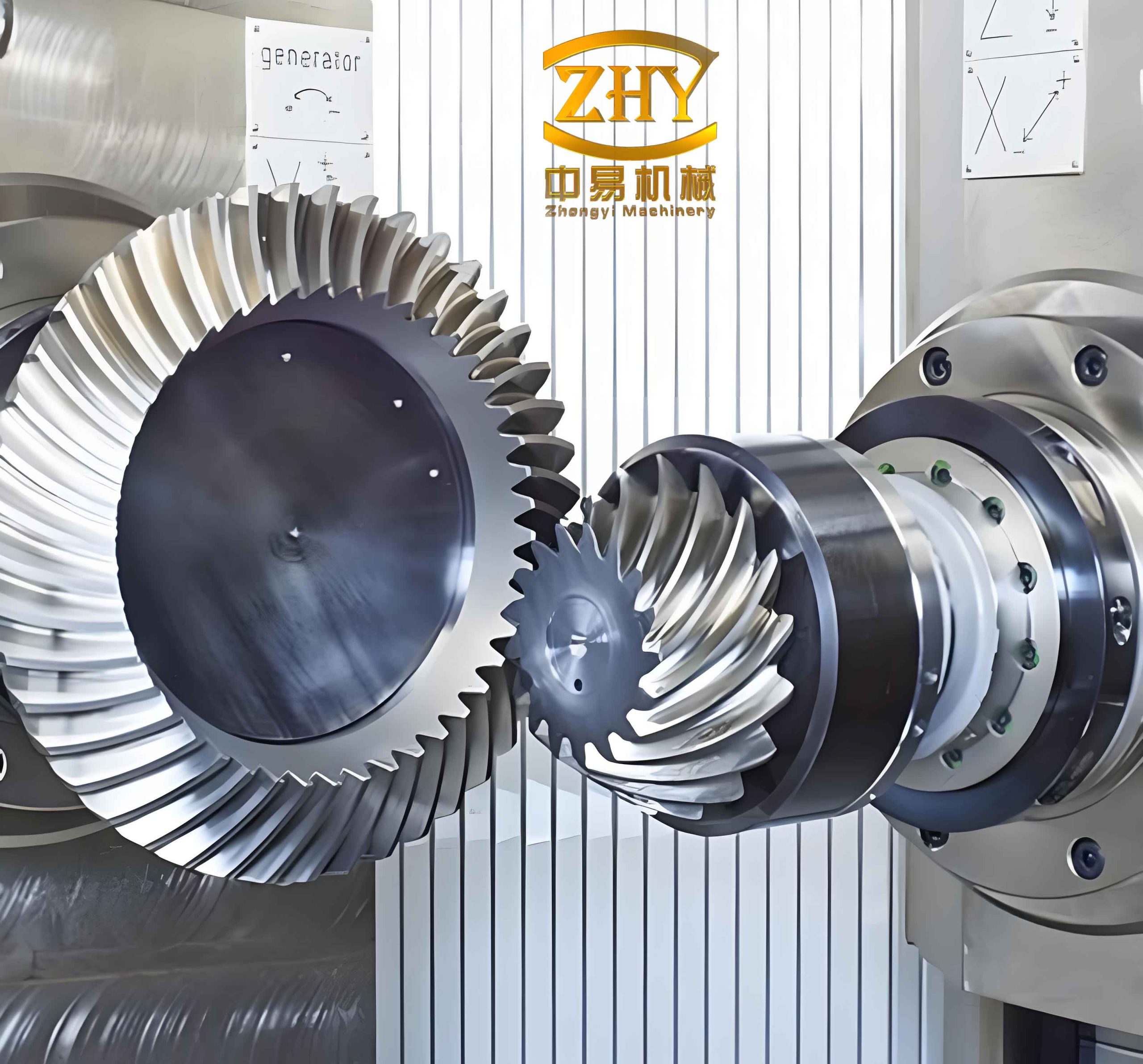
The resulting 3D model captures the complex curvature of hyperboloid gears, essential for accurate meshing simulation. Below is an illustration of such a hyperboloid gear pair, showing the offset axes and spiral teeth.
With the geometric model ready, I proceeded to develop the finite element model in ABAQUS. The hyperboloid gear pair was meshed using hexahedral elements (C3D8R) to ensure accuracy and computational efficiency. The mesh consisted of approximately 276,722 elements and 237,804 nodes, covering the entire gear bodies to minimize geometric simplification effects. Material properties were assigned as per typical automotive gear steel: Young’s modulus of 206 GPa, Poisson’s ratio of 0.27, and density of 7.90×10⁻⁹ t/mm³. The contact between pinion and gear teeth was defined as surface-to-surface interaction with a friction coefficient of 0.1, using “hard” contact for normal behavior. The analysis was set up as a quasi-static simulation to replicate steady-state driving conditions. Two steps were defined: first, a load application step where the pinion input was fixed and a resistive torque was applied to the gear output; second, a meshing rotation step where the pinion was given an angular displacement and the gear torque was maintained. Initial conditions included predefined angular velocities to stabilize the solution. For instance, to simulate a vehicle at 40 km/h, the pinion speed was set to 9.6 rad/s, and the gear resistive torque was varied from small values (e.g., 10 N·m) to large values (e.g., 9,000 N·m) to study load effects.
The FEM analysis provided detailed stress distributions and contact patterns. Under a torque of 9,500 N·m, the maximum principal stress showed compressive stresses at the contact zones and tensile stresses at the tooth roots, with multiple teeth in contact simultaneously. This contrasts with spur gears, where contact transitions abruptly; for hyperboloid gears, the contact shifts smoothly from one end to the other, reducing impact. To compute the time-varying mesh stiffness, I post-processed the FEM results to extract key parameters: the equivalent normal force \( W_t \), the transmission errors \( \Delta \theta^0_t \) and \( \Delta \theta^L_t \), and the directional radius \( \lambda^{(l)}_{xt} \). For small loads (e.g., 10 N·m), the transmission error approximated a parabolic shape, as designed to minimize meshing impacts. The meshing forces per tooth showed no overlap, indicating single-tooth contact under light loads. Comparison with tooth contact analysis (TCA) results confirmed the accuracy, with mean point coordinates and normal vectors aligning closely. For large loads (e.g., 9,000 N·m), the transmission error remained parabolic but shifted downward with reduced fluctuation due to increased deformations. The equivalent meshing force \( W_t \) varied cyclically, and the mesh stiffness \( k_t \) was calculated using the formula above.
The results for time-varying mesh stiffness under a large load are plotted in Figure 1, showing periodic variation with the meshing cycle. The stiffness starts high, decreases, stabilizes, then drops before rising sharply into the next cycle. Unlike spur gears, hyperboloid gears exhibit no abrupt stiffness changes, promoting smoother meshing. To explore load effects, I computed stiffness for torques of 1,000, 3,000, 5,000, 7,000, and 9,000 N·m. The findings are summarized in Table 4.
| Load Torque (N·m) | Average Mesh Stiffness (N/m) | Stiffness Fluctuation Amplitude (N/m) | Observations |
|---|---|---|---|
| 1,000 | 2.1 × 10⁸ | 0.5 × 10⁸ | Higher fluctuation, lower mean stiffness |
| 3,000 | 2.4 × 10⁸ | 0.4 × 10⁸ | Increased mean, reduced fluctuation |
| 5,000 | 2.7 × 10⁸ | 0.3 × 10⁸ | Further stabilization |
| 7,000 | 3.0 × 10⁸ | 0.2 × 10⁸ | Near-constant meshing |
| 9,000 | 3.2 × 10⁸ | 0.15 × 10⁸ | Highest mean, minimal fluctuation |
As load increases, the average mesh stiffness rises due to greater gear body deformations and improved contact conformity. Simultaneously, the stiffness fluctuation diminishes because of higher meshing overlap and reduced impact. This behavior underscores the importance of considering load conditions in hyperboloid gear dynamics. The periodic nature of stiffness can be modeled using Fourier series, but my FEM approach captures the full non-linearity without simplification.
In discussion, the implications of these findings are significant for automotive drive axle design. The time-varying mesh stiffness of hyperboloid gears directly influences dynamic responses such as vibration and noise. By accurately computing this stiffness, engineers can optimize gear geometry and loading conditions to enhance performance. For instance, the parabolic transmission error under small loads helps mitigate meshing shocks, while the load-dependent stiffness variation suggests that operating at higher torques may reduce dynamic excitations. However, trade-offs exist, as higher loads increase stress and potential fatigue. My method provides a tool to balance these factors through simulation. Compared to prior studies that used constant stiffness or approximate methods, this FEM-based approach offers a more realistic representation, crucial for advancing hyperboloid gear applications in electric vehicles and high-performance cars where NVH is critical.
To further elaborate, the mathematical model I developed is generalizable to other gear types, but its application to hyperboloid gears is particularly valuable due to their complexity. The key innovation lies in the extraction of equivalent parameters from FEM results, avoiding assumptions about force direction or contact geometry. This process involves scripting in Python within ABAQUS to automate data extraction and stiffness calculation. For example, the equivalent normal force \( W_t \) is computed from reaction forces, and the directional radius \( \lambda^{(l)}_{xt} \) is derived from moment equilibrium. The transmission error is obtained from rotational displacements. All these steps ensure a comprehensive stiffness profile over multiple meshing cycles.
Moreover, the geometric modeling phase highlights the precision required for hyperboloid gears. Errors in tooth surface generation can lead to inaccurate contact patterns, affecting stiffness calculations. I validated the CATIA model by comparing with theoretical contact points, ensuring fidelity. The use of NURBS surfaces allows for smooth representation, critical for FEM meshing. In future work, this model can be extended to include thermal effects or lubricant films, but for now, the quasi-static assumption suffices for many automotive scenarios.
In conclusion, I have presented a complete methodology for calculating the time-varying mesh stiffness of hyperboloid gears in automotive drive axles. This approach integrates advanced geometric modeling, finite element analysis, and post-processing techniques to capture the intricate meshing behavior. The results demonstrate that hyperboloid gear stiffness varies periodically with the meshing cycle and is highly dependent on applied load. As load increases, stiffness mean values rise while fluctuations decrease, promoting smoother operation. This method provides a foundation for dynamic modeling of gear systems, enabling better prediction of vibration and noise. By leveraging tools like MATLAB, CATIA, and ABAQUS, engineers can simulate hyperboloid gear performance under real-world conditions, driving innovations in automotive design. The insights gained underscore the unique characteristics of hyperboloid gears and their critical role in vehicle dynamics.
To reiterate, the hyperboloid gear is a cornerstone of modern drivetrains, and understanding its time-varying mesh stiffness is essential for optimization. My work contributes to this understanding by offering a practical, validated computational framework. Future applications could include integration with multi-body dynamics software for full system simulation, or exploration of material non-linearities. Regardless, the principles outlined here will remain relevant for advancing hyperboloid gear technology and enhancing automotive performance.