
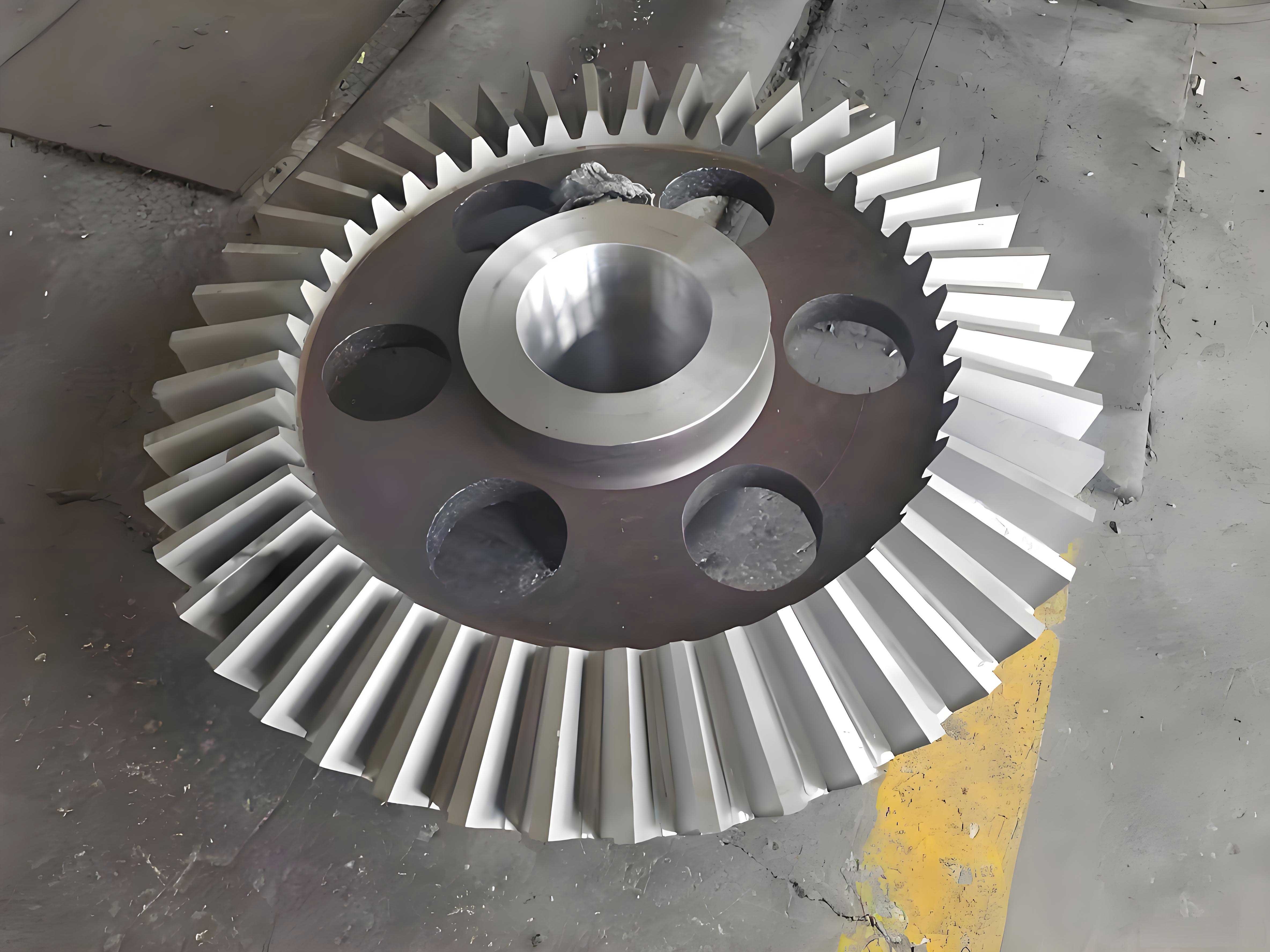
In the heavy machinery and mining equipment manufacturing industries, large-modulus straight miter gears are predominantly produced using the form-cutting method. The key to enhancing tooth profile accuracy in form-cutting miter gears lies in the correct design of the template and the adoption of a rational, simplified adjustment methodology. The precise tooth form of a straight miter gear is a spherical involute. Although the template curve on miter gear planing machines is designed based on the principle of spherical involutes, the formulas traditionally used calculate the template curve for the initial position where the indexing angle equals zero. Since the tooth flank curve at this initial position differs from its actual position during cutting by half the tooth thickness angle, the projections of these two curves onto the same template are not identical, even when rotated by a corresponding angle. This discrepancy increases with larger half-tooth thickness angles, leading to significant errors in miter gear production.
Some manufacturing plants, as noted in prior literature, resort to leaving minimal allowances on pinions and iteratively adjusting cuts based on assembly contact patterns to achieve satisfactory flank contact. This approach is inefficient and compromises precision. Another method proposes adjusting the template using curvature matching, but it involves complex calculations requiring large-scale computer resources for each gear, making it impractical for widespread use. In this paper, I introduce a novel method for calculating the template curve based on the actual position of the tooth flank during machining. Concurrently, I provide the necessary formulas for template adjustment, offering a more efficient and accurate solution for miter gear manufacturing.
The spherical involute is fundamental to understanding miter gear geometry. Consider a sphere of radius \(R\) with center \(O\). A base circle lies on this sphere, with plane center \(O_b\) and radius \(r_b\). A coordinate system is established such that the \(z\)-axis coincides with \(OO_b\), and the \(x\)- and \(y\)-axes form a right-handed system. For any point \(P\) on the spherical involute originating from a point on the base circle, the position vector \(\mathbf{r}\) can be expressed using spherical coordinates. Let \(\theta\) be the polar angle and \(\phi\) the azimuthal angle. The spherical involute equations are derived from the geometry of the miter gear.
Using vector notation, let \(\mathbf{i}, \mathbf{j}, \mathbf{k}\) be unit vectors along the \(x, y, z\) axes, respectively. The position vector \(\mathbf{r}\) for a point on the spherical involute is given by:
$$ \mathbf{r} = R \left( \cos \phi \sin \theta \, \mathbf{i} + \sin \phi \sin \theta \, \mathbf{j} + \cos \theta \, \mathbf{k} \right) $$
Here, \(\phi\) is related to the generating parameter. Specifically, if \(\phi_0\) is the base cone angle and \(\alpha\) is the pressure angle, the relationship is derived from spherical trigonometry. The parameter \(\phi\) varies along the involute curve, and for miter gears, it is crucial to account for the base cone geometry. The base cone angle \(\phi_0\) satisfies:
$$ \sin \phi_0 = \frac{r_b}{R} $$
where \(r_b\) is the base circle radius. The spherical involute parameterization ensures accurate tooth form representation for miter gears.
In miter gear planing machines, the tool tip trajectory must be analyzed. The machine tool’s working principle involves a rotating tool holder. Define a coordinate system fixed to the machine: let \(O_c\) be the intersection point of the tool holder rotation axis, the tool tip trajectory extension line, and the roller axis. Establish a spatial Cartesian coordinate system \(O_c-xyz\) with unit vectors \(\mathbf{e}_x, \mathbf{e}_y, \mathbf{e}_z\). During machining, the tooth centerline is parallel to the machine’s guide plane, so the coordinate system is rotated accordingly.
Let \(\psi\) be the rotation angle of the tool holder, and \(\beta\) be the angle between the roller axis and the tool guide surface. For a miter gear with tooth number \(z\), the tool tip trajectory vector \(\mathbf{T}\) in the \(O_c-xyz\) system is derived from kinematic analysis. The position of the tool tip relative to \(O_c\) depends on machine parameters and gear geometry.
The transformation involves rotations about specific axes. If \(\mathbf{u}\) is a unit vector along the tool holder rotation axis, and \(\mathbf{T}_0\) is the initial tool tip direction, after rotation by \(\psi\), the new direction \(\mathbf{T}\) is given by Rodrigues’ rotation formula:
$$ \mathbf{T} = \mathbf{T}_0 \cos \psi + (\mathbf{u} \times \mathbf{T}_0) \sin \psi + \mathbf{u} (\mathbf{u} \cdot \mathbf{T}_0)(1 – \cos \psi) $$
For miter gear machining, specific angles are defined. Let \(\delta\) be the pitch cone angle, and \(\alpha\) the pressure angle. The tool tip trajectory must align with the spherical involute of the miter gear tooth. The relationship between machine settings and gear parameters is encapsulated in the following equations. Define \(\theta’\) as the projection of the pitch cone angle onto the machine plane, and \(\gamma\) as a machine-specific constant. Then, the coordinates of the tool tip are:
$$ x_T = f_1(\psi, \delta, \alpha, z), \quad y_T = f_2(\psi, \delta, \alpha, z), \quad z_T = f_3(\psi, \delta, \alpha, z) $$
where \(f_1, f_2, f_3\) are functions derived from spherical trigonometric relations. For instance, using the law of sines in spherical triangles, we have:
$$ \frac{\sin \theta’}{\sin \delta} = \cos \alpha $$
This ensures that the tool tip follows the correct path to generate the miter gear tooth.
The roller axis parameterization is critical for template design. The roller axis and tool tip trajectory are rigidly connected during machining. Let \(\mathbf{R}_0\) be the unit vector along the roller axis in the initial position. After the tool holder rotates by \(\psi\), the roller axis vector \(\mathbf{R}\) is obtained by rotating \(\mathbf{R}_0\) about the same axis \(\mathbf{u}\) by an angle \(\zeta\), which is a function of machine geometry.
From the machine structure, \(\zeta\) is related to \(\psi\) and other parameters. If \(\eta\) is the angle between the roller axis and the tool tip direction, then:
$$ \zeta = g(\psi, \eta) $$
where \(g\) is a kinematic function. The roller axis line in the coordinate system can be expressed parametrically. Let \(\mathbf{R}\) be represented as:
$$ \mathbf{R} = \mathbf{R}_0 \cos \zeta + (\mathbf{u} \times \mathbf{R}_0) \sin \zeta + \mathbf{u} (\mathbf{u} \cdot \mathbf{R}_0)(1 – \cos \zeta) $$
The template curve is the envelope of the roller axis projections onto the template plane, which is perpendicular to a specific direction. Assume the template plane is at a distance \(d\) from the sphere center \(O\). The intersection of the roller axis line with this plane yields the template curve.
In parametric form, let \(s\) be a parameter along the roller axis. The equation of the roller axis line is:
$$ \mathbf{L}(s) = \mathbf{P}_0 + s \mathbf{R} $$
where \(\mathbf{P}_0\) is a reference point. The template plane equation is \(\mathbf{n} \cdot \mathbf{r} = d\), where \(\mathbf{n}\) is the unit normal. Solving for \(s\) gives the projection point. The theoretical template curve is then the locus of these points as \(\psi\) varies.
However, the actual template curve is the inner envelope of this locus, accounting for the roller radius \(r_r\). To obtain the practical template profile for miter gear production, we offset the theoretical curve by the roller radius in the normal direction. The offset curve coordinates \((X, Y)\) on the template plane are calculated using differential geometry.
Let the theoretical curve be given by \(X_t(\psi), Y_t(\psi)\). The normal vector \(\mathbf{N}\) is:
$$ \mathbf{N} = \left( -\frac{dY_t}{d\psi}, \frac{dX_t}{d\psi} \right) $$
Then, the actual template curve coordinates are:
$$ X_a(\psi) = X_t(\psi) – r_r \frac{dY_t/d\psi}{\sqrt{(dX_t/d\psi)^2 + (dY_t/d\psi)^2}} $$
$$ Y_a(\psi) = Y_t(\psi) + r_r \frac{dX_t/d\psi}{\sqrt{(dX_t/d\psi)^2 + (dY_t/d\psi)^2}} $$
This ensures proper contact between the roller and template during miter gear machining.
The new method calculates the template curve based on the actual tooth flank position during cutting, unlike previous approaches that used the initial position. This reduces errors significantly. To illustrate, compare the results from the proposed formulas with those from traditional methods. The following table summarizes coordinate values on the template curve for a sample miter gear with parameters: pitch cone angle \(\delta = 30^\circ\), pressure angle \(\alpha = 20^\circ\), tooth number \(z = 20\), and module \(m = 10 \, \text{mm}\). The template curves are calculated at various points along the profile.
| Parameter \(\psi\) (deg) | Proposed Method X (mm) | Proposed Method Y (mm) | Traditional Method X (mm) | Traditional Method Y (mm) | Error in X (mm) | Error in Y (mm) |
|---|---|---|---|---|---|---|
| 0 | 0.000 | 0.000 | 0.000 | 0.000 | 0.000 | 0.000 |
| 5 | -2.145 | 1.876 | -2.140 | 1.872 | -0.005 | 0.004 |
| 10 | -4.210 | 3.892 | -4.200 | 3.885 | -0.010 | 0.007 |
| 15 | -6.125 | 6.012 | -6.110 | 6.000 | -0.015 | 0.012 |
| 20 | -7.832 | 8.245 | -7.810 | 8.225 | -0.022 | 0.020 |
| 25 | -9.285 | 10.587 | -9.255 | 10.560 | -0.030 | 0.027 |
The errors are minimal but become more pronounced at higher pressure angles or for miter gears with larger tooth thickness. For instance, at the tooth root where \(\psi = -10^\circ\), the error in tooth profile can reach up to \(0.05 \, \text{mm}\), while at the tooth tip (\(\psi = 20^\circ\)), it may be \(0.03 \, \text{mm}\). These deviations affect the contact pattern and load distribution in miter gear assemblies.
Furthermore, when using the traditional formula with adjusted rotation, the template curve shape deviates from the ideal. The proposed method yields a curve that better matches the spherical involute of the miter gear. The following equations encapsulate the new calculation approach for the template curve coordinates \((X, Y)\) as functions of the machine rotation angle \(\psi\) and gear parameters:
$$ X = R \sin \theta \cos \phi – d \frac{\partial \phi}{\partial \psi} \cdot \frac{r_r}{\sqrt{1 + \left( \frac{\partial \theta}{\partial \psi} \right)^2}} $$
$$ Y = R \sin \theta \sin \phi + d \frac{\partial \theta}{\partial \psi} \cdot \frac{r_r}{\sqrt{1 + \left( \frac{\partial \phi}{\partial \psi} \right)^2}} $$
where \(\theta\) and \(\phi\) are derived from spherical involute relations specific to the miter gear:
$$ \theta = \arccos \left( \frac{\cos \phi_0}{\cos \alpha} \right) $$
$$ \phi = \phi_0 + \tan \alpha \cdot \ln \left( \tan \left( \frac{\theta}{2} \right) \right) $$
These formulas ensure that the template accurately guides the tool to produce precise miter gear teeth.
Template adjustment is essential when machining miter gears with different tooth numbers or non-standard pressure angles. In conventional planing machines, the template is designed for a specific indexing angle (zero position), so adjustment involves rotating the template by an angle \(\Delta \psi\) calculated via back-cone development:
$$ \Delta \psi_{\text{old}} = \frac{\phi_0}{z} $$
where \(\phi_0\) is the base cone angle and \(z\) is the tooth number. Additionally, the template is translated by a distance \(\Delta d\) to compensate for positional errors. However, this method introduces inaccuracies, especially for miter gears with high tooth counts or large pressure angles.
The new method proposes a simplified adjustment. Since the template curve is now calculated for the actual cutting position, the rotation angle required for different tooth numbers is smaller and more precise. Let \(z_0\) be the design tooth number for the template, and \(z\) be the actual miter gear tooth number. The template rotation angle \(\Delta \psi_{\text{new}}\) is:
$$ \Delta \psi_{\text{new}} = \frac{\phi_0}{2} \left( \frac{1}{z_0} – \frac{1}{z} \right) $$
This reduces the adjustment magnitude and minimizes errors. Moreover, by aligning the template rotation center with the coordinate axis during tool tip engagement at the pitch line, no translation is needed, simplifying the machine structure and operation for miter gear production.
For miter gears with non-standard pressure angles \(\alpha’ \neq \alpha\), additional adjustments are required. Using the back-cone development method, the template must be rotated and translated. Let \(\Delta \alpha = \alpha’ – \alpha\). The rotation angle \(\Delta \psi_{\alpha}\) and translation \(\Delta d_{\alpha}\) are approximately:
$$ \Delta \psi_{\alpha} = \frac{\Delta \alpha}{\sin \phi_0} $$
$$ \Delta d_{\alpha} = R \phi_0 \Delta \alpha $$
However, for higher accuracy, spherical involute principles should be applied. The exact adjustment formulas derived from geometry are:
$$ \Delta \psi_{\alpha} = \arctan \left( \frac{\sin \phi_0 \tan \Delta \alpha}{1 + \cos \phi_0 \tan \Delta \alpha} \right) $$
$$ \Delta d_{\alpha} = R \left( \sin \phi_0 \Delta \alpha – \cos \phi_0 \Delta \psi_{\alpha} \right) $$
These adjustments ensure that the template correctly generates the tooth profile for non-standard miter gears. The following table compares adjustment values for common non-standard pressure angles, using a miter gear with \(\phi_0 = 25^\circ\), \(z = 20\), and \(R = 100 \, \text{mm}\).
| Pressure Angle \(\alpha’\) (deg) | \(\Delta \psi_{\alpha}\) (deg) – Proposed | \(\Delta d_{\alpha}\) (mm) – Proposed | \(\Delta \psi_{\alpha}\) (deg) – Traditional | \(\Delta d_{\alpha}\) (mm) – Traditional |
|---|---|---|---|---|
| 18 | -1.25 | -3.45 | -1.20 | -3.50 |
| 22 | 1.30 | 3.55 | 1.35 | 3.60 |
| 25 | 2.80 | 7.80 | 2.85 | 7.85 |
The discrepancies are minor, but the proposed method offers better consistency with spherical involute theory, enhancing miter gear quality.
In summary, the improved template design and adjustment method for miter gear planing machines addresses critical limitations in traditional approaches. By calculating the template curve based on the actual tooth flank position during machining, errors due to half-tooth thickness angles are minimized. The derived formulas for spherical involute representation, tool tip trajectory, and roller axis parameterization provide a comprehensive framework for accurate template generation. Additionally, the simplified adjustment procedures for different tooth numbers and non-standard pressure angles reduce complexity and improve precision in miter gear manufacturing. This advancement contributes to higher efficiency and reliability in producing miter gears for heavy-duty applications, ensuring better contact patterns and load capacity in final assemblies.
The implementation of these methods can significantly enhance the performance of miter gear planing machines, leading to cost savings and improved product quality. Future work may involve integrating these calculations into computer-aided design (CAD) systems for automated template production, further streamlining the manufacturing process for miter gears. As the demand for precise power transmission components grows, such innovations are crucial for advancing mechanical engineering practices.