
The pursuit of superior dynamic performance, characterized by low noise and vibration, is a paramount objective in the design of high-power-density gear transmissions. Among these, the hyperboloid gear, particularly in its hypoid configuration with a non-zero offset, stands out for its ability to transmit motion and power between non-intersecting, non-parallel axes. This geometry offers significant advantages, including high contact ratio, excellent efficiency, smooth operation, and the capacity for large reduction ratios. The inherent sliding action along both the tooth profile and face width facilitates running-in, and the teeth are amenable to post-hardening lapping processes, which further refine the contact pattern and surface finish, ultimately contributing to quieter operation. Given its widespread application in critical systems such as automotive rear axles, the dynamic optimization of hyperboloid gear pairs is a subject of intense research focus. This article delves into a methodology for the optimization design of the loaded transmission error (LTE), a primary excitation source for gear noise and vibration, specifically for hyperboloid gear pairs manufactured via the HGT (Hypoid Generated by Tilt) method.
The core principle of dynamic performance enhancement lies in controlling the Loaded Transmission Error (LTE). In an ideal, perfectly conjugate gear pair, the transmission error would be zero. In reality, manufacturing deviations, intentional modifications, and elastic deformations under load cause slight deviations from perfect motion transfer. The LTE curve represents the angular displacement error of the driven gear as a function of the pinion’s angular position under operating loads. The amplitude and waveform of this LTE curve are direct indicators of dynamic performance: a smaller fluctuation amplitude correlates with smoother transmission and lower noise, while a larger amplitude indicates greater dynamic excitation and potential for vibration. Therefore, a primary optimization goal is to minimize the peak-to-peak amplitude of the LTE curve under specified operating conditions. For hyperboloid gear pairs, this is intrinsically linked to the design of the tooth surfaces, which is governed by the machine-tool settings used in their generation.
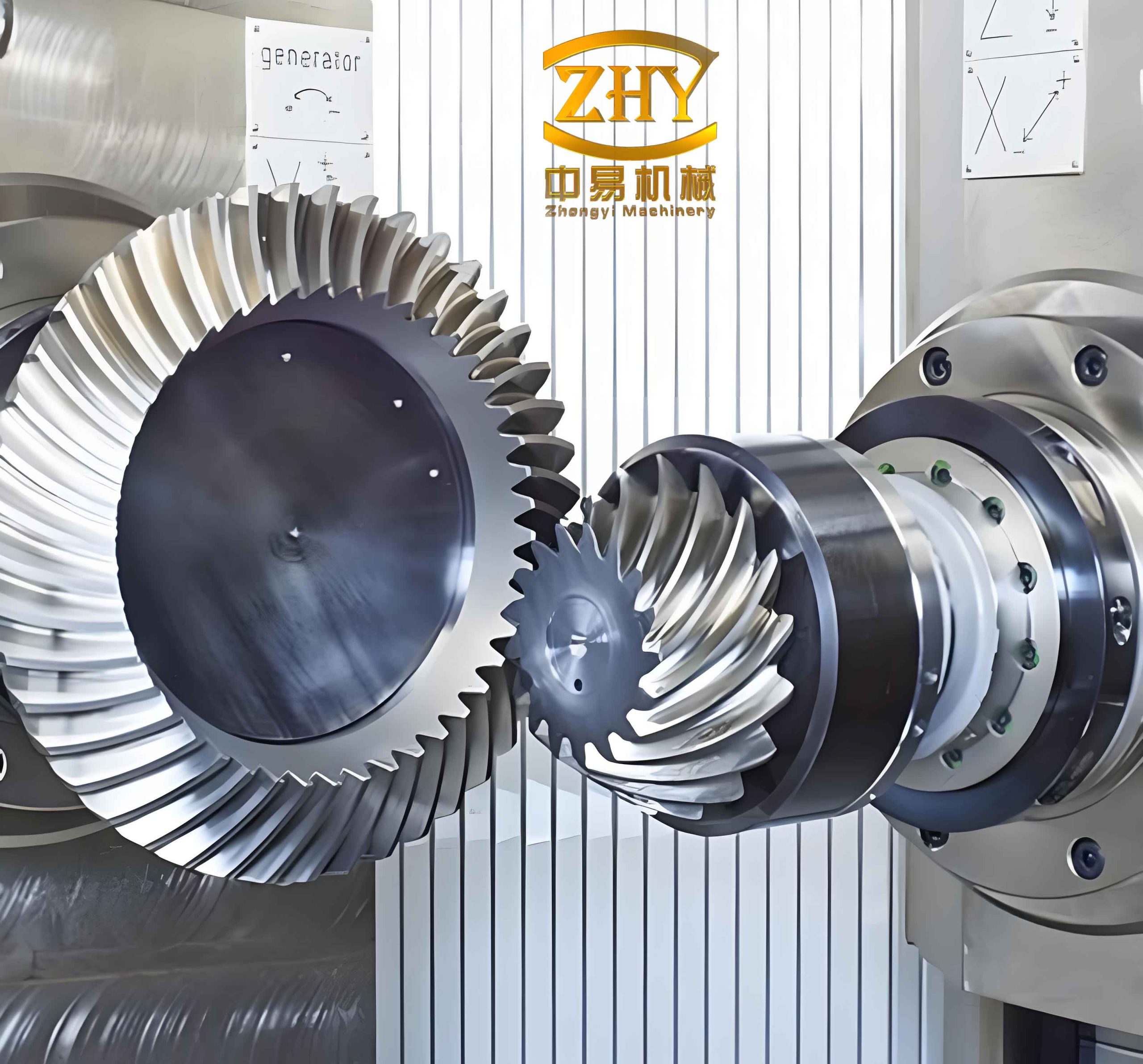
The HGT manufacturing method, typically performed on advanced multi-axis CNC hypoid generators, offers high flexibility in controlling the localized geometry of the tooth flanks. The foundation for achieving desirable contact characteristics is the Local Synthesis method. This approach allows the designer to prescribe specific meshing conditions at a chosen mean contact point, thereby pre-controlling the gear pair’s performance. Key local control parameters, which become the levers for optimization, include:
- The first derivative of the transmission ratio function, denoted as \( m’_{21} \).
- The angle \( \eta_2 \) between the contact path (or trace) on the gear tooth surface and the root line.
- The semi-major axis length \( a \) of the contact ellipse.
- The location of the mean contact point on the tooth flank.
These parameters collectively determine the shape and amplitude of the unloaded (or geometric) transmission error curve, the orientation and length of the contact path, and the size and position of the contact ellipse. For instance, the amplitude \( \Delta \) at the transition point of a parabolic function transmission error curve is directly related to \( m’_{21} \):
$$
\Delta = -\frac{3600}{2} \cdot \frac{180}{\pi} \cdot \left( \frac{\pi}{z_1} \right)^2 \cdot m’_{21}
$$
where \( z_1 \) is the number of pinion teeth. The angle \( \eta_2 \) strongly influences the contact ratio; a larger, more longitudinally oriented contact path promotes a higher theoretical contact ratio, which is beneficial for load sharing and smoothness. The machine settings for both the gear and the pinion—such as cutter radius, tilt angle, swivel angle, machine center settings (vertical, horizontal, axial), and ratio of roll—are then calculated backwards from these specified local conditions. The design flow begins with defining the local parameters, calculating the gear machine settings, and then iteratively solving for the corresponding pinion settings that will mesh correctly with the gear, forming a closed-loop process.
Optimizing the LTE is a complex, nonlinear contact problem. The relationship between the design variables (machine settings derived from local parameters) and the objective function (LTE amplitude) is implicit and cannot be expressed in a simple closed-form equation. Furthermore, the solution space is likely to contain multiple local minima. Traditional gradient-based optimization algorithms are often unsuitable for this challenge. Therefore, a Genetic Algorithm (GA) is employed. GAs are robust, population-based search algorithms inspired by natural selection. Their strengths include:
- Operating directly on a set of candidate solutions (a population).
- Using probabilistic, rather than deterministic, rules for selection, crossover, and mutation, enabling a global search.
- Requiring minimal problem-specific knowledge, making them a versatile tool.
The optimization process using a GA involves encoding the design variables into a chromosome, evaluating each candidate’s fitness (LTE amplitude), and iteratively applying selection, crossover, and mutation to evolve the population toward better solutions.
Optimization Model Formulation
The optimization model is constructed to minimize the dynamic excitation of the hyperboloid gear pair by targeting the LTE amplitude.
Design Variables: Based on the principles of Local Synthesis, two highly influential local parameters are selected as the primary design variables for optimization:
$$
\mathbf{X} = [m’_{21}, \ \eta_2]
$$
These two variables effectively control the transmission error curve’s shape (\(m’_{21}\)) and the contact pattern’s geometry and potential contact ratio (\(\eta_2\)).
Objective Function: The goal is to minimize the peak-to-peak fluctuation of the LTE curve over one mesh cycle under a designated load. For a set of discrete angular positions \( \phi_i \) (where \(i = 1, 2, …, n\)), the LTE values \( \text{LTE}(\phi_i) \) are computed via loaded tooth contact analysis (LTCA). The objective function is:
$$
f(\mathbf{X}) = \max(\text{LTE}(\phi_i)) – \min(\text{LTE}(\phi_i))
$$
Minimizing \( f(\mathbf{X}) \) directly aims to produce the flattest possible LTE curve, thereby reducing dynamic excitation.
Constraints: Practical design limits are imposed on the variables:
- To obtain a parabolic function transmission error curve with a “hunting” characteristic (where the gear lags and leads the ideal position), \( m’_{21} \) must be negative:
$$ m’_{21} \in (-0.3, 0) $$ - To ensure continuous and smooth power transmission and to avoid severe edge contact leading to high vibration, a minimum design contact ratio is enforced. This is influenced by \( \eta_2 \), which is constrained to promote a sufficiently long contact path:
$$ \eta_2 \in (20^\circ, 35^\circ) $$
The complete optimization workflow integrates the GA with the gear design and analysis modules: the GA proposes a set of \([m’_{21}, \eta_2]\); these are used to re-calculate the pinion machine settings via Local Synthesis; a new pinion tooth surface is generated; LTCA is performed under the target load to compute the LTE curve and its amplitude; this amplitude is fed back as the fitness value to the GA, which then generates a new population. This loop continues until convergence criteria are met.
Computational Analysis and Results
To demonstrate the effectiveness of the methodology, an optimization case study is presented for the drive side (gear convex / pinion concave) of a hypoid pair. The common automotive operating load of 800 Nm on the gear was selected as the optimization condition. A compact GA population size of 10 was used for efficiency, with a convergence rule stopping the search if the fitness did not improve for 5 consecutive generations.
The tables below contrast the key machine settings for the pinion before and after optimization. Note that the gear settings remain unchanged.
| Parameter | Value |
|---|---|
| Cutter Blade Angle | 14.000° |
| Cutter Point Radius | 149.800 mm |
| Cutter Tilt Angle | 8.179° |
| Cutter Swivel Angle | 299.346° |
| Machine Center to Back (Vertical) | -124.819 mm |
| Sliding Base (Horizontal) | 58.718 mm |
| Ratio of Roll | 0.206 |
| Parameter | Value |
|---|---|
| Cutter Blade Angle | 14.000° |
| Cutter Point Radius | 149.633 mm |
| Cutter Tilt Angle | 8.179° |
| Cutter Swivel Angle | 299.575° |
| Machine Center to Back (Vertical) | -131.012 mm |
| Sliding Base (Horizontal) | 60.992 mm |
| Ratio of Roll | 0.196 |
The optimization algorithm converged to an optimal local solution with \( m’_{21} = -0.00018 \) and \( \eta_2 = 25^\circ \), compared to the initial design values of \( m’_{21} = -0.00019 \) and \( \eta_2 = 30^\circ \). The unloaded tooth contact analysis (TCA) for the optimized design showed a longer, more favorable contact path, increasing the design contact ratio from 2.15 to 2.25.
The primary result is the significant reduction in LTE amplitude. Under the 800 Nm optimization load, the peak-to-peak LTE amplitude was reduced from 3.560 arc-seconds to 2.210 arc-seconds, representing a 37.92% improvement. Crucially, the benefits of this optimization extend beyond the single design load. At a higher load of 1500 Nm, the LTE amplitude for the optimized hyperboloid gear pair was 4.130 arc-seconds, compared to 4.950 arc-seconds for the original design, a reduction of 16.57%. This demonstrates the robustness of the optimized tooth flank geometry across a range of operating torques.
| Gear Load (Nm) | Original LTE Amplitude (arc-sec) | Optimized LTE Amplitude (arc-sec) | Reduction |
|---|---|---|---|
| 800 | 3.560 | 2.210 | 37.92% |
| 1500 | 4.950 | 4.130 | 16.57% |
To understand the behavior across the operational envelope, LTE was computed for a wide spectrum of loads, from very low (5 Nm) to high (2000 Nm). The analysis reveals important phenomena:
- At very light loads (~5 Nm), the LTE curve coincides almost perfectly with the unloaded (geometric) transmission error curve, indicating that only the central portion of the contact path is active, resulting in a contact ratio of nearly 1.
- As load increases, tooth deflections compensate for initial separations between neighboring tooth pairs. The actual, loaded contact ratio increases. This is observed as the LTE curve deviating from the geometric TE curve and spanning a wider, flatter region.
- For this specific hyperboloid gear design with a contact ratio above 2, the LTE amplitude versus load curve exhibits two local minima. For the optimized design, these minima occurred near 100 Nm and 800 Nm loads. The original design had minima near 300 Nm and 1000 Nm.
A further investigation into the relationship between the key design parameter \( m’_{21} \), the design contact ratio (\( \epsilon_d \)), and the LTE amplitude reveals a critical design trend:
- For gear pairs with a design contact ratio \( \epsilon_d \leq 2 \), the LTE amplitude vs. load curve typically has one local minimum.
- For pairs with \( 2 < \epsilon_d < 3 \), the curve often exhibits two local minima.
- In both cases, as the value of \( m’_{21} \) increases (becomes less negative), the position of the local minimum/minima on the load axis shifts toward higher torque values.
This relationship is summarized by the following conceptual observation:
$$
\text{Increase in } m’_{21} \ \Rightarrow \ \text{Shift of LTE minimum to higher load}
$$
This implies that to achieve a low LTE amplitude for a hyperboloid gear pair designed with a larger \( m’_{21} \), the gear system must operate under a correspondingly higher load to reach its optimal dynamic condition. Conversely, a design with a more negative \( m’_{21} \) will have its “sweet spot” at a lower load.
| Design Contact Ratio (\( \epsilon_d \)) | Typical Number of LTE Minima | Effect of Increasing \( m’_{21} \)) |
|---|---|---|
| \( \epsilon_d \leq 2 \) | One | Minimum shifts to higher load |
| \( 2 < \epsilon_d < 3 \) | Two | Minima shift to higher load |
Conclusion
This study presents a comprehensive methodology for the dynamic optimization of hyperboloid gear drives, specifically targeting the minimization of loaded transmission error amplitude. By integrating the Local Synthesis method for flank design with a Genetic Algorithm for robust parameter search, a systematic approach is established. The optimization, using the first derivative of the transmission ratio function \( m’_{21} \) and the contact path angle \( \eta_2 \) as design variables, successfully yielded a modified pinion tooth surface. The key outcomes are:
- The optimized hyperboloid gear pair demonstrated a substantial reduction in LTE amplitude—37.92% at the 800 Nm design load and 16.57% at 1500 Nm—confirming the method’s efficacy in enhancing dynamic performance.
- The investigation of LTE across multiple loads revealed that gear pairs, especially those with a design contact ratio greater than 2, operate at optimal dynamic conditions (local LTE minima) at specific load levels. For the best vibration characteristics, the gear system should be designed to operate near these optimal load points.
- A significant relationship was identified: the parameter \( m’_{21} \) governs the load at which minimum LTE amplitude occurs. An increase in \( m’_{21} \) shifts the optimal dynamic condition to a higher torque. This provides crucial guidance for designers: achieving low vibration in a high \( m’_{21} \) hyperboloid gear design necessitates operation at higher loads, and vice-versa.
This optimization framework provides a powerful tool for tailoring the dynamic response of hyperboloid gear pairs, enabling the design of quieter and smoother transmissions for demanding applications like automotive axles and industrial power systems. The insights into the interplay between local design parameters, contact ratio, load, and LTE amplitude offer valuable principles for the advanced engineering of these complex gear systems.