
Based on the machining principles of hypoid (or hyperboloid) gears and the spatial motion characteristics of five-axis machine tools, a mathematical model for tooth surface generation is established. Utilizing the theories of Tooth Contact Analysis (TCA) and gear meshing, mathematical models for the tooth contact path and transmission error of hyperboloid gears are developed. This study systematically analyzes the influence law of variations in machine tool adjustment parameters on the gear contact pattern. Furthermore, by constructing tooth surface mismatch (ease-off) diagrams, the impact of these machine parameters on the formation of the tooth profile is elaborated. The results from the mismatch analysis are consistent with the theoretical TCA outcomes. This work provides a theoretical foundation for improving the meshing performance of hyperboloid gear drives and for adjusting machine tool processing parameters.
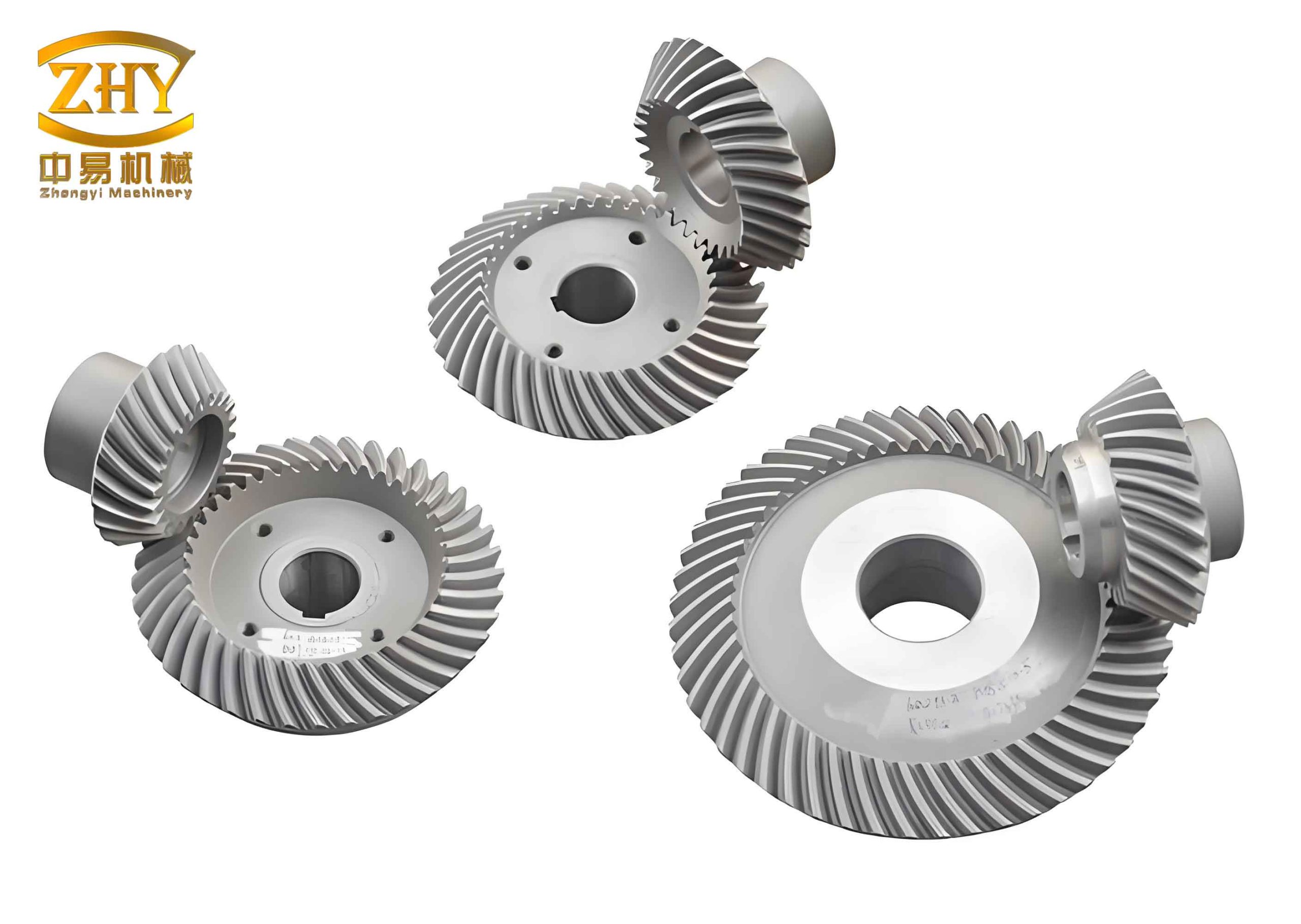
Hyperboloid gears are essential components for transmitting motion and power between non-intersecting, non-parallel axes. They offer significant advantages such as high load-carrying capacity, smooth and quiet operation, and the ability to achieve high reduction ratios in compact spaces. Consequently, hyperboloid gears find widespread application in critical industries including automotive drivetrains, aerospace, and heavy machinery. The superior performance of a hyperboloid gear pair is intrinsically linked to the quality of its tooth surface contact, which directly influences noise, vibration, and service life. However, the complex geometry of hyperboloid gears necessitates numerous adjustable parameters during their manufacturing process on specialized gear cutting machines. This complexity makes precise control over the final meshing performance a significant challenge. Therefore, a deep understanding of the relationship between machine tool adjustment parameters and the resulting meshing characteristics is paramount for the high-quality production of hyperboloid gears. This research focuses on investigating this critical relationship using mathematical modeling and simulation techniques.
Mathematical Model of the Hyperboloid Gear Tooth Surface
The manufacturing of hyperboloid gears, particularly the pinion, often employs the duplex helical method on a multi-axis cradle-style machine. The generation of the pinion tooth surface can be represented as the envelope of a family of tool surfaces (typically a cutting cone) undergoing a series of coordinated motions. The coordinate systems involved in machining the pinion are established as shown in Figure 1. Here, \( S_{m1} \), \( S_c \), and \( S_d \) are coordinate systems fixed to the machine tool. \( S_p \) is the coordinate system attached to the cutter head, rotating about its axis \( z_p \). During cutting via the duplex helical method, the cradle rotates about axis \( Z_{m1} \) while simultaneously performing a helical motion along the same axis. Concurrently, the pinion blank undergoes a rotational motion about axis \( x_d \). The enveloping action between the tool and the blank generates the final pinion tooth surface.
The key machine tool adjustment parameters (MTA) for the pinion include:
- \( q_1 \): Cutter phase angle (Swivel)
- \( S_{r1} \): Radial distance (Sliding base)
- \( i \): Cutter tilt angle
- \( j \): Cutter rotation angle
- \( e_1 \): Vertical offset (Vertical work offset)
- \( x_b \): Machine center to back (Bed offset)
- \( \gamma_{m1} \): Machine root angle
- \( x_{g1} \): Horizontal work offset
- \( H_l \): Helical motion coefficient
In the cutter coordinate system \( S_p \), the surface of the straight-sided cutting blade (forming a cone) can be described by the vector function \( \mathbf{r}_p \) and its unit normal vector \( \mathbf{n}_p \):
$$ \mathbf{r}_p(u_1, \beta_1) = \begin{bmatrix} (r_{g1} + u_1 \sin\alpha_1) \cos\beta_1 \\ (r_{g1} + u_1 \sin\alpha_1) \sin\beta_1 \\ -u_1 \cos\alpha_1 \end{bmatrix}_1 $$
$$ \mathbf{n}_p(u_1, \beta_1) = \begin{bmatrix} \cos\alpha_1 \cos\beta_1 \\ \cos\alpha_1 \sin\beta_1 \\ \sin\alpha_1 \end{bmatrix}_1 $$
where \( r_{g1} \) is the nominal cutter point radius, \( \alpha_1 \) is the blade pressure angle (cutter profile angle), \( u_1 \) is the distance parameter along the blade, and \( \beta_1 \) is the rotational parameter of the cutter.
Using the transformation matrices between the coordinate systems \( S_p \), \( S_{m1} \), \( S_d \), and finally to the pinion coordinate system \( S_1 \), the generated pinion tooth surface equation \( \mathbf{r}_1 \) and its unit normal \( \mathbf{n}_1 \) in \( S_1 \) are obtained:
$$ \mathbf{r}_1 (u_1, \beta_1, \phi) = \mathbf{M}_{1p}(\phi, \mathbf{X}) \cdot \mathbf{r}_p (u_1, \beta_1) $$
$$ \mathbf{n}_1 (u_1, \beta_1, \phi) = \mathbf{L}_{1p}(\phi, \mathbf{X}) \cdot \mathbf{n}_p (u_1, \beta_1) $$
$$ f_1 (u_1, \beta_1, \phi) = \mathbf{n}_1 \cdot \frac{\partial \mathbf{r}_1}{\partial \phi} = 0 $$
Here, \( \phi \) is the cradle rotation angle (generating parameter), \( \mathbf{M}_{1p} \) is the \( 4 \times 4 \) homogeneous transformation matrix from \( S_p \) to \( S_1 \), \( \mathbf{L}_{1p} \) is the \( 3 \times 3 \) rotational sub-matrix of \( \mathbf{M}_{1p} \), and \( f_1 = 0 \) is the equation of meshing between the cutter and the pinion during generation. The matrix \( \mathbf{M}_{1p} \) is a function of \( \phi \) and the vector of machine setting parameters \( \mathbf{X} = [q_1, S_{r1}, i, j, e_1, x_b, \gamma_{m1}, x_{g1}, H_l]^T \).
In practical machining, adjustments are primarily made to the pinion tooth surface to achieve optimal meshing with the gear. Therefore, deviations in the pinion’s machine settings are of primary interest. The actual machine setting \( \mathbf{X}’ \) can be expressed as:
$$ \mathbf{X}’ = \mathbf{X} + \Delta\mathbf{X} $$
where \( \mathbf{X} \) is the theoretical (nominal) setting vector and \( \Delta\mathbf{X} \) is the error or adjustment vector. Substituting Equation (4) into Equations (1-3) yields the pinion tooth surface equation that incorporates machine parameter errors.
$$ \mathbf{r}_1 = \mathbf{r}_1 (u_1, \beta_1, \phi, \mathbf{X}’) $$
The gear (wheel) tooth surface is typically generated by a formate (non-generated) process using a separate cutter head. Its mathematical model \( \mathbf{r}_2(u_2, \theta_2) \) and unit normal \( \mathbf{n}_2(\theta_2) \) in its own coordinate system \( S_2 \) can be established similarly but with a fixed relationship to the cutter, lacking a generating motion parameter like \( \phi \).
Tooth Contact Analysis (TCA) Mathematical Model
TCA is a fundamental tool for simulating the meshing of conjugate gear surfaces under no-load conditions. The objective is to determine the path of contact, transmission error, and the instantaneous contact ellipse on the tooth surfaces. The meshing coordinate system is illustrated in Figure 3. Coordinate systems \( S_1 \) and \( S_2 \) are attached to the pinion and gear, respectively, rotating about fixed axes in the housing coordinate system \( S_h \). The assembly parameters include the shaft offset \( E \) and the initial rotational positions.
The conditions for continuous tangency between the mating pinion and gear tooth surfaces are expressed by the following system of vector equations:
$$ \mathbf{r}_h^{(1)}(u_1, \beta_1, \phi, \varphi_1, \mathbf{X}’) = \mathbf{r}_h^{(2)}(u_2, \theta_2, \varphi_2, E) $$
$$ \mathbf{n}_h^{(1)}(\beta_1, \phi, \varphi_1, \mathbf{X}’) = \mathbf{n}_h^{(2)}(\theta_2, \varphi_2, E) $$
$$ f_1(u_1, \beta_1, \phi) = 0 $$
Here:
- \( \mathbf{r}_h^{(1)}, \mathbf{n}_h^{(1)} \): Position and unit normal vectors of the pinion surface expressed in the fixed housing system \( S_h \). They are obtained via transformation: \( \mathbf{r}_h^{(1)} = \mathbf{M}_{h1}(\varphi_1) \mathbf{r}_1 \).
- \( \mathbf{r}_h^{(2)}, \mathbf{n}_h^{(2)} \): Position and unit normal vectors of the gear surface expressed in \( S_h \). \( \mathbf{r}_h^{(2)} = \mathbf{M}_{he} \mathbf{M}_{e2}(\varphi_2) \mathbf{r}_2 \).
- \( \varphi_1, \varphi_2 \): Rotation angles of the pinion and gear, respectively.
- \( f_1=0 \): The equation of meshing for the pinion generation, which must also hold during operation.
The system contains seven unknowns (\( u_1, \beta_1, \phi, \varphi_1, u_2, \theta_2, \varphi_2 \)) and six independent scalar equations (three from the vector position equality and two from the independent components of the unit normal equality, plus one from the equation of meshing). Therefore, by fixing one parameter, for example, the pinion rotation angle \( \varphi_1 \), and providing initial guesses for the others, the system can be solved numerically (e.g., using the Newton-Raphson method) to find a contact point. By incrementing \( \varphi_1 \) through a small angular range corresponding to one mesh cycle, a discrete set of contact points on the gear tooth surface is obtained. The curve connecting these points is the path of contact (contact trajectory).
The transmission error (TE) is defined as the deviation of the gear’s actual angular position from its theoretical position based on a constant ratio. It is calculated as:
$$ \Delta \varphi_2(\varphi_1) = \varphi_2(\varphi_1) – \left( -\frac{N_1}{N_2} \varphi_1 \right) $$
where \( N_1 \) and \( N_2 \) are the numbers of teeth on the pinion and gear, respectively. The negative sign accounts for the opposite direction of rotation.
Furthermore, based on the principal curvatures and directions of the two surfaces at the contact point, the instantaneous contact ellipse (representing the area where elastic deformation brings the surfaces into contact under light load) can be calculated. Its orientation and dimensions provide insight into the contact pattern.
Influence of Machine Adjustment Parameters on Contact Path and Transmission Error
To investigate the specific effects of machine tool adjustments, a numerical TCA study was conducted on a sample hyperboloid gear pair. The basic gear blank data and nominal machine settings are summarized in Tables 1 and 2 below.
| Parameter | Pinion | Gear |
|---|---|---|
| Number of Teeth | 7 | 43 |
| Outer Pitch Diameter (mm) | 150.1349 | 150.3843 |
| Mean Pressure Angle (°) | 22.5 | |
| Offset (mm) | 25.4 | |
| Face Width (mm) | 43.7299 | 40 |
| Shaft Angle (°) | 90 | |
| Spiral Angle (°) | 45 | 33.45 |
| Hand of Spiral | Left | Right |
| Parameter | Pinion | Gear |
|---|---|---|
| Cutter Blade Angle (°) | 20 | 30 |
| Cutter Point Radius (mm) | 114.8409 | 116.1 |
| Vertical Offset, e1 (mm) | 27.3700 | 111.0757 |
| Radial Setting, Sr1 (mm) | 117.1353 | 0 |
| Horizontal Offset, xg1 (mm) | 0.0730 | 9.6518 |
| Cutter Phase, q1 (°) | 65.6224 | 0 |
| Cutter Tilt, i (°) | 16.3882 | 0 |
| Cutter Rotation, j (°) | -25.6862 | 0 |
| Machine Root Angle, γm1 (°) | -6.4576 | 70.2509 |
| Ratio of Roll | 6.0615 | 0 |
| Bed Offset, xb (mm) | 14.6514 | 0 |
| Helical Motion Coefficient, Hl (mm/rad) | 7.1860 | 0 |
Using the TCA model, each of the nine primary pinion machine settings was varied individually by a small amount (0.1 mm for linear parameters, 0.1° for angular parameters) from its nominal value. The resulting changes in the contact path on the gear tooth and the transmission error curve were analyzed for both the drive-side (convex for pinion, concave for gear) and coast-side (concave for pinion, convex for gear) surfaces. The results are synthesized in the following analysis and summarized in Table 3 for transmission error magnitude.
2.1 Influence of Linear (Displacement) Machine Parameters
Linear parameters include Vertical Offset (\(e_1\)), Bed Offset (\(x_b\)), Horizontal Offset (\(x_{g1}\)), and Radial Setting (\(S_{r1}\)). The key findings are:
- Vertical Offset (\(e_1\)): A positive increase shifts the drive-side contact path towards the toe (outer end) of the gear tooth. A negative change shifts it towards the heel (inner end). The coast-side shifts in the opposite direction. The effect on TE magnitude is relatively small.
- Horizontal Offset (\(x_{g1}\)): A positive change shifts both drive-side and coast-side contact paths towards the toe. A negative change shifts them towards the heel.
- Bed Offset (\(x_b\)): A positive increase shifts both tooth flanks’ contact paths towards the heel. A negative change shifts them towards the toe.
- Radial Setting (\(S_{r1}\)): This parameter has a significant influence. A positive increase shifts the drive-side contact towards the heel and the coast-side contact towards both the toe and the tip, risking edge contact. A negative change has the opposite effect.
Summary for Linear Parameters:
- They primarily affect the contact path location along the lengthwise direction (toe-heel).
- The order of influence on contact path shift is: Radial Setting (\(S_{r1}\)) > Vertical Offset (\(e_1\)) > Bed Offset (\(x_b\)) > Horizontal Offset (\(x_{g1}\)).
- The order of influence on Transmission Error magnitude is: Radial Setting (\(S_{r1}\)) > Bed Offset (\(x_b\)) > Horizontal Offset (\(x_{g1}\)) > Vertical Offset (\(e_1\)).
- The impact of these parameters is generally more pronounced on the drive-side contact path than on the coast-side, except for Horizontal Offset.
2.2 Influence of Angular Machine Parameters
Angular parameters include Cutter Blade Angle (\(\alpha_1\) or its equivalent machine setting), Cutter Tilt (\(i\)), Cutter Rotation (\(j\)), Cutter Phase (\(q_1\)), and Machine Root Angle (\(\gamma_{m1}\)).
- Cutter Blade Angle (\(\alpha_1\)): This parameter strongly affects the profile (top-root) direction. A positive increase shifts the drive-side contact towards the toe and tip, and the coast-side towards the heel and root. Negative change does the opposite. Excessive error can cause edge contact at the tip or root.
- Cutter Tilt (\(i\)): Primarily affects the lengthwise direction. A positive increase shifts contact paths for both flanks towards the toe. A negative change shifts them towards the heel.
- Cutter Rotation (\(j\)): Affects the lengthwise direction. On the drive-side, positive change shifts contact to the heel, negative to the toe. On the coast-side, changes in either direction tend to shift the contact towards the heel.
- Cutter Phase (\(q_1\)): This parameter has a negligible effect on both the contact path and the transmission error for the small variations studied.
- Machine Root Angle (\(\gamma_{m1}\)): This is a highly influential parameter. It affects both length and profile directions. A positive increase shifts both flanks’ contact towards the heel and root. A negative change shifts them towards the toe and tip, risking edge contact.
Summary for Angular Parameters:
- They affect both the lengthwise and profile directions of the contact path.
- The order of influence on contact path shift is: Machine Root Angle (\(\gamma_{m1}\)) > Cutter Blade Angle (\(\alpha_1\)) > Cutter Tilt (\(i\)) > Cutter Rotation (\(j\)) > Cutter Phase (\(q_1\)).
- The order of influence on Transmission Error magnitude is: Cutter Blade Angle (\(\alpha_1\)) > Cutter Tilt (\(i\)) > Machine Root Angle (\(\gamma_{m1}\)) > Cutter Rotation (\(j\)) > Cutter Phase (\(q_1\)).
- The impact on the drive-side contact path is greater than on the coast-side for Blade Angle, Tilt, and Root Angle, but the opposite is true for Cutter Rotation.
| Varied Parameter | Change | Drive-side TE (μrad) | Coast-side TE (μrad) | Drive-side Dev. (%) | Coast-side Dev. (%) |
|---|---|---|---|---|---|
| Nominal | 0 | -12.0 | -12.5 | — | — |
| Blade Angle | +0.1° | -11.9 | -7.3 | 0.83 | 41.6 |
| -0.1° | -10.8 | -14.3 | 10.0 | 14.4 | |
| Cutter Tilt (i) | +0.1° | -12.04 | -15.35 | 0.33 | 22.8 |
| -0.1° | -11.22 | -9.1 | 6.5 | 27.2 | |
| Vertical Offset (e1) | +0.1 mm | -12.05 | -12.42 | 0.42 | 0.64 |
| -0.1 mm | -11.96 | -12.54 | 0.33 | 0.32 | |
| Bed Offset (xb) | +0.1 mm | -11.93 | -11.88 | 0.58 | 4.96 |
| -0.1 mm | -12.01 | -12.91 | 0.10 | 3.28 | |
| Cutter Rotation (j) | +0.1° | -11.48 | -12.9 | 4.33 | 3.2 |
| -0.1° | -12.24 | -12.3 | 2.0 | 1.6 | |
| Cutter Phase (q1) | +0.1° | -12.0 | -12.0 | 0 | 0 |
| -0.1° | -12.0 | -12.0 | 0 | 0 | |
| Horizontal Offset (xg1) | +0.1 mm | -12.13 | -12.34 | 1.08 | 1.28 |
| -0.1 mm | -11.86 | -12.5 | 1.20 | 0 | |
| Radial Setting (Sr1) | +0.1 mm | -11.99 | -9.55 | 0.08 | 23.6 |
| -0.1 mm | -10.55 | -14.3 | 12.08 | 14.4 | |
| Root Angle (γm1) | +0.1° | — | -11.0 | — | 12.0 |
| -0.1° | -11.66 | -13.2 | 2.88 | 5.6 |
Influence of Machine Parameters on Tooth Surface Topography (Mismatch Analysis)
To gain a deeper, more visual understanding of how machine settings alter the pinion tooth surface itself, a mismatch (or ease-off) analysis is performed. The mismatch is defined as the normal deviation between a theoretical (nominal) tooth surface and a modified surface generated with a changed machine parameter. For a grid of points on the tooth surface, the mismatch \( m_{ij} \) is calculated as:
$$ m^{k}_{ij} = (\mathbf{r}^{k}_{ij} – \mathbf{r}^{1}_{ij}) \cdot \mathbf{n}^{1}_{ij} $$
where \( \mathbf{r}^{1}_{ij} \) and \( \mathbf{n}^{1}_{ij} \) are the position vector and unit normal of the nominal surface grid point, and \( \mathbf{r}^{k}_{ij} \) is the position vector of the corresponding point on the modified surface (\( k \)) after aligning the two surfaces at a reference point (e.g., the mean point).
Analysis of mismatch topographies for key parameters like Blade Angle (\(\alpha_1\)), Radial Setting (\(S_{r1}\)), and Machine Root Angle (\(\gamma_{m1}\)) reveals the following:
- Blade Angle (\(\alpha_1\)): Its variation primarily modifies the pressure angle of the profile. On the drive-side, this changes the effective curvature in the profile direction, explaining the shift in contact towards the tip or root. On the coast-side, it also influences the effective spiral angle, affecting lengthwise contact position.
- Radial Setting (\(S_{r1}\)): Its variation strongly alters the effective spiral angle of the pinion tooth. On the drive-side, this dominantly shifts the contact lengthwise. On the coast-side, it affects both spiral angle and pressure angle, causing combined shifts in length and profile directions.
- Machine Root Angle (\(\gamma_{m1}\)): Its variation affects the basic orientation of the tooth in space, changing both its effective spiral angle and pressure angle. This explains its strong influence on both lengthwise and profile contact location, especially on the coast-side.
General Observations from Mismatch:
- The magnitude of mismatch is generally larger at the toe than at the heel.
- The influence of Radial Setting on surface topography is significantly greater than that of Blade Angle or Root Angle.
- The effects of positive and negative changes in a parameter are roughly symmetric in terms of the mismatch topography pattern.
- The changes in tooth surface topography revealed by the mismatch diagrams are in complete agreement with the contact path shifts observed in the TCA results, providing a clear geometrical explanation for the meshing behavior changes.
Conclusion
This study establishes a comprehensive mathematical framework for modeling the tooth surface of a hyperboloid gear machined via the duplex helical method and for performing Tooth Contact Analysis. The systematic investigation into the effects of nine critical machine tool adjustment parameters on the meshing performance—specifically the contact path and transmission error—provides clear guidance for gear engineers. The key findings categorize parameters based on their primary influence: linear parameters (e.g., \(S_{r1}\), \(e_1\), \(x_b\), \(x_{g1}\)) predominantly control the lengthwise positioning of the contact pattern, while angular parameters (e.g., \(\alpha_1\), \(\gamma_{m1}\), \(i\)) influence both lengthwise and profile directions, with Blade Angle and Root Angle being particularly sensitive. The supplemental analysis using tooth surface mismatch diagrams offers an intuitive, three-dimensional understanding of how these parameter changes physically alter the pinion tooth geometry, thereby validating and explaining the TCA results. This integrated approach—combining TCA and ease-off analysis—forms a powerful theoretical basis for diagnosing contact issues, optimizing meshing performance, and efficiently adjusting machine settings during the manufacturing and testing of high-precision hyperboloid gears. Future work could extend this analysis to include the effects of load (Loaded Tooth Contact Analysis) and dynamic factors to more fully characterize hyperboloid gear performance under operational conditions.