
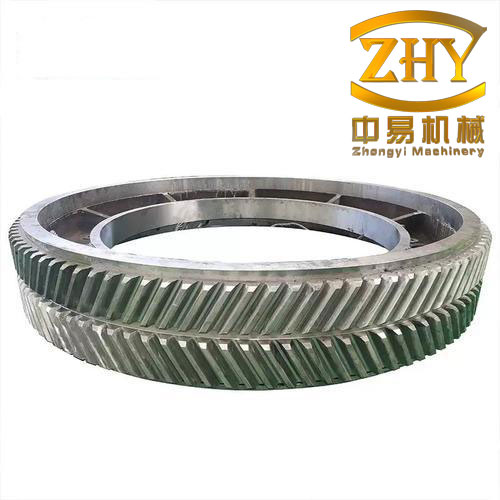
In our study, we focus on the dynamic behavior of herringbone gear transmissions, which are widely used in heavy-duty machinery due to their high load capacity, smooth operation, and minimal axial load. However, manufacturing imperfections, particularly symmetry errors between the left and right helical sections, can significantly degrade performance. We establish a comprehensive loaded tooth contact analysis (LTCA) model that accounts for symmetry errors, tooth surface gaps, force equilibrium, and axial displacement. Through finite element simulations and analytical derivations, we investigate how varying symmetry errors affect tooth contact patterns, axial vibrations, and axial forces. We then propose a novel compensation method that leverages axial assembly errors to mitigate the detrimental effects of symmetry errors. Our results demonstrate that symmetry errors induce severe load imbalance and axial vibrations, while the proposed error coupling compensation effectively reduces these issues, enhancing transmission stability.
The herringbone gear, characterized by two opposite helical teeth on a single gear, offers inherent axial force cancellation under ideal conditions. However, real-world manufacturing constraints often introduce symmetry errors, which we define as the linear offset between the tooth trace extensions of the left and right helical gears. This error disrupts the balance of axial forces, leading to increased vibration and noise. Our study systematically quantifies these effects and provides a practical compensation strategy.
We begin our analysis by developing a robust loaded contact model. Based on the classical LTCA methodology for helical gears, we treat the herringbone gear pair as two parallel helical gear contacts. The tooth contact region is simplified as a series of discrete points along the major axis of the instantaneous contact ellipse. As shown in our model, the initial gap at any point k on the contact ellipse is given by:
$$ w_k^I = \delta + b_k^I + \zeta_s $$
$$ w_k^{II} = \delta + b_k^{II} – \zeta_s $$
where the superscripts I and II denote the left and right helical gears, respectively, δ is the transmission error, b_k is the gap due to tooth geometry, and ζ_s is half of the symmetry error projected onto the normal direction. This formulation accounts for the asymmetry introduced by manufacturing.
Under an external load P, the herringbone gear experiences elastic deformation. We assume the pinion is fixed while the gear undergoes a normal displacement Z. The displacement compatibility equation for each tooth pair is:
$$ [S]^t \{F\}^t + \{U\}^t + \{w\}^t = \{Z\} + \{d\}^t $$
where [S] is the tooth bending-shear flexibility matrix, {F} is the load vector at discrete points, {U} is the contact deformation vector, {w} is the initial gap vector, and {d} is the residual gap vector after loading. No penetration condition requires that for each point, either the gap is zero and the force is positive, or the gap is positive and the force is zero.
Due to the symmetry error, the initial gaps on the left and right sides differ, causing unequal load distribution. To balance the axial forces, the pinion is allowed to float axially by a displacement σ. The equilibrium condition is:
$$ \sum_{k=1}^n F_k^I = \sum_{k=1}^n F_k^{II} $$
Combining these equations with the axial displacement transformation, we derive the complete loaded contact model for herringbone gears with symmetry error:
$$ \begin{cases} -[S]^t \{F\}^t – \{U\}^t + \{Z\} + \{d\}^t + \{\sigma_s\}^t = \{w\}^t \\ \sum_{k=1}^n F_k^I = \sum_{k=1}^n F_k^{II} \\ \left|\sum_{k=1}^n \sigma_{sk}^I\right| + \left|\sum_{k=1}^n \sigma_{sk}^{II}\right| = 0 \\ d_k^t = 0, F_k^t > 0 \quad \text{or} \quad d_k^t > 0, F_k^t = 0 \end{cases} $$
Here, {σ_s} represents the axial displacement vector projected onto the normal direction, with opposite signs for the left and right sides.
We validated our model by comparing its predictions with finite element simulations. A three-dimensional model of a herringbone gear pair was created using the parameters listed in Table 1. The pinion was assumed error-free, while the gear had a symmetry error of 0.02 mm. In the finite element model, we used eight-node hexahedral elements with a mesh of 400,480 nodes and 134,864 elements. Boundary conditions included a cylindrical joint for the pinion (allowing axial float and rotation) and a revolute joint for the gear (only rotation). Speed and torque were gradually applied over 0.1 s to avoid transient shocks.
Table 1 Basic parameters of herringbone gear pair
| Parameter | Pinion | Gear |
|---|---|---|
| Number of teeth | 34 | 30 |
| Module (mm) | 5 | 5 |
| Pressure angle α (°) | 20 | 20 |
| Helix angle β (°) | 35 | 35 |
| Total face width b (mm) | 160 | 160 |
| Relief groove width bd (mm) | 24 | 24 |
| Relief groove depth d (mm) | 5 | 4 |
| Symmetry error ζ (mm) | 0 | 0.02 |
| Rotational speed n (r/min) | 2000 | – |
| Load torque T (N·m) | – | 6000 |
The finite element results for axial displacement and loaded transmission error closely matched our LTCA predictions, as shown in Figure 5 (reference only). Discrepancies were attributed to nonlinear contact and friction effects captured by the finite element method. Both approaches revealed periodic fluctuations in axial displacement and transmission error due to varying tooth pair engagement. The symmetry error caused an initial axial shift of about 0.018 mm, with transmission error oscillating around -0.174 rad.
To systematically investigate the influence of symmetry error magnitude, we considered values of ζ = 0.05, 0.1, 0.15, and 0.2 mm. These cover typical manufacturing tolerances for large herringbone gears (grades 6 to 10). Finite element analyses were performed under the same boundary conditions.
2.1 Tooth Contact Analysis under Symmetry Error
The contact stress distributions for different symmetry errors showed that the load is shared among four adjacent teeth. Ideally, the herringbone gear should have line contact, but due to elastic deformation and bearing compliance, the contact pattern resembles an ellipse. Symmetry error causes asymmetric contact stress between the left and right helical gears, leading to load concentration on one side. As ζ increases, the peak contact stress on the heavily loaded side rises. For example, at ζ=0.2 mm, the maximum contact stress exceeded the material’s endurance limit in the initial engagement phase, reducing gear life. This demonstrates that symmetry error directly degrades load distribution and reliability.
2.2 Axial Displacement Analysis
We divided the transmission process into three stages: start-up, loading, and steady-state. During start-up, no contact occurs, so axial displacement remains zero. As the teeth engage, the symmetry error causes an initial impact on one side, generating a sudden axial jump. The magnitude of this jump increases with ζ. In the loading stage, the gear oscillates axially with decaying amplitude. At steady state, the axial displacement oscillates periodically around a mean value close to the symmetry error itself. Table 2 summarizes key parameters.
Table 2 Axial displacement parameters under different symmetry errors
| Symmetry error ζ (mm) | Start-up duration (s) | Max displacement (mm) | Mean displacement at steady state (mm) |
|---|---|---|---|
| 0.05 | 0.0034 | 0.091 | 0.051 |
| 0.1 | 0.0023 | 0.138 | 0.099 |
| 0.15 | 0.0009 | 0.176 | 0.149 |
| 0.2 | 0.0002 | 0.208 | 0.186 |
We observed that larger symmetry errors shorten the start-up phase and amplify both the peak and steady-state axial displacement. The mean displacement at steady state is approximately equal to the symmetry error, confirming that this error directly dictates the axial offset of the floating pinion.
2.3 Axial Force Analysis
Axial force, being the primary driver of axial vibration, was also analyzed in three stages. During start-up, no axial force exists. When teeth first contact, a large impulsive axial force occurs, followed by several rebounds. The maximum axial force appears at the second or third impact. At steady state, the axial force oscillates with a period equal to the meshing frequency (≈999 Hz in our case). The fluctuation amplitude increases with symmetry error. Table 3 provides quantitative data.
Table 3 Axial vibration parameters under different symmetry errors
| Symmetry error ζ (mm) | Max axial force (N) | Mean axial force (N) | Standard deviation (N) | Frequency (Hz) |
|---|---|---|---|---|
| 0.05 | 970.27 | 99.38 | 322.31 | 994.02 |
| 0.1 | 1527.58 | 130.78 | 516.44 | 1002.14 |
| 0.15 | 1989.74 | 168.35 | 845.26 | 1014.57 |
| 0.2 | 2172.76 | 231.28 | 989.76 | 999.74 |
The standard deviation increases dramatically with ζ, indicating more violent fluctuations. The frequency remains close to the meshing frequency, suggesting that symmetry error amplifies the inherent time-varying stiffness excitation. This leads to tooth separation, impact, and reduced mesh stiffness, further deteriorating stability.
Given the difficulty of reducing manufacturing errors, we propose compensating symmetry errors by deliberately introducing an axial assembly error. This approach adjusts the initial gap distribution to restore balance. The compensation principle is captured by modifying the initial gap equations:
$$ w_k^I = \delta + b_k^I + \zeta_s – \lambda $$
$$ w_k^{II} = \delta + b_k^{II} – \zeta_s + \lambda $$
where λ is the component of the axial assembly error projected onto the normal direction. By selecting λ appropriately, we can counteract the effect of ζ_s. Substituting these into the LTCA model yields compensated results.
In our simulations, we applied assembly offsets of 0.05, 0.1, 0.15, and 0.18 mm corresponding to the symmetry errors tested. The contact stress nephograms after compensation showed symmetric distribution between left and right teeth, with significantly reduced load imbalance. The axial displacement became minimal, oscillating around zero with amplitudes of only a few microns (4.93 to 7.83 μm). The axial force was also drastically reduced, with mean values around 60 N (approximately 1.5% of the peak single-side force). The oscillations became regular and small, confirming effective cancellation of axial forces.
Figure 9 (reference only) illustrates the improved contact stress uniformity. Figure 10 shows axial displacement curves after compensation, all centered near zero. Figure 11 displays axial force time histories, now bounded within ±300 N. These results demonstrate that error coupling compensation is highly effective.
Our study leads to the following conclusions:
- We established a loaded contact model for herringbone gears with symmetry error, validated by finite element simulations. The model accurately predicts axial displacement and force.
- Symmetry error causes asymmetric contact stress and load concentration, reducing gear strength and lifetime. As symmetry error increases, the heavily loaded side experiences higher stress.
- Symmetry error induces severe axial vibrations during both transient and steady-state operation. Axial displacement and force fluctuations increase with error magnitude and are synchronized with the meshing frequency.
- We proposed a compensation method using axial assembly error to counteract symmetry error. This technique effectively restores load balance, reduces axial displacement to near zero, and lowers axial force by over 98%. It provides a practical and economical way to improve herringbone gear transmission stability.
Our research underscores the critical impact of symmetry errors on herringbone gear dynamics and offers a viable solution through error coupling compensation. This approach can be applied directly in assembly processes without costly manufacturing upgrades. Future work will explore the effects of combined errors and dynamic responses under variable operating conditions.