
In the field of gear engineering, hyperboloid gears, particularly those with epicycloidal tooth profiles, represent a significant advancement due to their superior performance in transmitting motion between non-intersecting and non-parallel shafts. As an engineer specializing in gear design and simulation, I have developed a comprehensive simulation machining system for hyperboloid gears to address the challenges associated with traditional manufacturing processes. This system leverages advanced interface design and three-dimensional modeling to optimize the design, analysis, and virtual machining of hyperboloid gears, ensuring efficiency and accuracy before physical production. The hyperboloid gear, with its complex geometry, requires meticulous attention to parameters and potential defects such as cutter interference, tooth surface scratches, and ridge formation at the groove bottom. In this article, I will detail the interface design principles, system components, and key validation checks implemented in our simulation platform, emphasizing the integration of formulas and tables for data summarization. Throughout, the term hyperboloid gear will be frequently highlighted to underscore its centrality in this work.
The simulation machining system for hyperboloid gears is built to replicate the intricate processes involved in manufacturing these gears, which are widely used in aerospace, automotive, and heavy machinery industries. Traditional methods for hyperboloid gear production often involve trial-and-error adjustments, leading to resource wastage and increased costs. By contrast, our system provides a virtual environment where designers can input parameters, perform feasibility checks, conduct strength verification, and visualize the machining process in three dimensions. This not only reduces material waste but also enhances design precision. The hyperboloid gear’s unique characteristics, such as its epicycloidal tooth flank, necessitate specialized software tools for geometry calculation and interference analysis. Our system addresses these needs through a user-friendly interface that adheres to established design principles, ensuring that even non-expert users can efficiently navigate the platform.
One of the core components of the simulation system is its interface, which is designed based on principles of consistency, simplicity, and guided interaction. As I developed this system, I prioritized creating an intuitive layout that minimizes user error and maximizes productivity. The interface is divided into several sequential modules: system startup, basic data input, gear parameter design, feasibility testing, strength verification, result output, and system help. Each module is interconnected, allowing for seamless transitions and real-time feedback. For instance, during data input, the system automatically assigns default values to common parameters like the clearance coefficient and addendum coefficient, reducing manual entry and speeding up calculations. This approach is crucial for handling the complex equations involved in hyperboloid gear design, which I will elaborate on using formulas and tables later.
To illustrate the geometric foundation of hyperboloid gears, let’s consider some key formulas used in the simulation system. The tooth profile of an epicycloidal hyperboloid gear is derived from the generating principle of a crown gear with an elongated epicycloidal curve. The basic geometry can be described using the following parameters: the normal module at the reference point \( m_n \), the pitch cone angle \( \delta \), the offset distance \( E \), and the spiral angle \( \beta \). The tooth depth \( h \) is calculated as:
$$ h = (2.25 \times m_n) + c $$
where \( c \) is the clearance. The addendum \( h_a \) and dedendum \( h_f \) are given by:
$$ h_a = m_n \times (1 + x) $$
$$ h_f = m_n \times (1.25 – x) $$
Here, \( x \) is the profile shift coefficient, which is adjusted based on the gear pair requirements. For hyperboloid gears, the offset \( E \) influences the tooth curvature and contact pattern, and it is optimized through iterative simulations in our system. The following table summarizes the primary design parameters for a typical hyperboloid gear pair, as used in the simulation input module:
| Parameter | Symbol | Typical Value Range | Unit |
|---|---|---|---|
| Normal Module | \( m_n \) | 2–10 | mm |
| Number of Teeth (Pinion) | \( z_1 \) | 10–30 | – |
| Number of Teeth (Gear) | \( z_2 \) | 20–50 | – |
| Offset Distance | \( E \) | 20–100 | mm |
| Spiral Angle | \( \beta \) | 30°–50° | deg |
| Pressure Angle | \( \alpha_n \) | 20°–22.5° | deg |
After inputting these parameters, the system proceeds to the gear parameter design module, where it calculates derived values such as the pitch diameters, cone angles, and tooth thicknesses. The calculations are based on the fundamental equations for hyperboloid gears. For example, the pitch diameter of the pinion \( d_1 \) is given by:
$$ d_1 = \frac{m_n \times z_1}{\cos \beta} $$
Similarly, the gear pitch diameter \( d_2 \) is computed, and the virtual crown gear geometry is used to simulate the machining process. This virtual modeling is essential for predicting the behavior of hyperboloid gears under actual cutting conditions. The system also incorporates strength verification modules that assess contact and bending stresses using standardized formulas. The contact stress \( \sigma_H \) is evaluated with:
$$ \sigma_H = Z_E \times Z_H \times Z_\epsilon \times \sqrt{\frac{F_t \times K_A \times K_V \times K_{H\beta} \times K_{H\alpha}}{b \times d_1 \times \cos \alpha_n}} $$
where \( Z_E \) is the elasticity factor, \( Z_H \) is the zone factor, \( Z_\epsilon \) is the contact ratio factor, \( F_t \) is the tangential force, \( K \) factors account for load distribution, and \( b \) is the face width. The bending stress \( \sigma_F \) is calculated as:
$$ \sigma_F = \frac{F_t \times K_A \times K_V \times K_{F\beta} \times K_{F\alpha}}{b \times m_n \times Y_F \times Y_S \times Y_\beta} $$
Here, \( Y_F \) is the form factor, \( Y_S \) is the stress correction factor, and \( Y_\beta \) is the spiral angle factor. These formulas are integral to ensuring the reliability of hyperboloid gears in demanding applications. The system automatically compares these stresses with material limits and provides warnings if adjustments are needed.
Once the design parameters are finalized, the simulation system moves to the three-dimensional modeling phase, where virtual machining of the hyperboloid gear is performed. This phase is critical for identifying potential defects that could arise during actual production. The system generates solid models of the cutter and gear blank, allowing for visual inspection of interactions. For hyperboloid gears, common issues include cutter interference, tooth surface scratches, and ridge formation at the groove bottom. To analyze these, the system uses Boolean operations and geometric checks within the modeled environment. For instance, cutter interference occurs when the non-cutting edges of the tool inadvertently contact the gear tooth during machining, especially for gears with large pitch cone angles. The system checks this by positioning the cutter entity relative to the gear blank at various swing angles \( \lambda \) and verifying for intersections.
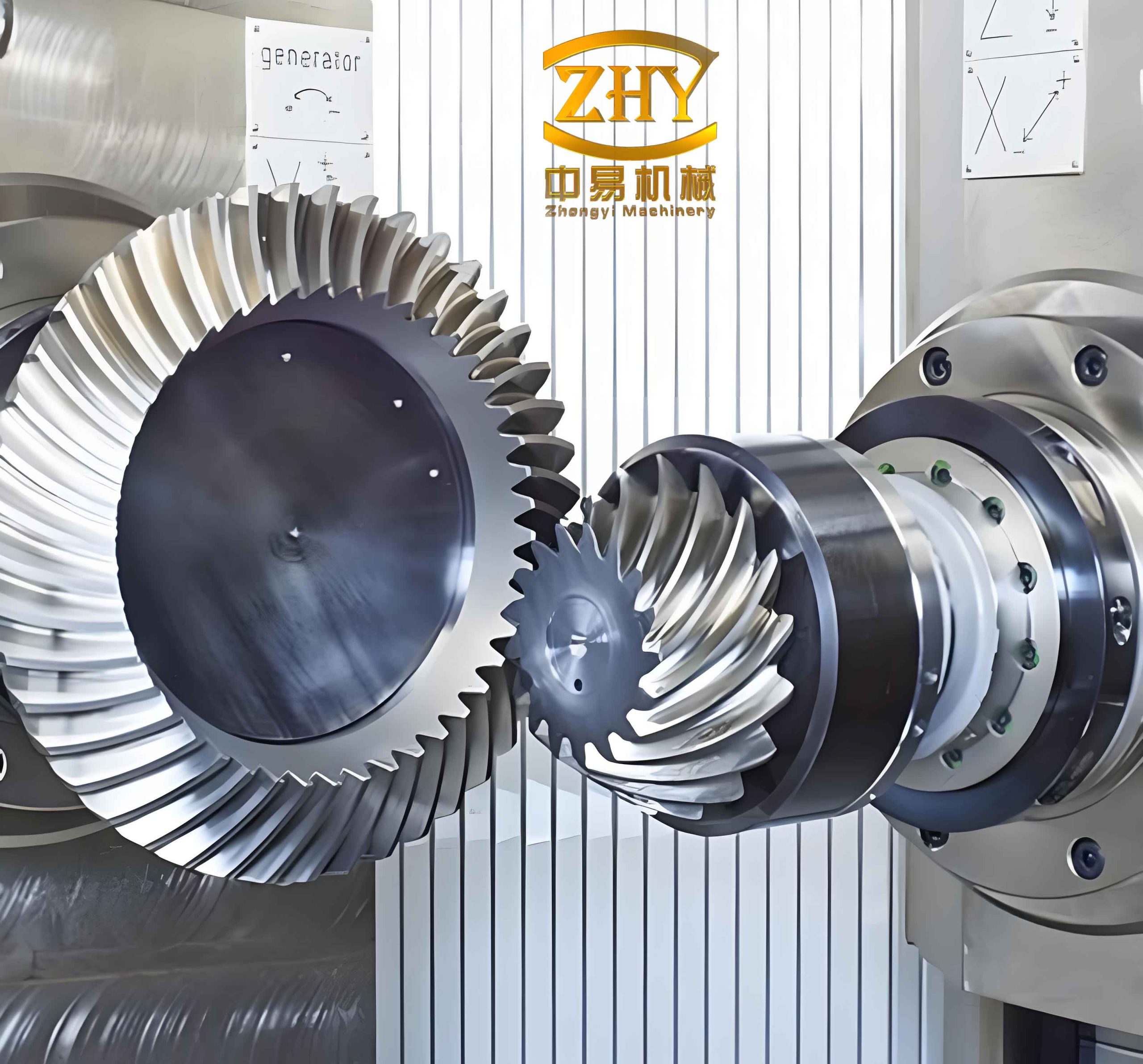
The image above illustrates the complex geometry of hyperboloid gears, highlighting their non-parallel axes and curved tooth profiles. In our simulation, such visualizations aid in understanding the spatial relationships during machining. For ridge formation analysis, the system examines the merged tool paths of the inner and outer cutters that form the generating gear tooth. If the resulting tooth entity shows cracks or discontinuities, it indicates potential ridge issues in the actual gear groove. Similarly, tooth surface scratches are detected by inspecting the smoothness of the gear tooth flank after virtual cutting. The system performs a Boolean subtraction between the gear blank and the generated tooth slot, and any突起 or irregularities on the surface suggest scratching risks. These checks are automated and provide immediate feedback to the designer, enabling quick parameter adjustments.
To further elaborate on the validation processes, let’s consider the mathematical models used for interference checking. For a hyperboloid gear, the cutter interference condition depends on the relative positions of the cutter center \( O_0 \), the swing center \( O_p \), and the gear blank center \( O_2 \). The distance \( d_{interference} \) between the cutter edge and the gear tooth surface is computed at critical points, such as the entry and exit positions of the cutting process. If \( d_{interference} < 0 \) at any point, interference is flagged. The system uses the following inequality to check for interference at the gear’s large end:
$$ r_0 \times \sin(\theta) + E \times \cos(\delta) > R_{gear} $$
where \( r_0 \) is the nominal cutter radius, \( \theta \) is the angle of cutter rotation, \( E \) is the offset, \( \delta \) is the pitch cone angle, and \( R_{gear} \) is the gear blank radius at the check point. This formula is applied iteratively across the machining cycle to ensure comprehensive validation. The table below summarizes the key checks performed in the system for hyperboloid gears, along with their criteria and outcomes:
| Check Type | Description | Mathematical Criterion | Outcome if Failed |
|---|---|---|---|
| Cutter Interference | Verifies non-cutting tool contact | \( d_{interference} \geq 0 \) at all points | Adjust cutter radius or cone angle |
| Tooth Surface Scratch | Ensures smooth tooth flank | Surface curvature continuity \( C^2 \) | Modify tool profile or cutting path |
| Groove Bottom Ridge | Prevents ridge formation in groove | No cracks in generated tooth entity | Optimize tool overlap or feed rate |
| Strength Verification | Assesses contact and bending stresses | \( \sigma_H \leq \sigma_{H,lim} \), \( \sigma_F \leq \sigma_{F,lim} \) | Change material or geometry |
The interface design of the simulation system plays a pivotal role in facilitating these checks. As I implemented the system, I ensured that each module provides clear prompts and defaults to guide the user. For example, in the cutter interference check module, the system automatically suggests a nominal cutter radius based on the input normal module, reducing the need for manual lookup. The help section offers detailed explanations of terms like “hyperboloid gear” and “epicycloidal curve,” making the platform accessible to novice users. Moreover, the output module generates detailed reports including adjustment cards for machine settings, which can be exported for physical machining. This seamless integration from design to simulation underscores the system’s utility in hyperboloid gear production.
In terms of computational methods, the system employs numerical algorithms to solve the complex equations governing hyperboloid gear geometry. For instance, the tooth surface coordinates are derived using parametric equations based on the generating process. The surface of a hyperboloid gear tooth can be represented as:
$$ \vec{r}(u, v) = \begin{bmatrix} x(u, v) \\ y(u, v) \\ z(u, v) \end{bmatrix} $$
where \( u \) and \( v \) are parameters related to the tool motion and gear rotation. These coordinates are used to create the 3D mesh for visualization and interference analysis. The system also incorporates finite element analysis (FEA) capabilities for stress distribution studies, though that is beyond the scope of this article. The focus remains on the interface and simulation aspects that directly impact design validation for hyperboloid gears.
Looking ahead, the simulation system for hyperboloid gears is continuously evolved to include more advanced features such as real-time collaboration tools and cloud-based processing. The hyperboloid gear, with its growing applications in electric vehicles and robotics, demands ever-higher precision and efficiency. Our platform aims to meet these demands by integrating machine learning algorithms for predictive defect analysis and automated optimization. For example, by analyzing historical data from previous hyperboloid gear designs, the system can suggest optimal parameter sets to minimize interference risks or maximize strength. This proactive approach reduces design iteration time and enhances overall product quality.
In conclusion, the development of a simulation machining system for hyperboloid gears represents a significant step forward in gear manufacturing technology. Through careful interface design and robust validation checks, the system enables designers to create high-quality hyperboloid gears with minimal trial and error. The use of formulas and tables, as demonstrated throughout this article, provides a structured framework for handling the complex calculations involved. By frequently emphasizing the term hyperboloid gear, I highlight its importance in modern mechanical systems. This system not only serves as a theoretical foundation but also as a practical tool that bridges the gap between design and production, ensuring that hyperboloid gears meet the stringent requirements of today’s industries. As an engineer, I believe that such simulation platforms will become indispensable in the future of gear engineering, driving innovation and efficiency in hyperboloid gear applications.