
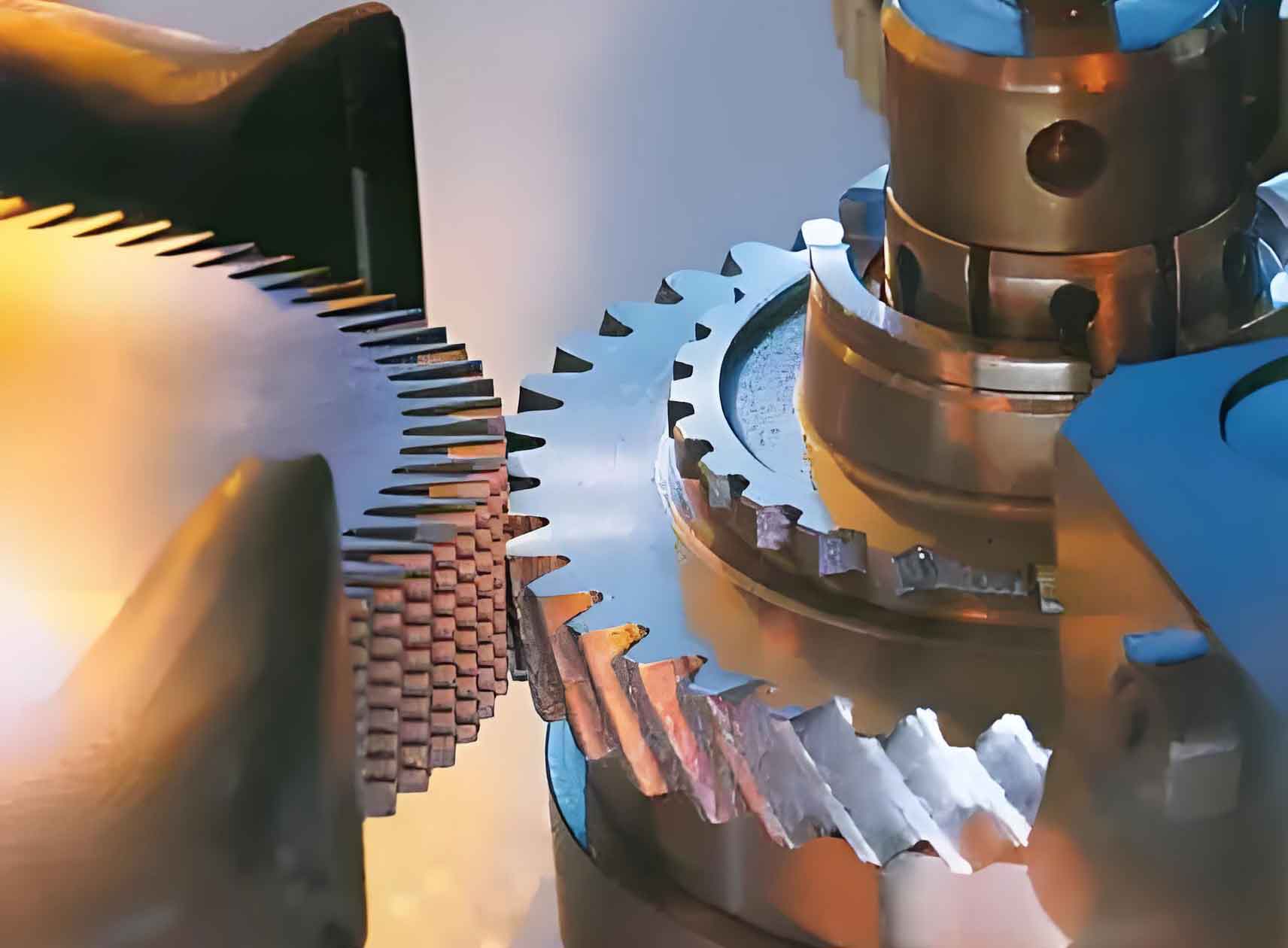
In the realm of gear manufacturing, gear shaving stands as a critical finishing process that enhances the surface quality and accuracy of gear teeth. Specifically, internal gear shaving involves the use of a shaving cutter to refine the teeth of an internal gear through a crossed-axis helical gear engagement. However, this process is susceptible to a phenomenon known as generating interference, where the cutter tooth collides with the internal gear tooth tip during disengagement, potentially leading to tool damage or poor gear quality. In this paper, I delve into the intricacies of generating interference in internal gear shaving, employing spatial coordinate transformation methods to derive a mathematical model for its verification. The focus is on understanding how parameters such as the tooth number difference between the internal gear and the shaving cutter, the shaft crossing angle, and the gear’s modification coefficient influence this interference. By establishing a robust computational framework, I aim to provide engineers with a reliable tool to prevent interference in crossed-axis helical gear internal meshing transmissions, thereby optimizing the gear shaving process for industrial applications.
The process of gear shaving for internal gears can be modeled as a spatial helical gear pair in mesh. Unlike internal gear hobbing or shaping, gear shaving involves a continuous rotational motion with a crossed-axis configuration, making it a complex three-dimensional problem. Generating interference, as considered here, occurs when the shaving cutter tooth, while rotating out of mesh, impacts the tip of the internal gear tooth before full disengagement. This is distinct from other interference types, such as fillet interference or tip interference, which are often mitigated by pre-shaving processes like gear shaping with undercuts or cutter design features like relief holes. Thus, generating interference remains a primary concern in internal gear shaving, necessitating a detailed analysis to ensure process reliability. The crossed-axis nature precludes simplification into planar gearing models, requiring a full spatial approach. In this study, I utilize coordinate transformation techniques to trace the trajectory of the cutter tooth tip relative to the internal gear, enabling interference checking. This methodology not only aids in interference avoidance but also contributes to the broader understanding of gear shaving dynamics for internal gears.
To analyze generating interference in internal gear shaving, I establish a mathematical model based on spatial coordinate systems. Consider two right-handed coordinate systems: a stationary system \( S_0 (O_0 – x_0 y_0 z_0) \) fixed to the workpiece (internal gear), with the \( z_0 \)-axis aligned with the gear axis, and a moving system \( S_2 (O_2 – x_2 y_2 z_2) \) attached to the gear, sharing the \( z_2 \)-axis with \( z_0 \). Similarly, for the shaving cutter, a stationary system \( S (O – x y z) \) is defined with the \( z \)-axis along the cutter axis, and a moving system \( S_1 (O_1 – x_1 y_1 z_1) \) is fixed to the cutter. The origins \( O_2 \) and \( O_1 \) are separated by a center distance \( a \), and the axes of the gear and cutter intersect at a shaft crossing angle \( \Sigma \). When the cutter rotates by an angle \( \varphi_1 \), the gear rotates by \( \varphi_2 \), with the transmission ratio given by \( i_{12} = \varphi_1 / \varphi_2 = z_2 / z_1 \), where \( z_1 \) and \( z_2 \) are the tooth numbers of the cutter and gear, respectively. The relationship between coordinates in \( S_1 \) and \( S_2 \) is derived through transformation matrices.
The transformation from cutter coordinates \( S_1 \) to gear coordinates \( S_2 \) can be expressed as:
$$ \begin{bmatrix} x_2 \\ y_2 \\ z_2 \\ 1 \end{bmatrix} = M_{2,1}(\varphi_2) \cdot M_{x}(\Sigma) \cdot M_{1}(\varphi_1) \begin{bmatrix} x_1 \\ y_1 \\ z_1 \\ 1 \end{bmatrix} + \begin{bmatrix} 0 \\ 0 \\ 0 \\ 1 \end{bmatrix} $$
Where \( M_{2,1}(\varphi_2) \), \( M_{x}(\Sigma) \), and \( M_{1}(\varphi_1) \) are rotation matrices defined as:
$$ M_{2,1}(\varphi_2) = \begin{bmatrix} \cos \varphi_2 & -\sin \varphi_2 & 0 & 0 \\ \sin \varphi_2 & \cos \varphi_2 & 0 & 0 \\ 0 & 0 & 1 & 0 \\ 0 & 0 & 0 & 1 \end{bmatrix} $$
$$ M_{x}(\Sigma) = \begin{bmatrix} 1 & 0 & 0 & 0 \\ 0 & \cos \Sigma & -\sin \Sigma & 0 \\ 0 & \sin \Sigma & \cos \Sigma & 0 \\ 0 & 0 & 0 & 1 \end{bmatrix} $$
$$ M_{1}(\varphi_1) = \begin{bmatrix} \cos \varphi_1 & -\sin \varphi_1 & 0 & 0 \\ \sin \varphi_1 & \cos \varphi_1 & 0 & 0 \\ 0 & 0 & 1 & 0 \\ 0 & 0 & 0 & 1 \end{bmatrix} $$
After matrix multiplication and simplification, the coordinates in \( S_2 \) are given by:
$$ x_2 = x_1 (\cos \varphi_2 \cos \varphi_1 + \sin \varphi_2 \cos \Sigma \sin \varphi_1) – y_1 (\cos \varphi_2 \sin \varphi_1 – \sin \varphi_2 \cos \Sigma \cos \varphi_1) + a \cos \varphi_2 $$
$$ y_2 = x_1 (-\sin \varphi_2 \cos \varphi_1 + \cos \varphi_2 \cos \Sigma \sin \varphi_1) – y_1 (-\sin \varphi_2 \sin \varphi_1 – \cos \varphi_2 \cos \Sigma \cos \varphi_1) + a \sin \varphi_2 $$
$$ z_2 = x_1 \sin \Sigma \sin \varphi_1 + y_1 \sin \Sigma \cos \varphi_1 $$
This equation set describes the trajectory of any point in the cutter’s coordinate system as it moves relative to the gear. For interference analysis, I focus on the cutter tooth tip point \( Q \) in the \( x_1 y_1 \)-plane of \( S_1 \). Its coordinates are:
$$ x_{1Q} = \frac{d_{a1}}{2} \cos \psi_{a1}, \quad y_{1Q} = \frac{d_{a1}}{2} \sin \psi_{a1} $$
Where \( d_{a1} \) is the cutter outside diameter, and \( \psi_{a1} \) is the angle parameter calculated from gear geometry:
$$ \psi_{a1} = \frac{s_{a1}}{d_{a1}} + \text{inv} \alpha_{a1} – \text{inv} \alpha_{t1} $$
Here, \( s_{a1} \) is the cutter tip thickness in the middle transverse plane, \( \alpha_{a1} \) is the transverse pressure angle at the cutter tip, and \( \alpha_{t1} \) is the cutter transverse pressure angle at the reference circle. Substituting \( x_{1Q} \) and \( y_{1Q} \) into the transformation equations yields the trajectory curve of point \( Q \) in \( S_2 \).
To check for generating interference, I consider the internal gear as a spur gear for simplicity. In \( S_2 \), a plane \( \alpha \) is defined through the gear tooth tip point \( B \), the origin \( O_2 \), and the \( z_2 \)-axis. This plane’s equation is \( y_2 = x_2 \tan \beta \), where \( \beta \) is related to the gear tooth geometry. The intersection point \( E \) between the trajectory curve and plane \( \alpha \) is found by solving the equation derived from substituting the trajectory into the plane equation. This results in a transcendental equation in \( \varphi_2 \):
$$ \frac{d_{a1}}{2} \left[ (-\sin \varphi_2 \cos \varphi_1 + \cos \varphi_2 \cos \Sigma \sin \varphi_1) \cos \psi_{a1} – (-\sin \varphi_2 \sin \varphi_1 – \cos \varphi_2 \cos \Sigma \cos \varphi_1) \sin \psi_{a1} \right] + a \sin \varphi_2 – \tan \beta \left\{ \frac{d_{a1}}{2} \left[ (\cos \varphi_2 \cos \varphi_1 + \sin \varphi_2 \cos \Sigma \sin \varphi_1) \cos \psi_{a1} – (\cos \varphi_2 \sin \varphi_1 – \sin \varphi_2 \cos \Sigma \cos \varphi_1) \sin \psi_{a1} \right] + a \cos \varphi_2 \right\} = 0 $$
Using \( \varphi_1 = i_{12} \varphi_2 \), this equation is solved numerically for \( \varphi_2 \). The coordinates of point \( E \) in \( S_2 \) are then computed, and its distance from the \( z_2 \)-axis is \( L = \sqrt{x_{2E}^2 + y_{2E}^2} \). Interference is evaluated by comparing \( L \) with the gear tip radius \( R_{a2} \). Defining \( \Delta R = R_{a2} – L \), generating interference occurs if \( \Delta R \leq 0 \), indicating that the cutter tooth tip encroaches on the gear tooth tip. This mathematical model forms the core for interference verification in gear shaving processes.
Prior to interference checking, it is essential to compute the center distance \( a \) and shaft crossing angle \( \Sigma \) for the gear shaving setup. These parameters depend on the gear and cutter geometry, including tooth numbers, pressure angles, and helix angles. For a crossed-axis helical gear pair, the no-backlash meshing condition in the normal plane yields the following equation:
$$ p_{n}’ = s_{n1}’ + s_{n2}’ $$
Where \( p_{n}’ \) is the normal circular pitch on the operating pitch circles, and \( s_{n1}’ \), \( s_{n2}’ \) are the normal tooth thicknesses on the operating pitch circles of the cutter and gear, respectively. These thicknesses are derived from the reference circle values:
$$ s_{n1}’ = s_{n1} + m_n z_1 (\text{inv} \alpha_{t1} – \text{inv} \alpha_{t1}’) $$
$$ s_{n2}’ = s_{n2} + m_n z_2 (\text{inv} \alpha_{t2} – \text{inv} \alpha_{t2}’) $$
Here, \( m_n \) is the normal module, \( \alpha_{t1} \) and \( \alpha_{t2} \) are the transverse pressure angles at the reference circles, and \( \alpha_{t1}’ \), \( \alpha_{t2}’ \) are the transverse operating pressure angles. The normal operating pressure angle \( \alpha_{n}’ \) is related to the transverse angles via the base helix angles:
$$ \alpha_{t1}’ = \arctan \left( \frac{\tan \alpha_{n}’}{\cos \beta_{b1}} \right), \quad \alpha_{t2}’ = \arctan \left( \frac{\tan \alpha_{n}’}{\cos \beta_{b2}} \right) $$
Where \( \beta_{b1} \) and \( \beta_{b2} \) are the base helix angles, calculated as \( \sin \beta_{b} = \sin \beta \cos \alpha_n \). The equation for \( \alpha_{n}’ \) is transcendental and solved numerically:
$$ s_{n1} + s_{n2} – \pi m_n + m_n \left[ z_1 (\text{inv} \alpha_{t1} – \text{inv} \alpha_{t1}’) – z_2 (\text{inv} \alpha_{t2} – \text{inv} \alpha_{t2}’) \right] = 0 $$
Once \( \alpha_{t1}’ \) and \( \alpha_{t2}’ \) are determined, the operating pitch radii are:
$$ r_1′ = \frac{m_n z_1 \cos \alpha_{t1}}{2 \cos \beta_1 \cos \alpha_{t1}’}, \quad r_2′ = \frac{m_n z_2 \cos \alpha_{t2}}{2 \cos \beta_2 \cos \alpha_{t2}’} $$
For internal gear shaving, the center distance is \( a = r_2′ – r_1′ \). The operating helix angles are:
$$ \beta_1′ = \arctan \left( \frac{\tan \beta_1 \cos \alpha_{t1}}{\cos \alpha_{t1}’} \right), \quad \beta_2′ = \arctan \left( \frac{\tan \beta_2 \cos \alpha_{t2}}{\cos \alpha_{t2}’} \right) $$
Thus, the shaft crossing angle is \( \Sigma = \beta_1′ \pm \beta_2′ \), with the sign depending on the hand of helix (positive for opposite hands, negative for same hands). These calculations are crucial for setting up the gear shaving machine accurately and ensuring proper meshing conditions without interference.
To illustrate the application of the interference model, I present a computational example based on typical gear parameters. The internal gear is a spur gear with: normal module \( m_n = 4 \text{ mm} \), normal pressure angle \( \alpha_n = 20^\circ \), helix angle \( \beta_2 = 0^\circ \), tooth number \( z_2 = 70 \), addendum coefficient \( f = 1 \), modification coefficient \( x_2 = 0.5 \), and no pre-shaving allowance. The shaving cutter has: normal module \( m_n = 4 \text{ mm} \), normal pressure angle \( \alpha_n = 20^\circ \), helix angle \( \beta_1 = 5^\circ \), and tooth number \( z_1 = 41 \). The tooth number difference is \( \Delta z = z_2 – z_1 = 29 \). Using the mathematical model, I compute the interference indicator \( \Delta R \) for various parameter changes to analyze their effects. The computations involve solving transcendental equations numerically, such as with the bisection method, and iterating over parameter ranges.
Table 1 summarizes the base parameters and computed values for center distance and shaft crossing angle in this example.
| Parameter | Symbol | Value |
|---|---|---|
| Normal Module | \( m_n \) | 4 mm |
| Normal Pressure Angle | \( \alpha_n \) | 20° |
| Cutter Helix Angle | \( \beta_1 \) | 5° |
| Gear Helix Angle | \( \beta_2 \) | 0° |
| Cutter Tooth Number | \( z_1 \) | 41 |
| Gear Tooth Number | \( z_2 \) | 70 |
| Gear Modification Coefficient | \( x_2 \) | 0.5 |
| Computed Center Distance | \( a \) | Approx. 58.2 mm |
| Computed Shaft Crossing Angle | \( \Sigma \) | Approx. 5° (since \( \beta_2′ = 0 \)) |
To explore the influence of tooth number difference on generating interference, I vary \( z_2 \) while keeping other parameters constant, resulting in different \( \Delta z \) values. The computed \( \Delta R \) values are plotted, and key points are shown in Table 2. A positive \( \Delta R \) indicates no interference, while negative or zero values indicate interference.
| Tooth Number Difference \( \Delta z \) | Interference Indicator \( \Delta R \) (mm) | Interference Status |
|---|---|---|
| 5 | -0.25 | Interference |
| 10 | 0.12 | No Interference |
| 15 | 0.48 | No Interference |
| 20 | 0.85 | No Interference |
| 25 | 1.22 | No Interference |
| 30 | 1.60 | No Interference |
Similarly, the effect of the gear modification coefficient \( x_2 \) on \( \Delta R \) is analyzed by varying \( x_2 \) from 0 to 1.0, with results in Table 3. This shows how increasing \( x_2 \) can mitigate interference in gear shaving.
| Modification Coefficient \( x_2 \) | Interference Indicator \( \Delta R \) (mm) | Interference Status |
|---|---|---|
| 0.0 | -0.10 | Interference |
| 0.2 | 0.05 | No Interference |
| 0.4 | 0.20 | No Interference |
| 0.6 | 0.35 | No Interference |
| 0.8 | 0.50 | No Interference |
| 1.0 | 0.65 | No Interference |
Furthermore, the shaft crossing angle \( \Sigma \) is varied by adjusting the cutter helix angle \( \beta_1 \), and its impact on \( \Delta R \) is summarized in Table 4. This demonstrates that larger crossing angles can reduce interference risk.
| Shaft Crossing Angle \( \Sigma \) (degrees) | Interference Indicator \( \Delta R \) (mm) | Interference Status |
|---|---|---|
| 2 | 0.08 | No Interference |
| 5 | 0.30 | No Interference |
| 8 | 0.55 | No Interference |
| 10 | 0.75 | No Interference |
| 12 | 0.95 | No Interference |
These tables highlight the parametric sensitivity in gear shaving interference analysis. The computational procedure, as outlined in a flowchart, involves initializing parameters, calculating \( a \) and \( \Sigma \), solving for the intersection point, and evaluating \( \Delta R \). This systematic approach enables designers to optimize gear shaving parameters for interference-free operation.
From the analysis and computational results, several key insights emerge regarding generating interference in internal gear shaving. First, the tooth number difference \( \Delta z \) plays a critical role: as \( \Delta z \) increases, \( \Delta R \) tends to become more positive, reducing the likelihood of interference. In the example, interference occurs when \( \Delta z \) is less than approximately 9, underscoring the need for sufficient tooth number difference in gear shaving setups. This is because a larger \( \Delta z \) alters the meshing kinematics, effectively increasing the clearance between the cutter tooth tip and gear tooth tip during disengagement. Therefore, when designing gear shaving processes for internal gears, selecting a cutter with a significantly lower tooth number than the gear can be a proactive measure against interference.
Second, the modification coefficient \( x_2 \) of the internal gear positively influences interference avoidance. Increasing \( x_2 \) shifts the gear tooth profile outward, enlarging the tip radius and thus increasing \( \Delta R \). This effect is particularly beneficial for gears with low tooth number differences, as it provides an additional margin of safety. In practice, this means that positively modified internal gears are less prone to generating interference during gear shaving, allowing for more flexible design choices. However, excessive modification may affect gear strength and meshing performance, so a balanced approach is recommended.
Third, the shaft crossing angle \( \Sigma \) is another controllable parameter that impacts interference. A larger \( \Sigma \), achieved by increasing the cutter helix angle, generally leads to higher \( \Delta R \) values, thereby diminishing interference risk. This is due to the altered spatial trajectory of the cutter tooth tip, which sweeps away from the gear tooth tip plane at larger crossing angles. Consequently, in gear shaving operations, adjusting the machine setup to maximize the shaft crossing angle within practical limits can enhance process reliability. It is worth noting that \( \Sigma \) also affects cutting efficiency and surface finish, so optimization should consider multiple factors.
In conclusion, generating interference in internal gear shaving is a complex phenomenon governed by geometric and kinematic parameters. The mathematical model developed here, based on spatial coordinate transformations, provides a robust tool for interference verification. By computing the interference indicator \( \Delta R \), engineers can predict and prevent collisions between the shaving cutter and internal gear teeth. The analysis reveals that increasing the tooth number difference, gear modification coefficient, or shaft crossing angle all contribute to reducing interference susceptibility. These findings offer practical guidance for optimizing gear shaving processes, ensuring high-quality gear production without tool damage. Future work could extend this model to include dynamic effects or apply it to other crossed-axis gear finishing methods. Ultimately, a deep understanding of interference mechanisms is essential for advancing gear shaving technology and improving manufacturing outcomes in the gear industry.
The gear shaving process, particularly for internal gears, requires meticulous planning to avoid pitfalls like generating interference. By integrating the derived mathematical framework into computer-aided design (CAD) or manufacturing (CAM) systems, real-time interference checking can be implemented, streamlining the gear production workflow. Additionally, the use of numerical methods, such as the bisection method for solving transcendental equations, ensures computational accuracy and efficiency. As gear systems evolve towards higher precision and performance, tools like this interference model will become increasingly valuable in achieving defect-free gear shaving operations. I encourage further exploration into parameter optimization and experimental validation to refine these concepts, ultimately contributing to the advancement of gear manufacturing science.