
In the realm of automotive drivetrain systems, hyperboloid gears, often referred to as hypoid gears, play a pivotal role in transmitting power between non-intersecting axes, particularly in drive axles. These gears are critical components that influence vehicle performance, efficiency, and noise-vibration-harshness (NVH) characteristics. As demands for higher comfort and precision in automotive applications escalate, the accuracy of hyperboloid gear tooth surfaces becomes paramount. However, during manufacturing, inevitable errors arise due to factors such as machine tool inaccuracies, elastic deformations, installation misalignments, and thermal effects. These errors manifest as deviations between the actual machined tooth surface and the designed theoretical surface, potentially leading to increased noise, vibration, and reduced lifespan. Therefore, developing effective methods to correct these flank errors by adjusting machine setting parameters is essential for achieving high-quality hyperboloid gears. This paper presents a novel flank error correction method for hyperboloid gears based on regression analysis, which addresses limitations in traditional approaches by selectively adjusting fewer parameters with minimized adjustments, thereby enhancing correction efficacy and practicality in real-world manufacturing.
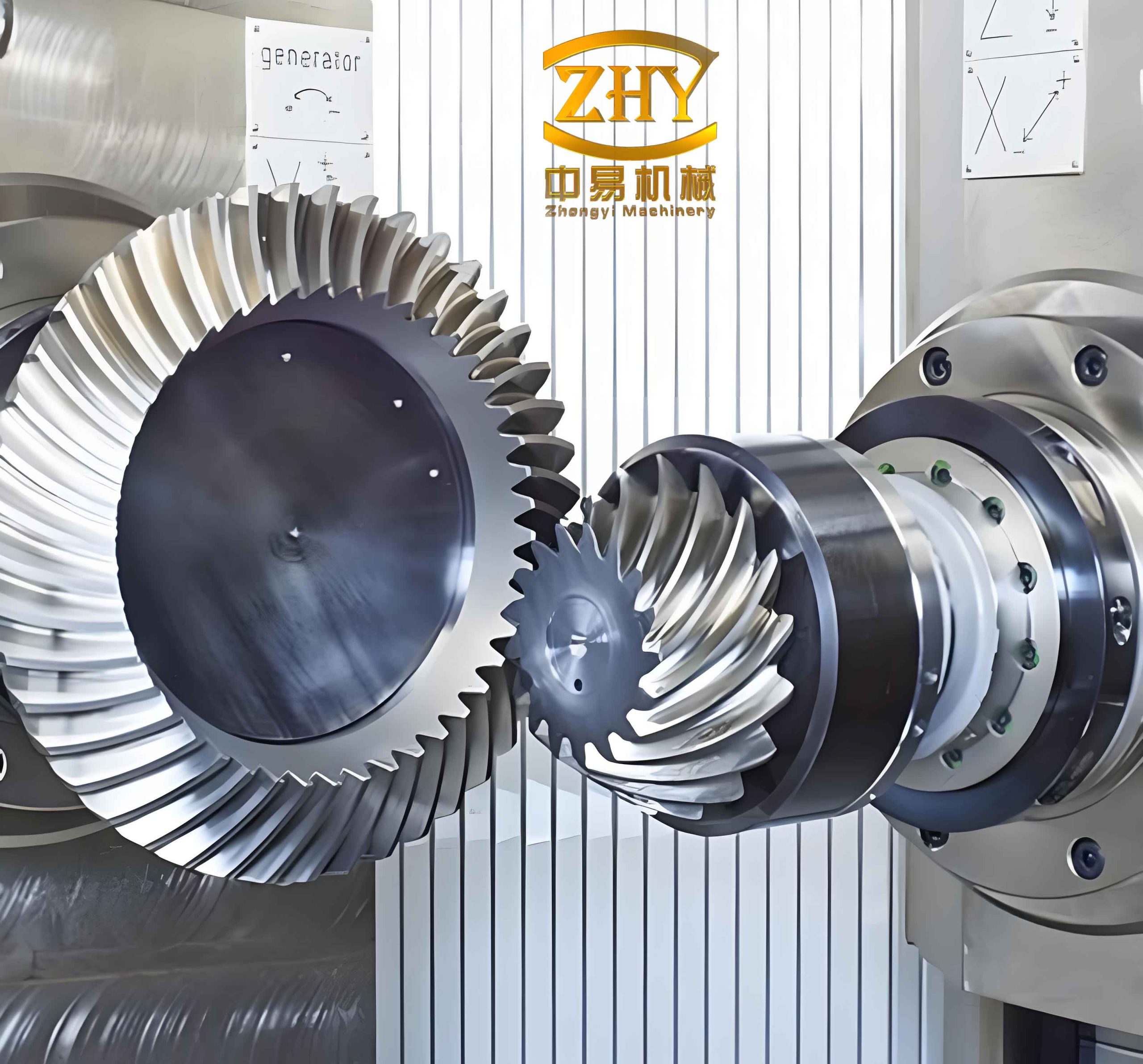
The manufacturing of hyperboloid gears typically employs complex methods such as the hypoid-format-tilt (HFT) process, which involves intricate relative motions between the cutter and gear blank. The tooth surface geometry is mathematically derived from these motions, and any deviations in machine settings can lead to significant flank errors. Traditional correction methods often rely on sensitivity coefficient matrices that relate machine parameter changes to flank errors, but they frequently adjust all parameters simultaneously, ignoring coupling effects and leading to suboptimal results. In practice, engineers usually adjust only 2–3 parameters based on experience, but selecting the most influential parameters remains challenging. This work introduces a regression-based approach that analyzes the linear correlation between sensitivity vectors of machine parameters and measured error vectors, enabling intelligent variable selection and reduced adjustment magnitudes. Through theoretical derivation and experimental validation, this method demonstrates superior performance in correcting flank errors for hyperboloid gears, offering a robust framework for gear manufacturing optimization.
Mathematical Modeling of Hyperboloid Gear Tooth Surfaces
The tooth surface of a hyperboloid gear is generated through a series of coordinated movements between the cutting tool and the gear blank. For the HFT method, which is commonly used for Gleason-type spiral bevel gears, the process involves separate machining of convex and concave sides. To formulate the tooth surface, we establish coordinate systems representing the machine, cutter, and gear blank. Let \( O_m \), \( O_c \), and \( O_g \) denote the origins of the machine, cutter, and gear blank coordinate systems, respectively. The relative position and orientation are defined by machine setting parameters such as horizontal wheel position \( X_p \), vertical wheel position \( E_m \), machine root angle \( \delta_m \), radial distance \( S \), angular position \( q \), cutter rotation angle \( j \), cutter tilt angle \( i \), machine ratio \( i_{pc} \), cutter radius \( r_c \), and cutter blade angle \( \alpha_c \).
Using coordinate transformations and vector calculus, the tooth surface equation in the gear blank coordinate system can be derived. The surface is parameterized by two variables, \( \theta \) and \( \phi \), which correspond to the cutter surface and motion parameters, respectively. The position vector \( \mathbf{r} \) and unit normal vector \( \mathbf{n} \) of any point on the tooth surface are expressed as:
$$
\mathbf{r} = \mathbf{r}(\theta, \phi, \zeta_j), \quad \mathbf{n} = \mathbf{n}(\theta, \phi, \zeta_j), \quad j = 1, 2, \dots, 11,
$$
where \( \zeta_j \) represents the machine setting parameters. The meshing condition, \( \mathbf{v}_{pc} \cdot \mathbf{n}_{pc} = 0 \) (the relative velocity between cutter and blank dotted with the normal vector equals zero), is incorporated to ensure conjugate action. This equation forms the basis for calculating theoretical tooth surfaces and analyzing errors.
Discretization and Flank Error Definition
To quantify flank errors, the tooth surface is discretized into a grid of points for comparison between designed and actual surfaces. Typically, the surface is projected onto an axial plane, and a grid of 9 points along the lengthwise direction and 5 points along the profile direction is defined, resulting in 45 points per flank. The coordinates of these grid points in the projection plane, \( x_g \) and \( y_g \), are related to the surface parameters via:
$$
x_g = -\mathbf{r} \cdot \mathbf{p}, \quad y_g = |\mathbf{r} \times \mathbf{p}|,
$$
where \( \mathbf{p} \) is the unit vector along the gear axis. By solving these equations iteratively with the tooth surface equations, the spatial coordinates and normal vectors for each grid point are obtained.
The actual tooth surface is measured using gear inspection equipment such as a coordinate measuring machine (CMM) or dedicated gear tester. For each grid point \( i \), the flank error \( e_i \) is defined as the distance between the measured point \( \mathbf{r}_{\text{real},i} \) and the theoretical point \( \mathbf{r}_i \) along the theoretical normal direction \( \mathbf{n}_i \):
$$
e_i = (\mathbf{r}_{\text{real},i} – \mathbf{r}_i) \cdot \mathbf{n}_i, \quad i = 1, 2, \dots, 45.
$$
The error vector for the entire flank is then:
$$
\mathbf{e} = [e_1, e_2, \dots, e_{45}]^T.
$$
To account for pitch deviations, the errors are often adjusted by rotating the measured surface so that the error at the midpoint is zero. Additionally, averaging errors over multiple teeth reduces random measurement noise.
Sensitivity Analysis and Traditional Correction Method
The influence of machine setting parameters on flank errors is characterized by sensitivity coefficients. When a parameter \( \zeta_j \) is perturbed by a small amount \( \Delta \zeta_j \), while keeping others constant, the induced error vector \( \boldsymbol{\varepsilon}_j \) is approximated linearly as:
$$
\boldsymbol{\varepsilon}_j \approx \frac{\partial \mathbf{e}}{\partial \zeta_j} \Delta \zeta_j.
$$
The sensitivity coefficient vector \( \mathbf{s}(\zeta_j) \) for parameter \( \zeta_j \) is computed via finite difference:
$$
\mathbf{s}(\zeta_j) = \frac{\boldsymbol{\varepsilon}_j(d\zeta_j)}{d\zeta_j},
$$
where \( d\zeta_j \) is a small perturbation (e.g., 0.001 mm or 0.01°). Assembling these vectors into a matrix yields the sensitivity matrix \( \mathbf{S} \):
$$
\mathbf{S} = [\mathbf{s}(\zeta_1), \mathbf{s}(\zeta_2), \dots, \mathbf{s}(\zeta_{11})].
$$
In traditional correction methods, the adjustment vector \( \mathbf{d} = [d_1, d_2, \dots, d_{11}]^T \) for all parameters is obtained by solving a least-squares problem to minimize the residual errors:
$$
\min_{\mathbf{d}} \| \mathbf{S} \mathbf{d} + \mathbf{e} \|_2.
$$
This approach assumes linear independence and ignores coupling effects between parameters, which can lead to large adjustments and reduced accuracy when multiple parameters are changed simultaneously. For hyperboloid gears, this often results in impractical corrections and requires iterative trials.
Regression-Based Correction Method for Hyperboloid Gears
To overcome these limitations, a regression-based correction method is proposed. This method selects a subset of machine parameters for adjustment based on their linear correlation with the measured error vector, thereby minimizing the number of adjustments and their magnitudes. The process involves the following steps:
- Linear Regression Analysis: For each machine parameter \( \zeta_j \), perform a simple linear regression between its sensitivity vector \( \mathbf{s}(\zeta_j) \) and the error vector \( \mathbf{e} \). Solve for the coefficient \( \alpha_j \) that minimizes:
$$
\min_{\alpha_j} \| \mathbf{e} + \alpha_j \mathbf{s}(\zeta_j) \|_2.
$$
The coefficient of determination \( R^2_j \) is computed to assess the linear fit. A higher \( R^2 \) indicates stronger correlation, meaning the parameter’s sensitivity pattern aligns well with the observed errors. - Variable Selection: Select the parameter \( \zeta_f \) with the highest \( R^2 \) value as the first adjustment variable. If the residual error after this single-variable regression meets the tolerance criteria (e.g., maximum error < 10 μm), then \( \zeta_f \) is the only adjusted parameter with adjustment amount \( \alpha_f \). Otherwise, proceed to multi-variable selection.
- Iterative Expansion: For the second round, consider pairs \( (\zeta_f, \zeta_j) \) with \( j \neq f \), and perform multiple linear regression to solve:
$$
\min_{\alpha_f, \alpha_j} \| \mathbf{e} + \alpha_f \mathbf{s}(\zeta_f) + \alpha_j \mathbf{s}(\zeta_j) \|_2.
$$
Again, select the pair with the highest \( R^2 \). Continue this process, adding one variable at a time, until either the residual error is acceptable or a preset maximum number of variables (e.g., 3) is reached. - Adjustment Calculation: The final adjustment amounts for the selected parameters are obtained from the regression coefficients. This approach ensures that only the most relevant parameters for the specific error pattern are adjusted, with minimal changes.
The advantages of this method for hyperboloid gears include reduced parameter coupling issues, smaller adjustment magnitudes, and improved practicality in manufacturing settings. By focusing on parameters that are linearly correlated with errors, the method effectively compensates for flank deviations while maintaining process stability.
Experimental Validation and Results
To validate the regression-based method, experiments were conducted on a hypoid gear set manufactured using the HFT process. The gear basic parameters are summarized in Table 1.
| Parameter | Value | Parameter | Value |
|---|---|---|---|
| Number of teeth (gear) | 37 | Number of teeth (pinion) | 9 |
| Module | 11.49 mm | Gear face width | 61 mm |
| Offset distance | 26 mm | Shaft angle | 90° |
| Pinion spiral angle | 43.65° | Mean pressure angle | 22.5° |
| Gear pitch angle | 73.87° | Pinion pitch angle | 15.99° |
The pinion was machined on a five-axis CNC grinder (model YKE2060A), with initial machine settings for concave and convex sides as shown in Table 2. Flank errors were measured using a gear inspection center, averaging over several teeth. The initial error vectors had maximum magnitudes of 49.6 μm for the concave side and 44 μm for the convex side, indicating significant deviations.
| Machine Parameter | Concave Side | Convex Side |
|---|---|---|
| Angular position \( q \) (°) | 60.3220 | 60.7954 |
| Vertical wheel position \( E_m \) (mm) | 18.0000 | 34.0000 |
| Horizontal wheel position \( X_p \) (mm) | 0.7360 | 3.5325 |
| Machine root angle \( \delta_m \) (°) | -4.5273 | -6.2152 |
| Radial distance \( S \) (mm) | 151.2363 | 165.7187 |
| Machine ratio \( i_{pc} \) | 5.4328 | 5.7153 |
| Bed position \( X_B \) (mm) | 14.1914 | 29.7285 |
| Cutter rotation angle \( j \) (°) | 151.1859 | 318.1273 |
| Cutter tilt angle \( i \) (°) | -17.6359 | 17.5129 |
| Cutter radius \( r_c \) (mm) | 149.0029 | 159.1733 |
| Cutter blade angle \( \alpha_c \) (°) | 20.0000 | 25.0000 |
For correction, two methods were compared: the traditional full-parameter adjustment (using 8 parameters, excluding cutter radius and blade angle as they are costly to change) and the proposed regression-based method (limiting to 3 parameters). The computed adjustments are listed in Table 3.
| Correction Method | Adjusted Parameters and Values | Concave Side | Convex Side |
|---|---|---|---|
| Traditional Method | Vertical wheel position \( \Delta E_m \) (mm) | -7.1497 | -6.3393 |
| Horizontal wheel position \( \Delta X_p \) (mm) | 1.7025 | 0.3502 | |
| Machine root angle \( \Delta \delta_m \) (°) | 0.7632 | -0.2455 | |
| Radial distance \( \Delta S \) (mm) | -1.2738 | -5.3630 | |
| Machine ratio \( \Delta i_{pc} \) | -0.0887 | -0.0411 | |
| Bed position \( \Delta X_B \) (mm) | -14.3924 | 5.8067 | |
| Cutter rotation angle \( \Delta j \) (°) | 0.4889 | -4.3320 | |
| Cutter tilt angle \( \Delta i \) (°) | -0.4151 | 0.0822 | |
| Regression-Based Method | Radial distance \( \Delta S \) (mm) | 0.2951 | 0.4410 |
| Bed position \( \Delta X_B \) (mm) | -1.9655 | — | |
| Cutter tilt angle \( \Delta i \) (°) | -0.0150 | — | |
| Horizontal wheel position \( \Delta X_p \) (mm) | — | 0.0781 | |
| Machine root angle \( \Delta \delta_m \) (°) | — | -0.2014 |
The theoretical residual errors \( \boldsymbol{\sigma}_{\text{theory}} \) after applying these adjustments were computed using the sensitivity model, and the actual corrected errors \( \boldsymbol{\sigma}_{\text{correct}} \) were estimated by summing the initial errors and the induced changes from adjustments. The results, in terms of maximum absolute error and root-mean-square (RMS) error, are presented in Table 4.
| Correction Method | Error Metric | Concave Side | Convex Side |
|---|---|---|---|
| Traditional Method | Max absolute error (μm) | 15.4 | 4.6 |
| RMS error (μm) | 8.9 | 2.0 | |
| Regression-Based Method | Max absolute error (μm) | 3.4 | 4.9 |
| RMS error (μm) | 1.5 | 2.2 |
The regression-based method achieved residual errors below 5 μm for both sides, meeting the industrial tolerance of 10 μm, while the traditional method yielded a maximum error of 15.4 μm for the concave side, indicating inadequate correction due to parameter coupling. The selected parameters required smaller adjustments, enhancing practicality. To further validate, the adjusted parameters were applied to machine new hyperboloid gear samples. Post-correction measurements showed maximum flank errors of 7.7 μm (concave) and 6.4 μm (convex), confirming the effectiveness of the regression-based approach for hyperboloid gear manufacturing.
Discussion and Implications
The regression-based correction method offers several advantages for hyperboloid gears. First, by leveraging linear correlation analysis, it identifies the most influential machine parameters for a given error pattern, reducing the number of adjustments and minimizing coupling effects. This is particularly beneficial for hyperboloid gears, where parameter interactions are complex due to the hypoid geometry. Second, the method requires smaller adjustment magnitudes, which decreases the risk of introducing new errors from large parameter changes and aligns with practical shop-floor constraints. Third, the approach is generalizable to other gear types and machining processes, such as spiral bevel or face gear manufacturing, by adapting the sensitivity vectors and error definitions.
Mathematically, the method can be extended to nonlinear regression if sensitivity relationships are not strictly linear, though for small errors, linear approximation suffices. The selection criterion based on \( R^2 \) ensures that parameters with similar sensitivity patterns to the error vector are prioritized, which is crucial for hyperboloid gears where errors often exhibit specific trends like bias or twist. Additionally, the iterative variable selection process can be automated, making it suitable for computer-aided manufacturing (CAM) systems for hyperboloid gears.
In terms of implementation, the method requires accurate sensitivity coefficients, which can be pre-computed via simulation or experimental calibration. For hyperboloid gears, factors like cutter wear or machine stiffness may affect sensitivities, so periodic updates are recommended. The regression analysis also provides insights into error sources; for example, if parameters like radial distance or bed position are frequently selected, it may indicate systematic issues in the machining setup for hyperboloid gears.
Conclusion
This paper presents a robust flank error correction method for hyperboloid gears based on regression analysis. By analyzing the linear correlation between machine parameter sensitivity vectors and measured error vectors, the method intelligently selects a subset of parameters for adjustment, thereby reducing the number of changes and their magnitudes compared to traditional full-parameter approaches. Theoretical derivations and experimental validations on a hypoid gear set demonstrate that the regression-based method achieves residual errors within 5 μm, outperforming traditional methods that suffer from coupling effects. The approach enhances the manufacturability and precision of hyperboloid gears, which are critical components in automotive and industrial applications. Future work may explore integration with real-time monitoring systems, adaptive learning for sensitivity updates, and application to other complex gear geometries. Overall, this method provides a practical and effective solution for improving the quality of hyperboloid gears through data-driven correction strategies.