
The design and manufacturing of hyperboloid gear sets, particularly for automotive final drive applications, present a classic engineering trade-off. While renowned for their high load capacity, smooth operation, and compact design enabling lower vehicle centers of gravity, the pursuit of optimal performance often involves balancing conflicting objectives. Reducing the physical volume of the gear set directly lowers material costs and weight, contributing to overall vehicle efficiency. Simultaneously, minimizing transmission noise is paramount for passenger comfort and meeting stringent NVH (Noise, Vibration, and Harshness) standards. Traditional design methods, which often rely on empirical experience to select key parameters, may yield functional gears but frequently fail to achieve the Pareto-optimal balance between these competing goals of minimal size and minimal noise. This article details a systematic approach, employing a state-of-the-art multi-objective genetic algorithm, to establish and solve the mathematical model for optimizing hyperboloid gear pairs, with a focus on minimizing gear pair volume and meshing noise.
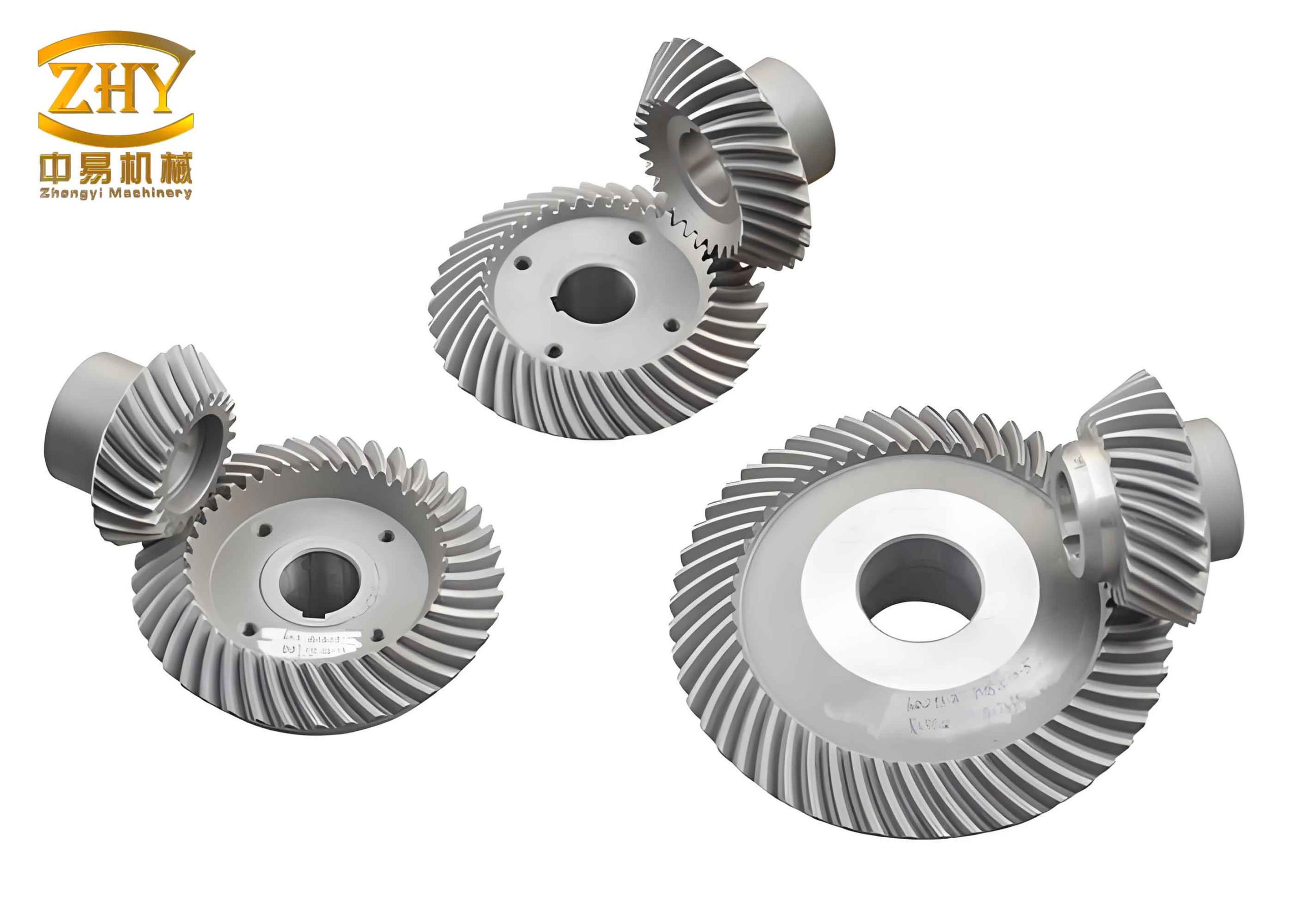
Hyperboloid gears, also commonly referred to as hypoid gears, are central components in automotive drive axles. Their defining characteristic is the offset between the pinion and gear axes, which allows for a lower pinion position and consequently a lower vehicle profile. The complex geometry involves conjugate tooth surfaces with a combination of rolling and sliding motions, necessitating precise design to ensure proper contact patterns, strength, and quiet operation. A typical model of a hyperboloid gear pair is shown below.
The core challenge in moving beyond traditional design is formulating the problem mathematically. A successful optimization model requires a careful selection of independent design variables, the definition of objective functions that accurately represent our goals (volume and noise), and the establishment of practical constraints based on mechanical, manufacturing, and geometric limitations.
1. Formulation of the Optimization Model for Hyperboloid Gears
1.1 Selection of Design Variables
For a given gear ratio and within typical automotive design boundaries, several key parameters can be independently varied to influence both size and acoustic performance. Based on the functional relationships within the volume and noise calculations, we select five primary design variables. These variables, which form the vector that the optimization algorithm will manipulate, are:
$$
\mathbf{X} = [z_1, \ d_{e2}, \ b_2, \ E, \ \beta_{m2}]^T
$$
Where:
- $z_1$: Number of teeth on the pinion.
- $d_{e2}$: Outer pitch diameter of the gear (larger member).
- $b_2$: Face width of the gear.
- $E$: Offset distance between the pinion and gear axes.
- $\beta_{m2}$: Spiral angle at the mean point of the gear tooth.
The pinion face width $b_1$ is typically derived from $b_2$ and other geometric relations, and the gear tooth number $z_2$ is determined by the fixed ratio and $z_1$. Therefore, the vector $\mathbf{X}$ effectively controls the major geometric footprint and meshing characteristics of the hyperboloid gear pair.
1.2 Definition of Objective Functions
We establish two distinct objective functions to be minimized.
Objective 1: Minimization of Gear Pair Volume. A simplified yet effective model for estimating the overall material volume of the gear pair involves approximating both the pinion and the gear as truncated cones. The total volume $V$ is the sum of the volumes of the pinion ($V_1$) and the gear ($V_2$). The objective function is:
$$
\min F_1(\mathbf{X}) = V_1 + V_2 = \frac{\pi}{4} \left[ b_1 \left( d_{e1}^2 – 2 d_{e1} b_1 \sin \delta_1 + \frac{4}{3} b_1^2 \sin^2 \delta_1 \right) \cos \delta_1 \right] + \frac{\pi}{4} \left[ b_2 \left( d_{e2}^2 – 2 d_{e2} b_2 \sin \delta_2 + \frac{4}{3} b_2^2 \sin^2 \delta_2 \right) \cos \delta_2 \right]
$$
Here, $\delta_1$ and $\delta_2$ are the pitch angles of the pinion and gear, respectively, and $d_{e1}$ is the outer pitch diameter of the pinion, all of which are functions of the primary design variables (e.g., $d_{e1} = d_{e2} / i$, where $i$ is the gear ratio). Minimizing $F_1(\mathbf{X})$ directly reduces material usage and weight.
Objective 2: Minimization of Meshing Noise. The acoustic performance of gears is closely linked to the smoothness of the torque transfer, which is influenced by the contact ratio. Research indicates that a transverse contact ratio approaching 2 promotes the most uniform load distribution and minimal excitation, thereby reducing noise. Therefore, we formulate our second objective to drive the design towards this optimal contact condition. The function is based on the absolute deviation of the calculated transverse contact ratio $\varepsilon_{F}$ from the ideal value of 2:
$$
\min F_2(\mathbf{X}) = | 2 – \varepsilon_{F} |
$$
For hyperboloid gears, the transverse contact ratio can be approximated by a function involving the mean spiral angle $\beta_m$, the outer transverse module $m_t$, and the pitch cone distance $A_0$. A common formulation is:
$$
\varepsilon_{F} \approx \left( k_2 \tan \beta_m – \frac{k_3^2}{3} \tan^3 \beta_m \right) \frac{A_0}{\pi m_t}
$$
Where $k_2$ and $k_3$ are coefficients related to the gear geometry (often derived from tooth geometry factors). By minimizing $F_2(\mathbf{X})$, we inherently push the design towards quieter operation.
1.3 Establishment of Constraint Functions
The design space defined by the variables must be bounded by practical engineering constraints to ensure the resulting hyperboloid gear is manufacturable, strong, and functional.
| Constraint Category | Mathematical/Descriptive Form | Engineering Rationale |
|---|---|---|
| Gear Tooth Numbers | $5 \leq z_1 \leq 12$; $z_2 \geq 30$; $40 \leq z_1 + z_2 \leq 60$ | Prevents undercutting on the pinion, ensures smooth meshing, and maintains optimal transmission stability. |
| Offset Distance | $0.1 \cdot d_{e2} \leq E \leq 0.2 \cdot d_{e2}$ | Limits excessive sliding velocity to avoid scuffing and excessive wear, while maintaining the compactness advantage. |
| Gear Face Width | $4 m_t \leq b_2 \leq 10 m_t$ | Ensures adequate load capacity without causing significant manufacturing difficulties or load concentration at the ends. |
| Mean Spiral Angle | $30^\circ \leq \beta_m \leq 50^\circ$ | Balances high contact ratio (favoring larger angles) with manageable axial thrust forces (favoring smaller angles). |
| Contact Strength | $S_H \geq S_{Hmin}$ | Ensures the calculated contact stress safety factor meets or exceeds the minimum allowable value to prevent surface pitting. |
| Bending Strength | $S_F \geq S_{Fmin}$ | Ensures the calculated root bending stress safety factor meets or exceeds the minimum allowable value to prevent tooth breakage. |
The strength constraints $S_H$ and $S_F$ are typically calculated using standardized methods (e.g., AGMA or Gleason formulae), which are functions of the design variables, material properties, and applied load torque.
2. Solution via the NSGA-II Multi-Objective Genetic Algorithm
Our problem is a true multi-objective optimization (MOO) problem. Unlike single-objective problems, there is no single “best” solution that simultaneously minimizes both volume $F_1$ and noise deviation $F_2$. Improving one objective often degrades the other. The solution to such a problem is not a single point but a set of points known as the Pareto-optimal front. Each point on this front represents a design where no objective can be improved without worsening at least one other objective.
We employ the Non-dominated Sorting Genetic Algorithm II (NSGA-II), a powerful and widely used elitist MOO algorithm. Its superiority lies in three key features compared to its predecessor and other methods:
- Fast Non-dominated Sorting: It efficiently ranks the population of candidate solutions (designs) into successive fronts of non-domination (Pareto fronts).
- Crowding Distance Estimation: It measures the density of solutions surrounding a particular point in the objective space. This metric helps maintain diversity along the Pareto front by favoring solutions in less crowded regions.
- Elitist Selection Strategy: It combines the current population with the best candidates (elites) from previous generations, ensuring that good solutions are never lost.
The algorithm iteratively evolves a population of designs through selection, crossover, and mutation operations, guided by the non-dominated rank and crowding distance. This process steers the population towards the true Pareto-optimal front over many generations. The workflow is as follows:
Step 1: Initialize a random parent population $P_t$ of size $N$.
Step 2: Evaluate objectives and constraints for all individuals in $P_t$.
Step 3: Create an offspring population $Q_t$ from $P_t$ using selection, crossover, and mutation.
Step 4: Combine parent and offspring populations to form $R_t = P_t \cup Q_t$ (size $2N$).
Step 5: Perform fast non-dominated sorting on $R_t$ and identify Pareto fronts $F_1, F_2, …$
Step 6: Fill the new parent population $P_{t+1}$ with individuals from the best fronts. If adding a whole front $F_i$ would exceed $N$, select the most diverse individuals from $F_i$ using the crowding distance metric.
Step 7: Repeat from Step 3 until a termination criterion (e.g., max generations) is met.
For our specific problem, we implement the model using MATLAB’s `gamultiobj` solver, which is based on a controlled, elitist genetic algorithm (a variant of NSGA-II). Key parameters are set to ensure a thorough search: a population size of 150, a maximum of 1000 generations, a Pareto fraction of 0.7 (meaning 70% of the population is kept on the Pareto front), and stringent function tolerance.
3. Optimization Case Study and Results
To demonstrate the efficacy of the proposed method, we apply it to the optimization of a hyperboloid gear pair for a light vehicle final drive. The baseline design parameters, obtained through conventional empirical methods, are as follows:
| Parameter | Symbol | Baseline Value |
|---|---|---|
| Gear Ratio | $i$ | 4.1 |
| Pinion Teeth | $z_1$ | 10 |
| Gear Outer Diameter | $d_{e2}$ | 200.0 mm |
| Gear Face Width | $b_2$ | 30.0 mm |
| Offset | $E$ | 20.0 mm |
| Gear Mean Spiral Angle | $\beta_{m2}$ | 37.14° |
The `gamultiobj` algorithm is executed with the mathematical model described in Sections 1 and 2. After convergence, the algorithm outputs a set of Pareto-optimal solutions. The distribution of these solutions in the objective space ($F_1$ vs. $F_2$) forms the Pareto front, visualized in the plot below. Each point on this front is a viable optimal design, representing a different compromise between volume and noise.
Analysis of the Pareto Front: The front exhibits a clear trade-off relationship. Points on the upper-left region represent designs with lower noise (contact ratio closer to 2) but at the expense of a larger gear pair volume. Conversely, points on the lower-right region achieve a very compact design (small volume) but with a contact ratio further from the ideal, implying potentially higher noise. The designer’s task is now to select the most appropriate point from this set based on specific program priorities (e.g., stringent cost target vs. premium NVH target).
For the purpose of this case study, we select a solution that offers a balanced improvement, particularly one where the noise metric $F_2$ is better (smaller) than the baseline. A point near $F_2 \approx 0.05$ (meaning $\varepsilon_F \approx 1.95$) is chosen. The optimized design parameters and a comparison of the key performance metrics are shown below.
| Design Method / Metric | Baseline (Empirical) Design | Optimized Design (NSGA-II) | Percentage Change |
|---|---|---|---|
| Pinion Teeth, $z_1$ | 10 | 10 | 0% |
| Gear Outer Diameter, $d_{e2}$ (mm) | 200.00 | 196.99 | -1.5% |
| Offset, $E$ (mm) | 20.00 | 19.72 | -1.4% |
| Gear Face Width, $b_2$ (mm) | 30.00 | 26.13 | -12.9% |
| Gear Spiral Angle, $\beta_{m2}$ (°) | 37.14 | 38.51 | +3.7% |
| Gear Pair Volume, $V$ ($\times 10^5$ mm³) | 2.8324 | 2.4725 | -12.7% |
| Transverse Contact Ratio, $\varepsilon_{F}$ | 2.1552 | 1.9532 | – |
| Noise Objective, $F_2 = |2 – \varepsilon_{F}|$ | 0.1552 | 0.0468 | -69.8% |
The results are compelling. The NSGA-II algorithm successfully found a design that significantly improves upon the empirically derived baseline:
- Volume Reduction: The total gear pair volume was reduced by 12.7%. This translates directly to material savings, lower weight, and potentially reduced inertia.
- Noise Improvement: The primary noise-related metric, $F_2$, was reduced dramatically by nearly 70%. The contact ratio of the optimized design (1.9532) is substantially closer to the theorized optimum of 2 than the baseline design (2.1552), predicting smoother and quieter meshing action.
- Design Changes: The optimization achieved this by subtly adjusting several parameters: slightly reducing the gear diameter and offset, more significantly reducing the face width (which strongly impacts volume), and increasing the spiral angle (which helps increase the contact ratio to compensate for the reduced face width and move it towards the optimal value). All changes remained well within the prescribed practical constraints.
4. Conclusion
This study demonstrates a robust and effective framework for the multi-objective optimal design of hyperboloid gear pairs. By formulating the competing goals of minimizing volume and minimizing noise into a proper mathematical model with precise design variables, objective functions, and practical constraints, and by employing the advanced NSGA-II genetic algorithm to solve it, we move decisively beyond traditional rule-of-thumb design practices.
The case study provides clear evidence of the method’s value. Compared to an empirically designed baseline, the optimized hyperboloid gear design achieved a significant reduction in material volume (12.7%) alongside a predicted major improvement in meshing quietness (noise metric reduced by ~70%). This Pareto-optimal solution represents a superior balance of cost and performance. The ability of the algorithm to explore a vast design space and present a set of valid optimal trade-offs empowers the engineer to make informed decisions based on specific project priorities. This methodology is not limited to hyperboloid gears but can be readily adapted and applied to the optimization of other complex mechanical transmission components, such as spiral bevel gears, cylindrical gears, or planetary gear sets, wherever multiple, conflicting performance criteria must be balanced.