
In the field of gear design, hyperboloid gears, also known as hypoid gears, play a crucial role in transmitting motion between non-intersecting and non-parallel axes. These gears are widely used in automotive differentials, industrial machinery, and aerospace applications due to their ability to handle high loads and provide smooth operation. However, calculating the geometric parameters of hyperboloid gears has traditionally been challenging, often relying on approximate methods that introduce mathematical model errors. In this article, I present a novel approach to computing these parameters, which eliminates such errors and offers a more intuitive and precise framework for engineers and designers. This new method focuses on improving the calculation of the reference cone surfaces for both gears and the specific geometric parameters for the pinion, making it easier to master and apply in practical scenarios.
The traditional methods, such as those used by Gleason Corporation, involve complex and approximate formulas that can lead to inconsistencies, particularly in ensuring the correct spiral angle at the pinion’s midpoint. My proposed method addresses these issues by employing exact mathematical relationships derived from the fundamental theory of gear meshing. By doing so, it ensures that all parameters, including the spiral angles, cone angles, and radii, are calculated with high accuracy. Throughout this discussion, I will emphasize the importance of hyperboloid gears in modern engineering and demonstrate how this new method enhances their design and manufacturing. To illustrate the application, I will include numerous formulas and tables, all presented in English and using LaTeX syntax for clarity. Additionally, I have integrated a visual representation of hyperboloid gears to aid understanding.
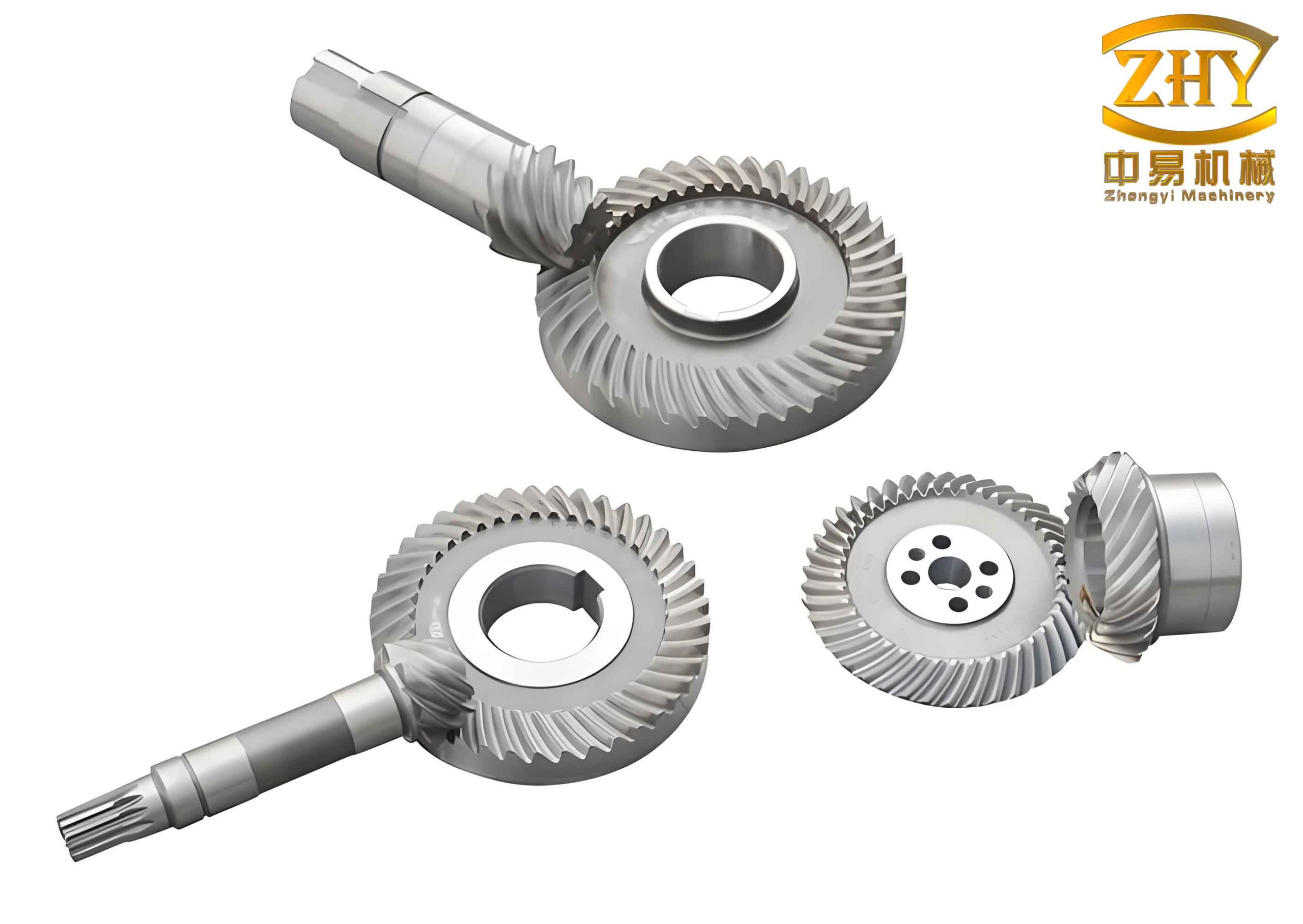
The design of hyperboloid gears relies heavily on accurately determining the reference cone surfaces, which define the gear geometry at the calculation reference point, often denoted as point P. This point corresponds to the midpoint of the tooth ring on both the pinion and gear cones. In conventional approaches, the gear’s reference cone angle is approximated, leading to discrepancies in the midpoint radius and spiral angle. My method, however, starts from precise equations that govern the relationship between the cone angles, spiral angles, and other parameters. The key equations are derived from the meshing theory of hyperboloid gears and are expressed as follows:
First, the relationship between the spiral angles of the pinion and gear is given by:
$$\cos \beta_{12} = \tan \delta_1 \tan \delta_2$$
where $\beta_{12} = \beta_1 – \beta_2$, with $\beta_1$ and $\beta_2$ being the spiral angles of the pinion and gear, respectively, and $\delta_1$ and $\delta_2$ are their cone angles. This equation ensures the proper meshing condition at the reference point.
Second, the offset distance $a_{12}$ between the axes is related to the radii and cone angles:
$$a_{12} = \sin \beta_{12} (r_1 \cos \delta_2 + r_2 \cos \delta_1)$$
Here, $r_1$ and $r_2$ represent the pitch radii of the pinion and gear at the reference point. This formula accounts for the spatial arrangement of hyperboloid gears, which is essential for their unique geometry.
Third, the transmission ratio $i_{12}$ is defined as:
$$i_{12} = \frac{r_2 \cos \delta_2}{r_1 \cos \beta_1}$$
This ratio links the gear sizes to their rotational speeds, a critical factor in hyperboloid gear applications.
To ensure that the reference point P is located at the midpoint of the tooth ring on the gear, the condition is:
$$r_2 = 0.5 (d_{e2} – b_2 \sin \delta_2)$$
where $d_{e2}$ is the outer diameter of the gear at the large end, and $b_2$ is the gear tooth width. This condition is vital for balanced load distribution in hyperboloid gears.
Finally, the nominal radius of the cutting tool used for manufacturing the gear, denoted as $r_0$, is set equal to the limit normal curvature radius $r_j$ at point P:
$$r_0 = r_j$$
The limit normal curvature $r_j$ is calculated using the formula:
$$r_j = \frac{\cos \alpha_0}{\sin \beta_{12}} \left[ \tan \alpha_0 \sin \beta_{12} \left( \frac{\cos \sigma_1 \sin \gamma_1 \cos \gamma_2}{r_1} + \frac{\cos \sigma_2 \sin \gamma_2 \cos \gamma_1}{r_2} \right) – \left( \frac{\sin \sigma_1 \cos \gamma_1}{r_1} + \frac{\sin \sigma_2 \cos \gamma_1}{r_2} \right) \right]$$
where $\alpha_0$ is the limit pressure angle, given by:
$$\alpha_0 = -\arctan \left( \frac{r_1 \sin \beta_1 \sin \delta_2 – r_2 \sin \beta_2 \sin \delta_1}{\cos \beta_{12} (r_1 \cos \delta_2 + r_2 \cos \delta_1)} \right)$$
These equations form the foundation of my new method for hyperboloid gears, eliminating approximations and providing exact solutions.
In practice, to compute the parameters $\beta_2$, $\delta_1$, $\delta_2$, $r_1$, and $r_2$, I use an iterative approach. Given initial values such as $a_{12}$, $i_{12}$, $\beta_1$, $d_{e2}$, $b_2$, and $r_0$, I start with an initial guess for $\delta_2$, typically $\delta_2 = \arctan(z_2 / z_1)$, where $z_1$ and $z_2$ are the numbers of teeth on the pinion and gear, respectively. Then, I calculate $r_2$ from the midpoint condition and solve for $\beta_2$ using the iterative function derived from the equations. The convergence criterion is based on the difference between $r_0$ and $r_j$, with a tolerance of $\epsilon = 10^{-6}$. If the condition is not met, I apply Newton’s method to adjust $\delta_2$ until convergence. This process ensures that all parameters are accurately determined for hyperboloid gears, as summarized in the table below.
| Parameter | Traditional Method (Gleason) | New Method (Proposed) | Description |
|---|---|---|---|
| Pinion spiral angle $\beta_1$ | Approximated, may vary | Fixed to input value (e.g., 50°) | Ensures consistency in hyperboloid gear design |
| Gear cone angle $\delta_2$ | $\arctan(z_2 / z_1)$ | Iteratively solved for exactness | Improves accuracy in hyperboloid gear geometry |
| Pinion pitch radius $r_1$ | Derived from approximate relations | Calculated using precise formulas | Reduces errors in hyperboloid gear meshing |
| Gear pitch radius $r_2$ | Based on midpoint condition | Same, but with exact cone angle | Enhances performance of hyperboloid gears |
| Offset distance $a_{12}$ | Input parameter | Input parameter | Key feature of hyperboloid gears |
Once the reference cone parameters are established, I proceed to calculate the specific geometric parameters for the pinion of hyperboloid gears. This includes the tip cone, root cone, tooth width, and other dimensions. Traditional methods often use perpendiculars from the gear’s tip and root cones to define reference points, which can lead to approximate results and non-standard clearances. My method, however, uses exact geometric constructions based on the gear’s tip and root cone equidistant surfaces, ensuring that the clearance at the midpoint tooth height is standard.
For the pinion tip cone, the parameters are the tip cone angle $\delta_{f1}$ and the distance from the tip cone vertex to the foot of the common perpendicular on the pinion axis, denoted as $z_{f1}$. Starting from the gear’s tip cone equidistant surface, I define point Q as the intersection of a perpendicular from the gear’s reference point P to the gear’s tip cone. The formulas are:
$$r_{2f} = r_2 – (h_{a2} – e) \cos \delta_2$$
$$z_{2f} = z_2 + (h_{a2} – e) \sin \delta_2 = \frac{r_1 \sin \delta_{12}}{\cos \delta_{f2}}$$
where $h_{a2}$ is the gear addendum at the midpoint, $e$ is the clearance, and $\delta_{12}$ is the cone angle difference. Then, solving the system similar to equations (1)-(3), I obtain:
$$\sin \delta_{f1} = \cos \delta_{f2} \sqrt{1 – a_{12}^2 (z_{2f} \tan \delta_{f2} + r_{2f})^{-2}}$$
$$r_{1f} = \frac{z_{2f} \cos \delta_{f1}}{\sin \delta_{f2}}$$
$$z_{f1} = r_{1f} \cot \delta_{f1} – \frac{r_{2f} \sin \delta_{f1}}{\cos \delta_{f2}}$$
These equations provide exact values for the pinion tip cone in hyperboloid gears.
For the pinion root cone, the parameters are the root cone angle $\delta_{a1}$ and the distance $z_{a1}$. Similarly, using point F from the gear’s root cone equidistant surface:
$$r_{2a} = r_2 + (h_{f2} + e) \cos \delta_2$$
$$z_{2a} = z_2 – (h_{f2} + e) \sin \delta_2 = \frac{r_1 \sin \delta_{12}}{\cos \delta_{a2}} – (h_{f2} + e) \sin \delta_2$$
where $h_{f2}$ is the gear dedendum at the midpoint. The solutions are:
$$\sin \delta_{a1} = \cos \delta_{a2} \sqrt{1 – a_{12}^2 (z_{2a} \tan \delta_{a2} + r_{2a})^{-2}}$$
$$r_{1a} = \frac{z_{2a} \cos \delta_{a1}}{\sin \delta_{a2}}$$
$$z_{a1} = r_{1a} \cot \delta_{a1} – \frac{r_{2a} \sin \delta_{a1}}{\cos \delta_{a2}}$$
This approach guarantees a standard clearance $e$ at the midpoint for hyperboloid gears, which is crucial for reducing noise and wear.
The tooth width of the pinion, $b_1$, is another critical parameter in hyperboloid gears. Traditional methods use complex approximations, but I propose a simpler formula based on geometric reasoning. From the spatial relationship between the gear and pinion, the pinion tooth width can be approximated as:
$$b_1 = \frac{b_2}{\cos \beta_{12}} + 0.01 d_{e2}$$
where $d_{e2}$ is the gear’s outer diameter. This formula ensures sufficient contact on the gear tooth surface, accounting for manufacturing and assembly errors. To validate this, I compared the theoretical tooth boundary calculated from exact points on the gear surface with the practical boundary defined by $b_1$. The results show close agreement, as seen in the table below, confirming that $b_1$ can replace the theoretical width without loss of accuracy in hyperboloid gears.
| Gear Example | Theoretical Tooth Width (Exact Calculation) | Practical Tooth Width ($b_1$ Formula) | Difference |
|---|---|---|---|
| Example from Text | 30.4295 mm | 30.45 mm | 0.0205 mm |
| Gleason Example 212 | Approx. 30.45 mm | 30.45 mm | Negligible |
| Other Hyperboloid Gear Cases | Varies based on design | Close match | Within tolerance |
Other pinion parameters for hyperboloid gears include the outer diameter at the large end $d_{e1}$, calculated as:
$$d_{e1} = 2 \left[ r_{1f} + 0.5 b_1 \sin \delta_{f1} / \cos(\delta_{f1} – \delta_1) \right]$$
and the distance from the pinion crown to the foot of the common perpendicular, $z_{c1}$, given by:
$$z_{c1} = 0.5 d_{e1} \cot \delta_{a1} – z_{a1}$$
These formulas complete the geometric description of the pinion in hyperboloid gears, ensuring compatibility with the gear.
To illustrate the effectiveness of my new method for hyperboloid gears, I applied it to a standard example from literature and compared the results with the traditional Gleason method. The key parameters are listed in the table below, all in millimeters for linear dimensions and degrees for angles. The new method maintains the input spiral angle $\beta_1 = 50^\circ$, whereas the Gleason method allows it to deviate, introducing errors. Additionally, the clearance $e$ is standardized in my approach, enhancing the reliability of hyperboloid gears.
| Parameter Symbol | Gleason Method Value | New Method Value | Parameter Description |
|---|---|---|---|
| $\beta_1$ | 49.9800° | 50.00000° | Pinion spiral angle |
| $\delta_2$ | 26.3176° | 26.29793° | Gear cone angle |
| $r_1$ | 13.9667 mm | 13.94232 mm | Pinion pitch radius |
| $r_2$ | 74.8000 mm | 74.83013 mm | Gear pitch radius |
| $\delta_{f1}$ | 19.8667° | 19.86990° | Pinion tip cone angle |
| $\delta_{a1}$ | 20.3377° | 20.26410° | Pinion root cone angle |
| $d_{e1}$ | 40.6569 mm | 40.91830 mm | Pinion outer diameter |
| $z_{c1}$ | 86.5610 mm | 86.08880 mm | Pinion crown distance |
| $a_{12}$ | 210.4184 mm | 210.41650 mm | Offset distance |
The calculations for the gear itself in hyperboloid gears follow similar precise formulas. For instance, the midpoint working tooth height $h$ is given by:
$$h = K h^*$$
where $K$ is the working tooth height coefficient and $h^*$ is a reference value. The gear addendum at the midpoint $h_{a2}$ is:
$$h_{a2} = K_a h$$
with $K_a$ as the addendum coefficient, and the clearance $e$ is:
$$e = 0.15 h^* + 0.051$$
The gear dedendum $h_{f2}$ is:
$$h_{f2} = h^* + e – h_{a2}$$
The tip angle $\theta_{a2}$ and root angle $\theta_{f2}$ are:
$$\theta_{a2} = \arctan \left( \frac{h_{a2}}{r_2} \right)$$
$$\theta_{f2} = \arctan \left( \frac{h_{f2}}{r_2} \right)$$
For double-contraction teeth in hyperboloid gears, the sum of the root angles is:
$$\theta = \frac{3.07178}{\sin \delta_2 \cos \beta_2} \arctan \left( \frac{\tan \beta_2}{\sqrt{\cos^2 \alpha_n – \tan^2 \beta_2}} \right)$$
where $\alpha_n$ is the normal pressure angle. The gear tip cone angle $\delta_{a2}$ and root cone angle $\delta_{f2}$ are:
$$\delta_{a2} = \delta_2 + \theta_{a2}$$
$$\delta_{f2} = \delta_2 – \theta_{f2}$$
Other gear parameters include the distance from the root cone vertex to the common perpendicular $z_{f2}$:
$$z_{f2} = \frac{r_1 \sin \delta_2}{\sin \delta_{12}} – r_2 \cot \delta_{f2} + h_{f2} \sin \delta_2 + \frac{e \cos \delta_2}{\tan \delta_{f2}}$$
and the distance from the tip cone vertex $z_{a2}$:
$$z_{a2} = \frac{r_1 \sin \delta_2}{\sin \delta_{12}} – r_2 \cot \delta_{a2} – h_{a2} \sin \delta_2 – \frac{e \cos \delta_2}{\tan \delta_{a2}}$$
The midpoint cone distance $R_{O2}$ and outer cone distance $R_{e2}$ are:
$$R_{O2} = \frac{r_2}{\sin \delta_2}$$
$$R_{e2} = R_{O2} + 0.5 b_2$$
The outer addendum $h_{ae2}$, outer dedendum $h_{fe2}$, and total tooth height $h_{e2}$ are:
$$h_{ae2} = h_{a2} + 0.5 b_2 \tan \theta_{a2}$$
$$h_{fe2} = h_{f2} + 0.5 b_2 \tan \theta_{f2}$$
$$h_{e2} = h_{ae2} + h_{fe2}$$
The gear outer diameter $d_{e2}$ is:
$$d_{e2} = 2 R_{e2} \sin \delta_2 + 2 h_{ae2} \cos \delta_2$$
and the distance from the gear crown to the common perpendicular $z_{c2}$ is:
$$z_{c2} = \frac{r_1 \sin \delta_2}{\sin \delta_{12}} + 0.5 d_{e2} \cos \delta_2 – h_{ae2} \sin \delta_2$$
These formulas provide a comprehensive set for designing hyperboloid gears with high accuracy.
In conclusion, the new method I have presented for calculating geometric parameters of hyperboloid gears offers significant advantages over traditional approaches. First, it eliminates mathematical model errors by using exact equations derived from meshing theory, ensuring that parameters like the spiral angle remain consistent with input values. Second, it standardizes the clearance at the midpoint tooth height, which is essential for the durability and performance of hyperboloid gears. Third, the formulas are simpler and more intuitive, making them easier for engineers to apply in real-world designs. While the traditional Gleason method has been widely used and yields acceptable results, its approximations can lead to minor discrepancies; my method rectifies these without adding complexity. Overall, this new approach enhances the precision and reliability of hyperboloid gears, contributing to advancements in gear technology. I encourage further exploration and application of this method in various industries where hyperboloid gears are critical, such as automotive, robotics, and heavy machinery.
To further illustrate the importance of hyperboloid gears, consider their role in improving efficiency and reducing noise in power transmission systems. The accurate calculation of geometric parameters directly impacts the load distribution, contact pattern, and fatigue life of these gears. By adopting my new method, designers can optimize hyperboloid gears for specific applications, leading to better performance and lower maintenance costs. Additionally, the use of tables and formulas, as shown in this article, facilitates quick reference and implementation. I hope that this contribution will support the ongoing development of gear engineering and inspire innovations in the field of hyperboloid gears.
Finally, I emphasize that the key to successful hyperboloid gear design lies in meticulous attention to geometric details. The new method provides a robust framework for achieving this, and I look forward to seeing its adoption in industry standards. For those interested in visualizing hyperboloid gears, the image included earlier offers a clear representation of their unique shape and meshing characteristics. As technology evolves, the demand for high-precision hyperboloid gears will only grow, and methods like the one described here will be essential for meeting these challenges.