
In my extensive experience with mechanical power transmission systems, bevel gears play a pivotal role, especially in applications where space is limited and high efficiency is paramount. As an engineer focused on optimizing gear performance, I have dedicated significant effort to refining the design, manufacturing, and assembly processes for bevel gears. This article delves into the intricacies of bevel gears, emphasizing structural optimization, precise manufacturing techniques, and meticulous assembly practices to ensure reliability and smooth operation. Throughout this discussion, the term “bevel gears” will be frequently referenced to underscore their importance in various industrial contexts, such as aviation, automotive, and heavy machinery. The challenges associated with bevel gears often stem from their complex geometry and the need for high precision in hostile environments, which I will address in detail.
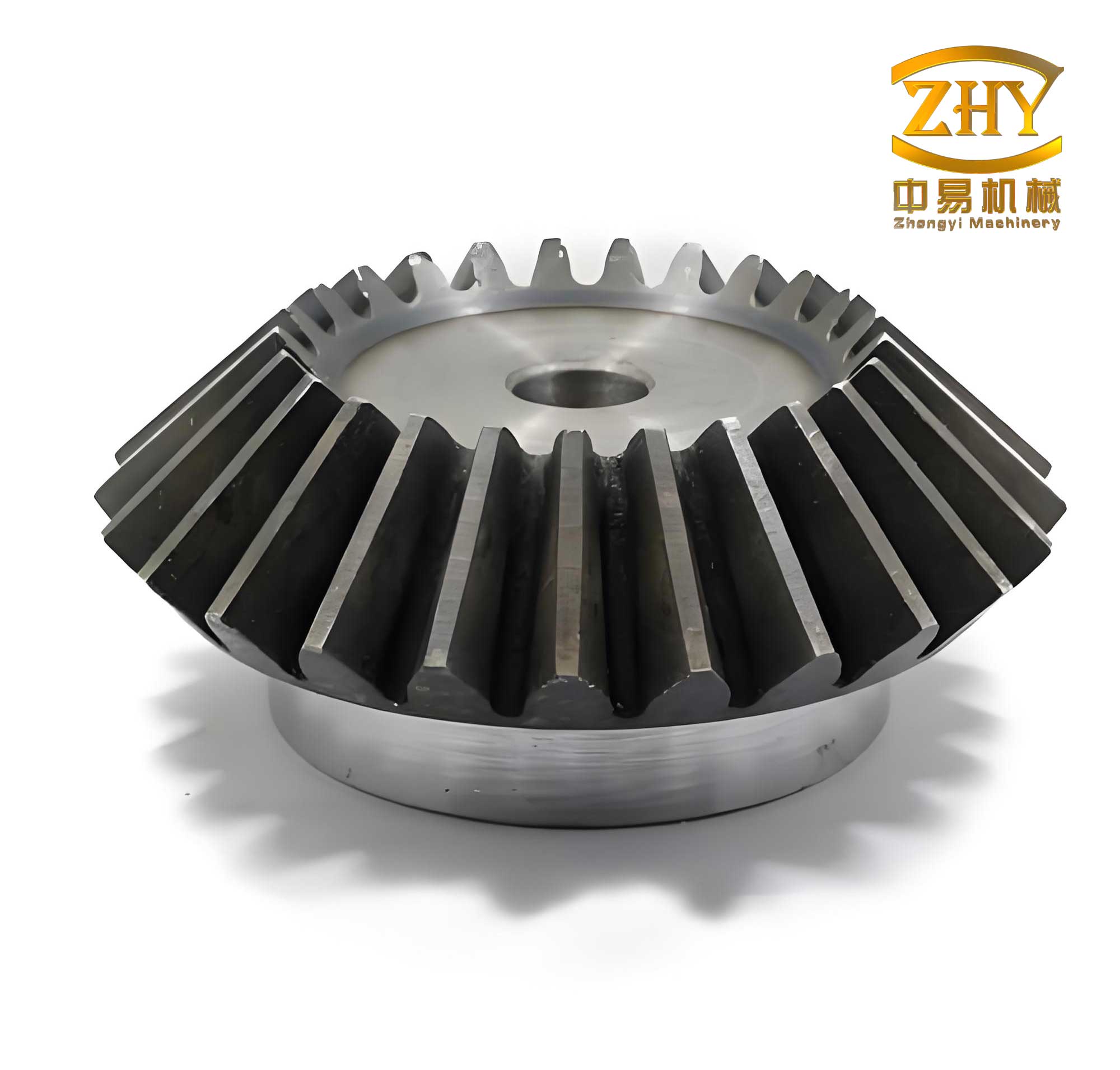
To begin, let’s consider the fundamental aspects of bevel gears. Bevel gears are conical gears used to transmit motion between intersecting shafts, typically at a 90-degree angle. Their design must account for factors like load capacity, noise reduction, and longevity. In this article, I will share insights from my hands-on work, incorporating formulas and tables to summarize key concepts. The integration of advanced manufacturing technologies has revolutionized how we approach bevel gears, but core principles remain essential. For instance, the image below illustrates a typical bevel gear, highlighting its conical shape and tooth geometry, which are critical for understanding subsequent sections.
In the following sections, I will explore the structural design of bevel gears, focusing on principles and calculations. Then, I will delve into manufacturing processes, particularly for spiral bevel gears, which offer superior performance due to their curved teeth. Finally, I will cover installation and pattern adjustment techniques, which are vital for achieving optimal meshing. Throughout, I will emphasize practical considerations based on my observations in the field. Bevel gears, when properly engineered, can significantly enhance system efficiency, and this guide aims to provide a comprehensive resource for engineers and technicians.
Structural Design of Bevel Gears
Designing bevel gears requires a balance between geometric constraints and performance requirements. In my practice, I often encounter scenarios where gearboxes have limited space, yet power demands are increasing. This necessitates compact designs without compromising strength. Bevel gears must be optimized to handle high loads while minimizing weight and volume. One key aspect is the selection of gear type. I prefer using Gleason system spiral bevel gears with equal-depth teeth, as they provide better load distribution and reduced stress concentrations. The design principles for bevel gears revolve around avoiding undercutting, ensuring adequate tooth strength, and selecting appropriate materials.
Firstly, the design principles for bevel gears involve careful consideration of tooth numbers. Reducing tooth counts can lead to undercutting, which weakens the gear. Therefore, I use the minimum tooth number formula to determine a safe range. For bevel gears, the minimum number of teeth to avoid undercutting can be expressed as:
$$ z_{\min} = \frac{2}{\sin^2\alpha} $$
where $\alpha$ is the pressure angle. However, in practical applications, I adjust this based on empirical data. Additionally, I opt for contracted teeth with equal clearance, where tooth height decreases from the large end to the small end. This design enhances root strength by increasing the fillet radius at the small end, reducing stress concentration. It also allows for larger tool tip radii during manufacturing, extending tool life. Material selection is another critical factor. I typically choose nickel-chromium steel for bevel gears due to its high mechanical properties and minimal heat treatment distortion. The carburizing depth must be optimized; too shallow a layer risks peeling, while too deep a layer increases brittleness. The core hardness should be moderate to prevent plastic deformation or brittle fracture. To mitigate deformation under load, I design supports as simply supported beams, which improve load-bearing capacity.
Secondly, design calculations for bevel gears are essential for ensuring performance. I start by estimating the initial pitch diameter at the large end for the pinion, denoted as $d_0$. The design process involves calculating the equivalent spur gear parameters at the mean point of the tooth width. For spiral bevel gears, I use the Gleason method, which incorporates high correction factors to optimize tooth geometry. The module is determined analogically based on similar applications. To handle heavy loads, I often select a transmission ratio around 1.2. The pitch arc tooth thickness is calculated using:
$$ S_1 = m \left( \frac{\pi}{2} + 2x_1 \tan\alpha + x_{t1} \right) $$
$$ S_2 = p – S_1 $$
where $m$ is the module, $x_1$ is the addendum modification coefficient, $\alpha$ is the pressure angle, $x_{t1}$ is the tangential correction, and $p$ is the circular pitch. The cone angles, including pitch cone angle, tip cone angle, and root cone angle, are derived from geometric relations. It’s crucial to control the tooth width factor; excessive width can cause thinning at the small end and increased stress. Below is a table summarizing key design parameters for a typical bevel gear pair based on my projects:
| Parameter | Symbol | Value Range | Remarks |
|---|---|---|---|
| Module (large end) | $m$ | 4-10 mm | Depends on power transmission |
| Number of Teeth (pinion) | $z_1$ | 12-20 | Avoid undercutting |
| Transmission Ratio | $i$ | 1.0-2.0 | Optimized for compactness |
| Pressure Angle | $\alpha$ | 20° | Standard for strength |
| Tooth Width Factor | $K_b$ | 0.25-0.3 | Prevents small-end issues |
| Carburizing Depth | $d_c$ | 0.8-1.2 mm | Based on module |
In my design approach, I also perform strength calculations using the equivalent gear method. The bending stress $\sigma_b$ and contact stress $\sigma_H$ are evaluated with:
$$ \sigma_b = \frac{F_t K_A K_v K_{H\beta}}{b m_n Y_F Y_S} $$
$$ \sigma_H = Z_E Z_H Z_\epsilon \sqrt{\frac{F_t K_A K_v K_{H\beta}}{b d_1} \cdot \frac{u+1}{u}} $$
where $F_t$ is the tangential force, $K_A$ is the application factor, $K_v$ is the dynamic factor, $K_{H\beta}$ is the face load factor, $b$ is the face width, $m_n$ is the normal module, $Y_F$ and $Y_S$ are form and stress correction factors, $Z_E$ is the elasticity coefficient, $Z_H$ is the zone factor, $Z_\epsilon$ is the contact ratio factor, $d_1$ is the pinion pitch diameter, and $u$ is the gear ratio. These calculations ensure that the bevel gears can withstand operational loads without failure. Through iterative refinement, I optimize the geometry to achieve a balance between size and durability, which is critical for applications like aircraft engines where weight savings are essential.
Manufacturing and Processing of Spiral Bevel Gears
The manufacturing of spiral bevel gears is a complex process that demands precision at every stage. In my work, I have identified several key challenges that must be addressed to produce high-quality bevel gears. These include controlling carburizing depth after grinding, adjusting contact patterns, managing heat treatment deformation, and accurately measuring parameters. Each of these aspects directly impacts the performance and reliability of bevel gears in service.
Firstly, controlling the carburizing depth after grinding is a critical issue. During grinding, the carbon content on the tooth surface can decrease, potentially compromising hardness. I ensure that the grinding allowance is uniform, typically within 0.05 mm, to maintain consistent carburizing depth. This requires precise control during铣齿 (milling) operations. To achieve this, I often increase the cutter blade diameter and use adjustment shims to fine-tune the tool tip diameter. The relationship between grinding parameters and carburizing depth can be expressed as:
$$ d_{c,\text{final}} = d_{c,\text{initial}} – \Delta g $$
where $d_{c,\text{initial}}$ is the carburizing depth before grinding, and $\Delta g$ is the material removed during grinding. By monitoring $\Delta g$ closely, I prevent excessive carbon loss, ensuring that the surface hardness meets specifications. In practice, I use non-destructive testing methods like eddy current to verify depth consistency across the tooth profile.
Secondly, adjusting the contact pattern is vital for proper meshing. The contact pattern, or “color imprint,” indicates how the teeth engage under load. During static testing, I apply a braking force to the driven bevel gear and examine the pattern. Common issues include patterns偏向大端或小端 (biased toward the large or small end), 齿根或齿顶 (toward the root or tip), or diagonal contact. To correct these, I adjust the cutter location during manufacturing. For instance, if the pattern is toward the large end, I modify the machine settings to shift the contact toward the center. The adjustment process involves iterative trials, and I document the changes in a table for future reference. Below is a table summarizing typical pattern issues and corrective actions for spiral bevel gears:
| Pattern Issue | Possible Cause | Corrective Action |
|---|---|---|
| Pattern at Large End | Excessive cutter offset | Reduce radial setting |
| Pattern at Small End | Insufficient cutter offset | Increase radial setting |
| Pattern at Tooth Root | Incorrect blade angle | Adjust blade tilt |
| Diagonal Contact | Misalignment in machine | Realign workpiece or tool |
| Excessive Pattern Size | Over-engagement | Modify tooth curvature |
Thirdly, heat treatment deformation poses a significant challenge. Spiral bevel gears have complex shapes, and residual stresses from machining can lead to distortion during heat treatment. In my experience, selecting appropriate cutting paths and heat treatment parameters is crucial. I use finite element analysis (FEA) to simulate the process and predict deformation. The deformation $\delta$ can be modeled as:
$$ \delta = f(S, T, t) $$
where $S$ is the stress state from machining, $T$ is the temperature profile, and $t$ is the time. By optimizing these variables, I minimize distortion, ensuring that the grinding allowance is sufficient to achieve final dimensions. For example, I often employ cryogenic treatment after carburizing to stabilize the microstructure. Additionally, I monitor the hardness gradient to ensure that the core hardness is in the range of 30-40 HRC, which balances toughness and strength.
Fourthly, parameter measurement is essential for quality control. I use tooth topography mapping to assess the gear geometry. This involves measuring 45 points on the tooth surface (arranged in a 9×5 grid) and comparing them to theoretical values. The deviation at each point, denoted as $\Delta z_{ij}$, is recorded in micrometers. A positive $\Delta z_{ij}$ indicates the actual surface is above the theoretical point. The overall topography error $E_t$ is calculated as:
$$ E_t = \sqrt{\frac{1}{n} \sum_{i=1}^{9} \sum_{j=1}^{5} (\Delta z_{ij})^2} $$
where $n=45$. I aim to keep $E_t$ below 10 µm for high-precision bevel gears. This data helps identify manufacturing errors and guides adjustments in the process. Moreover, I measure parameters like tooth thickness, pitch, and runout using coordinate measuring machines (CMMs) to ensure compliance with design specifications. Regular calibration of measurement tools is necessary to maintain accuracy.
Throughout the manufacturing process, I emphasize the importance of consistency. Bevel gears are often produced in batches, and statistical process control (SPC) is employed to monitor key variables. For instance, I track the mean and range of carburizing depth across multiple gears to detect trends. By addressing these manufacturing challenges, I can produce bevel gears that meet stringent performance criteria, reducing noise and increasing lifespan in applications such as wind turbines or industrial gearboxes.
Installation and Pattern Adjustment of Spiral Bevel Gears
The installation of spiral bevel gears is a critical phase that directly influences their operational performance. In my experience, even perfectly manufactured bevel gears can fail if not assembled correctly. This section covers assembly techniques, pattern adjustment methods, and other factors that affect the meshing of bevel gears. Proper installation ensures that the gears transmit power smoothly and reliably, minimizing wear and tear.
Firstly, the assembly process involves setting the installation distance, which is the axial distance from the cone apex to the mounting surface. I adjust this distance using shims to compensate for cumulative tolerances in the gearbox components. The installation distance for the pinion ($A_1$) and gear ($A_2$) are determined based on design values, but in practice, they have a range due to manufacturing variances. I use the following formulas to calculate the required shim thickness:
$$ \Delta A_1 = A_{1,\text{design}} – A_{1,\text{measured}} $$
$$ \Delta A_2 = A_{2,\text{design}} – A_{2,\text{measured}} $$
where $\Delta A_1$ and $\Delta A_2$ are the shim adjustments. By iteratively adding or removing shims, I achieve the desired backlash and contact pattern. It’s important to note that the mounting surfaces must be parallel and clean to avoid misalignment. I often use dial indicators to measure axial runout, ensuring it is within 0.02 mm for precision assemblies.
Secondly, pattern adjustment is performed after assembly. I apply a thin layer of marking compound (e.g., Prussian blue) to the tooth surfaces and rotate the gears under light load. The resulting imprint reveals the contact area. The ideal pattern should be centered on the tooth face, covering 30-50% of the area. If the pattern is incorrect, I adjust the shims to shift the gears axially. For example, if the pattern is toward the toe (small end), I increase the installation distance for the pinion. The relationship between adjustment and pattern shift can be approximated linearly for small changes. However, if the pattern shows issues like one side at the tip and the other at the root, it may indicate manufacturing errors beyond adjustment. In such cases, the bevel gears must be replaced. I document all adjustments in a log, including backlash measurements, which should typically be between 0.1-0.2 mm for medium-sized bevel gears.
Thirdly, other factors influence the assembly quality. The type of marking compound is important; I prefer compounds with low oil content to prevent smearing and provide clear imprints. Additionally, backlash must be controlled. Excessive backlash leads to noise and impact loads, while insufficient backlash can cause binding and overheating. The actual backlash $j$ is affected by thermal expansion and load, so I use the formula:
$$ j_{\text{operational}} = j_{\text{assembly}} + \alpha \Delta T L $$
where $\alpha$ is the coefficient of thermal expansion, $\Delta T$ is the temperature change, and $L$ is the effective gear dimension. I aim for a slightly larger backlash during assembly to accommodate operational conditions. Environmental factors like humidity and contamination can also affect the pattern, so I conduct adjustments in a controlled environment. Below is a table summarizing common assembly issues and solutions for bevel gears:
| Issue | Symptom | Solution |
|---|---|---|
| Excessive Noise | High-pitched whining | Increase backlash slightly |
| Localized Wear | Pattern concentrated on edge | Realign gears or adjust shims |
| Overheating | Gears run hot | Check lubrication and reduce preload |
| Vibration | Unsteady operation | Balance gears and verify bearing fit |
| Short Lifespan | Premature pitting or breakage | Review load calculations and material |
In addition, I consider the lubrication system. Proper lubrication is crucial for bevel gears, especially in high-speed applications. I select oils with adequate viscosity and anti-wear additives. The lubricant film thickness $h$ can be estimated using the elasto-hydrodynamic lubrication (EHL) theory:
$$ h = 1.6 \frac{(U \eta_0)^{0.7} R^{0.43}}{\alpha^{0.54} E’^{0.03} W^{0.13}} $$
where $U$ is the rolling speed, $\eta_0$ is the dynamic viscosity, $R$ is the equivalent radius, $\alpha$ is the pressure-viscosity coefficient, $E’$ is the equivalent modulus, and $W$ is the load per unit width. Maintaining an adequate film prevents metal-to-metal contact, reducing wear on the bevel gears. I also implement condition monitoring techniques, such as vibration analysis and oil debris monitoring, to detect early signs of failure.
Conclusion
In summary, the design, manufacturing, and assembly of bevel gears are interconnected processes that require meticulous attention to detail. Based on my experience, optimizing the structure of bevel gears through careful calculation and material selection lays the foundation for durability. During manufacturing, controlling carburizing depth, adjusting contact patterns, managing heat treatment deformation, and precise measurement are essential for producing high-quality bevel gears. Finally, proper installation and pattern adjustment ensure that the gears operate smoothly and reliably in service. The techniques discussed here, including the use of formulas and tables, provide a practical framework for engineers working with bevel gears. As technology advances, I continue to explore innovations like additive manufacturing for custom bevel gears and AI-driven optimization for design. However, the core principles remain unchanged: understanding the geometry, loads, and environmental factors is key to success. Bevel gears will continue to be vital components in mechanical systems, and by applying these insights, we can enhance their performance and longevity across various industries.
Throughout this article, I have emphasized the importance of bevel gears in power transmission, and I hope that the detailed explanations and examples will serve as a valuable resource. From aerospace to automotive applications, the reliability of bevel gears directly impacts system efficiency, and I encourage ongoing research and development in this field. By sharing my firsthand knowledge, I aim to contribute to the collective expertise on bevel gears, fostering innovation and improvement in their design and application.