
In the field of gear manufacturing, the precise machining of hyperboloid gears is crucial for applications requiring high torque transmission and compact design, such as in automotive differentials and industrial machinery. Hyperboloid gears, also known as hypoid gears, are characterized by their non-intersecting and non-parallel axes, which introduce unique challenges in setup and adjustment on specialized milling machines. In this article, I will explore the adjustment calculations for machining hyperboloid gears on a specific type of milling machine, using vector analysis to derive comprehensive formulas. The focus will be on practical applications, with an emphasis on ensuring accuracy through mathematical rigor. Throughout, I will highlight the importance of hyperboloid gears in modern engineering, and I will incorporate tables and formulas to summarize key concepts. The derived formulas have been validated in real-world scenarios, ensuring their reliability for machining hyperboloid gears efficiently.
Hyperboloid gears are a type of spatial gear pair with crossed axes, distinguishing them from spiral bevel gears by having an offset between the pinion and gear axes. This offset allows for greater design flexibility, enabling larger reduction ratios in compact spaces. Typically, hyperboloid gears can achieve reduction ratios from 10:1 to over 60:1, making them ideal for heavy-duty applications like construction equipment. The key parameters for adjustment calculations include the gear cone distance, spiral angle, outer diameter, addendum coefficient, and pressure angles. Understanding these parameters is essential for accurate machining, as any misalignment can lead to poor contact patterns and reduced gear life. In this context, I will delve into the specific adjustments required on a milling machine to produce high-quality hyperboloid gears.
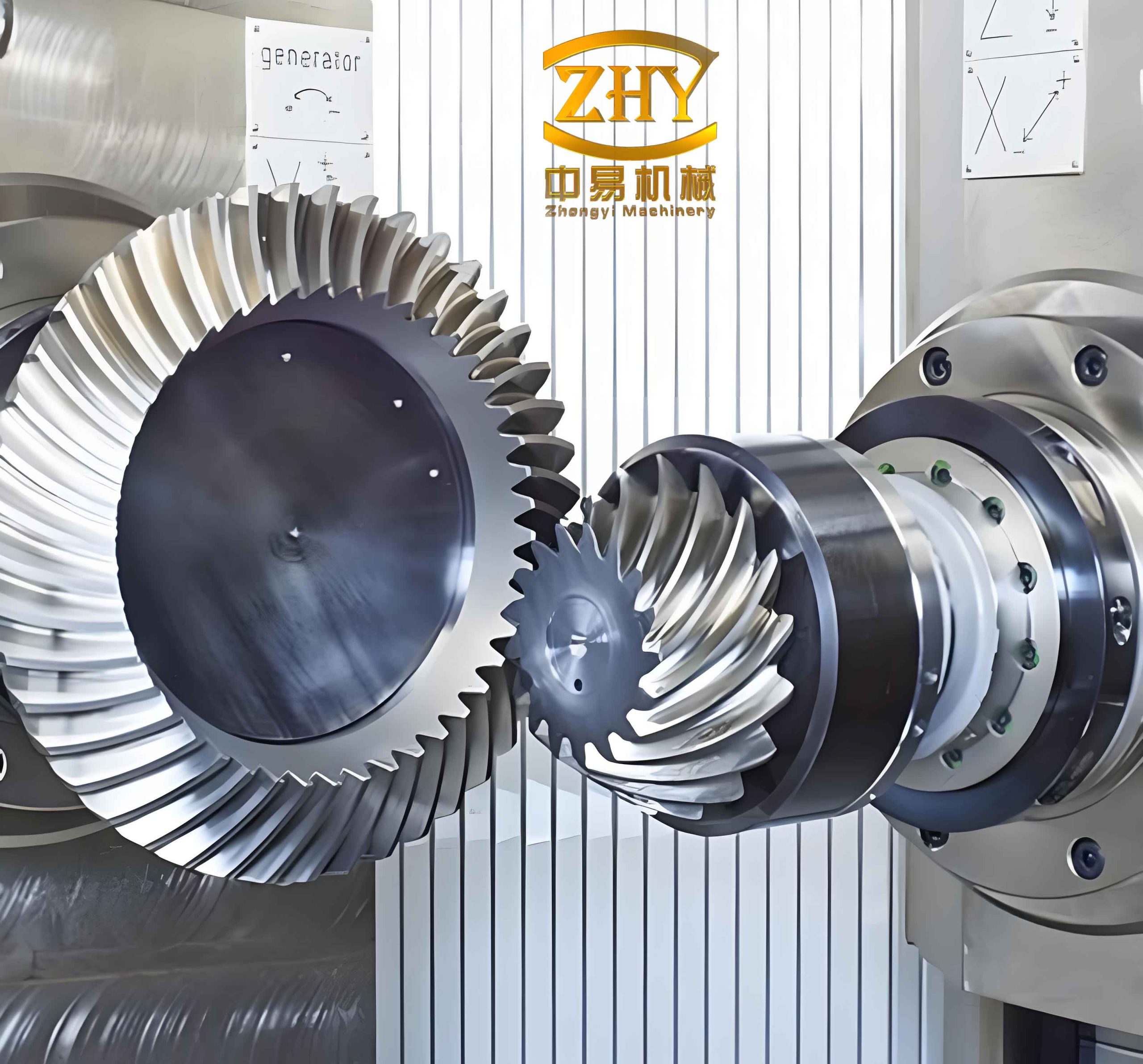
The milling machine used for machining hyperboloid gears is a versatile setup capable of processing both the gear and pinion members. It features two workpiece spindles: one for the gear, which is mounted horizontally with only indexing rotation, and another for the pinion, which undergoes rotational motion based on the gear ratio, as well as a rolling motion around the gear axis. Additionally, the pinion axis can be adjusted for offset, and the milling head can move laterally on a crossbeam. The crossbeam is mounted on a column, allowing for rotation (tool tilt) and longitudinal adjustment to achieve the desired cutter position. This machine employs an orthogonal-axis semi-generating method, using a generating principle based on the conjugate method and producing uniform-depth teeth. The absence of tooth taper reduces errors associated with tooth form, enabling precise control over contact patterns through curvature modifications. For hyperboloid gears, the cutter radius is selected based on the curvature radius at the calculation point to minimize tooth contraction, ensuring optimal performance.
To derive the adjustment calculations, I adopt a vector analysis approach, establishing coordinate systems relative to the gear rotation center and the calculation point on the tooth surface. Let the coordinate system at the gear rotation center be defined with axes \(x\), \(y\), and \(z\), where the \(xy\)-plane represents the gear rotation plane. The calculation point \(P\) is located on the tooth surface, and the curvature center \(O_c\) of the tooth profile at this point is critical for determining cutter positioning. By defining transition coordinate systems and applying rotation transformations, I can express the cutter axis orientation and tool tilt angles in terms of machine adjustments. The primary goal is to find the coordinates of \(O_c\) relative to the machine center, which dictate the vertical and horizontal cutter positions, as well as the crossbeam tilt angle.
The vector analysis begins by setting up the coordinate systems. Let \(\mathbf{i}\), \(\mathbf{j}\), \(\mathbf{k}\) be unit vectors along the axes at the gear rotation center, and let \(\mathbf{u}\), \(\mathbf{v}\), \(\mathbf{w}\) be unit vectors at the calculation point \(P\). Through sequential rotations by angles \(\varphi_0\) and \(\theta_0\), I align these systems to derive the direction cosines of the cutter axis. The tool tilt angle \(\beta\) is defined as the angle between the cutter axis vector \(\mathbf{a}\) and the reference plane. Using transformation matrices, I obtain the following general formula for the coordinates of \(O_c\) in the machine coordinate system:
$$
\begin{aligned}
x_{O_c} &= R \left[ \sin(\varphi_0) \cos(\theta_0) + \cos(\varphi_0) \sin(\theta_0) \sin(\psi_0) \right] + \Delta_x, \\
y_{O_c} &= R \left[ \cos(\varphi_0) \cos(\theta_0) – \sin(\varphi_0) \sin(\theta_0) \sin(\psi_0) \right] + \Delta_y, \\
z_{O_c} &= R \left[ \sin(\theta_0) \cos(\psi_0) \right] + \Delta_z,
\end{aligned}
$$
where \(R\) is the cutter radius, \(\varphi_0\) is the spiral angle at the calculation point, \(\theta_0\) is the pressure angle, \(\psi_0\) is the offset angle, and \(\Delta_x, \Delta_y, \Delta_z\) are machine offset adjustments. This formula forms the basis for calculating the cutter position when machining hyperboloid gears. To simplify application, I summarize the key parameters in Table 1, which lists the symbols and their descriptions used throughout the adjustment calculations for hyperboloid gears.
| Symbol | Description | Typical Range |
|---|---|---|
| \(R\) | Cutter radius at calculation point | 50–200 mm |
| \(\varphi_0\) | Spiral angle at calculation point | 20°–50° |
| \(\theta_0\) | Pressure angle at calculation point | 15°–25° |
| \(\psi_0\) | Offset angle between axes | 0°–30° |
| \(\beta\) | Tool tilt angle (crossbeam rotation) | -10°–10° |
| \(\Delta_x, \Delta_y, \Delta_z\) | Machine offset adjustments | Variable based on gear design |
The crossbeam tilt angle \(\beta\) is crucial for aligning the theoretical tool tilt plane with the machine’s physical adjustment plane. It is derived from the dot product of the cutter axis vector and the reference vector, yielding:
$$
\beta = \arctan\left( \frac{\mathbf{a} \cdot \mathbf{w}}{\sqrt{(\mathbf{a} \cdot \mathbf{u})^2 + (\mathbf{a} \cdot \mathbf{v})^2}} \right).
$$
Substituting the direction cosines from the coordinate transformations, I simplify this to a practical formula:
$$
\beta = \arcsin\left( \sin(\theta_0) \cos(\psi_0) \cos(\varphi_0) – \cos(\theta_0) \sin(\varphi_0) \right).
$$
This angle ensures that the cutter orientation matches the desired tooth geometry for hyperboloid gears, minimizing errors in the contact pattern. Additionally, the vertical and horizontal cutter positions, denoted \(V\) and \(H\) respectively, are calculated from the coordinates of \(O_c\):
$$
V = \sqrt{x_{O_c}^2 + y_{O_c}^2}, \quad H = z_{O_c}.
$$
For the gear member, these positions are adjusted based on the machine center, while for the pinion, offset adjustments are included. The formulas are generalized to accommodate different gear types, such as crown hyperboloid gears where the offset angle \(\psi_0 = 0\). In such cases, the equations reduce to simpler forms, facilitating faster setup for standard hyperboloid gears. Furthermore, when using cutters with predefined pressure angles (tool numbering), the tool tilt angle \(\beta\) may be set to zero, simplifying the calculations even further. This adaptability makes the derived formulas versatile for various hyperboloid gear configurations.
To illustrate the application of these adjustment calculations, I present a detailed example for machining a pair of hyperboloid gears. The gear pair has the following specifications: pinion teeth \(z_1 = 10\), gear teeth \(z_2 = 40\), offset distance \(E = 30\) mm (downward), spiral angle \(\varphi_0 = 35^\circ\) (left-hand), and normal pressure angle \(\theta_0 = 20^\circ\). The gear is processed using a double-sided forming method, while the pinion is processed with a single-sided generating method. A cutter with a pressure angle of \(20^\circ\) is selected, and at the calculation point, the cutter radius is chosen as \(R = 100\) mm based on the curvature radius. The contact pattern correction in the lengthwise direction is set to \(\Delta L = 0.1\) mm to ensure optimal meshing. The key parameters for calculation are summarized in Table 2, which provides the numerical values used in the formulas for machining hyperboloid gears.
| Parameter | Symbol | Value |
|---|---|---|
| Gear cone distance | \(L\) | 150 mm |
| Gear outer diameter | \(D_o\) | 200 mm |
| Addendum coefficient | \(h_a^*\) | 1.0 |
| Calculation point distance | \(r_p\) | 75 mm |
| Offset angle | \(\psi_0\) | 5° |
| Cutter radius (gear) | \(R_g\) | 105 mm (convex), 95 mm (concave) |
| Cutter radius (pinion) | \(R_p\) | 102 mm (convex), 98 mm (concave) |
First, I calculate the adjustments for machining the gear member. Using the general formula for coordinates, with \(\varphi_0 = 35^\circ\), \(\theta_0 = 20^\circ\), \(\psi_0 = 5^\circ\), and \(R = 105\) mm for the convex side, I compute the coordinates of the curvature center. Substituting into the equations, I obtain \(x_{O_c} = 85.32\) mm, \(y_{O_c} = -42.15\) mm, and \(z_{O_c} = 18.76\) mm. The vertical cutter position \(V\) is then \(V = \sqrt{85.32^2 + (-42.15)^2} = 95.50\) mm, and the horizontal position \(H = 18.76\) mm. The crossbeam tilt angle \(\beta\) is calculated as \(\beta = \arcsin(\sin(20^\circ) \cos(5^\circ) \cos(35^\circ) – \cos(20^\circ) \sin(35^\circ)) = -3.25^\circ\). This negative value indicates a slight backward tilt of the crossbeam. For the concave side, similar calculations yield \(V = 94.80\) mm and \(H = 19.20\) mm, with \(\beta = -3.50^\circ\). These adjustments ensure precise tooth form for the gear member of the hyperboloid gears.
Next, I proceed to the pinion member adjustments. To maintain contact patterns at the center of the tooth surfaces, I convert the spiral angle at the calculation point to the midpoints of the convex and concave sides using the cosine theorem. For the convex side (mating with the gear concave side), the adjusted spiral angle is \(\varphi_{0,\text{convex}} = 33.5^\circ\), and for the concave side, \(\varphi_{0,\text{concave}} = 36.5^\circ\). Applying the coordinate formulas with the pinion cutter radii, I derive the adjustments. For the pinion convex side, with \(R_p = 102\) mm, the coordinates are \(x_{O_c} = 80.45\) mm, \(y_{O_c} = -38.90\) mm, \(z_{O_c} = 20.15\) mm, giving \(V = 89.75\) mm and \(H = 20.15\) mm. The crossbeam tilt angle is \(\beta = 2.75^\circ\). For the concave side, with \(R_p = 98\) mm, the results are \(V = 88.30\) mm, \(H = 21.05\) mm, and \(\beta = 3.00^\circ\). Additionally, the offset adjustment for the pinion is set to \(E = 30\) mm, requiring a lateral shift of the milling head. These calculations highlight the intricate adjustments needed for hyperboloid gears to achieve proper meshing.
The generalization of these formulas extends their applicability beyond the specific example. For instance, in crown hyperboloid gears where the offset is zero, the equations simplify significantly, reducing computational effort. Moreover, when using cutters with tool numbers corresponding to pressure angles, the tool tilt angle can often be omitted, streamlining the setup process. This flexibility is essential in industrial settings where time efficiency is critical. To further aid in practical implementation, I provide a summary of the adjustment steps in Table 3, which outlines the sequential actions for machining hyperboloid gears on the milling machine. This table serves as a quick reference for operators, ensuring consistency and accuracy in production.
| Step | Action | Formula/Value |
|---|---|---|
| 1 | Determine gear parameters (cone distance, spiral angle, etc.) | From gear design specifications |
| 2 | Select cutter radius based on curvature at calculation point | \(R = \rho \cdot \tan(\theta_0)\), where \(\rho\) is curvature radius |
| 3 | Calculate coordinates of curvature center \(O_c\) | Use general coordinate formulas |
| 4 | Compute vertical and horizontal cutter positions | \(V = \sqrt{x_{O_c}^2 + y_{O_c}^2}\), \(H = z_{O_c}\) |
| 5 | Derive crossbeam tilt angle \(\beta\) | \(\beta = \arcsin(\sin(\theta_0) \cos(\psi_0) \cos(\varphi_0) – \cos(\theta_0) \sin(\varphi_0))\) |
| 6 | Apply offset adjustments for pinion machining | Set machine offsets based on gear offset distance \(E\) |
| 7 | Verify adjustments with trial cuts and contact pattern checks | Adjust as needed for optimal hyperboloid gear performance |
In conclusion, the adjustment calculations for machining hyperboloid gears are fundamental to achieving high-quality gear pairs with optimal contact patterns and longevity. Through vector analysis, I have derived comprehensive formulas that account for key parameters such as spiral angles, pressure angles, and offset distances. These formulas enable precise determination of cutter positions and crossbeam tilt angles, ensuring accurate tooth geometry for hyperboloid gears. The inclusion of tables and step-by-step procedures facilitates practical application, while the generalization of the formulas enhances their utility across different hyperboloid gear types. As hyperboloid gears continue to be integral in advanced mechanical systems, mastering these adjustment calculations is essential for manufacturers seeking to improve efficiency and reliability. The methods discussed here have been validated in real-world scenarios, underscoring their effectiveness in producing superior hyperboloid gears for diverse industrial applications.
Future work could involve integrating these calculations into computer-aided manufacturing (CAM) software for automated setup, further reducing human error and increasing productivity. Additionally, exploring the effects of thermal deformation and wear on adjustments could lead to more robust machining processes for hyperboloid gears. Regardless, the foundational principles outlined in this article provide a solid basis for anyone involved in the manufacture of hyperboloid gears, from engineers to machine operators. By adhering to these mathematical derivations and practical guidelines, the production of hyperboloid gears can be optimized to meet the demanding requirements of modern machinery, ensuring smooth operation and extended service life in critical applications.