
The design and manufacture of hyperboloid gears represent one of the most complex challenges in gear engineering. As a gear designer and software developer specializing in power transmission systems, I have long been fascinated and challenged by the intricate geometry of hyperboloid gears. Their ability to transmit high torque between non-intersecting, offset axes makes them indispensable in automotive differentials, aerospace applications, and heavy machinery. However, this very utility is born from profound geometric complexity. The tooth flanks are not simple involutes but complex, spatially curved surfaces whose precise form dictates performance characteristics like noise, vibration, and durability. Traditional design and manufacturing processes for hyperboloid gears are highly iterative, reliant on extensive manual calculation, expert intuition for contact pattern adjustment, and physical trial-and-error in testing. This process is not only time-consuming and costly but also limits optimization and repeatability. To overcome these barriers, I embarked on the development of a fully integrated software system that seamlessly combines computer-aided design (CAD), sophisticated mathematical analysis, and computer-aided manufacturing (CAM) preparation for hyperboloid gears. This system aims to digitize and automate the entire workflow—from initial blank dimensioning and strength verification through advanced tooth contact analysis and automatic drawing generation to the final output of machine setup data.
The core philosophy behind the system I developed is integration. It is not merely a collection of separate calculators but a cohesive platform where each module feeds data into the next, creating a continuous digital thread. The system architecture is built upon several interconnected core modules, each addressing a critical phase in the development of hyperboloid gears. The design process, as facilitated by this system, follows a logical and optimized sequence, ensuring that each decision is informed by rigorous analysis. The initial phase involves defining the gear pair’s fundamental requirements, followed by a cascade of automated design and verification steps.
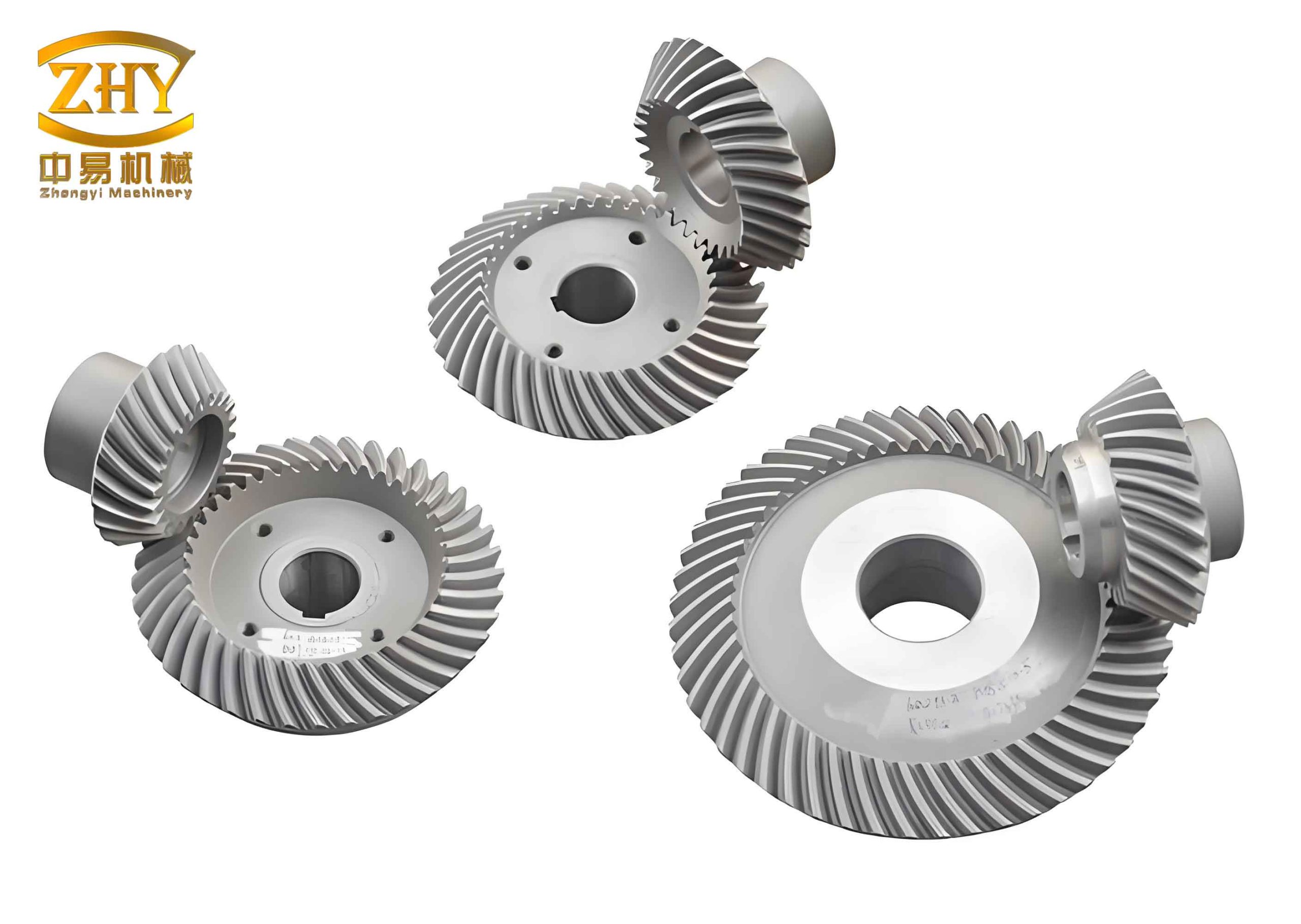
The complexity of hyperboloid gear geometry cannot be overstated. Unlike parallel-axis gears, the meshing action involves a combination of rolling and sliding along complex paths on doubly curved surfaces. The local curvature and pressure angle vary significantly across the tooth face, making the prediction of contact behavior under load a non-trivial task. Successfully manufacturing functional hyperboloid gears requires precise control over numerous machine tool settings—cutter head geometry, machine root angles, sliding base settings, and ratio-of-roll—all of which interact in a highly nonlinear fashion to generate the desired tooth form. My system tackles this complexity by embedding industry-standard calculation methods (such as the Gleason system for blank design and AGMA standards for rating) with advanced numerical techniques for simulation and optimization. By creating a digital twin of the gear pair and its manufacturing process, the system allows for virtual prototyping, eliminating much of the physical testing traditionally required. This digital approach is paramount for achieving high performance, reliability, and efficiency in the production of modern hyperboloid gears.
System Architecture and Modular Design
The integrated system is structured into five primary, interlinked modules. Each module is responsible for a distinct stage in the design-to-manufacture pipeline, yet they share a common data model, ensuring consistency and eliminating manual data re-entry errors. The following table summarizes the function and key output of each module.
| Module Name | Primary Function | Key Inputs | Key Outputs |
|---|---|---|---|
| Gear Blank Design | Calculates all geometric dimensions of the gear pair. | Number of teeth, shaft angle, offset, face width, pressure angle. | Pitch diameters, whole depth, addendum, dedendum, cutter specifications. |
| Strength Rating & Verification | Checks bending and contact fatigue strength against AGMA standards. | Applied torque, speed, material properties, safety factors. | Bending stress, contact stress, safety factors, pass/fail status. |
| Tooth Contact Analysis (TCA) | Simulates the meshing to predict contact pattern and transmission error. | Machine settings, cutter data, misalignments. | Contact ellipse path, size, and orientation; transmission error curve. |
| Machine Adjustment Card Generator | Computes settings for specific gear cutting machines. | Finalized geometry and TCA-corrected settings. | Setup cards for roughing/finishing of pinion and gear for machines like Y2250, Gleason PHOENIX. |
| Parametric CAD Drafting | Automatically generates production drawings. | Final gear geometry and user-specified hub/blank details. | Fully dimensioned 2D CAD drawings of the gear and pinion. |
The system’s workflow is sequential yet features critical feedback loops. The process initiates with the Gear Blank Design module. Here, the user inputs the fundamental design parameters. The system performs initial feasibility checks on these parameters (e.g., ensuring the offset is not too large for the chosen shaft angle and ratio) before proceeding with comprehensive geometric calculations based on established hypoid gear theory. The module automatically selects appropriate design factors, such as the cutter radius and addendum coefficients, based on the chosen tooth depth system (standard, dual, or tilted root line). A significant challenge in designing hyperboloid gears is the interdependency of parameters; a change in one often necessitates recalculation of many others. This module handles all such dependencies automatically, outputting a complete dataset including pitch cone angles, spiral angles, mean cone distances, and detailed tooth proportions for both the gear and pinion, considering their different handedness and concave/convex flanks.
Detailed Module Functionality and Implementation
1. Gear Blank Design and Parameter Validation
The blank design for hyperboloid gears is governed by a set of trigonometric relationships derived from the relative positioning of the axes. The core geometry is defined by the shaft angle $\Sigma$, the offset $E$, and the pitch diameters. The mean cone distance $R_{m}$ is a central parameter calculated from the pitch diameter and face width. The pitch angles $\gamma$ (for the gear) and $\delta$ (for the pinion) are not simply complementary when an offset exists; they are calculated using specific formulas. For the gear:
$$ \tan \gamma = \frac{\sin \Sigma}{\frac{z_2}{z_1} + \cos \Sigma} $$
where $z_1$ and $z_2$ are the pinion and gear tooth counts. The pinion pitch angle is $\delta = \Sigma – \gamma$.
The system validates all input parameters against a comprehensive rule set stored in an internal database. For instance, it checks for undercutting conditions on the pinion, validates the face width against the cone distance, and ensures the spiral angle is within a manufacturable range. The output of this module forms the immutable geometric foundation for all subsequent analyses of the hyperboloid gears. All relevant data is stored in a structured format, ready for access by the strength rating module.
2. Strength Rating and Verification Module
Once the geometry of the hyperboloid gears is established, their mechanical integrity under load must be verified. This module implements the American Gear Manufacturers Association (AGMA) rating standards for the bending and pitting resistance of hypoid and bevel gears. The calculation considers the unique loading conditions on hyperboloid gears, where significant sliding action affects the surface durability.
The fundamental bending stress equation for hyperboloid gears is evaluated for both the pinion and gear:
$$ \sigma_F = \frac{F_t}{b m_n} \cdot \frac{K_A K_V K_{H\beta}}{K_L K_X} \cdot Y_J Y_C $$
where $F_t$ is the tangential load at the mean radius, $b$ is the face width, $m_n$ is the normal module, $K$ factors account for application, dynamic load, load distribution, life, and size effects, and $Y_J$ and $Y_C$ are the geometry and curvature factors specific to hyperboloid gears.
Similarly, the contact (pitting) stress is calculated using:
$$ \sigma_H = Z_E \sqrt{\frac{F_t}{b d_{m1}} \cdot \frac{K_A K_V K_{H\beta}}{K_L K_X} \cdot \frac{Z_I Z_C}{Z_R}} $$
where $Z_E$ is the elastic coefficient, $d_{m1}$ is the pinion mean diameter, and $Z_I$, $Z_C$, $Z_R$ are the geometry, curvature, and roughness factors for hyperboloid gears.
The system provides a user interface with drop-down selectors for material grade (e.g., AISI 8620 carburized), heat treatment, lubricant type, and desired reliability. It then retrieves the appropriate allowable stress limits $( \sigma_{FP} )$ and $( \sigma_{HP} )$ from its integrated material database. The calculated stresses are compared to these limits, generating safety factors. If the safety factor for either bending or pitting is below the user-defined threshold (e.g., 1.2 for design validation), the system flags a failure. The designer is then prompted to revisit the initial parameters—perhaps increasing the face width, selecting a stronger material, or adjusting the tooth proportions—and the process iterates from the blank design stage. This closed-loop verification is crucial for developing robust and reliable hyperboloid gears.
3. Advanced Tooth Contact Analysis (TCA) and Contact Pattern Optimization
The Tooth Contact Analysis module is the computational heart of the system for optimizing the performance of hyperboloid gears. TCA is a numerical simulation technique that determines the conditions of contact between the mating tooth surfaces by solving for their points of intersection under loaded or unloaded conditions. The quality of meshing for hyperboloid gears is judged primarily by two outputs: the contact pattern (the imprint area on the tooth flank under slight load) and the transmission error (the slight deviation from perfectly conjugate motion, often a source of gear noise).
The mathematical foundation of TCA involves defining the tooth surfaces of both the pinion and gear mathematically. These surfaces are generated via the manufacturing process simulation. A generic point on the generated pinion surface $\mathbf{r}_1$ can be expressed as a function of the surface parameters $(\theta, \phi)$ and the machine settings $\mathbf{S}_1$:
$$ \mathbf{r}_1 = \mathbf{r}_1(\theta, \phi; \mathbf{S}_1) $$
Similarly, the gear surface is $\mathbf{r}_2 = \mathbf{r}_2(\psi, \xi; \mathbf{S}_2)$. The TCA algorithm solves for the set of parameters that satisfy the contact conditions: 1) Position vector equality: $\mathbf{r}_1(\theta, \phi) = \mathbf{r}_2(\psi, \xi)$, and 2) Surface normal collinearity: $\mathbf{n}_1(\theta, \phi) \parallel \mathbf{n}_2(\psi, \xi)$.
My system implements this solver efficiently. The initial contact pattern from the basic machine settings often requires optimization. The system allows for first-order and second-order modifications to the machine settings (like changing the cutter blade angle, altering the ratio-of-roll, or applying bias modifications) to steer the contact pattern. The goals are to: center the pattern on the tooth flank, give it an appropriate size and oval shape, orient its path correctly to manage sliding, and minimize the amplitude of the transmission error curve, preferably making it symmetric and low in magnitude. The system provides real-time graphical updates of the contact pattern movement and transmission error change as the user virtually “adjusts” the machine, offering an unprecedented level of control in the digital domain before a single piece of metal is cut.
4. Machine Adjustment Card Generation
Once the TCA process yields an optimal contact pattern for the hyperboloid gears, the virtual machine settings must be translated into actual, actionable setup instructions for specific gear cutting machines. This is the role of the Adjustment Card Generator module. It contains the kinematic models and post-processors for various popular machines such as Gleason’s Phoenix series, Klingelnberg’s AMK series, and legacy models like the Y2250.
The module takes the final, optimized set of theoretical machine settings (cradle angle, swivel angle, sliding base, machine root angle, etc.) and converts them into the specific dial readings, bracket positions, and parameter entries required by the target machine’s control system. It generates distinct setup cards for:
- Gear Roughing and Finishing
- Pinion Roughing (with perhaps a different method like Single-Side) and Finishing
- Gear Inspection Data (e.g., dimensions for a gear checking machine)
- Summary of all modifications applied
These cards are the direct link between the digital design and the physical manufacturing of the hyperboloid gears, ensuring the optimized geometry is accurately reproduced on the shop floor.
5. Parametric CAD Drafting Automation
The final module closes the digital loop by automatically creating production drawings. Upon finalizing the design, the system can launch AutoCAD and load an ObjectARX application. This application reads the finalized geometric data file generated by the previous modules. Using a parametric model, it constructs a fully detailed 2D drawing of the gear or pinion. The user is prompted via a dialog box to specify additional manufacturing details such as hub bore diameter, keyway size, bolt circle, and tolerances. The ARX application then executes a series of parametric drawing commands, placing views (usually a front and side section), drawing the precise tooth outline based on calculated coordinates, adding all necessary dimensions, geometric tolerances (like runout specifications critical for hyperboloid gears), and surface finish symbols. This automation eliminates hours of manual drafting and ensures the drawing is perfectly synchronized with the calculated design data.
Key Technological Innovations in System Development
The creation of this integrated system for hyperboloid gears required solving significant software engineering challenges, primarily involving the seamless interoperability of three distinct technological domains: user interface and application logic, advanced mathematical computing, and professional computer-aided design.
Hybrid Programming: Integrating VC++, MATLAB, and AutoCAD
The system’s core is built in Microsoft Visual C++ (MFC framework) for its robust Windows application structure, excellent memory management, and powerful user interface controls. However, coding the complex numerical algorithms for TCA and optimization from scratch in C++ would be immensely time-consuming and error-prone. Instead, I employed a hybrid programming approach leveraging MATLAB.
MATLAB Integration for TCA: The entire TCA algorithm, including surface generation, contact solving, and graphical plotting of results, was first developed and debugged in the MATLAB language due to its rich library of matrix operations and visualization tools. This MATLAB code was then compiled into a C++ shared library using the MATLAB Compiler (mcc). The process can be summarized by the following key integration steps:
- Develop and test the core TCA function in a MATLAB .m file (e.g., `HypoidTCA.m`).
- Use the compiler command to generate C++ wrappers: `mcc -t -L Cpp -W cpplib:libHypoidTCA -T link:lib HypoidTCA.m`.
- In the VC++ project, include the generated `libHypoidTCA.h` header and link against the generated `libHypoidTCA.lib` and necessary MATLAB runtime libraries (like `libmclmcrrt.lib`).
- Initialize the MATLAB Runtime environment in the VC++ application during startup.
- Call the exported TCA function from the VC++ code. Data exchange between VC++ variables (like arrays of machine settings) and MATLAB data types (mxArray) is handled through specific API functions provided in the generated wrapper.
This approach allowed me to create a highly responsive Windows application with a professional GUI, while the computationally intensive and algorithmically complex tasks for analyzing hyperboloid gears were executed by the optimized, reliable numerical engines within MATLAB.
Automated CAD Drawing via ObjectARX
Automating drawing generation for hyperboloid gears required deep integration with AutoCAD. This was achieved using ObjectARX, which is a C++ class library for developing full-fledged AutoCAD applications. Unlike simpler scripting methods (AutoLISP), ARX applications run in the same memory space as AutoCAD, offering direct access to its database and kernel, resulting in extremely high performance.
The implementation involved:
- Application Structure: Creating an ARX dynamic link library (DLL) with a defined entry point (`acrxEntryPoint`) to handle loading, unloading, and command registration.
- Command Registration: Defining custom AutoCAD commands (e.g., “DRAW_HYPOID_GEAR”) that, when typed by the user or called programmatically, execute the drawing function.
- Data Exchange: The main VC++ host application, after completing all calculations, writes the final gear data to a well-defined text or XML file. It then launches AutoCAD (using `CreateProcess` API) and sends a Windows message or uses a COM interface to instruct AutoCAD to load the ARX module and run the drawing command. The ARX command function reads the data file.
- Parametric Drawing: The ARX code uses the AutoCAD C++ API (`AcDb` classes) to programmatically create entities (lines, arcs, splines for tooth profiles), add them to the model space block table record, create layers, set linetypes, and add dimensions and annotations. The tooth profile points are calculated from the geometric parameters in the data file, ensuring a perfect match between the design and the drawing.
System Databases for Standards and Materials
To make the system practical, it needed instant access to a vast amount of standardized data. I implemented an internal database system using Microsoft Access and ODBC (Open Database Connectivity) for maximum compatibility. The VC++ application uses the MFC ODBC classes (`CDatabase`, `CRecordset`) to query these databases. Key databases include:
- Material Database: Contains grades (e.g., AISI 9310, 20MnCr5), their heat treatment states, core and case hardness, and corresponding AGMA allowable stress numbers $(S_{at}, S_{ac})$ for bending and contact.
- Cutter Database: Stores standard cutter diameters, point widths, and pressure angles available in a tooling inventory.
- Geometry Factor Database: Holds pre-calculated or tabulated values of the geometry factors $(J, I)$ for various combinations of tooth numbers, spiral angle, and pressure angle, as per AGMA standards, to speed up the rating process for hyperboloid gears.
This database-driven approach prevents manual lookup errors and dramatically accelerates the design process.
System Characteristics and Advantages
The developed integrated system offers transformative advantages for engineers working with hyperboloid gears:
1. Complete Process Integration: It eradicates the traditional “islands of automation.” The digital model flows continuously from blank design to finished drawing and machine code, ensuring data integrity and traceability for every set of hyperboloid gears produced.
2. Advanced Virtual Prototyping and Optimization: The embedded TCA and optimization module allows for exhaustive exploration of the design space. Engineers can proactively design-in favorable contact patterns and low transmission error, leading to hyperboloid gears that are quieter, more durable, and require less break-in time, all before manufacturing begins.
3. User-Centric Design with Guided Workflow: The MFC-based interface guides the user through a logical sequence. Complex choices (like tooth system or material) are presented via combo boxes and radio buttons populated from the databases. Context-sensitive help and validation warnings prevent nonsensical inputs, making the system accessible even to less experienced designers.
4. High Efficiency and Accuracy: Automation eliminates tedious, error-prone manual calculations for hyperboloid gears. Tasks that once took days—iterating blank design, performing strength checks, manually laying out contact patterns from roll test data, and drafting—can now be accomplished in hours with superior accuracy.
5. Flexibility and Extensibility: The modular architecture means individual components can be updated or replaced. For example, a new TCA algorithm or a different rating standard (e.g., ISO) can be integrated into its respective module. Support for new gear cutting machines can be added to the adjustment card generator by implementing new post-processor kinematics.
Conclusion
The development of this integrated CAD/CAM/CAE system represents a significant step forward in the methodology for designing and manufacturing hyperboloid gears. By unifying the entire process chain within a single, cohesive digital environment, it addresses the core challenges of complexity, iteration time, and dependency on physical prototyping. The system successfully combines the graphical interface strength of VC++, the unparalleled numerical and analytical power of MATLAB, and the industry-standard drafting automation of AutoCAD through ObjectARX. The result is a powerful tool that not only calculates the geometry of hyperboloid gears but also simulates and optimizes their performance, directly generates the instructions to manufacture them, and produces the accompanying production documentation. This holistic approach empowers engineers to push the boundaries of performance, efficiency, and reliability in hyperboloid gear design, ultimately leading to better products across the automotive, aerospace, and industrial sectors. The principles of integration, simulation-driven design, and process automation demonstrated here are undoubtedly the future of complex mechanical systems engineering.