
In my extensive experience with gear systems, particularly in automotive and industrial applications, I have often encountered the critical role of hyperboloid gears. These gears, also known as hypoid gears, are essential for transmitting power between non-intersecting and non-parallel shafts, commonly found in rear axles of vehicles. The unique geometry of hyperboloid gears allows for smooth and efficient torque transfer, but it also introduces a key parameter: the offset. The offset, denoted as $E$, is the perpendicular distance between the axes of the pinion and the ring gear in a hyperboloid gear pair. Accurate measurement of this offset is paramount during repair or replacement, as any deviation can lead to premature wear, reduced load capacity, or even failure of the gear system. Over the years, I have developed and refined a method to measure this offset reliably, especially when dealing with worn-out gear sets where traditional approaches fall short.
Hyperboloid gears are characterized by their curved tooth profiles, which enable them to handle high loads and provide quiet operation. The offset $E$ is a fundamental design parameter that influences the gear’s performance, including contact patterns, stress distribution, and efficiency. In a typical hyperboloid gear setup, the pinion is offset from the ring gear’s axis, creating a hypoid configuration. This offset allows for larger pinion diameters, enhancing strength and durability. However, when these gears fail due to wear or damage, precise measurement of the original offset becomes challenging. Traditional methods, such as using the worn gear teeth or relying on bearing housing bores, often yield inaccurate results because of deformation or wear in the components. Through trial and error, I have identified these limitations and sought a more robust solution.
The core of my method involves fabricating two custom measurement components: a gauge block for the ring gear bearing housings and a mandrel for the pinion bearing seat. These components are designed to simulate the ideal geometric conditions, allowing direct measurement of the offset. Below, I outline the specifications and manufacturing requirements for these tools, summarized in a table for clarity.
| Component | Dimension | Tolerance | Notes |
|---|---|---|---|
| Gauge Block (Ring Gear Side) | Diameter $D_1$ | Match bearing bore nominal size, e.g., $\phi 80$ mm with H7 fit | Ensures snug fit in bearing housings |
| Gauge Block Length $L_1$ | Equal to distance between bearing housing inner faces | ±0.02 mm | Maintains alignment across bores |
| Mandrel (Pinion Side) Diameter $D_2$ | Match pinion bearing outer race, e.g., $\phi 50$ mm with g6 fit | Based on bearing specifications | Allows insertion into pinion seat |
| Mandrel Extension Diameter $d$ | $\phi 10$ mm (nominal, untoleranced) | N/A | Protrudes past ring gear axis for measurement |
To manufacture these components, I use carbon steel for durability and precision. The gauge block must have diameters $D_1$ and $D_1’$ that are concentric, achieved by turning or grinding in a single setup. Similarly, the mandrel requires concentricity across its sections $D_2$, $d$, and $D_2’$, with $D_2$ and $D_2’$ sized to fit the pinion bearing seats precisely. The length $L_1$ is critical; it must equal the distance between the inner faces of the ring gear bearing housings to ensure proper positioning. Once fabricated, I verify the actual dimensions using a micrometer, as these values are input into the offset calculation formula.
The measurement procedure begins by inserting the gauge block into the ring gear bearing housings. This block spans both housings, establishing a virtual axis for the ring gear. Next, the mandrel is installed into the pinion bearing seat, with its extension protruding beyond the ring gear axis. Using a vernier caliper, I measure the distance $M$ between the outer surface of the gauge block and the mandrel extension at the point where the axes would intersect if extended. This measurement must be taken carefully, aligning the caliper perpendicularly to avoid angular errors. The offset $E$ is then calculated using the formula:
$$ E = M – \frac{D_1 + D_2}{2} $$
where $D_1$ and $D_2$ are the actual measured diameters of the gauge block and mandrel, respectively. This equation derives from the geometric relationship between the axes. For instance, if $M = 120.5$ mm, $D_1 = 80.02$ mm, and $D_2 = 50.01$ mm, then:
$$ E = 120.5 – \frac{80.02 + 50.01}{2} = 120.5 – 65.015 = 55.485 \text{ mm} $$
This result can be rounded to practical precision, such as $E = 55.49$ mm. The accuracy of this method hinges on precise measurement of $D_1$ and $D_2$, as errors in these inputs propagate directly into $E$. To quantify this, consider the error analysis using partial derivatives. If $\Delta D_1$ and $\Delta D_2$ are the uncertainties in measuring $D_1$ and $D_2$, and $\Delta M$ is the caliper uncertainty, then the total error in $E$ is:
$$ \Delta E = \sqrt{(\Delta M)^2 + \left(\frac{1}{2} \Delta D_1\right)^2 + \left(\frac{1}{2} \Delta D_2\right)^2} $$
Assuming typical micrometer uncertainties of $\pm 0.01$ mm for diameters and caliper uncertainty of $\pm 0.05$ mm for $M$, we get:
$$ \Delta E = \sqrt{(0.05)^2 + (0.005)^2 + (0.005)^2} = \sqrt{0.0025 + 0.000025 + 0.000025} \approx 0.0505 \text{ mm} $$
Thus, the method yields an offset measurement with an error of about $\pm 0.05$ mm, which is sufficient for most hyperboloid gear applications. This precision surpasses traditional approaches, where errors can exceed $\pm 0.5$ mm due to wear or misalignment.
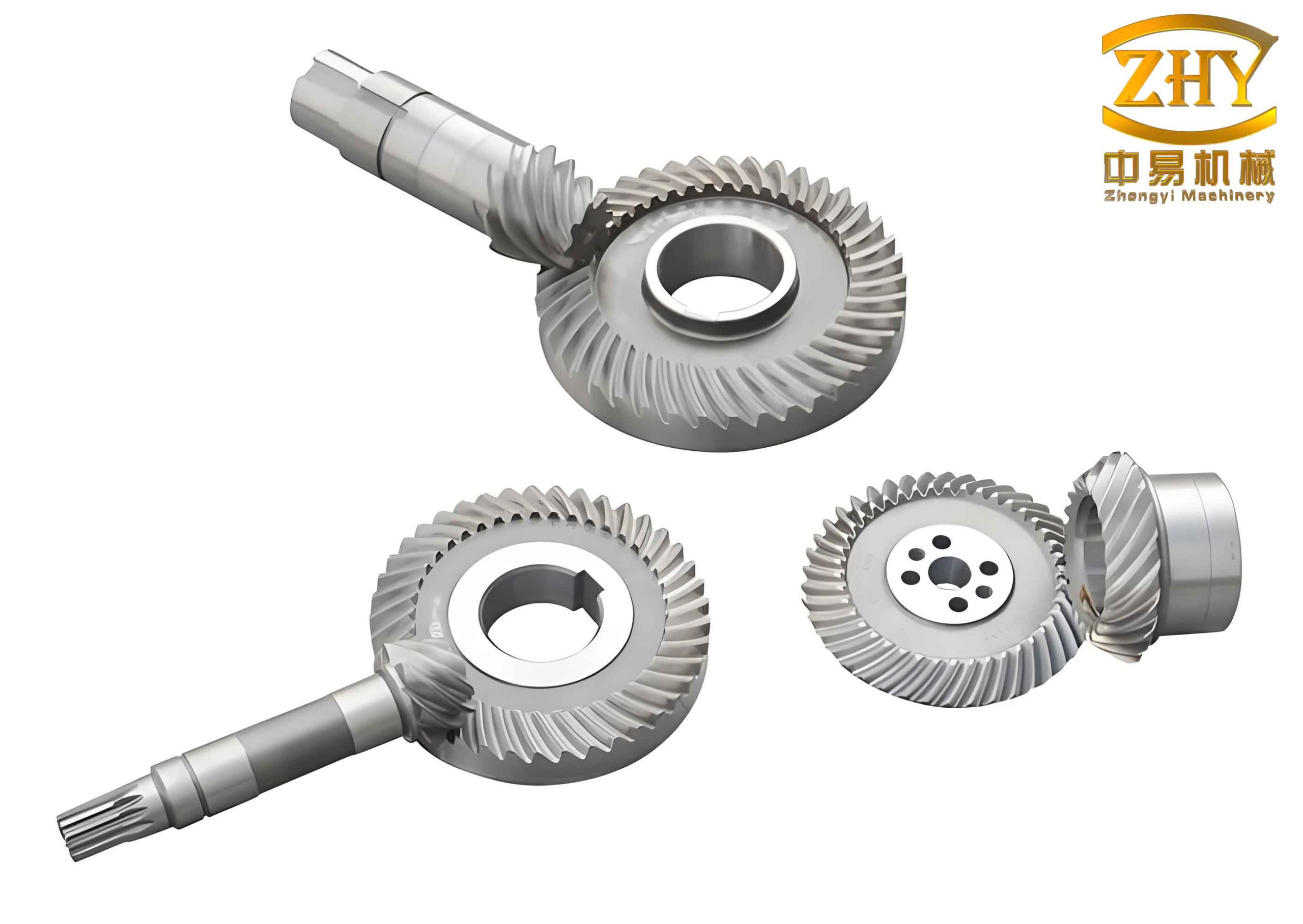
In practice, I have applied this method to various hyperboloid gear repairs, including those in off-road vehicles. For example, in a case involving a SUV rear differential, the original hyperboloid gears were severely worn, making direct measurement impossible. By using my custom tools, I determined an offset of $55.5$ mm. After manufacturing new hyperboloid gears based on this value, the reassembled differential operated smoothly, with no audible noise or excessive heating, confirming the method’s efficacy. This approach is particularly valuable for legacy systems where original design specifications are lost, as it allows reverse-engineering of key parameters.
Beyond measurement, understanding the dynamics of hyperboloid gears is crucial for optimal performance. The offset $E$ affects the gear tooth contact pattern, which can be modeled using the Gleason system for hypoid gears. The contact ellipse parameters, such as semi-major axis $a$ and semi-minor axis $b$, depend on $E$ and the gear geometry. For instance, the contact stress $\sigma_H$ can be estimated using the Hertzian contact formula:
$$ \sigma_H = \sqrt{\frac{F}{\pi \cdot \frac{1-\nu_1^2}{E_1} + \frac{1-\nu_2^2}{E_2}} \cdot \frac{1}{R}} $$
where $F$ is the normal load, $\nu$ is Poisson’s ratio, $E$ is Young’s modulus (not to be confused with offset), and $R$ is the effective radius of curvature. For hyperboloid gears, $R$ is influenced by $E$ through the pitch cone angles. A table summarizing key parameters for hyperboloid gear design can help illustrate these relationships.
| Parameter | Symbol | Typical Range | Influence of Offset $E$ |
|---|---|---|---|
| Offset | $E$ | 10–100 mm | Directly sets axis separation |
| Pinion Pitch Angle | $\delta_1$ | 15°–30° | Increases with $E$ for larger pinions |
| Ring Gear Pitch Angle | $\delta_2$ | 60°–75° | Decreases slightly with $E$ |
| Contact Ratio | $m_c$ | 1.5–2.5 | Optimized by adjusting $E$ |
| Load Capacity | $W_t$ | Depends on application | Higher $E$ allows stronger pinion |
In repair scenarios, after measuring $E$, I often perform a tooth contact analysis to verify the new gears will mesh properly. This involves applying a marking compound to the teeth and running the gears under light load to inspect the pattern. The ideal contact should be centered on the tooth flank, avoiding edges. If the offset is incorrect, the pattern shifts, indicating need for adjustment. For hyperboloid gears, this is critical because misalignment can cause localized stress concentrations, leading to pitting or spalling.
Another aspect I consider is the lubrication of hyperboloid gears. The offset influences the sliding velocity between teeth, which affects film thickness. The specific film thickness $\lambda$ can be calculated as:
$$ \lambda = \frac{h_{\min}}{\sqrt{R_q1^2 + R_q2^2}} $$
where $h_{\min}$ is the minimum film thickness from elastohydrodynamic lubrication theory, and $R_q$ are surface roughness values. For hyperboloid gears, $h_{\min}$ depends on the relative curvature, which is a function of $E$. Ensuring $\lambda > 3$ is desirable for full-film lubrication, reducing wear in repaired systems.
My method also extends to quality control in manufacturing new hyperboloid gears. By using the gauge block and mandrel as reference fixtures, I can verify the offset during assembly before installation. This proactive check prevents costly rework. Additionally, for批量 production, I have developed jigs that incorporate these principles, allowing rapid measurement with digital indicators for even higher precision.
Reflecting on challenges, one issue is thermal expansion. During operation, hyperboloid gears heat up, causing dimensional changes. For high-precision applications, I account for this by measuring at room temperature and applying a correction factor. The offset at operating temperature $E_{\text{hot}}$ can be estimated as:
$$ E_{\text{hot}} = E \cdot (1 + \alpha \Delta T) $$
where $\alpha$ is the coefficient of thermal expansion for the housing material (e.g., $11 \times 10^{-6}$ /°C for steel), and $\Delta T$ is the temperature rise. In practice, for typical differentials, $\Delta T \approx 50°C$, so the change in $E$ is negligible ($\sim 0.03$ mm), but for racing or heavy-duty use, it may be significant.
Furthermore, the alignment of bearing preload affects offset measurement. In my procedure, I ensure the bearings are seated properly without excessive preload, as this can distort the housing. I use torque wrenches to apply specified preloads during measurement, documenting the conditions for reproducibility. This attention to detail has been key in achieving consistent results across multiple repairs.
In terms of tooling cost, the gauge block and mandrel are inexpensive to produce, making this method accessible for small workshops. I recommend using hardened steel for longevity, especially if used frequently. For one-off repairs, even aluminum can suffice, though with lower wear resistance. The table below compares materials for the measurement components.
| Material | Hardness (HRC) | Cost | Suitability |
|---|---|---|---|
| Carbon Steel | 20–30 | Low | Good for occasional use |
| Tool Steel | 55–60 | Medium | Excellent for frequent use |
| Aluminum | 10–15 | Very Low | Prototyping or single use |
Looking ahead, advancements in 3D scanning could complement my method. By scanning the housing bores and generating digital models, the offset can be computed virtually. However, for field repairs where such technology is unavailable, my mechanical approach remains robust. I have trained technicians in this method, emphasizing the importance of clean, burr-free surfaces and accurate micrometer readings.
In conclusion, the measurement of offset in hyperboloid gears is a critical step in repair and maintenance. My developed method, based on custom gauges and simple geometry, provides a reliable solution with high precision. By incorporating error analysis and considering operational factors, it ensures that repaired hyperboloid gears perform optimally, extending service life and maintaining load capacity. I continue to refine this approach, exploring automated measurement systems for even greater efficiency. Ultimately, understanding and controlling the offset is fundamental to the successful application of hyperboloid gears in various mechanical systems.
To further elaborate, let’s delve into the mathematical foundations. The geometry of hyperboloid gears can be described using coordinate transformations. Consider two skew axes in space, with offset $E$ and shaft angle $\Sigma$. The pinion axis is along the z-axis, and the ring gear axis is offset in the x-direction. The transformation matrix from pinion to ring gear coordinates involves a translation by $E$ and a rotation by $\Sigma$. For typical hyperboloid gears, $\Sigma = 90°$, but it can vary. The position vector of a point on the pinion tooth surface in ring gear coordinates is:
$$ \mathbf{r}_g = \begin{bmatrix} E + x_p \cos \Sigma – y_p \sin \Sigma \\ x_p \sin \Sigma + y_p \cos \Sigma \\ z_p \end{bmatrix} $$
where $(x_p, y_p, z_p)$ are coordinates in the pinion system. This transformation highlights how $E$ directly affects meshing. In repair, if $E$ is incorrect, the tooth surfaces will not conjugate properly, leading to transmission errors.
Moreover, the offset influences the bending stress in gear teeth. Using the Lewis formula modified for hyperboloid gears, the bending stress $\sigma_b$ can be approximated as:
$$ \sigma_b = \frac{W_t}{F \cdot m_n \cdot Y} \cdot K_v \cdot K_o $$
where $W_t$ is tangential load, $F$ is face width, $m_n$ is normal module, $Y$ is Lewis form factor, $K_v$ is dynamic factor, and $K_o$ is overload factor. The tangential load distribution depends on $E$ through the contact pattern. For accurate repair, ensuring $E$ matches the original design minimizes stress concentrations.
I also consider the impact of offset on efficiency. The sliding friction losses in hyperboloid gears are higher than in parallel-axis gears due to the offset. The efficiency $\eta$ can be estimated as:
$$ \eta = 1 – \frac{\mu \cdot v_s}{v_r} $$
where $\mu$ is coefficient of friction, $v_s$ is sliding velocity, and $v_r$ is rolling velocity. The sliding velocity $v_s$ is proportional to $E$ for a given speed. Thus, an incorrectly measured offset can reduce efficiency, increasing fuel consumption in vehicles.
In my practice, I document every measurement in a log, including environmental conditions and tool serial numbers. This traceability has been valuable for troubleshooting and for continuous improvement of the method. For instance, I once encountered a case where the offset measurement varied by 0.1 mm between two technicians. Upon investigation, I found that one was not accounting for caliper parallax error. By standardizing the procedure—holding the caliper perpendicular and taking multiple readings—we reduced variability.
Finally, the versatility of this method extends beyond automotive to industrial hyperboloid gears used in mining equipment or marine drives. In these applications, offsets can be larger, up to 200 mm, requiring scaled-up gauges. The fundamental principle remains the same, demonstrating its robustness. As hyperboloid gears continue to evolve with materials like powdered metal or composites, accurate offset measurement will remain a cornerstone of reliable operation.