
The analysis of dynamic behavior in gear transmission systems is paramount for ensuring reliability, durability, and noise-vibration-harshness (NVH) performance, especially in high-speed applications such as automotive drivetrains. Among various gear types, hyperboloid gears, commonly known as hypoid gears, are critically important for automotive final drives due to their ability to provide high torque transmission between non-parallel, non-intersecting axes with smooth and quiet operation. However, the very geometric complexity that grants hyperboloid gears their advantages also complicates their dynamic analysis. This article establishes a single-degree-of-freedom nonlinear vibration model specifically for hyperboloid gears, incorporating key excitations like time-varying mesh stiffness, transmission error, and backlash. A robust numerical framework based on the shooting method and parameter continuation is employed to solve for periodic responses, yielding insightful frequency response characteristics.
The dynamic performance of hyperboloid gear pairs is governed by several interacting factors. A primary source of vibration is the parametric excitation caused by the time-varying mesh stiffness (TVMS). As the contact moves across the tooth flank from the root to the tip and between different tooth pairs, the effective stiffness of the gear mesh fluctuates periodically. This fluctuation acts as a parametric excitation in the system’s equations of motion. Secondly, transmission error (TE), defined as the deviation of the output gear’s position from its theoretical location based on a perfect conjugate action, serves as a primary external displacement excitation. TE arises from manufacturing inaccuracies, assembly misalignments, and elastic deformations under load. Finally, backlash, the intentional clearance between mating teeth, is essential for lubrication and preventing binding but introduces a severe nonlinearity. The presence of backlash can lead to tooth separation, impacting, and a dramatic increase in dynamic loads and noise. The combination of these factors—TVMS, TE, and backlash—renders the dynamics of hyperboloid gear systems inherently nonlinear, characterized by phenomena such as sub-harmonic resonances, bifurcations, and chaos, which cannot be captured by linear models.
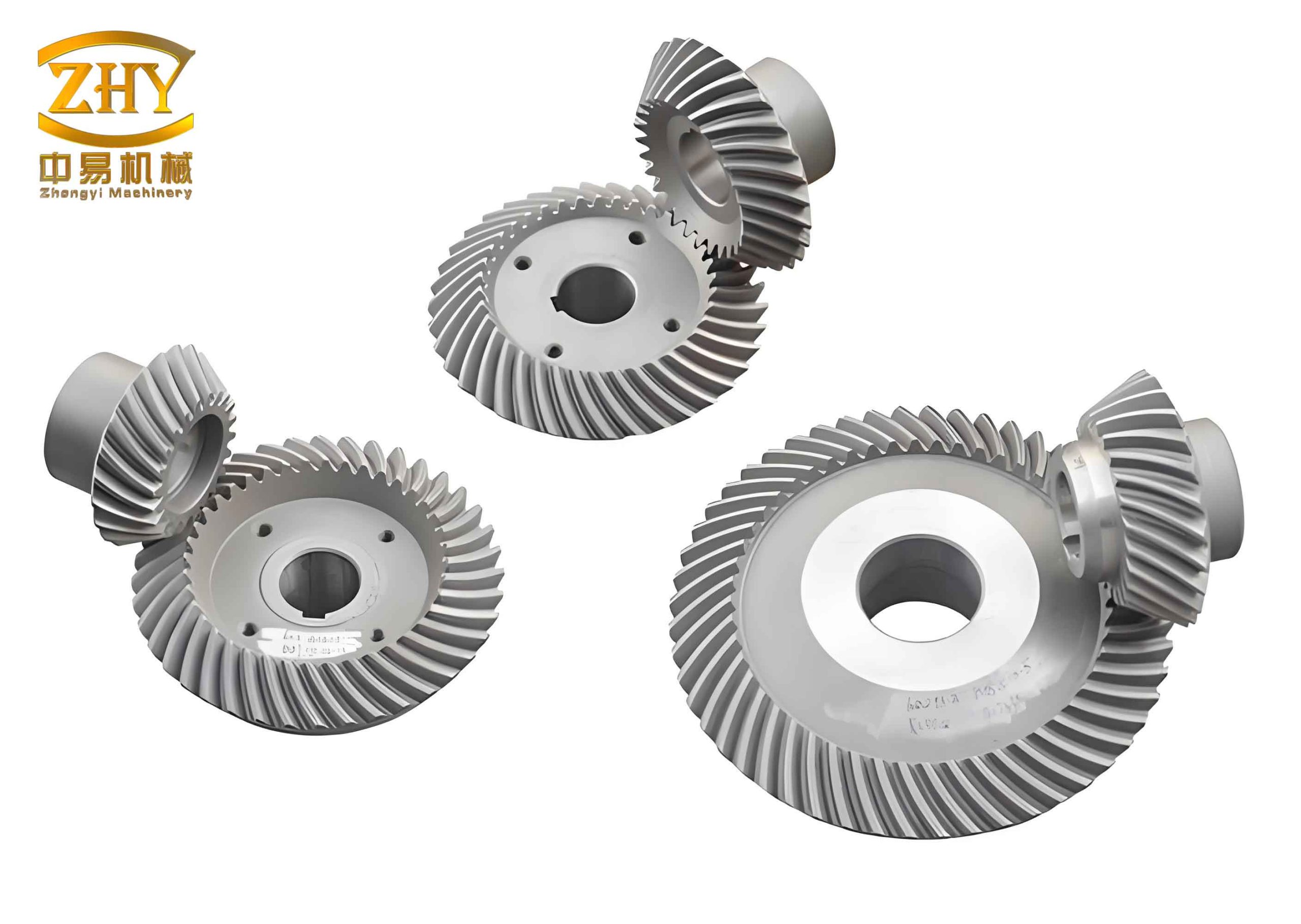
Mathematical Modeling of Hyperboloid Gear Vibration
To analyze the nonlinear dynamics, we begin by considering the torsional vibrations of the pinion and gear. Assuming the input and output shafts are rigidly connected to their respective gears, the equations of motion can be derived from fundamental mechanics. Let \( \theta_p(t) \) and \( \theta_g(t) \) represent the angular displacements of the pinion and gear, with moments of inertia \( I_p \) and \( I_g \). The input and output torques are \( T_p \) and \( T_g \). The nonlinear mesh force \( F_m \) acts along the line of action and is a function of the relative displacement, its derivative (damping), and the nonlinear backlash function.
The relative displacement along the line of action, considering the quasi-static transmission error excitation \( e(t) \), is given by:
$$ x(t) = r_{bp} \theta_p(t) – r_{bg} \theta_g(t) – e(t) $$
where \( r_{bp} \) and \( r_{bg} \) are the base circle radii (or their effective equivalents for hyperboloid gears). The dynamic mesh force can be modeled as:
$$ F_m = c_m \dot{\delta} + k_m(t) f(\delta) $$
Here, \( c_m \) is the mesh damping coefficient, \( k_m(t) \) is the time-varying mesh stiffness, and \( \delta \) is the dynamic deflection accounting for backlash. The backlash function \( f(\delta) \) is typically defined as:
$$
f(\delta) =
\begin{cases}
\delta – b, & \delta > b \\
0, & -b \le \delta \le b \\
\delta + b, & \delta < -b
\end{cases}
$$
where \( 2b \) represents the total gear backlash. The dynamic deflection is \( \delta = x(t) – x_0 \), with \( x_0 \) being the static deflection under load.
Applying Newton’s second law to each gear yields two coupled equations:
$$ I_p \ddot{\theta}_p + r_{bp} F_m = T_p $$
$$ I_g \ddot{\theta}_g – r_{bg} F_m = -T_g $$
By combining these equations to eliminate the reaction forces at the bearings, we can derive a single equation of motion for the relative displacement \( x(t) \). Defining an equivalent mass \( m_{eq} = \frac{I_p I_g}{I_g r_{bp}^2 + I_p r_{bg}^2} \) and an equivalent force \( F_{eq} = \frac{T_p}{r_{bp}} + \frac{T_g}{r_{bg}} \), the equation simplifies to:
$$ m_{eq} \ddot{x} + c_m \dot{x} + k_m(t) f(x – e(t) – x_0) = F_{eq} + m_{eq} \ddot{e}(t) $$
This is a nonlinear, parametrically and externally excited differential equation governing the dynamics of the hyperboloid gear pair.
For analytical and numerical convenience, we non-dimensionalize the equation. Introduce a nominal mesh frequency \( \omega_n = \sqrt{k_{mean} / m_{eq}} \), where \( k_{mean} \) is the average mesh stiffness. Define non-dimensional time \( \tau = \omega_n t \), non-dimensional displacement \( \bar{x} = x / b_c \) where \( b_c \) is a characteristic length (e.g., nominal backlash), and non-dimensional excitation frequency \( \bar{\omega} = \Omega / \omega_n \). The non-dimensional equation of motion becomes:
$$ \bar{x}” + 2\zeta \bar{x}’ + \bar{k}_m(\tau) \bar{f}(\bar{x} – \bar{e}(\tau)) = \bar{F}_{eq} + \bar{e}”(\tau) $$
where \( \zeta \) is the damping ratio, primes denote derivatives with respect to \( \tau \), \( \bar{k}_m \) is the non-dimensional stiffness variation, and \( \bar{f} \) is the normalized backlash function. This form is suitable for numerical investigation of the nonlinear response of hyperboloid gears.
Numerical Solution Methodology: Shooting and Continuation
Solving the derived nonlinear equation for periodic steady-state responses requires advanced numerical techniques. The shooting method, combined with parameter continuation, provides a powerful framework for this task.
The second-order non-dimensional equation is first transformed into a system of first-order state-space equations:
$$ \mathbf{y}’ = \mathbf{g}(\mathbf{y}, \tau, \lambda), \quad \mathbf{y} = [\bar{x}, \bar{x}’]^T $$
where \( \lambda \) represents a system parameter, typically the excitation frequency \( \bar{\omega} \). For a periodic solution with period \( T = 2\pi / \bar{\omega} \), the boundary condition is \( \mathbf{y}(T) – \mathbf{y}(0) = \mathbf{0} \). The shooting method aims to find an initial condition \( \mathbf{y}(0) = \mathbf{s} \) such that this boundary condition is satisfied. This is formulated as a root-finding problem for the function \( \mathbf{H}(\mathbf{s}, \lambda) = \mathbf{y}(T; \mathbf{s}) – \mathbf{s} = \mathbf{0} \), which is solved iteratively using the Newton-Raphson method:
$$ \mathbf{s}^{(j+1)} = \mathbf{s}^{(j)} – \left[ \frac{\partial \mathbf{H}}{\partial \mathbf{s}} \right]^{-1} \mathbf{H}(\mathbf{s}^{(j)}, \lambda) $$
The Jacobian matrix \( \partial \mathbf{H} / \partial \mathbf{s} \) is obtained by integrating the first-order variational equations alongside the original system.
To trace the solution branch as parameter \( \lambda \) varies, a parameter continuation technique is employed. Once a solution \( \mathbf{s}_0 \) is known for a parameter \( \lambda_0 \), a tangent predictor step estimates the solution \( \mathbf{s}_1 \) at \( \lambda_1 = \lambda_0 + \Delta \lambda \). This predictor is then corrected using the shooting method. However, near turning points or bifurcation points, the Jacobian \( \partial \mathbf{H} / \partial \mathbf{s} \) becomes singular, causing the standard continuation to fail.
To overcome this, an arc-length continuation or parameterization method is used. The parameter \( \lambda \) is treated as an additional dependent variable, and the arc-length \( l \) along the solution curve becomes the new independent parameter. The extended system includes the original state equations and the pseudo-arclength condition:
$$ \mathbf{N}(\mathbf{s}, \lambda, l) =
\begin{bmatrix}
\mathbf{H}(\mathbf{s}, \lambda) \\
(\mathbf{s} – \mathbf{s}_0)^T \dot{\mathbf{s}}_0 + (\lambda – \lambda_0) \dot{\lambda}_0 – \Delta l
\end{bmatrix} = \mathbf{0}
$$
where \( (\dot{\mathbf{s}}_0, \dot{\lambda}_0) \) is the unit tangent vector to the curve at the previous point. The Jacobian of this extended system is non-singular at regular turning points, allowing the solution path to be traced continuously through folds in the frequency response curve. The detection of bifurcation points (e.g., where a stable solution becomes unstable) can be monitored by examining the eigenvalues of the monodromy matrix (the state transition matrix over one period, which is closely related to \( \partial \mathbf{H} / \partial \mathbf{s} \)).
The table below summarizes the key aspects of the numerical methods employed for analyzing hyperboloid gear dynamics.
| Method | Purpose | Key Feature | Challenge Addressed |
|---|---|---|---|
| Shooting Method | Find periodic solutions for a fixed parameter. | Converts boundary value problem to initial value problem + root finding. | Solving nonlinear periodicity condition \( \mathbf{H}(\mathbf{s})=\mathbf{0} \). |
| Newton-Raphson | Solve \( \mathbf{H}(\mathbf{s})=\mathbf{0} \) iteratively. | Quadratic convergence near a root. | Requires computation of the Jacobian \( \partial \mathbf{H}/\partial \mathbf{s} \). |
| Parameter Continuation | Trace solution branch as a parameter (e.g., frequency) changes. | Uses tangent predictor and Newton corrector. | Fails at turning points where Jacobian is singular. |
| Arc-Length Continuation | Trace solution branch through turning points. | Parameterizes the solution curve by arc-length, not by system parameter. | Constructs an extended non-singular system; allows passage through folds. |
Numerical Example and Dynamic Response of Hyperboloid Gears
To demonstrate the application of the model and solution technique, a numerical case study for a representative hyperboloid gear set is presented. The system parameters are chosen to reflect typical automotive final drive applications. The time-varying mesh stiffness \( k_m(t) \) and static transmission error \( e(t) \) are approximated by Fourier series up to a specified harmonic order to make the numerical integration efficient while retaining essential dynamic characteristics.
The key parameters for the hyperboloid gear dynamic analysis are summarized in the following table:
| Parameter | Symbol | Value | Unit |
|---|---|---|---|
| Pinion Mass Moment of Inertia | \( I_p \) | \( 5.0 \times 10^{-4} \) | kg·m² |
| Gear Mass Moment of Inertia | \( I_g \) | \( 5.0 \times 10^{-3} \) | kg·m² |
| Mean Mesh Stiffness | \( k_{mean} \) | \( 2.5 \times 10^{8} \) | N/m |
| Mesh Damping Ratio | \( \zeta \) | 0.05 | – |
| Backlash | \( 2b \) | \( 2.0 \times 10^{-5} \) | m |
| Amplitude of Transmission Error (1st harmonic) | \( A_{TE} \) | \( 1.0 \times 10^{-6} \) | m |
| Amplitude of Stiffness Variation | \( \Delta k / k_{mean} \) | 0.3 | – |
The frequency response is computed using the arc-length continuation shooting method described previously. The response amplitude (often the peak-to-peak dynamic transmission error or dynamic mesh force) is plotted against the excitation frequency ratio \( \bar{\omega} = \Omega / \omega_n \). For a system with significant backlash, the frequency response curve exhibits pronounced nonlinear characteristics:
- Bending and Jump Phenomena: The resonance peak bends to the right (a hardening-type nonlinearity often due to the piecewise-linear stiffness from backlash) or, under different conditions, to the left. This bending leads to discontinuous jumps in amplitude as the frequency is slowly swept up or down.
- Coexistence of Solutions: Over certain frequency ranges, multiple periodic solutions (e.g., one stable and one unstable, or two stable with different amplitudes) can exist for the same parameter set. The attained solution depends on the initial conditions.
- Subharmonic and Chaotic Motions: At higher excitation levels or specific parameter combinations, the periodic solution may lose stability via period-doubling bifurcations, leading to subharmonic oscillations or even chaotic response, which significantly increases vibration and noise levels in hyperboloid gear systems.
The dynamic response is highly sensitive to the mean load (\( F_{eq} \)). Under high load, the gear pair may remain in continuous contact, linearizing the system and resulting in a response curve similar to a linear resonator. Under light or moderate load, the teeth frequently separate and impact due to backlash, triggering strong nonlinear behavior. Therefore, accurately modeling the backlash nonlinearity is not an option but a necessity for predicting the true dynamic performance of hyperboloid gears in real-world operating conditions, such as during coast or light throttle in vehicles.
Conclusion
This article has presented a comprehensive framework for the nonlinear dynamic analysis of hyperboloid gear systems. A single-degree-of-freedom model incorporating the essential nonlinearities of time-varying mesh stiffness, static transmission error, and backlash was developed. The model captures the complex dynamic interactions that dictate the vibration and noise generation in these critical automotive components. The shooting method, augmented with arc-length parameter continuation, was successfully applied to solve for the steady-state periodic responses, enabling the construction of complete frequency response curves that reveal nonlinear phenomena such as resonance peak bending, jump discontinuities, and multi-stability regions.
While the formulation and examples focused on hyperboloid gears, the mathematical structure of the governing equation and the robustness of the numerical solution technique have broad applicability. The same modeling approach and solution methodology can be directly extended to other gear types exhibiting similar excitations and clearance nonlinearities, such as helical gears and double-circular-arc gears. The insights gained from this nonlinear analysis are vital for the design and optimization of high-performance hyperboloid gear drives, guiding efforts to minimize dynamic loads, reduce noise, and enhance durability under the demanding conditions of modern automotive applications.