
The accurate prediction of dynamic behavior in gear transmission systems is paramount for noise, vibration, and harshness (NVH) refinement. For automotive drive axles, the primary source of excitation is often the transmission error (TE) of the final drive gear set. This kinematic error, arising from design modifications, manufacturing imperfections, and elastic deflections under load, injects vibrational energy into the system, which propagates through the structure and radiates as undesirable noise. While research on hyperboloidal gears has traditionally focused on sophisticated geometrical modeling for tooth contact analysis (TCA) and static load distribution to optimize contact patterns and stress, these static analyses fall short of predicting the system’s dynamic vibratory response. To bridge this gap, dynamic models of the gear system incorporating mass, damping, and stiffness properties are essential. Among these parameters, the time-varying mesh stiffness (km(t)) is the critical link between the static tooth contact behavior and the dynamic system response, serving as a primary parametric excitation.
Calculating this km(t) for hyperboloidal gears presents a significant challenge, unlike the case for parallel-axis spur or helical gears. For spur gears, the mesh force direction remains largely constant, and established analytical or empirical methods exist for stiffness calculation. In contrast, hyperboloidal gears feature complex, spatially curved tooth surfaces and an offset between axes. During meshing, the contact point moves across the face width and along the profile, causing the direction of the mesh force and its effective lever arm to change continuously with gear rotation and applied load. This complexity makes simplified analytical approaches inadequate. While some studies have approximated the stiffness with constant values or Fourier series, and others have used specialized software, a detailed, transparent, and general finite element method (FEM)-based approach using widely available tools like ABAQUS is less documented. This work proposes and validates a complete FEM-based methodology to calculate the true time-varying mesh stiffness of hyperboloidal gears, providing a foundation for more accurate driveline dynamic simulations.
1. Theoretical Foundation for Mesh Stiffness Calculation via FEM
The core idea is to simulate the quasi-static meshing process of the gear pair under load using nonlinear finite element analysis. From the FEA results—nodal forces, displacements, and reaction moments—the equivalent mesh stiffness at each instant in time can be derived. The following mathematical model formalizes this process.
Consider a gear pair in mesh. At any given time t, multiple tooth pairs may be in contact, and each contact patch is discretized into finite elements. The total instantaneous mesh force vector Ft is the sum of all contact force vectors on the interacting tooth flanks:
$$ \mathbf{F}^{(l)}_t = \sum_{i=1}^{N_{\text{tooth}}} \sum_{j=1}^{N_{\text{point}}^{(i)}} \mathbf{n}^{(l)}_{ij} k_{ij} \delta_{ij} $$
Where l denotes the coordinate system (gear 1 or 2), Ntooth is the number of simultaneously contacting tooth pairs, Npoint(i) is the number of contact elements on the i-th tooth pair, nij is the unit normal vector at the contact element, kij is the local contact stiffness, and δij is the local penetration. This can be conceptualized as an equivalent single-point contact with an effective mesh force magnitude Wt, an effective line of action nt, and an effective mesh stiffness kt:
$$ \mathbf{F}^{(l)}_t = \mathbf{n}^{(l)}_t \cdot k_t \delta_t = \mathbf{n}^{(l)}_t W_t $$
Thus, the magnitude of the total mesh force is Wt = ||Ft||. The effective point of application of this force, rt, is calculated as the force-weighted average of all contact point locations:
$$ \mathbf{r}^{(l)}_t = \frac{\sum_i \sum_j \mathbf{r}^{(l)}_{ij} k_{ij} \delta_{ij}}{\sum_i \sum_j k_{ij} \delta_{ij}} $$
The instantaneous torque Mt on the gear due to mesh forces must equal the sum of torques from all contact elements, and also equal the torque from the equivalent force Wt acting at rt:
$$ \mathbf{M}^{(l)}_t = \sum_i \sum_j ( \mathbf{r}^{(l)}_{ij} \times \mathbf{n}^{(l)}_{ij} ) k_{ij} \delta_{ij} = ( \mathbf{r}^{(l)}_t \times \mathbf{n}^{(l)}_t ) W_t $$
Defining the effective rotational radius vector as λt = rt × nt, we have Mt = λt Wt. For a gear rotating primarily about the x-axis, the component λxt is most critical. It relates the effective force to the applied torque: Mt ≈ λxt Wt.
The linear static transmission error (STE) under load is the deviation of the driven gear’s angular position from its ideal rigid position. If θ1 and θ2 are the rotations of the pinion and gear, and N1, N2 are their tooth numbers, the kinematic error is:
$$ \Delta \theta_t = \theta_{2t} – \frac{N_1}{N_2} \theta_{1t} $$
The loaded STE, ΔθLt, differs from the unloaded (or very lightly loaded) STE, Δθ0t, due to elastic deflections. The equivalent linear deflection along the line of action, δt, responsible for this change in STE is given by the projection of the angular error onto the effective rotational radius:
$$ \delta_t = (\Delta \theta_{Lt} – \Delta \theta_{0t}) \lambda_{xt} $$
Finally, the instantaneous mesh stiffness kt is defined as the ratio of the effective mesh force magnitude to this linear deflection:
$$ k_t = \frac{W_t}{\delta_t} = \frac{W_t}{(\Delta \theta_{Lt} – \Delta \theta_{0t}) \lambda_{xt}} $$
This formulation is general. For spur gears, λxt is essentially constant (the pitch radius). For hyperboloidal gears, λxt, Wt, and Δθt are all complex functions of the mesh position, which FEM can capture.
1.1 Model Validation: Application to Spur Gears
To validate this FEM-based approach, it was first applied to a standard spur gear pair where established methods (e.g., the Kuang model) exist. The gear parameters are listed below:
| Parameter | Gear | Pinion |
|---|---|---|
| Number of Teeth, N | 34 | 34 |
| Pressure Angle, α | 20° | |
| Module, m (mm) | 2.5 | |
| Face Width, b (mm) | 12 | 12 |
| Young’s Modulus, E (GPa) | 210 | |
| Poisson’s Ratio, ν | 0.3 | |
A 3D finite element model was built and analyzed under a static torque. The calculated mesh stiffness over one mesh cycle showed the characteristic double-to-single tooth contact transitions. The results from the proposed FEM method aligned closely with those from the Kuang analytical model, verifying the correctness of the stiffness extraction methodology. The FEM results naturally included minor fluctuations due to contact nonlinearities not modeled in simpler analytical approaches.
2. Geometrical and Finite Element Modeling of Hyperboloidal Gears
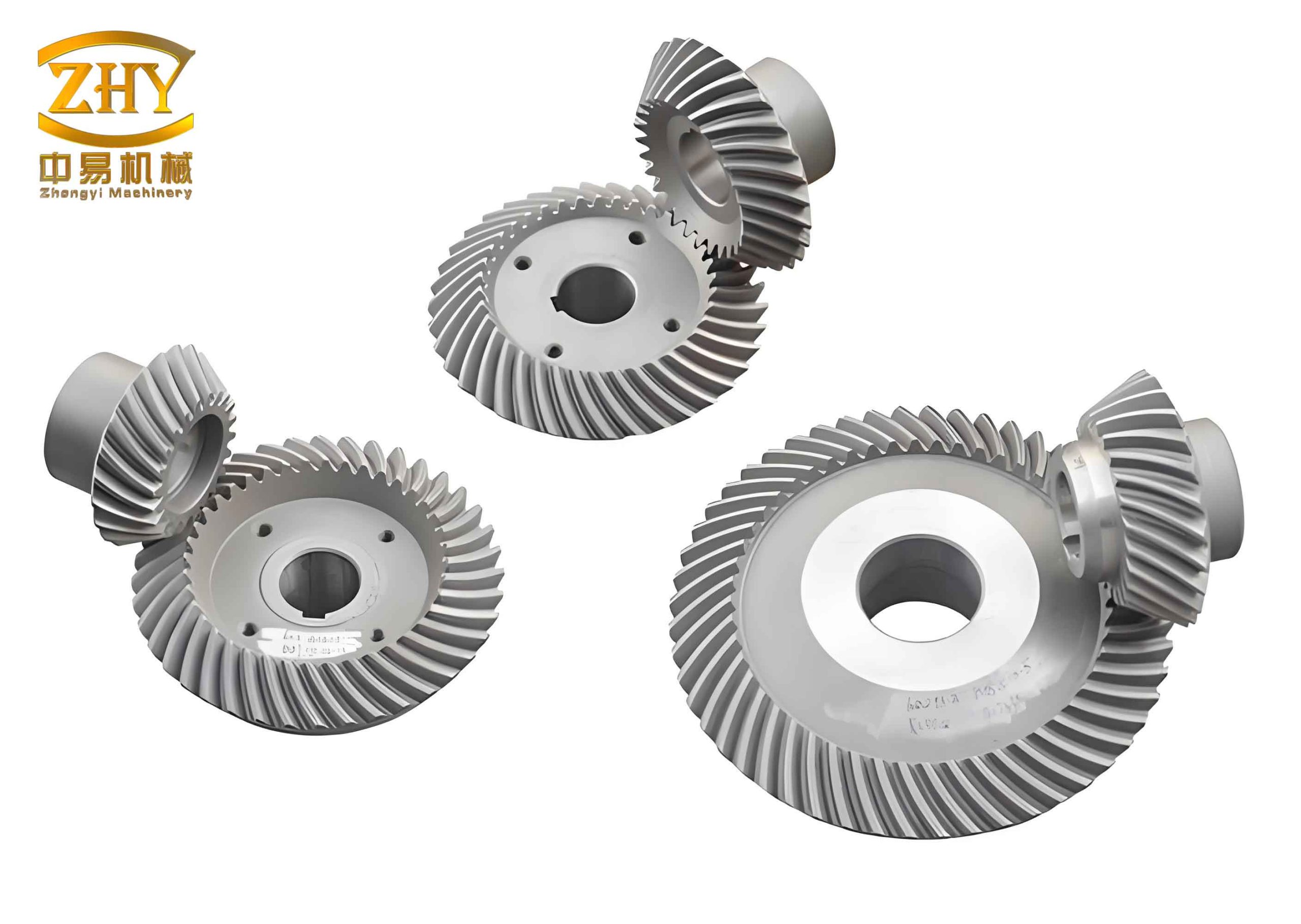
The accurate geometric modeling of hyperboloidal gears is the first and crucial step. The tooth surfaces are generated via a complex machining process (e.g., using Gleason methods). The mathematical model follows the gear generation kinematics, where the cutter surface (representing the tool) undergoes a series of coordinated motions relative to the gear blank. The locus of the cutter surface, satisfying the equation of meshing with the blank, defines the gear tooth surface.
The process can be summarized by the following coordinate transformations and conditions. Let Sc be the cutter coordinate system and Sg be the gear coordinate system. A point on the cutter surface is defined by parameters (u, θ). Its position vector in Sg is obtained through a sequence of transformations involving machine settings (cradle angle ψc, workpiece rotation ψg, etc.):
$$ \mathbf{r}_g(u, \theta, \psi_c) = \mathbf{M}_{gc}(\psi_c) \cdot \mathbf{r}_c(u, \theta) $$
The equation of meshing links the workpiece rotation to the cutter motion:
$$ f(u, \theta, \psi_c) = \mathbf{n}_c \cdot \mathbf{v}_c^{(cg)} = 0 $$
Where nc is the cutter surface normal and vc(cg) is the relative velocity. Solving this system for a discrete set of parameters yields point clouds for the convex and concave sides of both the pinion and gear. These points are then interpolated using Non-Uniform Rational B-Spline (NURBS) surfaces in CAD software (e.g., CATIA) to create a watertight 3D solid model. For this study, a face-hobbing (Formate) generated gear and a generated pinion were modeled. Key gear blank and machine setup parameters are summarized below.
| Parameter | Pinion | Gear |
|---|---|---|
| Number of Teeth | 8 | 43 |
| Module (mm) | 6.861 | |
| Offset (mm) | -25.4 | |
| Hand of Spiral | Left | Right |
| Mean Spiral Angle | 45° 3′ | 33° 49′ |
| Face Width (mm) | 44.8 | 41.0 |
| Mean Pressure Angle | 22° 30′ | |
2.1 Finite Element Model Development
The 3D CAD model was imported into a preprocessor for meshing. To preserve geometric accuracy and stress gradients, a full-gear model with second-order hexahedral (brick) elements was employed. The mesh consisted of approximately 277,000 elements and 238,000 nodes. The finite element analysis was performed in ABAQUS/Standard using a quasi-static procedure to simulate the slow-roll meshing under load, effectively capturing the nonlinear contact conditions without inertial effects.
Key Modeling Considerations:
- Material: Linear elastic steel properties were assigned (E = 206 GPa, ν = 0.27).
- Elements: C3D8R elements (8-node linear brick, reduced integration with hourglass control) were used.
- Contact: Surface-to-surface contact was defined between all potential contacting tooth flanks. A “hard” contact pressure-overclosure relationship was used in the normal direction, and a penalty friction formulation with a coefficient of 0.1 was used in the tangential direction.
- Analysis Steps:
- Load Step: A small rotational torque (e.g., 10 Nm) is applied to the gear to establish initial contact for the unloaded TE simulation. For the loaded case, the full operational torque (e.g., 9500 Nm) is applied.
- Rotation Step: A rotational displacement is applied to the pinion while the opposing torque is maintained on the gear. The rotation speed is chosen to be slow enough to maintain quasi-static conditions.
- Boundary Conditions: The pinion shaft end is fixed except for rotation about its axis. The gear shaft end is constrained against all motions except rotation about its axis, where the reaction torque is measured.
The static stress contour from a typical analysis under high load shows the expected Hertzian contact stress ellipse on the tooth surface and bending stress at the tooth root. The analysis clearly shows load sharing among multiple tooth pairs, a characteristic feature of hyperboloidal gears.
| Component | Young’s Modulus, E (MPa) | Poisson’s Ratio, ν | Density, ρ (tonne/mm³) |
|---|---|---|---|
| Gears | 2.06e5 | 0.27 | 7.90e-9 |
3. Calculation and Analysis of Hyperboloidal Gear Mesh Stiffness
3.1 Transmission Error Under Nominal and Light Loads
The first step in applying the stiffness formula is obtaining the unloaded (or lightly loaded) static transmission error Δθ0t. A very small torque (10 Nm) was applied to ensure stable contact in the FEA without inducing significant structural deflection. Under this condition, the analysis confirmed single-tooth-pair contact throughout the mesh cycle, as evidenced by non-overlapping force histories on individual tooth surfaces. The calculated STE, Δθ0t, exhibited a smooth, parabolic-like pattern over the mesh period. This parabolic function is a deliberate design outcome for hyperboloidal gears, intended to minimize acceleration discontinuities and thus reduce vibration excitation at light loads.
To verify the geometric accuracy of the FEM model, the contact pattern and pressure were examined at the design mean point. The location of the contact centroid and the normal vector from FEA showed excellent agreement with results from a purely geometrical Tooth Contact Analysis (TCA), confirming the fidelity of the generated tooth surfaces and the contact setup.
3.2 Loaded Meshing and Stiffness Extraction
Subsequently, a series of analyses were performed under operational loads, simulating a vehicle at a constant speed (e.g., 40 km/h). A pinion input speed of 9.6 rad/s and a resisting torque of 9500 Nm on the gear were applied. The force history on individual teeth now showed periods of overlap, confirming multi-tooth contact. The total equivalent mesh force Wt was computed by vector summation of all contact node forces at each output increment.
The loaded STE, ΔθLt, also displayed a periodic pattern but was offset to a larger mean value compared to the unloaded case, reflecting the cumulative elastic deflection of the teeth, shafts, and housing under load. Notably, the fluctuation amplitude of the loaded STE was smaller than that of the unloaded STE. This damping of fluctuation is due to the increased load sharing among multiple teeth and the nonlinear stiffening of the contact as load increases.
Using the time histories of Wt, ΔθLt, Δθ0t, and the computed λxt from the FEA results, the time-varying mesh stiffness kt was calculated according to the derived formula. The result for the 9500 Nm load case is plotted below conceptually. The stiffness exhibits a clear periodic variation with a period equal to the gear mesh cycle (pinion revolution / pinion tooth count).
The shape of the kt curve for hyperboloidal gears is distinctly different from the near-rectangular wave of spur gears. It shows a gradual decline, a relatively stable region, and then a sharp recovery. This smoother transition is a key reason for the lower noise propensity of hyperboloidal gears compared to spur gears, as it avoids the abrupt stiffness changes that cause significant impulsive excitations.
3.3 Influence of Load Magnitude on Mesh Stiffness
The analysis was repeated for a range of applied torques (1000, 3000, 5000, 7000, 9000 Nm) to investigate the load-dependency of the mesh stiffness. The following trends were observed and are summarized in the table below:
| Applied Torque (Nm) | Mean Mesh Stiffness | Stiffness Fluctuation Amplitude | Primary Cause |
|---|---|---|---|
| Low (1000) | Lower | Higher | Lower contact ratio, more sensitive to geometric variations. |
| Medium (5000) | Moderate | Moderate | Increased load sharing begins to smooth transitions. |
| High (9000) | Higher | Lower | High contact ratio and significant structural deflection dominate. |
Trend 1: Increase in Mean Stiffness. As the load increases, the average mesh stiffness over a cycle increases. This is somewhat counter-intuitive, as deflection increases with load. However, kt = Wt/δt. While both Wt and δt increase, δt includes deflections from gear body bending and shaft wind-up, which are non-linear and can be proportionally smaller at higher loads due to distributed contact and support, causing the ratio kt to rise.
Trend 2: Decrease in Fluctuation Amplitude. The peak-to-peak variation in kt within a mesh cycle decreases with increasing load. Higher loads engage more of the tooth surfaces, improve the contact ratio, and make the load transfer between successive tooth pairs more gradual. This “smoothing” effect is highly beneficial for NVH performance.
The relationship between load (W), composite deflection (δ), and stiffness (k) can be conceptually described by a nonlinear spring function:
$$ W = k(\delta) \cdot \delta $$
where k(δ) itself increases with δ, representing the stiffening contact.
4. Conclusion
This paper has presented a comprehensive and practical methodology for calculating the time-varying mesh stiffness of automotive hyperboloidal gears using nonlinear finite element analysis. The complete workflow encompasses:
- The derivation of a general stiffness extraction formula based on equivalence of work and torque from detailed FEM contact results.
- The accurate generation of hyperboloidal gear tooth geometry via mathematical simulation of the manufacturing process.
- The development of a robust quasi-static FEM model capturing multi-tooth contact, friction, and large rotations.
- The systematic post-processing of FEA data to obtain force, transmission error, and effective lever arm, leading to the instantaneous mesh stiffness.
The method was validated against a known spur gear model. When applied to hyperboloidal gears, it revealed their characteristic smooth, periodic stiffness variation, which contrasts sharply with the abrupt changes seen in spur gears. The study further quantified the load-dependency of this stiffness, showing an increase in mean value and a decrease in fluctuation amplitude with higher torque. The calculated stiffness functions are direct inputs for multi-body dynamic models of the entire drive axle system, enabling higher-fidelity simulation of gear whine and system dynamics without relying on simplified stiffness assumptions. This methodology provides a critical tool for the NVH-driven design and optimization of hyperboloidal gear sets in automotive applications.