
The design of geometric parameters for a pair of hyperboloidal gears constitutes the foundational and most critical step in their development. These gears, characterized by their complex spatial geometry and offset axes, are indispensable in high-performance powertrains found in automotive, aerospace, and heavy machinery industries. The quality of their meshing behavior—encompassing noise, vibration, contact pattern, and load-carrying capacity—is profoundly and directly influenced by the initial choices and calculations of their geometric dimensions. This article synthesizes the historical context, current research landscape, and future trajectories in the design of hyperboloidal gear geometry, presented from an integrated engineering perspective.
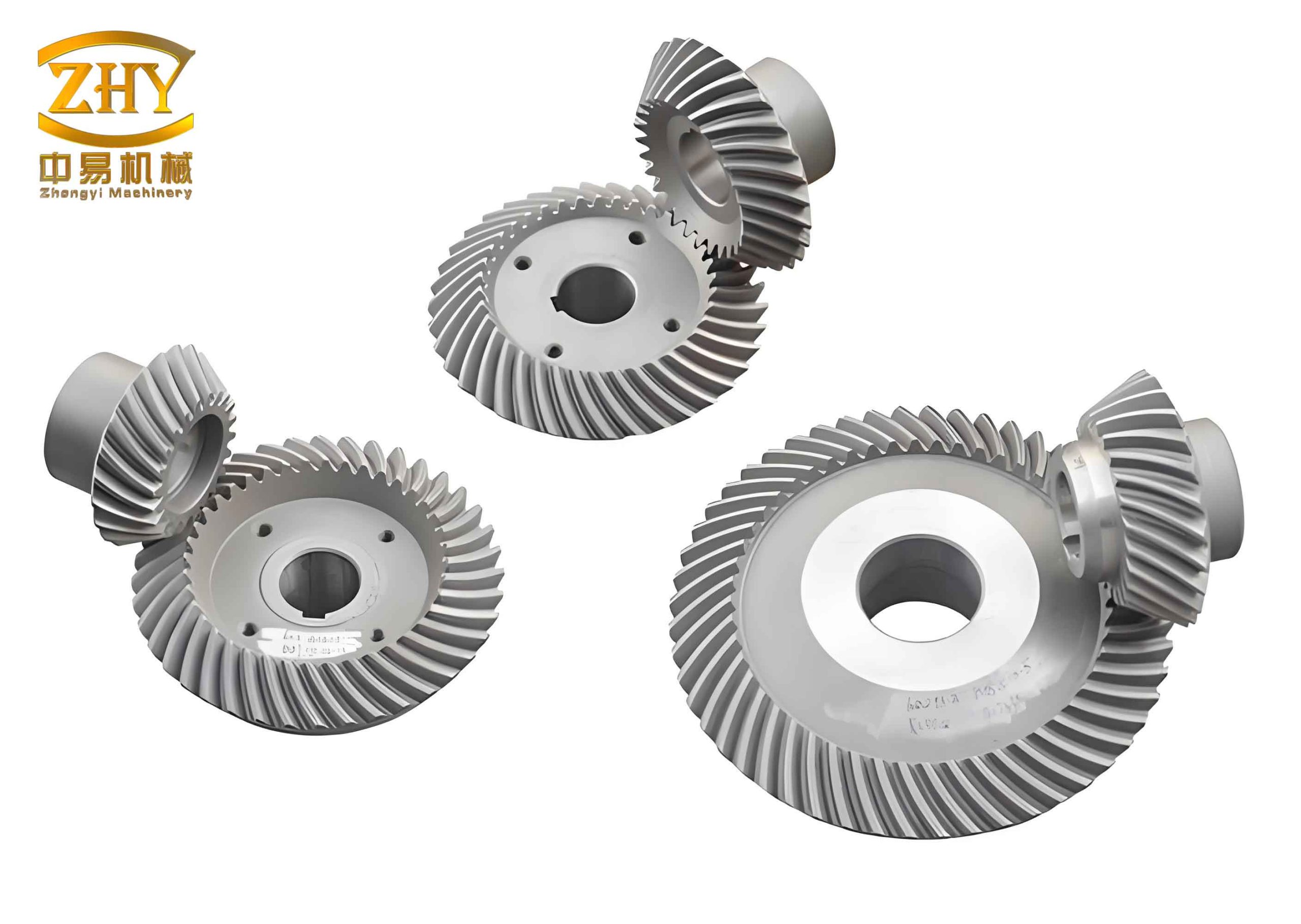
The inherent complexity of hyperboloidal gears arises from the fact that their tooth surfaces are generated from a non-planar pitch surface—a hyperboloid of revolution. This results in variable pressure angles and curvatures along the tooth profile and length. Consequently, defining parameters like pitch cone angles, spiral angles, offset, and tooth depth is not a straightforward task but rather the solution to a complex system of interdependent spatial geometric constraints. For decades, this process was governed by empirical charts and intricate calculation sequences developed by machine tool manufacturers. The transition from these manual, experience-based methods to precise, computationally-driven analytical and optimization-based frameworks represents the central theme of modern advancement in hyperboloidal gear design.
Historical Paradigm: The Gleason System and Its Limitations
The traditional methodology, most famously encapsulated in the Gleason calculation sheets, provided a systematic, step-by-step procedure involving over 150 sequential calculation steps or numbered formulas. This system, while groundbreaking for its time, was fundamentally designed for manual execution with logarithmic tables and slide rules. Its primary objective was not necessarily optimal performance but to yield a workable set of parameters that could be directly translated into machine settings for specific cutting methods (e.g., Formate or Duplex). The limitations of this paradigm are well-recognized:
| Aspect | Limitation in Traditional Gleason Method |
|---|---|
| Computational Nature | Designed for manual iteration; prone to human error and accumulation of rounding errors, leading to approximations. |
| Design Flexibility | Highly prescriptive. Parameters like addendum coefficient, pressure angle, and spiral angle were often selected from fixed charts, limiting optimization for specific goals (e.g., minimum noise, maximum strength). |
| Geometric Constraints | Often enforced symmetrical meshing conditions for both drive and coast sides as a default, which may not be optimal for unidirectional applications. |
| Pitch Cone Definition | The calculated pitch point (intersection of pitch cones) could deviate significantly from the desired mid-face position, affecting the stability of the contact pattern. |
| Cutter Radius Correlation | Calculated gear geometry and required cutter radius were loosely coupled, sometimes leading to mismatches requiring adjustment in later stages. |
The governing equations in the traditional system, though rarely presented in a consolidated analytical form, implicitly solved a set of geometric relations. A fundamental set involves the basic pitch cone geometry for a 90° shaft angle, which can be expressed as:
$$
\begin{aligned}
R_{m2} &= \frac{A_0}{\sin \Gamma} \\
R_{m1} &= \sqrt{R_{m2}^2 + E^2 – 2 R_{m2} E \cos \Gamma} \\
\sin \gamma &= \frac{R_{m2} \sin \Gamma}{R_{m1}} \\
\beta_{m1} &= \beta_{m2} \pm \theta
\end{aligned}
$$
Where \( R_{m1}, R_{m2} \) are the mean pitch radii of the pinion and gear, \( \gamma, \Gamma \) are the pitch angles, \( A_0 \) is the mean cone distance of the gear, \( E \) is the offset, and \( \beta_{m1}, \beta_{m2} \) are the mean spiral angles. The sign of \( \theta \) depends on the hand of spiral. Solving this system manually for a desired offset, ratio, and spiral angle required iterative look-ups and adjustments.
The Modern Computational Framework: A Multifaceted Advance
The advent of digital computation has revolutionized the design of hyperboloidal gears. Researchers have deconstructed the traditional “black box” approach, reformulating the problem into explicit mathematical models suitable for algorithmic solution and optimization. This modern framework can be categorized into several interconnected advances.
1. Analytical Reformulation of Pitch Cone Geometry
A pivotal shift has been moving from graphical/nomographic solutions to pure analytical geometry. The classical methods traced back to Everharter and others relied heavily on spatial visualization. Modern approaches use vector algebra and coordinate transformations to directly establish the governing equations. For two skewed pitch cones in tangency, the conditions can be defined by the coincidence of a point and the alignment of surface normals. This leads to a system of equations that fully defines the pitch cone parameters (\( \gamma, \Gamma, R_{m1}, R_{m2}, \beta_{m1}, \beta_{m2}, E \)) for any shaft angle \( \Sigma \).
Let \( \mathbf{O}_1 \) and \( \mathbf{O}_2 \) be the apex points of the pinion and gear pitch cones, separated by the shaft centerline distance. The vector \( \mathbf{r}_1 \) from \( O_1 \) to the pitch point \( P \) lies on the pinion pitch cone surface, and \( \mathbf{r}_2 \) from \( O_2 \) to \( P \) lies on the gear pitch cone surface. The tangency condition requires:
$$
\begin{aligned}
\mathbf{n}_1 \times \mathbf{n}_2 &= 0 \quad \text{(Normals are parallel)} \\
(\mathbf{r}_1 – \mathbf{r}_2) \cdot \mathbf{n}_1 &= 0 \quad \text{(Distance between surfaces at P is zero)}
\end{aligned}
$$
Expanding these vector equations with direction cosines derived from the pitch angles and spiral angles yields a solvable nonlinear system. This analytical foundation allows designers to treat parameters like the pinion spiral angle \( \beta_{m1} \) or the gear pitch angle \( \Gamma \) as independent variables to be precisely controlled, a significant improvement over the iterative guesswork of the past.
2. Virtual Pitch Cone and Parameter Reallocation
A significant conceptual breakthrough is the decoupling of the theoretical pitch cone from the physical blank geometry. Traditional design assumes the pitch cone lies within the gear blank. The “virtual pitch cone” or “modified pitch cone” method intentionally positions the gear’s pitch cone outside its physical body (i.e., the pitch angle \( \Gamma \) is made larger than the face angle). This is mathematically equivalent to assigning a negative addendum coefficient to the gear. The primary advantages are:
- Increased Pinion Strength: By allocating more material to the pinion root, its critical bending stress is reduced.
- Balanced Flash Temperature: Can improve the conformity of contacting surfaces, reducing contact pressure and risk of scuffing.
- Design for High Ratios: Facilitates the design of high-ratio hyperboloidal gears where traditional geometry becomes constrained.
The design process involves first calculating a standard gear set, then, while keeping the gear outer diameter and mean working depth constant, mathematically “shifting” the pitch cone outward. All other dependent geometry (pinion outer diameter, root angles, etc.) is recalculated based on the new virtual pitch cone parameters. The governing modification can be summarized by redefining the gear addendum \( a_2 \) and dedendum \( b_2 \):
$$
a_2 = k_{a2} m_t \quad \text{where } k_{a2} \le 0 \\
b_2 = h_{wk} – a_2 + c
$$
where \( k_{a2} \) is the gear addendum coefficient, \( m_t \) is the transverse module at the mean point, \( h_{wk} \) is the working depth, and \( c \) is the clearance.
3. Unified Computational Models and Constraint-Based Solving
Instead of following a rigid sequence, modern software models the entire geometric parameter set as a system of simultaneous equations with defined constraints. A typical comprehensive model might include over 20 equations involving pitch geometry, tooth depth proportions, blank dimensions, and cutter parameters. The system is solved using numerical methods like Newton-Raphson or as a constrained optimization problem.
For example, one can define the following three key control variables and their target constraints:
- Gear Pitch Angle (\( \Gamma \)): Constrain its solved value to equal its initial/target value.
- Pinion Spiral Angle (\( \beta_{m1} \)): Constrain its solved value to a specific target.
- Pitch Point Location: Constrain it to be at the mid-face width of the gear for optimal contact stability.
The solver then adjusts other free variables (like the initial cone distance or offset) to satisfy all geometric equations under these constraints. This approach directly addresses historical shortcomings, ensuring precise control over critical performance parameters. The mathematical problem can be framed as:
$$
\text{Minimize } F(\mathbf{X}) = w_1(\Gamma_{calc} – \Gamma_{targ})^2 + w_2(\beta_{1,calc} – \beta_{1,targ})^2 + w_3(P_z – 0)^2 \\
\text{Subject to: } \mathbf{G}(\mathbf{X}) = 0 \text{ (System of geometric equations)}
$$
where \( \mathbf{X} \) is the vector of design variables, \( P_z \) is the deviation of the pitch point from the gear mid-face along the axis, and \( w_i \) are weighting factors.
4. Optimization-Driven Design
Building on computational models, the next step is true optimization. Here, the geometric parameters become design variables in a formal optimization problem aimed at minimizing or maximizing specific performance metrics. Common objectives include:
| Optimization Objective | Relevant Geometric Parameters | Impact |
|---|---|---|
| Minimize Gear Noise | Spiral Angle \( \beta \), Pressure Angle \( \alpha \), Face Width \( F \), Offset \( E \) | Influences mesh stiffness variation, sliding velocities, and dynamic excitation. |
| Maximize Bending Strength | Pinion Addendum Coefficient \( k_{a1} \), Root Fillet Geometry, Virtual Pitch Cone | Directly affects the critical root stress of the weaker pinion. |
| Maximize Surface Durability (Pitting Resistance) | Relative Curvature Radii, Pressure Angle, Surface Conformity | Affects contact pressure (Hertzian stress). |
| Minimize System Volume/Weight | Gear Outer Diameter \( D_{o2} \), Face Width \( F \), Offset \( E \) | Reduces material usage and inertia. |
An example objective function for a multi-goal optimization of hyperboloidal gears could be:
$$
\text{Minimize: } \Phi = \mu_1 \cdot S_{max}^n + \mu_2 \cdot \sigma_{max}^m + \mu_3 \cdot L_{vol} + \mu_4 \cdot \Delta K
$$
where \( S_{max} \) is maximum contact stress, \( \sigma_{max} \) is maximum bending stress, \( L_{vol} \) is a normalized volume metric, \( \Delta K \) is an estimated mesh stiffness variation proxy for noise, and \( \mu_i \) are weighting coefficients. The exponents \( n, m \) can be used to tailor the sensitivity. The geometric parameters are varied within practical bounds to find the minimum of \( \Phi \).
5. Flexibility in Tooth Depth Parameters: Non-Zero Displacement
Traditional designs often used a “zero-displacement” or “standard height” tooth system. The concept of “non-zero displacement” for hyperboloidal gears (analogous to profile shift in parallel axis gears) provides another powerful degree of freedom. By independently choosing the pinion and gear addendum coefficients (\( k_{a1}, k_{a2} \)), designers can:
- Avoid undercut on low-tooth-count pinions.
- Balance specific sliding ratios to reduce wear and risk of scoring.
- Adjust the pressure angle at the critical root fillet region to reduce stress concentration.
For the drive side of a hyperboloidal gear set, the effective pressure angle can be influenced by the displacement. The relationship between the cutter pressure angle \( \alpha_c \), the generated gear pressure angle \( \alpha_g \), and the displacement is complex but follows fundamental gear generation theory. This flexibility is integral to modern low-noise, high-strength designs for hyperboloidal gears.
6. Systematic Derivation of Blank Dimensions
Once the pitch cone geometry is resolved, the determination of the gear blank dimensions (apex to back, face angles, root angles) follows a more deterministic and less chart-dependent path. The fundamental rule, ignoring clearance, is the mutual tangency of the pinion’s tip cone with the gear’s root cone, and vice versa. This yields clear trigonometric relations:
$$
\begin{aligned}
\text{Gear Face Angle } \delta_{f2} &= \Gamma + \theta_{a2} \\
\text{Gear Root Angle } \delta_{r2} &= \Gamma – \theta_{b2} \\
\text{Pinion Face Angle } \delta_{f1} &= \gamma + \theta_{a1} \\
\text{Pinion Root Angle } \delta_{r1} &= \gamma – \theta_{b1}
\end{aligned}
$$
where \( \theta_{a1}, \theta_{b1}, \theta_{a2}, \theta_{b2} \) are the addendum and dedendum angles, calculated from the addendum/dedendum and the pitch cone distance: \( \theta_a = \arctan(a / A) \). This systematic approach eliminates ambiguities.
Synthesis and Future Trajectories
The evolution from rigid manual procedures to flexible computational models marks a paradigm shift in hyperboloidal gear design. The future direction lies in deepening integration and expanding capabilities. The following trajectories are envisioned:
- Unified Parametric Design Frameworks: Developing a single, comprehensive mathematical model that encapsulates all geometric relationships for hyperboloidal gears, from basic pitch geometry to detailed tooth form, including the cutter geometry. This model would accept high-level performance targets (ratio, offset, strength targets, noise targets) and automatically converge on an optimal parameter set, eliminating the need for sequential calculation steps altogether.
- Multi-Objective Optimization with Weighted Coefficients: Creating advanced optimization suites where designers can assign priority weights (e.g., Noise: 0.4, Volume: 0.3, Bending Strength: 0.2, Durability: 0.1) to generate application-specific designs. This moves beyond single-goal optimization to true performance tailoring for automotive (noise-sensitive), aerospace (weight-sensitive), or industrial (strength-sensitive) applications of hyperboloidal gears.
- Deep Integration with Advanced Manufacturing (AGT & FEA): The design loop will become fully integrated with manufacturing simulation and tooth contact analysis (TCA). The geometric output will directly feed into simulations of the grinding/cutting process, predicting machine settings and potential errors. Simultaneously, FEA-based stress and durability analysis will provide feedback to the geometric optimizer, creating a closed-loop design-for-manufacture-and-performance system specifically for hyperboloidal gears.
- Generalization for Arbitrary Shaft Angles: While much research focuses on the common 90° shaft angle, systematic design methodologies for hyperboloidal gears with arbitrary, non-90° shaft angles are needed for specialized applications. This requires a fully generalized spatial gearing model.
- AI-Enhanced Design Exploration: Utilizing machine learning algorithms to explore the vast design space of hyperboloidal gear parameters, identifying non-intuitive correlations between geometry and performance, and suggesting novel design configurations that meet complex constraint sets.
Conclusion
The design of geometric parameters for hyperboloidal gears has transitioned from an artful practice guided by empirical manuals to a rigorous engineering science grounded in computational geometry and optimization. The key developments—analytical reformulation, virtual pitch cone concepts, constraint-based solving, and multi-objective optimization—have collectively empowered designers to move from finding a workable solution to discovering the optimal solution for a given application. The future of hyperboloidal gear design lies in the seamless fusion of this advanced geometric synthesis with high-fidelity performance simulation and digital manufacturing models, enabling the creation of next-generation hyperboloidal gear drives that are quieter, stronger, more compact, and more efficient than ever before.