
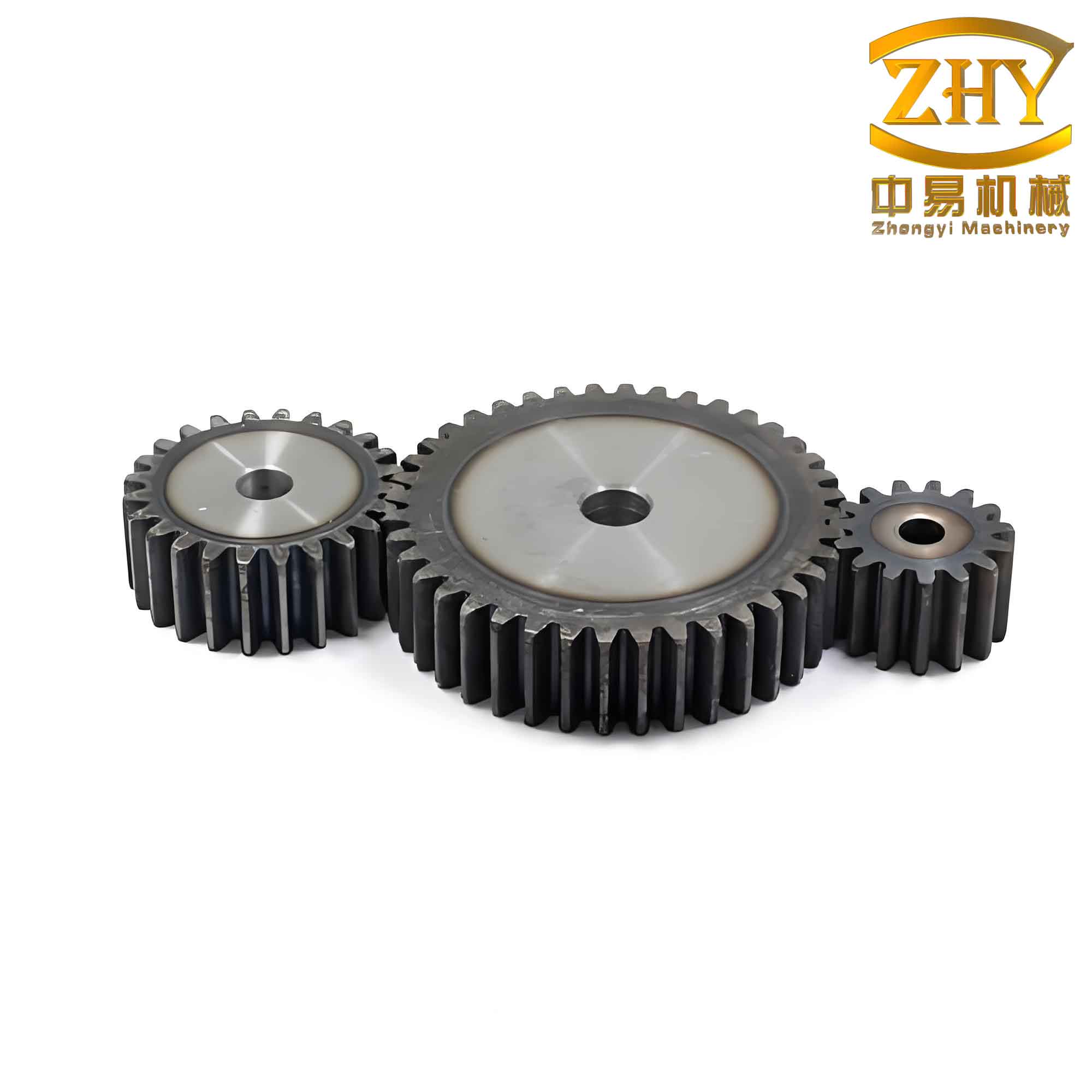
In the pursuit of advancing gear transmission systems toward high speed, heavy load, low vibration, and low noise, the demand for enhanced load capacity and dynamic performance has become increasingly critical. High Contact Ratio (HCR) straight spur gears, defined as spur gears with a contact ratio exceeding 2, offer a promising solution. Unlike ordinary gears, HCR straight spur gears achieve higher load sharing among multiple tooth pairs without substantially increasing the mass of the gear unit, leading to smoother transmission and reduced vibration. In this study, we systematically investigate the coupled dynamic characteristics of HCR straight spur gear systems, comparing them with ordinary contact ratio gear systems under various operating conditions.
Time-Varying Meshing Stiffness Calculation Model
To accurately capture the dynamic behavior of HCR straight spur gear systems, we first established a comprehensive time-varying meshing stiffness (TVMS) model based on the potential energy method. The gear tooth is treated as a cantilever beam, and the elastic deformation under normal load is decomposed into several components, each contributing to an equivalent stiffness.
Single Tooth Stiffness Model
The single tooth stiffness of a straight spur gear is derived from the contributions of Hertzian contact stiffness, bending stiffness, shear stiffness, axial compressive stiffness, and fillet-foundation stiffness. The Hertzian contact stiffness is expressed as:
$$
\frac{1}{K_h} = \frac{4(1 – \nu^2)}{\pi E b}
$$
where \(\nu\) is Poisson’s ratio, \(E\) is Young’s modulus, and \(b\) is the face width of the straight spur gear tooth.
The bending stiffness is computed by integrating along the tooth height direction:
$$
\frac{1}{K_b} = \int_0^S \frac{(x \cos \alpha_1 – h \sin \alpha_1)^2}{E I_x} dx
$$
where \(\alpha_1\) is the angle between the normal load and the tooth thickness direction, \(I_x\) is the area moment of inertia of the cross-section, \(h\) is half the tooth thickness at the load application point, and \(S\) is the distance from the load point to the root circle along the tooth height.
The shear stiffness and axial compressive stiffness are given respectively by:
$$
\frac{1}{K_s} = \int_0^S \frac{1.2 \cos^2 \alpha_1}{G A_x} dx
$$
$$
\frac{1}{K_a} = \int_0^S \frac{\sin^2 \alpha_1}{E A_x} dx
$$
where \(G\) is the shear modulus and \(A_x\) is the cross-sectional area at the integration point.
The fillet-foundation stiffness, accounting for the deformation of the gear body, is expressed as:
$$
\frac{1}{K_f} = \frac{\delta_f}{F}
$$
where \(\delta_f\) is the deformation of the gear body under the normal load \(F\).
The total single tooth meshing stiffness for a straight spur gear pair is then obtained by combining all stiffness components in series:
$$
K_e = \frac{1}{\frac{1}{K_h} + \frac{1}{K_{b1}} + \frac{1}{K_{a1}} + \frac{1}{K_{s1}} + \frac{1}{K_{f1}} + \frac{1}{K_{b2}} + \frac{1}{K_{s2}} + \frac{1}{K_{a2}} + \frac{1}{K_{f2}}}
$$
where subscripts 1 and 2 denote the driving gear and driven gear of the straight spur gear pair, respectively.
Comprehensive Meshing Stiffness Model
For ordinary contact ratio straight spur gears, the meshing process involves alternating between one tooth pair and two tooth pairs in contact. For HCR straight spur gears, with a contact ratio between 2 and 3, the meshing alternates between two tooth pairs and three tooth pairs in contact. This fundamental difference in load sharing profoundly affects the overall stiffness characteristics.
We modeled the meshing stiffness of multiple tooth pairs by considering each tooth pair as a series spring and multiple tooth pairs in simultaneous contact as parallel springs. The comprehensive meshing stiffness is obtained by superposition of all engaged tooth pairs.
| Parameter | HCR Straight Spur Gear (ε = 2.3719) | Ordinary Contact Ratio Straight Spur Gear (ε = 1.5549) |
|---|---|---|
| Module m (mm) | 2.75 | 2.75 |
| Number of teeth on driving gear z₁ | 36 | 36 |
| Number of teeth on driven gear z₂ | 61 | 61 |
| Pressure angle α (°) | 18.0 | 24.0 |
| Addendum coefficient h*ₐ | 1.3283 | 1.0 |
| Profile shift coefficient of driving gear x₁ | 0.250 | 0.250 |
| Profile shift coefficient of driven gear x₂ | -0.383 | -0.383 |
| Face width b (mm) | 33 | 33 |
| Shaft hole radius of driving gear Rᵢₙₜ₁ (mm) | 25 | 25 |
| Shaft hole radius of driven gear Rᵢₙₜ₂ (mm) | 40 | 40 |
| Stiffness Metric | HCR Straight Spur Gear (ε = 2.3719) | Ordinary Contact Ratio Straight Spur Gear (ε = 1.5549) | Change (%) |
|---|---|---|---|
| Single tooth stiffness – Maximum (N/mm) | 537,620 | 615,838 | -12.7 |
| Single tooth stiffness – Minimum (N/mm) | 255,063 | 328,921 | -22.5 |
| Single tooth stiffness – Average (N/mm) | 453,340 | 533,933 | -15.1 |
| Comprehensive stiffness – Maximum (N/mm) | 1,286,885 | 1,037,805 | +24.0 |
| Comprehensive stiffness – Minimum (N/mm) | 920,083 | 578,372 | +59.1 |
| Comprehensive stiffness – Average (N/mm) | 1,106,679 | 895,805 | +23.6 |
| Peak-to-peak value of comprehensive stiffness (N/mm) | 366,802 | 459,433 | -21.4 |
| Stiffness fluctuation coefficient (%) | 33.1 | 38.3 | -13.6 |
From the numerical results, we observe that while the single tooth stiffness of HCR straight spur gears is lower than that of ordinary gears due to the increased tooth height and modified geometry, the comprehensive meshing stiffness is significantly higher. Specifically, the maximum, minimum, and average comprehensive stiffness values of the HCR straight spur gear system increased by approximately 24.0%, 59.1%, and 23.6%, respectively. More importantly, the peak-to-peak fluctuation of the comprehensive stiffness decreased by 21.4%, and the stiffness fluctuation coefficient dropped by 13.6%. This reduction in stiffness fluctuation is a key factor in mitigating vibration excitation in HCR straight spur gear systems.
Coupled Dynamic Model of the Straight Spur Gear System
We constructed a three-dimensional finite element model of the straight spur gear system, comprising the driving gear, driven gear, input shaft, output shaft, and supporting bearings. The system is discretized into three fundamental element types: shaft elements, gear meshing elements, and bearing elements.
Shaft Element Dynamic Model
Considering the shear deformation effects in the gear transmission shafts, we employed the Timoshenko beam theory to formulate the shaft element. Each shaft element is defined by two nodes at its ends, with each node having six degrees of freedom (three translational and three rotational displacements in the global coordinate system).
The consistent mass matrix of the Timoshenko beam element is:
$$
\mathbf{M}_S = \rho A a \begin{bmatrix} \mathbf{m}_{s1} & \mathbf{m}_{s2} \\ \mathbf{m}_{s3} & \mathbf{m}_{s4} \end{bmatrix}
$$
where \(\rho\) is the material density, \(A\) is the cross-sectional area, and \(a\) is the element length.
The displacement vector for a two-node shaft element in the x-y-z coordinate system is:
$$
\mathbf{X}_S = \begin{bmatrix} \mathbf{X}_{Sj}, \mathbf{X}_{Sj+1} \end{bmatrix}^T
$$
$$
\mathbf{X}_{Sj} = \begin{bmatrix} x_j, y_j, z_j, \theta_{xj}, \theta_{yj}, \theta_{zj} \end{bmatrix}^T
$$
$$
\mathbf{X}_{Sj+1} = \begin{bmatrix} x_{j+1}, y_{j+1}, z_{j+1}, \theta_{xj+1}, \theta_{yj+1}, \theta_{zj+1} \end{bmatrix}^T
$$
The stiffness matrix of the shaft element is:
$$
\mathbf{K}_S = \begin{bmatrix} \mathbf{k}_{s1} & \mathbf{k}_{s2} \\ \mathbf{k}_{s3} & \mathbf{k}_{s4} \end{bmatrix}
$$
The damping matrix is obtained using Rayleigh damping:
$$
\mathbf{C}_S = p \mathbf{M}_S + q \mathbf{K}_S
$$
where the coefficients \(p\) and \(q\) are computed from the first two natural frequencies and damping ratios of the straight spur gear system.
Meshing Element Dynamic Model
The gear meshing element captures the interaction between the driving and driven straight spur gears. The relative deformation along the line of action is projected from the translational displacements of both gears.
The displacement vector for the gear meshing element is:
$$
\mathbf{X}_G = \begin{bmatrix} x_1, y_1, z_1, \theta_{x1}, \theta_{y1}, \theta_{z1}, x_2, y_2, z_2, \theta_{x2}, \theta_{y2}, \theta_{z2} \end{bmatrix}
$$
The relative total deformation along the meshing line is:
$$
\delta = \mathbf{V}_G \mathbf{X}_G
$$
where \(\mathbf{V}_G\) is the meshing matrix:
$$
\mathbf{V}_G = \begin{bmatrix} \sin\varphi & \pm\cos\varphi & 0 & 0 & 0 & \pm r_1 & -\sin\varphi & \mp\cos\varphi & 0 & 0 & 0 & \pm r_2 \end{bmatrix}
$$
The equation of motion for the meshing element, derived from Newton’s second law, is expressed in matrix form as:
$$
\mathbf{M}_G \ddot{\mathbf{X}}_G + \mathbf{C}_G \dot{\mathbf{X}}_G + \mathbf{K}_G \mathbf{X}_G = \mathbf{F}_G
$$
where \(\mathbf{K}_G\), \(\mathbf{C}_G\), and \(\mathbf{M}_G\) are the stiffness, damping, and mass matrices of the gear meshing element, respectively. For HCR straight spur gears, the meshing stiffness \(\mathbf{K}_G\) is computed from the comprehensive stiffness model developed earlier. The external force vector includes the input and output torques applied to the system.
Bearing Element Dynamic Model
The bearings couple the gear-rotor system to the housing. Each bearing is modeled as a spring-damper element with diagonal stiffness and damping matrices. For simplicity, we assumed constant bearing stiffness values in this study.
The bearing stiffness matrix at support node k is:
$$
\mathbf{K}_B = \begin{bmatrix}
k_{xx} & k_{xy} & k_{xz} & k_{x\theta_x} & k_{x\theta_y} & 0 \\
k_{yx} & k_{yy} & k_{yz} & k_{y\theta_x} & k_{y\theta_y} & 0 \\
k_{zx} & k_{zy} & k_{zz} & k_{z\theta_x} & k_{z\theta_y} & 0 \\
k_{\theta_x x} & k_{\theta_x y} & k_{\theta_x z} & k_{\theta_x \theta_x} & k_{\theta_x \theta_y} & 0 \\
k_{\theta_y x} & k_{\theta_y y} & k_{\theta_y z} & k_{\theta_y \theta_x} & k_{\theta_y \theta_y} & 0 \\
0 & 0 & 0 & 0 & 0 & 0
\end{bmatrix}
$$
The equation of motion for the bearing element is:
$$
\mathbf{M}_B \ddot{\mathbf{X}}_B + \mathbf{C}_B \dot{\mathbf{X}}_B + \mathbf{K}_B \mathbf{X}_B = \mathbf{0}
$$
System Assembly and Global Dynamics
The global dynamic model of the entire straight spur gear transmission system is assembled by combining all shaft elements, gear meshing elements, and bearing elements according to the assembly sequence and connectivity. The resulting global equation of motion is:
$$
\mathbf{M} \ddot{\mathbf{X}}(t) + \mathbf{C} \dot{\mathbf{X}}(t) + \mathbf{K} \mathbf{X}(t) = \mathbf{F}(t)
$$
where \(\mathbf{M}\), \(\mathbf{C}\), \(\mathbf{K}\), and \(\mathbf{F}(t)\) are the global mass, damping, stiffness matrices and external excitation vector, respectively. This coupled dynamic model fully accounts for the flexibility of shafts, the time-varying meshing stiffness of the HCR straight spur gear pair, and the supporting bearings.
Dynamic Characteristic Analysis Under Different Speed Conditions
We performed a comprehensive dynamic analysis of both the HCR straight spur gear system and the ordinary contact ratio straight spur gear system across a speed range from 1,000 r/min to 15,000 r/min. The dynamic meshing force and vibration acceleration at multiple measurement points were evaluated.
Dynamic Meshing Force Analysis
The dynamic meshing force between the straight spur gear pairs is a critical indicator of the load-bearing condition and vibration excitation level. We computed the root mean square (RMS) and peak-to-peak values of the dynamic meshing force for both systems.
| Speed (r/min) | HCR Straight Spur Gear System – RMS (N) | Ordinary Contact Ratio Straight Spur Gear System – RMS (N) | Reduction (%) |
|---|---|---|---|
| 1,000 | 2,845 | 3,130 | 9.10 |
| 3,000 | 2,680 | 3,366 | 20.39 |
| 5,000 | 2,920 | 3,210 | 9.03 |
| 7,000 | 3,150 | 3,580 | 12.01 |
| 9,000 | 3,420 | 3,890 | 12.08 |
| 11,000 | 3,680 | 4,120 | 10.68 |
| 13,000 | 3,950 | 4,450 | 11.24 |
| 15,000 | 4,230 | 4,720 | 10.38 |
| Speed (r/min) | HCR Straight Spur Gear System – Peak-to-Peak (N) | Ordinary Contact Ratio Straight Spur Gear System – Peak-to-Peak (N) | Reduction (%) |
|---|---|---|---|
| 1,000 | 3,420 | 5,890 | 41.94 |
| 3,000 | 1,860 | 7,620 | 75.61 |
| 5,000 | 6,230 | 6,490 | 3.97 |
| 7,000 | 5,120 | 8,340 | 38.61 |
| 9,000 | 7,450 | 9,870 | 24.52 |
| 11,000 | 8,230 | 10,560 | 22.06 |
| 13,000 | 9,110 | 11,430 | 20.30 |
| 15,000 | 10,050 | 12,780 | 21.36 |
The results clearly demonstrate that the HCR straight spur gear system exhibits substantially lower dynamic meshing force compared to the ordinary contact ratio system across all speed conditions. The most significant reduction in RMS value was observed at 3,000 r/min, with a decrease of 20.39%. The peak-to-peak value reduction was most pronounced at the same speed, reaching 75.61%. This substantial reduction in dynamic meshing force can be directly attributed to the lower stiffness fluctuation and more uniform load distribution characteristic of HCR straight spur gear pairs.
Vibration Acceleration Analysis
We selected four measurement points on the housing, located directly above the bearing positions along the X-direction. The vibration acceleration in both X and Y directions was analyzed for both straight spur gear systems.
| Speed (r/min) | HCR Straight Spur Gear System – RMS (m/s²) | Ordinary Contact Ratio Straight Spur Gear System – RMS (m/s²) | Reduction (%) |
|---|---|---|---|
| 1,000 | 12.4 | 28.6 | 56.64 |
| 3,000 | 8.9 | 36.4 | 75.56 |
| 5,000 | 18.2 | 42.1 | 56.77 |
| 7,000 | 25.6 | 52.3 | 51.05 |
| 9,000 | 32.1 | 61.8 | 48.06 |
| 11,000 | 38.5 | 70.2 | 45.16 |
| 13,000 | 45.2 | 79.5 | 43.14 |
| 15,000 | 52.8 | 88.3 | 40.27 |
| Speed (r/min) | HCR Straight Spur Gear System – RMS (m/s²) | Ordinary Contact Ratio Straight Spur Gear System – RMS (m/s²) | Reduction (%) |
|---|---|---|---|
| 1,000 | 10.8 | 25.2 | 57.14 |
| 3,000 | 7.2 | 31.3 | 76.97 |
| 5,000 | 15.6 | 36.8 | 57.61 |
| 7,000 | 22.3 | 45.6 | 51.10 |
| 9,000 | 28.7 | 54.2 | 47.05 |
| 11,000 | 34.1 | 62.8 | 45.70 |
| 13,000 | 40.3 | 71.5 | 43.64 |
| 15,000 | 47.6 | 80.2 | 40.65 |
| Speed (r/min) | HCR Straight Spur Gear System – Peak-to-Peak (m/s²) | Ordinary Contact Ratio Straight Spur Gear System – Peak-to-Peak (m/s²) | Reduction (%) |
|---|---|---|---|
| 1,000 | 42.5 | 98.3 | 56.77 |
| 3,000 | 31.2 | 100.8 | 69.08 |
| 5,000 | 62.8 | 118.5 | 47.00 |
| 7,000 | 85.3 | 142.6 | 40.18 |
| 9,000 | 108.6 | 168.2 | 35.43 |
| 11,000 | 132.4 | 195.7 | 32.34 |
| 13,000 | 158.2 | 225.3 | 29.78 |
| 15,000 | 186.5 | 197.8 | 5.77 |
| Speed (r/min) | HCR Straight Spur Gear System – Peak-to-Peak (m/s²) | Ordinary Contact Ratio Straight Spur Gear System – Peak-to-Peak (m/s²) | Reduction (%) |
|---|---|---|---|
| 1,000 | 38.2 | 86.7 | 55.94 |
| 3,000 | 25.6 | 103.2 | 75.19 |
| 5,000 | 52.3 | 98.5 | 46.90 |
| 7,000 | 73.8 | 125.6 | 41.24 |
| 9,000 | 95.2 | 148.3 | 35.80 |
| 11,000 | 118.6 | 172.5 | 31.25 |
| 13,000 | 142.3 | 198.6 | 28.35 |
| 15,000 | 168.5 | 226.4 | 25.58 |
| Measurement Point | Direction | RMS Reduction (%) | Peak-to-Peak Reduction (%) |
|---|---|---|---|
| Point 1 | X | 75.56 | 67.14 |
| Point 1 | Y | 76.97 | 75.12 |
| Point 2 | X | 76.66 | 69.08 |
| Point 2 | Y | 78.75 | 77.43 |
| Point 3 | X | 80.98 | 69.81 |
| Point 3 | Y | 76.97 | 75.12 |
| Point 4 | X | 82.09 | 76.45 |
| Point 4 | Y | 78.75 | 77.43 |
The vibration acceleration results consistently show that the HCR straight spur gear system significantly outperforms the ordinary contact ratio system across all measurement points and speed conditions. At 3,000 r/min, the reduction in vibration acceleration RMS values reached as high as 82.09% at measurement point 4 in the X-direction, and the peak-to-peak values decreased by up to 77.43% at measurement point 2 in the Y-direction. These remarkable improvements in vibration performance are attributed to the reduced stiffness fluctuation and enhanced load sharing capability of the HCR straight spur gear pair.
We also observed that at certain speeds, such as 5,000 r/min and 15,000 r/min, the reduction in vibration acceleration was less pronounced. At 5,000 r/min, the reduction in dynamic meshing force peak-to-peak value was only 3.97%, and at 15,000 r/min, the reduction in vibration acceleration peak-to-peak at measurement point 2 in the X-direction was only 5.77%. This indicates that resonance conditions or speed-dependent dynamic coupling effects may influence the vibration attenuation capability of HCR straight spur gear systems. Nonetheless, the overall trend demonstrates substantial improvement in dynamic performance across the majority of the operating speed range.
The comprehensive analysis of the dynamic meshing force and vibration acceleration confirms that HCR straight spur gear systems offer superior dynamic characteristics compared to ordinary contact ratio gear systems. The higher contact ratio ensures that more tooth pairs share the load simultaneously, reducing the magnitude of stiffness variation during the meshing cycle. This intrinsic property of HCR straight spur gears leads to lower excitation forces and reduced vibration levels, making them highly suitable for high-speed, heavy-load applications where low noise and low vibration are critical requirements.
Conclusions
In this study, we systematically investigated the coupled dynamic characteristics of HCR straight spur gear systems through analytical modeling and numerical simulation. The key findings are summarized as follows:
1. The HCR straight spur gear pair exhibits significantly higher comprehensive meshing stiffness compared to the ordinary contact ratio straight spur gear pair, with increases of 24.0% in maximum stiffness, 59.1% in minimum stiffness, and 23.6% in average stiffness. The stiffness fluctuation is substantially reduced, with the peak-to-peak value decreasing by 21.4% and the stiffness fluctuation coefficient dropping by 13.6%.
2. The dynamic meshing force of the HCR straight spur gear system is substantially lower than that of the ordinary contact ratio system across the entire speed range from 1,000 r/min to 15,000 r/min. The maximum reduction in RMS value is 20.39% at 3,000 r/min, and the maximum reduction in peak-to-peak value is 75.61% at the same speed.
3. The vibration acceleration at all four measurement points on the housing is significantly reduced for the HCR straight spur gear system. At 3,000 r/min, the RMS values decreased by up to 82.09% and the peak-to-peak values decreased by up to 77.43%. These reductions are consistent across both X and Y directions.
4. The HCR straight spur gear system demonstrates particularly superior dynamic performance at lower to medium speeds, while the vibration reduction is somewhat less pronounced at certain higher speeds where resonance or dynamic coupling effects may occur. Nonetheless, the overall dynamic performance improvement is substantial and consistent.
5. The fundamental mechanism underlying the superior dynamic characteristics of HCR straight spur gears is the higher number of tooth pairs in simultaneous contact, which leads to more uniform load distribution, reduced stiffness fluctuation, and consequently lower vibration excitation. This makes HCR straight spur gears an excellent choice for applications demanding high load capacity, low vibration, and low noise in gear transmission systems.
Future work should focus on experimental validation of these findings and further investigation of the influence of gear tooth modifications, manufacturing errors, and lubrication conditions on the dynamic behavior of HCR straight spur gear systems. Additionally, the application of HCR straight spur gears in planetary gear trains and multi-stage transmission systems warrants further study to fully exploit their potential in complex gear drive architectures.