
Power density and efficiency are perennial goals in the field of mechanical transmission. Among the various strategies to achieve this, gear drives with a low number of pinion teeth stand out as a particularly effective approach. High-reduction hypoid gears (HRH), a specialized and complex type of hyperboloidal gears, offer significant advantages including high contact ratio, minimal tooth count, lightweight design, and superior efficiency. These characteristics make them exceptionally promising for applications in highly integrated electromechanical power transmission systems, such as in aerospace actuators, robotics, and advanced automotive differentials. However, the complex spatial geometry of HRH tooth flanks, characterized by extreme curvature and high spiral angles, presents a formidable challenge. Conventional gear design and machining calculation methods, often based on “local synthesis” at a single reference point, struggle to control the overall topological structure and meshing quality across the entire highly twisted tooth surface of these hyperboloidal gears.
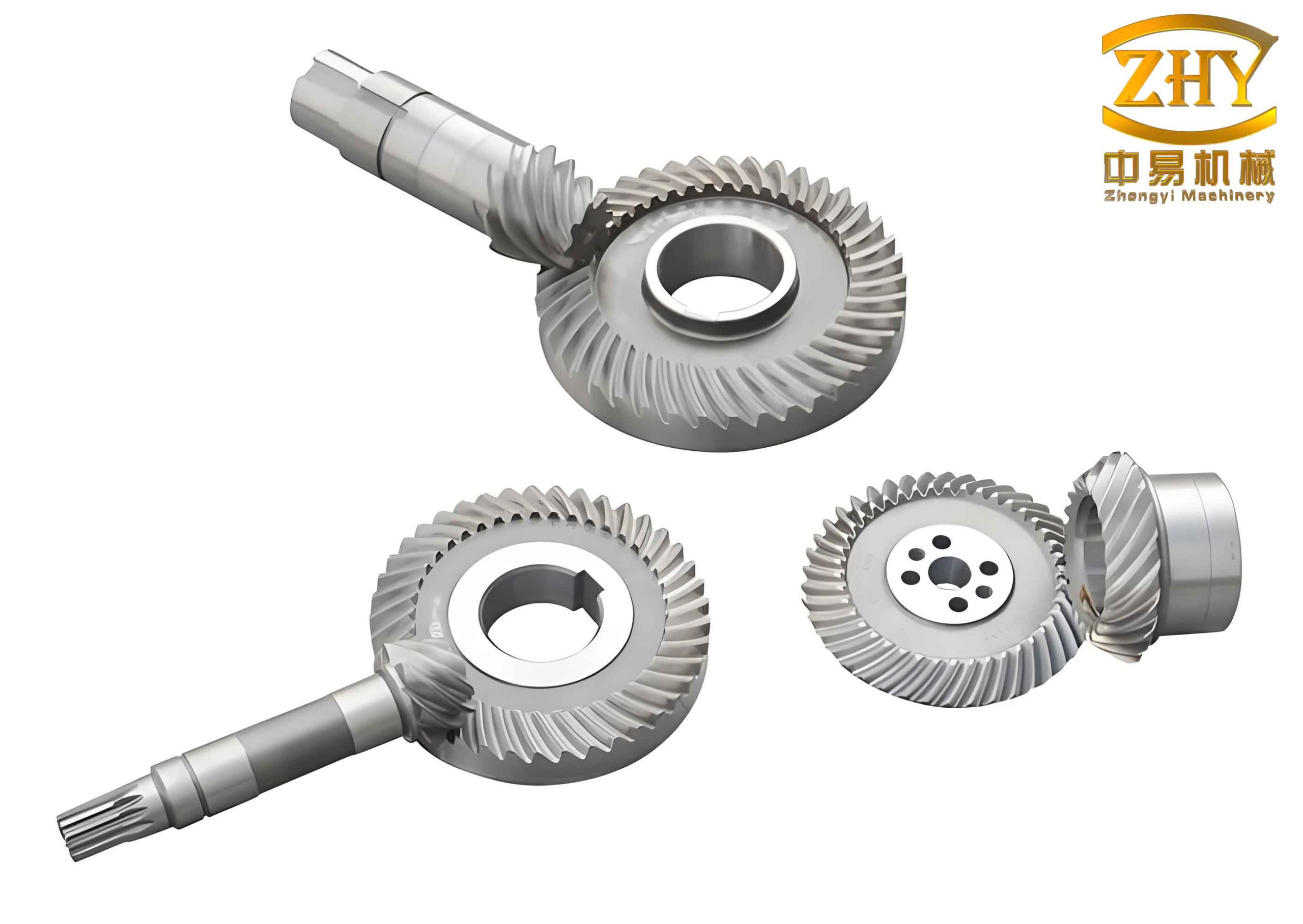
This article addresses the critical challenge of machining parameter calculation and meshing quality control for high-reduction hyperboloidal gears. We establish a comprehensive mathematical framework, propose novel tool modification strategies, and develop a surface synthesis methodology to achieve precise control over the tooth flank’s differential geometry and its resulting contact pattern. The core of our approach lies in integrating a target conjugate surface, derived from a defined ease-off topography, with the generating surface of the machine tool. This allows for the global synthesis of the pinion tooth surface, moving beyond local approximations.
General Formulation of Spatial Gear Meshing Equations
To analyze the meshing of hyperboloidal gears, we begin by establishing a generalized coordinate system for spatial crossed-axis gear transmission. Consider a gear pair (Σ⁽¹⁾, Σ⁽²⁾) with crossed axes. Coordinate systems S₁ and S₂ are rigidly connected to gear 1 (pinion) and gear 2 (gear), respectively. A fixed global coordinate system S₀(O₀-x₀y₀z₀) is defined, with its z₀-axis coincident with the gear axis z₂. Additional auxiliary coordinate systems S_d and S_p are used to describe the relative shaft position. The shaft offset is defined by the vector O₀O_d = [0, -E, G]ᵀ, where E is the horizontal offset and G is the vertical offset (often zero for pure hypoids). The shaft angle γ is the angle between the z₁ and z₂ axes. The instantaneous rotation angles of the pinion and gear are φ₁ and φ₂, with angular velocities ω₁ and ω₂, related by the gear ratio m₁₂ = ω₂/ω₁ = Z₁/Z₂.
The fundamental condition for contact between two mating surfaces is that their relative velocity at the point of contact is orthogonal to the common surface normal. This leads to the meshing equation. For the general spatial setup with fixed axis positions (E, G, γ constant) and a defined functional relationship φ₂(φ₁), the meshing equation can be derived. After coordinate transformations, a general explicit form of the meshing equation for crossed-axis gears can be expressed as:
$$ \cos(\phi + \epsilon) = \frac{W}{\sqrt{U^2 + V^2}}, \quad \tan \epsilon = \frac{V}{U} $$
where U, V, and W are functions of the surface coordinates and normal vector components of one gear (say, the gear surface Σ⁽²⁾) in the fixed coordinate system. For the specific case of a perpendicular axis configuration (γ = 90°, G=0), common in hypoid and many hyperboloidal gear sets, these functions simplify to:
$$
\begin{aligned}
U &= n_y z_2 – n_z y_2 \\
V &= n_z x_2 – n_x z_2 – E n_z \\
W &= n_x y_2 – n_y x_2 + m_{12} (n_x E)
\end{aligned}
$$
Here, (x₂, y₂, z₂) is a point on the gear tooth surface Σ⁽²⁾ and (n_x, n_y, n_z) is its unit normal vector, both expressed in the gear coordinate system S₂. This general meshing equation is the cornerstone for all subsequent conjugate surface generation and contact analysis of hyperboloidal gears.
Gear Generation and Cutter Modification for Hyperboloidal Gears
Formate Cutting of the Gear Member
For high-reduction hyperboloidal gears, the gear (larger member) is often produced using the formate (non-generating) process for efficiency. The tooth surface is directly copied from the cutting tool (cutter head). Establishing the coordinate systems for gear machining, the surface equation of the gear tooth flank Σ_g and its unit normal vector in the gear coordinate system S₂ can be obtained via homogeneous coordinate transformation from the machine cradle system.
The cutter head surface, typically a conical surface, is defined in its own coordinate system S_c. A point on the cutter blade and its normal vector are given by:
$$
\mathbf{r}_c = \begin{bmatrix} r_u \cos\theta + H \cos\alpha \\ r_u \sin\theta \\ -r_u \sin\alpha \end{bmatrix}, \quad
\mathbf{n}_c = \begin{bmatrix} -\cos\alpha \cos\theta \\ -\cos\alpha \sin\theta \\ -\sin\alpha \end{bmatrix}
$$
where $r_u = r_0 – u \sin\alpha$, with $r_0$ as the cutter point radius, $u$ and $\theta$ as the surface parameters, $H$ as the blade distance from the cutter center, and $\alpha$ as the blade pressure angle. Through transformations involving the machine root angle δ_m and radial setting $X_g$, the gear formate tooth surface $\mathbf{r}_2$ and normal $\mathbf{n}_2$ are calculated.
Cutter Head Modification via Parabolic Relief
A significant challenge with formate-cut hyperboloidal gears is insufficient longitudinal curvature of the gear tooth flank. According to the equivalent cylindrical gear principle, the theoretical curvature radius at the gear pitch point should be $\rho_2 = r_2′ / \cos^2 \beta_2$, where $r_2’$ is the pitch radius and $\beta_2$ is the spiral angle. The straight-sided cutter produces a ruled surface with zero Gaussian curvature along the ruling, which can lead to improper conjugation and edge contact with a conventionally generated pinion.
To correct this without resorting to complex pinion generation methods like Modified Roll (HGM) or cutter tilt (HFT)—which are difficult for small-module, high-spiral hyperboloidal gears—we propose a direct modification of the gear cutter head. The goal is to create a modified “osculating surface” $\Sigma_g^*$ that matches the desired local curvature at a designated reference point M_0.
The modification is applied in two directions:
1. Profile Direction (y_H – along the tooth height): A parabolic modification is applied to the blade pressure angle. Let the reference point M_0 have coordinates (u₀, θ₀) and nominal pressure angle α₀. The parabolic curve and its slope are defined as:
$$ w = 0.5 a_1 (u – u_0)^2, \quad w’ = a_1 (u – u_0) $$
The modified pressure angle becomes a function of u:
$$ \alpha_2(u) = \alpha_0 + \arctan(w’) \approx \alpha_0 + a_1 (u – u_0) $$
2. Longitudinal Direction (x_L – along the tooth length): Similarly, a parabolic modification is applied to the blade angular parameter θ to control the longitudinal curvature. The modification function is:
$$ L = 0.5 a_2 (\theta – \theta_0)^2, \quad L’ = a_2 (\theta – \theta_0) $$
$$ \theta_2(\theta) = \theta_0 + \arctan(L’) \approx \theta_0 + a_2 (\theta – \theta_0) $$
The coefficients a₁ and a₂ are the modification parameters controlling the amount of curvature correction. Substituting the modified functions $\alpha_2(u)$ and $\theta_2(\theta)$ into the original cutter surface equations yields the modified cutter surface. The envelope of this modified cutter, generated through the formate process, produces the gear’s osculating surface $\Sigma_g^*$ with the desired corrected curvatures at and around the reference point. This surface is crucial for the subsequent synthesis of the conjugate pinion surface for hyperboloidal gears.
Surface Synthesis for Topological Ease-Off Control
The core methodology for controlling the meshing of hyperboloidal gears is “Surface Synthesis.” This approach globally controls the pinion tooth flank topography by integrating two conceptual surfaces: the target conjugate pinion surface derived from the modified gear, and the physically realizable pinion surface generated by the machine tool. The link between them is a predefined “ease-off” surface, which represents the intentional slight deviation from perfect conjugate contact.
Definition of the Ease-Off Gradient Ellipse
The desired contact pattern is governed by an ease-off topography. At the reference point M_0, we define a local ease-off gradient using an elliptic cylinder. The equation of the base ellipse is:
$$ \frac{x^2}{a^2} + \frac{y^2}{b^2} = \frac{\delta}{4} $$
where (x, y) are local coordinates on the tangent plane (x along the lengthwise direction, y along the profile direction), ‘a’ and ‘b’ are the semi-axes controlling the size and shape of the contact ellipse, δ is the maximum ease-off value (typically ~0.01 mm), and λ is the angle of the ellipse’s major axis relative to the x-axis, controlling the orientation of the contact path. The principal relative curvatures (ease-off curvatures) along the ellipse axes are:
$$ \Delta k_a = \frac{\delta}{2a^2}, \quad \Delta k_b = \frac{\delta}{2b^2} $$
These parameters (a, b, λ, δ) provide direct geometric control over the resulting contact ellipse’s size, shape, and direction on the hyperboloidal gear pair.
Synthesis of the Osculating Conjugate Pinion Surface
The gear’s osculating surface $\Sigma_g^*$ (from the modified cutter) is not perfectly conjugate to the desired pinion surface due to the intentionally introduced ease-off. We now find the pinion surface $\Sigma_s$ that is conjugate to $\Sigma_g^*$ under the prescribed meshing motion, considering the ease-off as a separation. This involves solving the meshing equation between $\Sigma_g^*$ and the pinion.
Using the general meshing equation for the perpendicular axis case, and substituting the position vector $\mathbf{r}_g^*$ and normal vector $\mathbf{n}_g^*$ of surface $\Sigma_g^*$, we obtain the functional relationship $\phi_1 = \phi_1(u, \theta)$. For each parameter pair (u, θ) satisfying the meshing equation, a point on the theoretical conjugate pinion surface $\Sigma_s$ is calculated via coordinate transformation from the gear system S₂ to the pinion system S₁:
$$ \mathbf{r}_s^{(1)}(u, \theta) = \mathbf{M}_{1,2}(\phi_1) \cdot \mathbf{r}_g^{(2)}(u, \theta), \quad \mathbf{n}_s^{(1)}(u, \theta) = \mathbf{L}_{1,2}(\phi_1) \cdot \mathbf{n}_g^{(2)}(u, \theta) $$
where $\mathbf{M}_{1,2}$ is the homogeneous transformation matrix and $\mathbf{L}_{1,2}$ is the corresponding rotation matrix for the normal vector. This surface $\Sigma_s$ represents the ideal target pinion tooth flank that would mate with the modified gear, incorporating the planned ease-off topology for hyperboloidal gears.
Generation of the Pinion via Machine Tool Kinematics
The pinion is generated on a hypoid generator (or a multi-axis CNC machine emulating one). The machine kinematics define another family of surfaces: the generating crown gear (or imaginary planer) surface $\Sigma_t$, whose envelope under the relative rolling motion ($\phi_p = m_p \phi_1$, where $m_p$ is the machine ratio) produces the actual machined pinion surface $\Sigma_1$.
The cutter head surface (for pinion cutting/grinding) is defined similarly to before but with its own parameters (u₁, θ₁) and settings. The key machine settings for pinion generation include:
- $S_r$: Radial distance of cutter center from machine center.
- $q$: Angular position of cutter center (swivel angle).
- $E_m$: Vertical offset of the work piece (sliding base).
- $X_g$: Horizontal offset of the work piece.
- $\gamma_m$: Machine root angle (equal to pinion root cone angle).
- $X_b$: Blank offset (related to $X_g$ and $\gamma_m$).
- $m_p$: Generating ratio (roll).
The surface $\Sigma_1$ generated by these settings is a function of the machine parameters and the cutter geometry ($r_{c1}, \alpha_1$).
Solving for Machine Settings via Global Surface Matching
The fundamental idea of surface synthesis is that the target pinion surface $\Sigma_s$ and the machine-generated surface $\Sigma_1$ must be identical. Therefore, we formulate a nonlinear optimization problem to find the set of machine parameters that minimizes the difference between $\Sigma_s$ and $\Sigma_1$.
We select five strategic points on the target surface $\Sigma_s$, typically the center and the four extreme points along the ease-off ellipse axes. For each point ‘i’ with parameters ($u_s^{(i)}, \theta_s^{(i)}$), we have its coordinates $\mathbf{r}_s^{(i)}$ and normal $\mathbf{n}_s^{(i)}$. We require that for the same parameter values, the machine-generated surface $\Sigma_1$ yields the same coordinates and normals. This gives a system of equations:
$$ \mathbf{r}_s^{(i)}(u_s^{(i)}, \theta_s^{(i)}) – \mathbf{r}_1^{(i)}(u_1^{(i)}, \theta_1^{(i)}, \mathbf{X}) = 0 $$
$$ \mathbf{n}_s^{(i)}(u_s^{(i)}, \theta_s^{(i)}) – \mathbf{n}_1^{(i)}(u_1^{(i)}, \theta_1^{(i)}, \mathbf{X}) = 0 $$
where $\mathbf{X}$ is the vector of unknown machine parameters and the corresponding cutter point parameters ($u_1^{(i)}, \theta_1^{(i)}$) for each of the 5 points. The total number of scalar equations is 15 (3 coordinates × 5 points) + 10 (2 independent normal components × 5 points) = 25. The unknowns include 5 primary machine settings ($S_r, q, E_m, X_g, m_p$) and 10 cutter parameters (u₁, θ₁ for 5 points), totaling 15. This over-determined system is solved using a constrained optimization algorithm (e.g., Levenberg-Marquardt) to minimize the sum of squared errors:
$$ \min_{\mathbf{X}} \sum_{i=1}^{5} \left( \| \Delta \mathbf{r}^{(i)} \|^2 + \| \Delta \mathbf{n}^{(i)} \|^2 \right) $$
This process effectively “synthesizes” the machine settings that will produce a pinion tooth surface for hyperboloidal gears as close as possible to the ideal target surface defined by the ease-off topology. The initial guess for the parameters is derived from basic gear geometry and the principle of duality between the gear and the generating crown gear.
The following table summarizes the calculated machining parameters for an example HRH gear pair with a ratio of 60:3, an offset of 40 mm, and a high pinion spiral angle.
| Machining Parameter | Pinion (Concave) | Pinion (Convex) | Gear (Formate) |
|---|---|---|---|
| Machine Root Angle γ_m (°) | 10.9919 | 10.9919 | 74.7639 |
| Blank Offset X_b (mm) | -1.5253 | -1.5400 | 0 |
| Vertical Setting E_m (mm) | 39.8843 | 40.2278 | 0 |
| Horizontal Setting X_g (mm) | -0.3367 | -0.9467 | 5.3428 |
| Cutter Center Angle q (°) | 75.8424 | 81.5262 | 42.2143 |
| Radial Setting S_r (mm) | 52.0862 | 51.6782 | 53.1513 |
| Machine Ratio m_p | 20.0152 | 19.7476 | — |
| Cutter Point Radius r_c0 (mm) | 77.725 / 72.644* | 77.725 / 72.644* | 37.3 (Inner) / 38.9 (Outer) |
| Cutter Pressure Angle α (°) | 20.0 / 28.0* | 20.0 / 28.0* | 21.0 |
* Outer Blade / Inner Blade values for pinion cutting.
Tooth Contact Analysis (TCA) Simulation
Using the calculated machining parameters for our hyperboloidal gears, a Tooth Contact Analysis (TCA) program is executed. The TCA simulates the meshing of the theoretically generated pinion and gear surfaces under load-free conditions, considering small misalignments. The primary outputs are the transmission error (TE) curve and the contact path on the tooth flank.
For the convex side of the gear (drive side), the resulting ease-off topography (difference between the gear surface and the fully conjugate pinion surface) is shown graphically. The surface displays a clear elliptic gradient centered at the design point, with the maximum ease-off values at the extremities (e.g., 196 μm at one corner). This controlled deviation ensures a favorable contact bearing.
The contact path obtained from TCA runs diagonally across the tooth face in a “long and inner” pattern, which is characteristic of well-designed hyperboloidal gears for high contact ratio. The maximum separation at the ends of the contact line is about 128 μm and 166 μm, which helps prevent edge contact under load.
The transmission error plot is particularly insightful. It shows multiple overlapping parabolic-like curves, each representing the TE for a single tooth pair. The overlap between successive tooth pairs indicates the contact ratio. In this simulation, there are five clear intersections, yielding a calculated contact ratio of approximately 5.2. This very high contact ratio is a defining feature of successful high-reduction hyperboloidal gear design, contributing to smooth motion transfer, low noise, and high load capacity. The parabolic form of the TE curve for each mesh cycle is indicative of a second-order correction, which is effective for noise reduction.
Experimental Validation of Meshing Performance
Contact Pattern Test
The example 60:3 hyperboloidal gear pair was manufactured on a modern CNC hypoid grinder using the calculated settings. A rolling test (also called a lapping test or contact check) was performed on a gear testing machine. A thin layer of marking compound (prussian blue or similar) is applied to the gear teeth, and the pair is run under light load through several mesh cycles.
The resulting contact patterns on both the concave and convex flanks of the pinion are observed. The patterns are elliptical in shape, well-centered on the tooth flank, and occupy a significant portion of the available tooth area without reaching the edges. The size, shape, and location of these experimental contact ellipses show excellent agreement with the TCA predictions, validating the accuracy of the surface synthesis method and the calculated parameters for these complex hyperboloidal gears.
Dynamic Vibration Performance Test
To assess the dynamic behavior, the hyperboloidal gear set was installed in a dedicated test rig with a closed-loop power circulation system. Tri-axial accelerometers were mounted on the output gearbox housing near the mesh zone, oriented in the axial (X), radial (Y), and tangential/vertical (Z) directions. Vibration signals were acquired under various speed and torque conditions.
The axial (X-direction) vibration spectra are most indicative of pure meshing dynamics, being less influenced by shaft runout. Key observations from the spectral analysis include:
- Dominant Frequencies: The spectrum is dominated by the gear mesh frequency (GMF = pinion speed × pinion tooth count) and its harmonics, along with the shaft rotational frequencies. This is a clean signature, indicating the absence of significant random noise or spurious vibrations from poor contact.
- Load Effect: Under higher load (200 Nm vs. 50 Nm), the vibration amplitudes, particularly at the higher harmonics, show a tendency to stabilize or even decrease. This is attributed to the high contact ratio of the hyperboloidal gears; as load increases, more tooth pairs share the load, reducing the per-pair deflection and the fluctuation in mesh stiffness, leading to smoother dynamics.
- Speed Effect: At higher speeds, the amplitude of the first harmonic of GMF increases noticeably. This is expected as dynamic inertia forces become more significant. However, the overall vibration level remains low, with peak accelerations below 3.2 m/s² across the tested range, indicating “quiet” operation.
- Resonance: A consistent peak near 140 Hz appears across different speeds, corresponding to the GMF at 2790 rpm pinion speed, the 2nd harmonic at 1410 rpm, and the 4th harmonic at 720 rpm. This identifies a system natural frequency (likely a torsional or housing mode) that is excited by the meshing force.
- Modulation: For very low tooth count gears (like this 3-tooth pinion), the gear mesh frequency and the shaft frequency have a low integer multiple relationship (GMF = 3 × Shaft Frequency). This can lead to pronounced modulation in the time-domain signal, where the vibration envelope varies with shaft rotation. This was observed but did not lead to problematic vibration levels.
The time-domain signals clearly show periodicity linked to the shaft and mesh cycles. The dynamic tests confirm that the designed and manufactured hyperboloidal gears exhibit excellent meshing compatibility, smooth motion transfer, and low vibration, fulfilling the primary goals of high-performance gearing.
Conclusion
This work has developed and demonstrated a comprehensive methodology for the design, calculation, and validation of high-reduction hypoid (hyperboloidal) gears. The key contributions are:
- Generalized Meshing Framework: Establishment of a spatial meshing equation in a versatile form suitable for the analysis of complex crossed-axis gears like hyperboloidal gears.
- Cutter Modification Strategy: A practical method for modifying the formate cutter head using parabolic relief functions to correct for inherent longitudinal curvature deficiency, enabling proper conjugation without relying on complex pinion generation methods.
- Surface Synthesis Methodology: A global approach to pinion machine setting calculation by synthesizing a target ease-off topography, the modified gear osculating surface, and the machine tool’s generating surface. This provides direct control over the contact ellipse parameters (size, orientation, shape) and the resulting transmission error.
- Validation: Successful manufacturing and testing of an extreme ratio (60:3) hyperboloidal gear pair. Contact pattern tests confirmed the predicted elliptical contact, and dynamic vibration tests demonstrated smooth, low-noise operation with a high effective contact ratio, validating the overall design and calculation approach.
The surface synthesis method, coupled with strategic tool modification, effectively solves the long-standing challenge of controlling the differential geometry and meshing quality of highly twisted, low-tooth-count hyperboloidal gear flanks. This paves the way for the wider and more reliable application of these compact, high-power-density gears in advanced mechanical transmission systems.