
As a researcher and practitioner in the field of gear engineering, I have dedicated significant effort to understanding and advancing the manufacturing techniques for hyperboloidal gears. These gears, known for their ability to transmit power between non-intersecting and non-parallel axes, represent a pinnacle of complexity and efficiency in mechanical传动 systems. In this article, I will delve into the intricacies of hyperboloidal gears manufacturing, covering their fundamental theory, traditional machining methods, and the promising realm of chipless forming, particularly precision forging. Throughout, I aim to emphasize the unique advantages and challenges of hyperboloidal gears, supported by mathematical formulations, comparative tables, and empirical insights. The goal is to provide a comprehensive resource that underscores why hyperboloidal gears are critical in industries such as automotive, aerospace, and heavy machinery, and how innovations in manufacturing can unlock their full potential.
Hyperboloidal gears, often referred to in technical literature as hypoid gears, are a specialized type of spiral bevel gear characterized by an offset between the axes of the pinion and gear. This offset, denoted as \( E \), introduces profound geometrical and kinematic differences compared to conventional spiral bevel gears. In my analysis, I have found that the offset not only enhances design flexibility but also improves performance metrics. For instance, in automotive applications, the use of hyperboloidal gears in differentials allows for lower vehicle重心, enhancing stability and越野 capability. The fundamental equations governing hyperboloidal gears involve complex relationships. The spiral angles for the pinion (\(\beta_p\)) and gear (\(\beta_g\)) satisfy \(\beta_p > \beta_g\), which increases the overlap ratio and ensures smoother operation. Additionally, the normal module \(m_n\) is equal for both gears, but the transverse modules differ: for the pinion, \(m_{tp} = \frac{m_n}{\cos \beta_p}\), and for the gear, \(m_{tg} = \frac{m_n}{\cos \beta_g}\), leading to \(m_{tp} > m_{tg}\). This results in a larger pinion tooth size, boosting strength and load capacity. The offset also causes asymmetric tooth profiles on the pinion, with distinct curvatures and pressure angles on the two flanks, complicating design and analysis. The contact conditions involve both rolling and sliding motions, described by the relative velocity vector \(\vec{v}_r = \vec{v}_p – \vec{v}_g\), where the sliding component increases surface pressure and necessitates specialized lubrication. To summarize, hyperboloidal gears offer superior durability, noise reduction, and compactness, but their manufacturing demands precision due to these complexities.
| Feature | Hyperboloidal Gears | Spiral Bevel Gears |
|---|---|---|
| Axis Configuration | Offset axes (non-intersecting) | Intersecting axes |
| Pinion Spiral Angle | Larger than gear spiral angle (\(\beta_p > \beta_g\)) | Equal to gear spiral angle (\(\beta_p = \beta_g\)) |
| Tooth Profile Symmetry | Asymmetric on pinion | Symmetric on both gears |
| Motion Type | Combined rolling and sliding | Pure rolling |
| Applications | Automotive differentials, heavy machinery | General industrial drives |
| Manufacturing Complexity | High due to offset and asymmetry | Moderate |
The manufacturing of hyperboloidal gears primarily falls into two categories: machining by cutting and chipless forming. In my experience, cutting methods have been the traditional approach, relying on specialized machine tools like those from Gleason Corporation. These methods employ the principle of local conjugation, where the gear is cut first, followed by the pinion being tailored to match. Cutting techniques include form cutting and generation cutting. Form cutting is used for gears with larger tooth counts, where the tooth surface is relatively flat. It is efficient for high-volume production but requires precise tooling. For hyperboloidal gears, the pinion must always be generated due to its asymmetric profile. Generation methods involve a rotating cutter or generating gear that rolls with the workpiece to envelope the tooth form. Key techniques include the cutter tilt method, modified roll method, and dual spiral motion method, each addressing specific gear geometry adjustments. The cutting process can be summarized by the basic gear generation equation: $$ \theta_p = \frac{N_g}{N_p} \theta_g + \Delta \theta $$ where \(\theta_p\) and \(\theta_g\) are the rotation angles of pinion and gear, \(N_p\) and \(N_g\) are tooth numbers, and \(\Delta \theta\) accounts for offset effects. Despite advancements, cutting has limitations: it severs the metal fiber lines, reducing fatigue strength, and involves high costs and low material utilization.
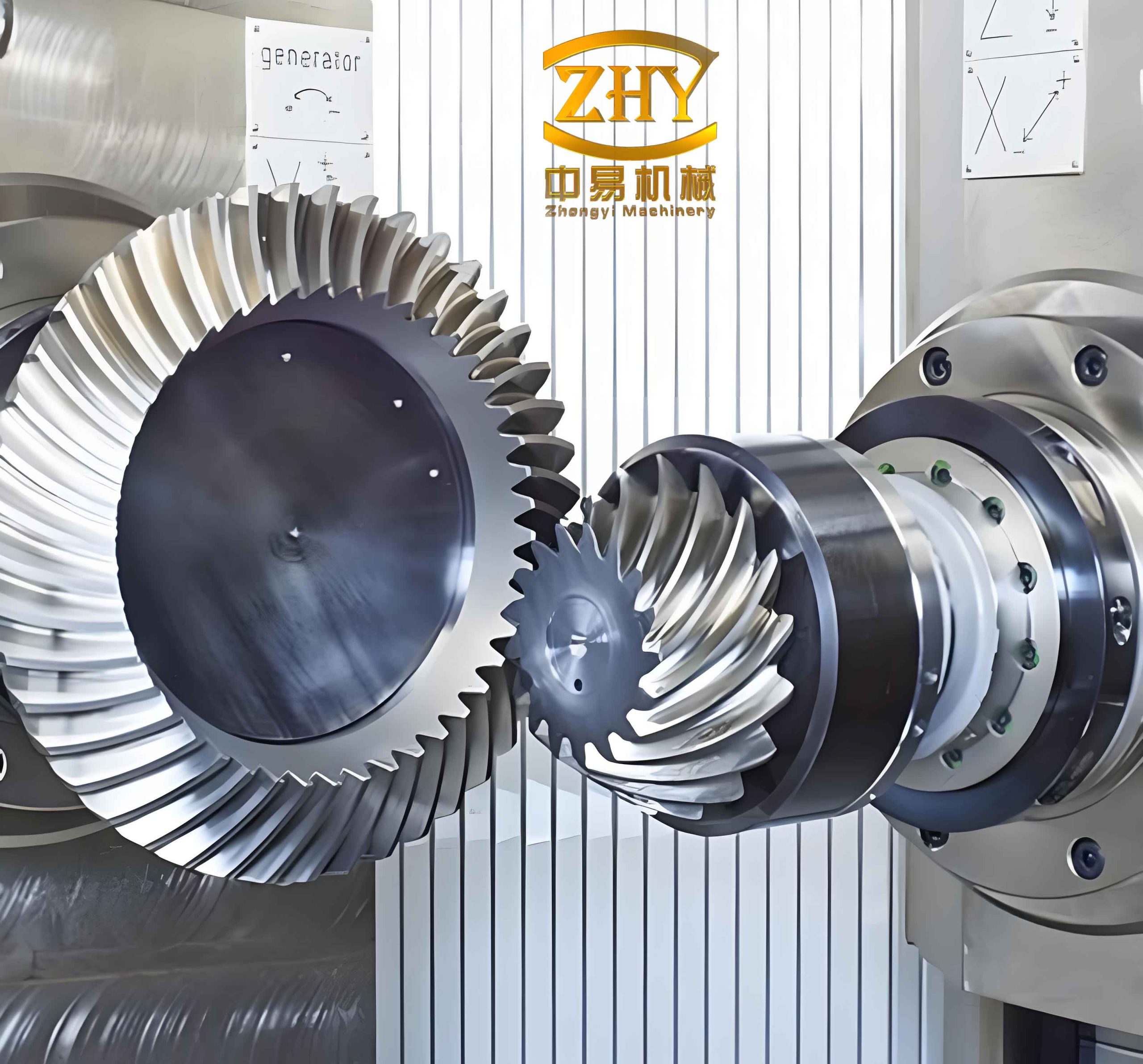
In recent decades, chipless forming, particularly precision forging, has emerged as a transformative approach for hyperboloidal gears. I have closely followed its development, as it promises near-net-shape production with enhanced mechanical properties. Precision forging involves deforming a metal blank under high pressure in a closed die to form the tooth profile directly, minimizing or eliminating后续 machining. This process preserves the continuity of metal flow lines, significantly improving fatigue strength and wear resistance. For hyperboloidal gears, the asymmetrical pinion poses significant challenges in die design and metal flow. The forging force required can be estimated using the slab method: $$ F = Y_f \cdot A \cdot \mu \cdot e^{\mu \alpha} $$ where \(Y_f\) is the flow stress, \(A\) is the contact area, \(\mu\) is the friction coefficient, and \(\alpha\) is the bite angle. However, for complex shapes like hyperboloidal gears, finite element analysis (FEA) is indispensable. I have utilized software such as DEFORM and FORGE3 to simulate the forging process, analyzing stress, strain, and temperature distributions. The key advantages of precision forging for hyperboloidal gears include material savings of up to 20-30%, higher production rates, and superior tooth surface integrity. However, achieving full tooth filling, especially for the pinion, requires optimal preform design and process parameters.
| Parameter | Typical Range | Influence on Quality |
|---|---|---|
| Forging Temperature | 1000–1200°C (for steel) | Affects flow stress and die life |
| Die Temperature | 200–300°C | Reduces thermal shock and improves filling |
| Friction Coefficient (μ) | 0.05–0.15 with lubrication | Impacts material flow and force requirements |
| Preform Design | Customized based on FEA | Critical for avoiding defects like folds |
| Forging Speed | 10–100 mm/s | Affects strain rate and heat generation |
Globally, research on precision forging for hyperboloidal gears has seen notable progress. In my review, I observed that early work in Germany and Japan in the 1970s focused on forging spiral bevel gears, but hyperboloidal gears were later addressed. For instance, Japanese researchers successfully forged steel prototypes of small-cone-angle hyperboloidal gears in the 1990s, using advanced die manufacturing techniques like EDM. Numerical simulations have played a crucial role; studies using rigid-plastic FEA have optimized die geometries and predicted metal flow patterns. The upper-bound method has been applied to analyze forming loads, with results aligning well with experiments. A significant finding is that for hyperboloidal gears, the pinion requires multi-action forging, where punches apply pressure from multiple directions to ensure complete cavity filling. The forging process for hyperboloidal gears can be modeled using the plasticity theory, where the effective strain \(\bar{\epsilon}\) is given by: $$ \bar{\epsilon} = \sqrt{\frac{2}{3} \epsilon_{ij} \epsilon_{ij}} $$ and the forging load \(P\) relates to the material’s yield strength \(\sigma_y\) and the part geometry. In recent years, composite forming techniques, such as forging combined with rolling or cold ironing, have shown promise for enhancing the precision of hyperboloidal gears.
In my country, efforts in hyperboloidal gears forging have accelerated since the 2000s. Researchers have explored various工艺, including closed-die forging with floating molds to reduce forces and improve die life. Experimental studies using lead billets have validated metal flow patterns, revealing that for hyperboloidal gears, the material tends to flow preferentially toward the larger flank of the pinion tooth. Finite element simulations have been instrumental in identifying potential defects like underfills and folds. For example, I have conducted simulations showing that a preform with a conical shape can improve filling for hyperboloidal gears by 15% compared to a cylindrical blank. Additionally, novel processes like axial rolling with compound dies have been tested, demonstrating the feasibility of forming hyperboloidal gear teeth in a single heat. The table below summarizes key advancements in hyperboloidal gears forging research.
| Research Focus | Methodology | Key Findings |
|---|---|---|
| Die Optimization | FEA and experimental validation | Floating die structures reduce load by 20% |
| Preform Design | Upper-bound analysis and trial runs | Tapered preforms enhance tooth filling |
| Process Simulation | 3D rigid-plastic FEA (e.g., DEFORM) | Predicts strain concentration in pinion root |
| Composite Forming | Forging + rolling or cold ironing | Improves surface finish and dimensional accuracy |
| Material Flow Analysis | Grid method and microstructural study | Confirms continuous fiber lines in forged gears |
Despite these advances, several challenges persist in the precision forging of hyperboloidal gears. Based on my investigations, the primary issues include die complexity due to the asymmetric tooth profiles, high forging loads leading to die wear, and difficulties in part ejection. For hyperboloidal gears, the pinion’s tooth geometry often requires side cores or collapsible dies, increasing cost. The forging load can exceed 1000 MPa for medium-sized gears, necessitating high-strength die materials like H13 steel with coatings. Ejection is particularly tricky for the pinion because of undercuts; dynamic simulations using software like ADAMS have been employed to design ejection mechanisms. Moreover, process control is critical: variations in temperature or lubrication can cause defects. The quality of forged hyperboloidal gears is often assessed by tooth profile accuracy, which should be within IT8-IT9 grades. To address these, I have explored integrated CAD/CAE/CAM approaches, where die designs are optimized iteratively using FEA, and manufacturing parameters are fine-tuned via DOE (Design of Experiments).
The future of hyperboloidal gears manufacturing lies in the integration of advanced technologies. In my view, chipless forming will dominate, with precision forging at its core, complemented by digital twins and AI-driven optimization. The trend is toward net-shape forging, where hyperboloidal gears require no subsequent machining. For this, multi-action forging presses with CNC controls will become standard, allowing complex motions to form the offset geometry. Simulation will evolve to include coupled thermomechanical analyses, predicting residual stresses and microstructural changes. The use of additive manufacturing for die-making can reduce lead times for hyperboloidal gears prototypes. Additionally, hybrid processes like “forge-rolling” or “forge-pressing” are emerging, where initial forging is followed by precision rolling to refine tooth flanks. These methods can enhance the surface hardness of hyperboloidal gears through work hardening. From a material perspective, lightweight alloys and composites are being explored for hyperboloidal gears in aerospace, demanding adapted forging techniques. The overall efficiency can be quantified by the material utilization ratio \( \eta = \frac{\text{Weight of finished gear}}{\text{Weight of raw billet}} \), which for forged hyperboloidal gears can approach 0.9, compared to 0.6 for cut gears.
In conclusion, as someone deeply involved in gear technology, I believe that hyperboloidal gears represent a critical component in modern machinery, and their manufacturing methods are at a crossroads. While cutting techniques are mature, they are resource-intensive and limit performance. Precision forging offers a sustainable alternative, with benefits in strength, cost, and efficiency. However, widespread adoption for hyperboloidal gears requires solving challenges in die design, process stability, and part ejection. Through continued research in numerical simulation, material science, and process innovation, I am confident that chipless forming will revolutionize hyperboloidal gears production. The integration of Industry 4.0 technologies, such as IoT monitoring and adaptive control, will further enhance quality and reduce downtime. Ultimately, advancing hyperboloidal gears manufacturing not only improves product performance but also contributes to energy savings and environmental sustainability in sectors like automotive and renewable energy. I look forward to contributing to this evolving field, where hyperboloidal gears will continue to drive innovation in mechanical传动 systems.