
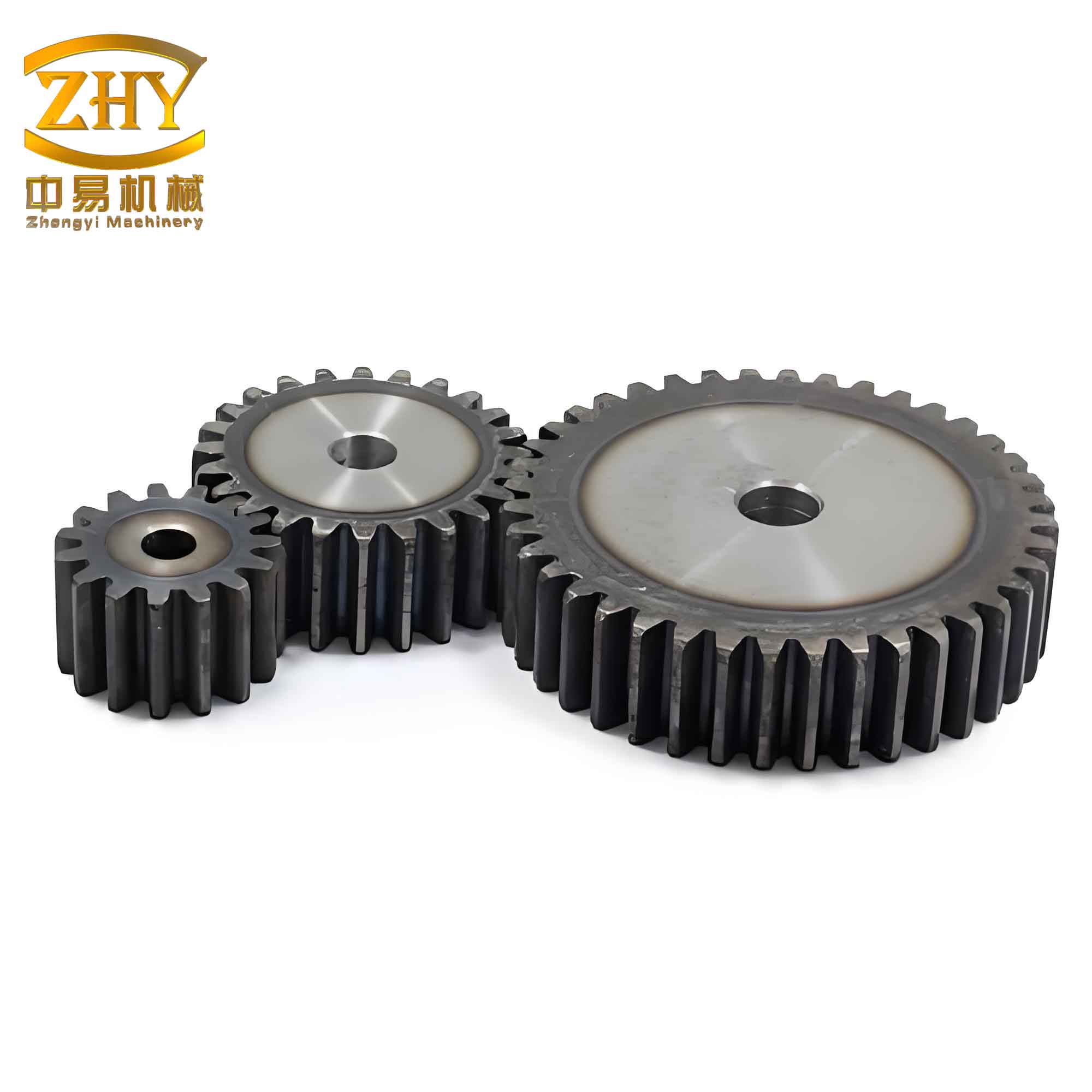
The cylindrical gear is a critical component in power transmission systems and finds extensive applications in automobiles, high-speed railways, and aerospace equipment. Traditionally, machining methods such as gear hobbing and shaving have been employed. However, these techniques are associated with material waste, discontinuous grain flow, relatively low production efficiency, and high overall costs. With the advancement of precision plastic forming and die manufacturing technologies, extrusion forming has emerged as a promising alternative. This process can yield cylindrical gears with superior tooth profile accuracy, enhanced surface quality, and improved load-bearing capacity. Nevertheless, achieving complete die fill, particularly in the tooth corners, while minimizing forming loads and defects like flash and collapse, presents a significant challenge. Existing research often focuses on single-factor analysis or specific defect mitigation, lacking a comprehensive methodology for multi-objective optimization of the extrusion process for cylindrical gears.
This article proposes a combined optimization strategy utilizing Principal Component Analysis (PCA) and Grey Relational Analysis (GRA) to address the multi-objective nature of cylindrical gear extrusion. The methodology transforms multiple correlated quality targets into a single Grey Relational Grade (GRG), facilitating efficient parameter optimization. A Central Composite Design (CCD) is conducted, and a response surface model is established to map the relationship between process parameters and the GRG. The optimal parameter set is identified and subsequently validated.
1. Experimental Design and Performance Targets
The study focuses on a cylindrical gear with a module of 4, pressure angle of 20°, and 16 teeth, made of 20CrMnTi steel. The billet preparation involves hot forging, annealing, and shot blasting. The final forming is achieved through a precision extrusion process. The primary challenge lies in the extrusion stage. To enhance material utilization and efficiency, a combined punch and die configuration is used for the plastic forming of the tooth profile, as illustrated in the following process schematic. The forming was conducted on a 100-ton hydraulic press at a constant speed, with a strain rate of 0.01 s-1, a billet pre-heat temperature of 350°C, and a total compressive deformation of 60%.
In this study, three key performance indicators are selected as optimization objectives: the collapse amount at the lower tooth tip (δ), the flash/bulge amount at the lower end face (h), and the maximum forming load (F). Four critical geometrical parameters of the die are chosen as influencing factors: the tooth tip fillet radius (R), the die entrance angle (μ), the split angle thickness (T), and the land length of the die (L). A five-level central composite design for four factors, comprising 31 experimental runs, was executed. The factors and their levels are detailed in Table 1.
| Factor | Level 1 | Level 2 | Level 3 | Level 4 | Level 5 |
|---|---|---|---|---|---|
| Tooth Tip Fillet R (mm) | 1.0 | 1.2 | 1.4 | 1.6 | 1.8 |
| Die Entrance Angle μ (°) | 35 | 40 | 45 | 50 | 55 |
| Split Angle Thickness T (mm) | 1 | 2 | 3 | 4 | 5 |
| Die Land Length L (mm) | 5 | 10 | 15 | 20 | 25 |
2. Theoretical Foundation: Grey Relational Analysis (GRA)
Grey Relational Analysis is a method for analyzing discrete sequences within a system, effective for dealing with uncertain and multi-factor relationships. It is particularly suitable for multi-objective optimization where the targets may have different units and scales. The core idea is to calculate the geometric proximity between a reference sequence (ideal performance) and comparative sequences (actual experimental results). The procedure is as follows:
First, the experimental data for the three objectives (δ, h, F) are normalized. Since a smaller value is desired for all three, the “smaller-the-better” characteristic is used for normalization:
$$ x_i^*(k) = \frac{\max x_i(k) – x_i(k)}{\max x_i(k) – \min x_i(k)} $$
where $x_i(k)$ is the original value of the k-th objective in the i-th experiment, and $x_i^*(k)$ is its normalized value.
The reference sequence $X_0$ is defined as the ideal normalized performance, i.e., $X_0 = \{1, 1, 1\}$ for the three objectives. The Grey Relational Coefficient (GRC) $\xi_i(k)$ for the k-th objective in the i-th experiment, which measures the proximity to the ideal, is calculated as:
$$ \xi_i(k) = \frac{\Delta_{min} + \rho \Delta_{max}}{\Delta_i(k) + \rho \Delta_{max}} $$
where $\Delta_i(k) = |x_0^*(k) – x_i^*(k)|$, $\Delta_{min} = \min_i \min_k \Delta_i(k)$, $\Delta_{max} = \max_i \max_k \Delta_i(k)$, and $\rho$ is the distinguishing coefficient, typically set to 0.5.
The overall Grey Relational Grade (GRG) $\gamma_i$ for the i-th experiment, which synthesizes the performance across all objectives, is a weighted sum of the GRCs:
$$ \gamma_i = \sum_{k=1}^{n} \beta_k \xi_i(k) $$
Here, $n=3$ (number of objectives), and $\beta_k$ is the weight of the k-th objective, satisfying $\sum_{k=1}^{n} \beta_k = 1$. A higher GRG indicates that the experimental result’s performance profile is closer to the ideal. Determining the appropriate weights $\beta_k$ is crucial and is addressed using PCA in the next section.
3. Multi-Objective Optimization via Combined PCA-GRA
3.1 Determination of Objective Weights using PCA
Principal Component Analysis is employed to objectively determine the weights ($\beta_k$) for the three objectives based on their variance and correlation. PCA transforms correlated variables into a set of uncorrelated principal components. The eigenvalue of each principal component indicates its contribution to the total variance of the dataset. The weight for an original objective is derived from its loading on the principal components that explain most of the variance.
The correlation matrix $R$ of the normalized objective data is computed. Solving the characteristic equation $|R – \lambda I|=0$ yields the eigenvalues $\lambda_k$ and corresponding eigenvectors. The contribution rate of the k-th principal component is $\lambda_k / \sum \lambda_k$. The results of the PCA are summarized in Table 2.
| Principal Component | Associated Objective | Eigenvalue ($\lambda_k$) | Contribution Rate (%) |
|---|---|---|---|
| 1st (PC1) | Collapse δ | 2.5834 | 85.0 |
| 2nd (PC2) | Flash h | 0.3421 | 10.9 |
| 3rd (PC3) | Load F | 0.1485 | 5.6 |
For the extrusion of the cylindrical gear, achieving complete tooth fill (minimizing collapse δ) is the paramount concern, followed by controlling flash and then minimizing load. The contribution rates from PCA reflect this priority objectively. Therefore, the weights are assigned proportionally to these contribution rates: $\beta_1 = 0.85$, $\beta_2 = 0.109$, $\beta_3 = 0.056$ (normalized to sum to 1: $\beta_1 \approx 0.83$, $\beta_2 \approx 0.105$, $\beta_3 \approx 0.054$).
3.2 Calculation of Grey Relational Grade
Using the weights determined by PCA, the Grey Relational Grade (GRG) for each of the 31 experimental runs is calculated according to the GRA procedure described in Section 2. A subset of the experimental design matrix along with the measured objective values and the calculated GRGs is presented in Table 3. The complete GRG for all runs serves as the comprehensive performance metric for subsequent optimization.
| Run | R (mm) | μ (°) | T (mm) | L (mm) | δ (mm) | h (mm) | F (kN) | GRG (γ) |
|---|---|---|---|---|---|---|---|---|
| 1 | 1.2 | 40 | 2 | 10 | 0.285 | 1.996 | 2141.4 | 0.326 |
| 2 | 1.6 | 40 | 2 | 10 | 0.283 | 1.934 | 2136.1 | 0.529 |
| 17 | 1.0 | 45 | 3 | 15 | 0.377 | 2.394 | 2234.6 | 0.156 |
| 18 | 1.8 | 45 | 3 | 15 | 0.318 | 1.957 | 2165.0 | 0.339 |
| … | … | … | … | … | … | … | … | … |
| 31 | 1.4 | 45 | 3 | 15 | 0.359 | 2.550 | 2236.9 | 0.218 |
The analysis of the GRG values indicates that a higher GRG corresponds to a better overall performance, meaning the combination of low collapse, low flash, and reasonable forming load. Initial observation suggests that parameters such as a larger tooth tip fillet (R=1.8 mm) and a smaller entrance angle (μ=35°) tend to yield higher GRG values.
3.3 Development of the Response Surface Model
To establish a quantitative relationship between the four process parameters (R, μ, T, L) and the comprehensive performance index (GRG), a second-order response surface model is fitted to the experimental data. The general form of the model is:
$$ \gamma = b_0 + \sum_{i=1}^{4} b_i x_i + \sum_{i=1}^{4} b_{ii} x_i^2 + \sum_{i<j} $$=""
where $\gamma$ is the predicted GRG, $x_i$ are the coded variables for R, μ, T, L, and $b$ are the regression coefficients. Using the experimental data, the specific fitted model for the cylindrical gear extrusion process is obtained:
$$
\begin{aligned}
\gamma = & 0.22156 + 0.1395R – 0.2498\mu – 0.05797T – 0.0197L \\
& -0.01595R^2 – 0.0038\mu^2 – 0.00248T^2 – 0.000692L^2 \\
& + 0.00692R\mu – 0.00197RT – 0.000384RL \\
& + 0.0038\mu T + 0.000273\mu L – 0.00722TL
\end{aligned}
$$
The adequacy and significance of the model are rigorously checked. The Analysis of Variance (ANOVA) for the regression model is presented in Table 4.
| Source | Degrees of Freedom | Sum of Squares | Mean Square | F-Value | P-Value |
|---|---|---|---|---|---|
| Model | 14 | 0.109375 | 0.007813 | 103.57 | < 0.0001 |
| Residual | 16 | 0.001207 | 0.000075 | – | – |
| Lack of Fit | 10 | 0.000859 | 0.000086 | 1.23 | 0.4151 |
| Pure Error | 6 | 0.000419 | 0.000070 | – | – |
| Total | 30 | 0.110582 | – | – | – |
The extremely low P-value (< 0.0001) for the model confirms that it is statistically highly significant. The non-significant P-value for Lack of Fit (0.4151 > 0.05) indicates the model fits the data well without unexplained systematic variation. Key goodness-of-fit statistics are shown in Table 5.
| R-Squared (R²) | Adjusted R-Squared (R²adj) | Predicted R-Squared (R²pred) | Standard Deviation (S) |
|---|---|---|---|
| 0.9891 | 0.9796 | 0.9452 | 0.00868 |
The high values of R², Adjusted R², and Predicted R² (all above 0.94), along with the low standard deviation, demonstrate that the model possesses excellent explanatory power, fitting capability, and prediction accuracy.
3.4 Parameter Optimization and Validation
Using the validated response surface model within the defined factor ranges, a numerical optimization is performed to maximize the Grey Relational Grade (γ). The optimal process parameters for extruding the cylindrical gear are identified as: Tooth Tip Fillet R = 1.8 mm, Die Entrance Angle μ = 35°, Split Angle Thickness T = 1 mm, and Die Land Length L = 5 mm. The predicted GRG under this condition is approximately 0.373.
To verify the model’s predictive accuracy, a comparison between the predicted GRG values from the model and the actual calculated GRG values from all 31 experiments is conducted. The average relative error between the predicted and actual values is calculated to be only 3.13%, confirming a strong agreement. Furthermore, a normal probability plot of the residuals shows points closely following a straight line, indicating the residuals are normally distributed and supporting the model’s validity.
4. Conclusion
This study successfully developed and applied a combined PCA-GRA methodology for the multi-objective optimization of the extrusion forming process for a cylindrical gear. The main conclusions are as follows:
1. The integration of Principal Component Analysis (PCA) and Grey Relational Analysis (GRA) effectively transforms the complex multi-objective optimization problem (minimizing collapse δ, flash h, and load F) into a straightforward single-objective optimization of the Grey Relational Grade (GRG). PCA provided an objective and rational basis for assigning weights to the conflicting objectives, reflecting their relative importance based on process variance.
2. A highly significant and accurate second-order response surface model was established to describe the relationship between the key die geometry parameters (R, μ, T, L) and the comprehensive performance index (GRG). The model exhibited excellent goodness-of-fit (R² > 0.98) and predictive capability, with an average prediction error of 3.13%.
3. The optimal process parameter combination for extruding the specified cylindrical gear was determined as: μ = 35°, R = 1.8 mm, T = 1 mm, and L = 5 mm. This configuration is predicted to yield the best balance between complete tooth filling, minimal flash formation, and acceptable forming load.
The proposed PCA-GRA-response surface methodology provides a systematic, effective, and generalizable framework for optimizing complex forming processes like cylindrical gear extrusion, where multiple, often conflicting, quality criteria must be simultaneously satisfied.