
The pursuit of higher efficiency, lower noise, and greater load capacity in power transmission systems has driven continuous innovation in gear design. Among the emerging solutions, the cylindrical gear with a curvilinear tooth trace presents a compelling alternative to traditional parallel-axis spur and helical gears. Unlike its straight or helically toothed counterparts, this cylindrical gear features teeth that are curved in the longitudinal direction, resembling a segment of a circle or a high-order curve. This fundamental geometric difference opens the door to unique meshing characteristics, primarily the potential for localized or even full line contact under loaded conditions, compared to the point contact typical of crowned gears or the theoretical line contact of perfect spur gears which is highly sensitive to misalignment.
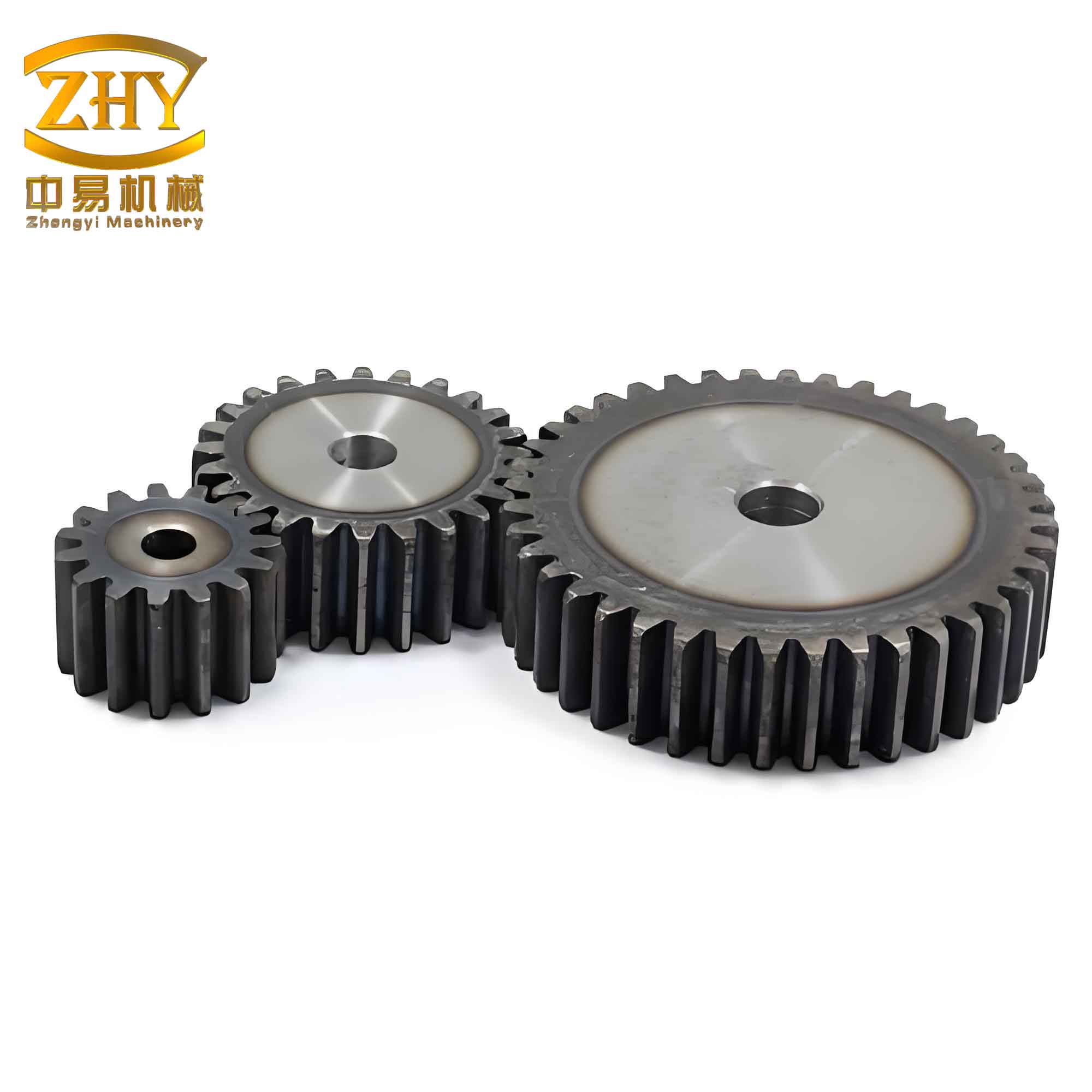
While the theoretical advantages of such line-contact cylindrical gear pairs are well-documented in academic literature, their practical adoption has been severely hindered by manufacturing challenges. Conventional gear hobbing or shaping machines are not suited for generating these complex curved tooth flanks. Proposed solutions often involve specialized, low-stiffness linkages, inefficient multi-axis milling with ball-end tools, or the need for multiple dedicated cutter heads, all of which increase cost, complexity, and production time. This article addresses this critical bottleneck by presenting a pragmatic and efficient machining methodology. The proposed method leverages existing six-axis CNC gear milling platforms, commonly used for spiral bevel gears, in conjunction with standard single-edge face-milling cutter heads. A comprehensive framework encompassing geometric modeling, CNC simulation, and precision verification is developed to demonstrate the feasibility and accuracy of this approach for producing high-quality line-contact curvilinear cylindrical gears.
Geometric Foundation and Mathematical Modeling
The core of manufacturing any precision gear lies in a rigorous mathematical definition of its tooth surface. For the curvilinear cylindrical gear considered here, the tooth flank is not a simple involute but a complex surface generated via the envelope of a cutter surface undergoing a specific relative motion with the gear blank. The machining principle involves two distinct steps using two different single-edge face-milling cutters: one for the concave (inner) flank and another for the convex (outer) flank of each tooth space. The fundamental kinematic relationship is one of pure rolling between the cutter’s pitch plane and the gear’s pitch circle during the generation process.
The process begins with defining the cutter geometry. A single-edge face-milling cutter head can be conceptualized by its cutting edge profile in the tool coordinate system. This profile consists of a straight-line segment (the main cutting edge) and a circular arc segment (the tip fillet or topping curve). The key geometric parameters of this profile are defined in the following table.
| Symbol | Description |
|---|---|
| $a$ | Addendum coefficient |
| $b$ | Dedendum coefficient |
| $\rho$ | Edge radius (fillet) coefficient |
| $\alpha_n$ | Normal pressure angle |
| $R$ | Nominal cutter point radius (cutter center to blade point) |
| $m$ | Gear module |
| $u$ | Variable parameter along the straight cutting edge |
| $\lambda$ | Angular parameter along the circular fillet edge |
Two cutters are needed: an “outer” cutter (with its effective cutting point on the outer side of the cutter axis) for generating the concave flank, and an “inner” cutter (cutting point on the inner side) for the convex flank. Their profiles are defined in a tool coordinate system $S_b$. For the straight-line segment, the vector is given by:
$$
\mathbf{r}_b^g(u) = \begin{bmatrix}
\pm u \sin\alpha_n \pm \frac{\pi m}{4} \\
u \cos\alpha_n \\
0 \\
1
\end{bmatrix}
$$
where the superscript $g$ denotes $i$ for inner cutter or $o$ for outer cutter. The signs are chosen appropriately based on the cutter type and flank being generated. For the circular fillet segment, the vector is:
$$
\mathbf{r}_b^g(\lambda) = \begin{bmatrix}
\pm \frac{\pi m}{4} \mp \tan\alpha_n (b m – \rho m + \rho m \sin\alpha_n) \mp \rho m (\cos\alpha_n – \cos\lambda) \\
\rho m – b m – \rho m \sin\lambda \\
0 \\
1
\end{bmatrix}
$$
This tool profile must then be swept through space to create the cutter surface. This is achieved by rotating the profile about the cutter axis, introducing a rotation parameter $\theta$. The transformation from coordinate system $S_b$ to the cutter coordinate system $S_c$ is defined by the matrix $\mathbf{M}_{c,b}(\theta)$. The cutter surface, both for the straight ($\mathbf{r}_c^{g,line}$) and fillet ($\mathbf{r}_c^{g,arc}$) parts, is generated in $S_c$:
$$
\mathbf{r}_c^{g,line}(u, \theta) = \mathbf{M}_{c,b}(\theta) \mathbf{r}_b^g(u)
$$
$$
\mathbf{r}_c^{g,arc}(\lambda, \theta) = \mathbf{M}_{c,b}(\theta) \mathbf{r}_b^g(\lambda)
$$
| Transformation | Matrix | Purpose |
|---|---|---|
| $S_b \to S_c$ | $\mathbf{M}_{c,b}(\theta)$ | Creates the revolving cutter surface from the blade profile. |
| $S_c \to S_1$ | $\mathbf{M}_{1,c}(\psi)$ | Places the moving cutter surface relative to the rotating gear blank. |
The gear tooth surface is the envelope of this moving cutter surface relative to the gear blank. The gear blank rotates about its own axis with angle $\psi$, and its center follows a specific trajectory relative to the cutter to maintain the pure-rolling condition. This relationship is captured by the transformation from the cutter system $S_c$ to the gear coordinate system $S_1$, represented by the matrix $\mathbf{M}_{1,c}(\psi)$. Applying this transformation gives the family of cutter surfaces in the gear space:
$$
\mathbf{r}_1^{g,line}(u, \theta, \psi) = \mathbf{M}_{1,c}(\psi) \mathbf{r}_c^{g,line}(u, \theta)
$$
$$
\mathbf{r}_1^{g,arc}(\lambda, \theta, \psi) = \mathbf{M}_{1,c}(\psi) \mathbf{r}_c^{g,arc}(\lambda, \theta)
$$
According to the theory of gearing, the actual tooth surface is identified within this family of surfaces by the equation of meshing. This equation states that the common normal vector at the contact point between the tool and the workpiece must be perpendicular to the relative velocity vector. Mathematically, for the generated surfaces, this condition is expressed as:
$$
f(u, \theta, \psi) = \left( \frac{\partial \mathbf{r}_1^{g,line}}{\partial \theta} \times \frac{\partial \mathbf{r}_1^{g,line}}{\partial u} \right) \cdot \frac{\partial \mathbf{r}_1^{g,line}}{\partial \psi} = 0
$$
for the main flank, and similarly for the fillet surface:
$$
f(\lambda, \theta, \psi) = \left( \frac{\partial \mathbf{r}_1^{g,arc}}{\partial \lambda} \times \frac{\partial \mathbf{r}_1^{g,arc}}{\partial \theta} \right) \cdot \frac{\partial \mathbf{r}_1^{g,arc}}{\partial \psi} = 0
$$
Solving the equation of meshing simultaneously with the surface family equations yields the definitive mathematical model of the tooth flank as a two-parameter surface. For the active flank (straight-edge generated part):
$$
\mathbf{R}_1^{flank} = \mathbf{r}_1^{g,line}(u, \theta, \psi(u, \theta))
$$
And for the root fillet (circular-edge generated part):
$$
\mathbf{R}_1^{fillet} = \mathbf{r}_1^{g,arc}(\lambda, \theta, \psi(\lambda, \theta))
$$
These equations form the exact numerical definition of the curvilinear cylindrical gear tooth. By discretizing the parameters $u$ (or $\lambda$) and $\theta$, a dense point cloud representing the entire tooth surface can be calculated. This point cloud serves as the “gold standard” for both constructing a perfect solid model for comparison and for generating the tool paths required for CNC machining.
Machining Methodology and CNC Simulation
The proposed machining strategy is designed for practicality, utilizing a standard six-axis CNC gear milling machine. The machine’s axes typically include three linear motions (X, Y, Z) and three rotational motions (A, B, C), where the A-axis rotates the workpiece (gear blank) and the C-axis spins the cutter. For generating the curvilinear tooth form, the fundamental relative motion between the cutter and the blank must replicate the pure-rolling kinematic defined in the mathematical model. This is achieved by synchronizing the linear travel of the cutter along the gear’s axial direction (mapped to the Y-axis) with the rotary motion of the gear blank (A-axis), while maintaining a fixed radial distance (X-axis) and a fixed workpiece tilt angle (B-axis, typically set to zero for this parallel-axis gear). The cutter’s own high-speed rotation (C-axis) provides the cutting action.
The process requires two separate setups with two different cutters, as summarized below:
| Stage | Cutter Type | Target Flank | Key Setup Offset | Kinematic Motion |
|---|---|---|---|---|
| 1 | Outer Cutter (Radius R) | Concave (Inner) Flank | Cutter center on pitch line tangent point. | Synchronized Y-axis slide and A-axis rotation for pure rolling. Index for next tooth. |
| 2 | Inner Cutter (Radius R) | Convex (Outer) Flank | Cutter center offset by $\pi m / 2$ in X from Stage 1 setup. | Identical synchronized Y/A motion as Stage 1, with re-indexing. |
The crucial detail is the offset between the two setups. When machining the convex flank with the inner cutter, its rotational center must be displaced by a distance of $\pi m / 2$ along the X-axis relative to the position used for the concave flank with the outer cutter. This offset is fundamental to ensuring that the two flanks generated by the two separate cutters will mesh correctly with the flanks of a mating gear, produced with the same method, to achieve the desired line contact.
To validate this method without physical prototyping, a virtual manufacturing environment was constructed using VERICUT software. This involved several key steps:
- Machine Tool Modeling: A digital twin of a six-axis CNC gear mill was created, accurately defining its kinematic chain, axis limits, and control system (e.g., FANUC).
- Cutters and Tool Assembly Modeling: Detailed 3D models of both the inner and outer single-edge face-milling cutter heads, based on the precise geometry defined in the mathematical model, were built and assembled with their tool holders.
- Workpiece and Fixture Modeling: A cylindrical gear blank was modeled and virtually fixed to the machine’s workpiece spindle (A-axis).
- CNC Program Generation: Based on the synchronized motion equations derived from the gear theory, a CNC program (G-code) was written. This program commands the coordinated movements of the Y and A axes for the generating motion, includes the necessary X-axis offset for the second setup, and incorporates precise indexing commands ($360^\circ / Z$, where $Z$ is the number of teeth) to machine all teeth on the cylindrical gear.
The simulation executes this program, showing the material removal process in real-time. The virtual cutter moves along its path, subtracting material from the blank to reveal the curvilinear tooth form. The successful completion of the simulation without collisions and with a fully formed gear is the first indicator of the method’s feasibility.
Accuracy Verification and Contact Analysis
Simulated machining is only useful if the resulting part geometry matches the theoretical design. To verify accuracy, a comparative deviation analysis was performed. The “as-simulated” gear model exported from VERICUT was compared against the “ideal” gear model constructed from the mathematical point cloud in a CAD software. This comparison, often performed using 3D metrology software modules, maps the normal distance between the simulated surface and the theoretical surface at thousands of points.
For a representative gear with parameters: number of teeth $Z = 31$, module $m = 4$ mm, and cutter radius $R = 60$ mm, the deviation analysis yielded the following results:
| Tooth Region | Nature of Deviation | Maximum Magnitude | Probable Cause |
|---|---|---|---|
| Convex Flank (Root) | Material Residual (Undercut) | 0.10 mm | Approximation in tool path or surface fitting tolerance. |
| Convex Flank (Active Profile) | Material Residual | < 0.06 mm | Very minor deviation, within acceptable limits. |
| Concave Flank (Root) | Overcut | 0.06 mm | Slight mismatch in fillet generation. |
| Concave Flank (Active Profile) | Mixed Overcut/Residual | 0.04-0.06 mm | Combined fitting and interpolation errors. |
The key finding is that the maximum observed deviation on the active tooth profiles is on the order of 0.06 mm. It is critical to note that this error budget includes not only the CNC simulation’s interpolation error but also the inherent error introduced when fitting a smooth CAD surface to the discrete mathematical point cloud to create the “ideal” model. Therefore, the actual machining error attributable solely to the proposed method is likely even smaller. This level of accuracy is generally acceptable for many industrial applications of a cylindrical gear, confirming the technical viability of the process.
The ultimate goal of manufacturing these gears is to achieve a line-contact condition in mesh. While the simulation validates form, the contact performance must be evaluated theoretically. For a pair of conjugate gears generated by the described method, the contact pattern under load can be analyzed using loaded tooth contact analysis (LTCA) software. The principle ensures that the convex flank of one gear perfectly matches the concave flank of its mate. The theoretical line contact is a curve that extends along the curved tooth trace. In practice, under load, this ideal line elastically deforms into an elongated contact ellipse. The following formula approximates the half-width $b$ of the contact ellipse for two elastic bodies in line contact, which is relevant for understanding the contact pressure:
$$
b = \sqrt{\frac{4 F \rho_{red}}{\pi L E_{red}}}
$$
where:
– $F$ is the normal load per unit length.
– $\rho_{red}$ is the reduced radius of curvature in the transverse plane.
– $L$ is the length of the contact line (effective face width).
– $E_{red}$ is the reduced modulus of elasticity for the two materials.
The stability and size of this contact pattern are significantly less sensitive to axial misalignment than in spur gears, which is a major functional advantage of this curvilinear cylindrical gear design.
Discussion and Comparative Advantages
The methodology presented here represents a significant step towards the practical realization of high-performance line-contact cylindrical gears. Its primary advantage is the leveraging of existing, high-stiffness CNC gear manufacturing infrastructure. This stands in stark contrast to previous approaches that relied on custom-built, often less rigid, dedicated mechanisms or highly inefficient multi-axis milling strategies using ball-end mills which produce scalloped surfaces requiring secondary finishing.
The use of standard single-edge face-milling cutters, common in bevel gear production, simplifies tooling logistics. However, it necessitates a two-stage, two-cutter process. An alternative hypothetical method using a special double-edged (pointed) cutter could generate both flanks simultaneously in a single setup, potentially doubling productivity. Yet, such a cutter is non-standard, requires precise sharpening and setting, and the method demands extremely precise control of the cutter’s nominal diameter relative to the gear parameters to achieve conjugacy. The proposed two-cutter method trades some efficiency for significantly greater practicality and reliance on proven tooling.
The table below summarizes the key comparative aspects of the proposed method against other potential approaches for manufacturing this type of cylindrical gear.
| Method | Required Machinery | Tooling | Estimated Efficiency | Key Challenges |
|---|---|---|---|---|
| Proposed 2-Cutter CNC | Existing 6-Axis Gear Mill | Two Standard Single-Edge Face-Mills | High (Generative Process) | Two setups, precise offset required. |
| Custom Linkage Mechanism | Special Purpose Machine | Form Tool or Simple Cutter | Low to Medium | Low rigidity, limited to softer materials, specialized machine cost. |
| 5-Axis Milling (Ball-End) | Generic 5-Axis CNC Mill | Standard Ball-End Mill | Very Low (Point-by-Point) | Extremely long cycle times, poor surface finish, high tool wear. |
| Hypothetical 1-Cutter CNC | Existing 6-Axis Gear Mill | One Special Double-Edge Face-Mill | Very High (Single Setup) | Design & procurement of special cutter, critical diameter control. |
Furthermore, the integrated workflow from mathematical modeling to CNC simulation establishes a robust digital thread. The same core mathematical model is used to:
1. Calculate the theoretical tooth form (point cloud).
2. Generate the tool paths for the CNC machine.
3. Serve as the reference for quality verification.
This consistency minimizes error propagation and ensures that the manufactured gear faithfully represents the designed intent for optimal line-contact meshing behavior in the final cylindrical gear transmission.
Conclusion and Outlook
This article has detailed a comprehensive and pragmatic solution for machining line-contact curvilinear cylindrical gears. By formulating a precise mathematical model of the tooth surface generated via a pure-rolling motion with a single-edge face-milling cutter, the foundation for accurate manufacturing is established. The proposed method successfully adapts this theory to existing six-axis CNC gear milling platforms, utilizing two standard cutter heads in a sequential two-stage process to generate the conjugate concave and convex flanks.
The feasibility and precision of the method were rigorously demonstrated through advanced CNC simulation and deviation analysis. The results confirm that gear teeth can be generated with form errors on the active profiles within a very acceptable range (less than 0.06 mm), which is likely to improve further with optimized tool path algorithms and post-process grinding or honing if required for ultra-precision applications.
The significance of this work is multifaceted. Firstly, it provides a clear, implementable pathway for producing these advanced gears without the need for capital investment in unproven, dedicated machinery. This lowers the barrier to entry for both researchers conducting physical experiments and for industries considering adoption. Secondly, it validates the entire digital process chain from geometric design to virtual manufacturing, enhancing confidence before physical cutting. Finally, by enabling the practical production of line-contact cylindrical gears, it opens the door for their performance advantages—such as higher load capacity, improved noise-vibration-harshness (NVH) characteristics, and better misalignment tolerance—to be empirically tested and leveraged in real-world parallel-axis drive systems, from high-performance automotive transmissions to heavy-duty industrial machinery.
Future work will naturally focus on physical implementation, including the refinement of cutting parameters, investigation of surface finish, and experimental validation of the meshing and transmission efficiency under load. The extension of this methodology to hardened gears via subsequent grinding processes also presents a valuable avenue for research, further solidifying the role of the innovative curvilinear cylindrical gear in the future of power transmission technology.