
In the field of agricultural machinery design, gear transmission systems play a pivotal role in transmitting motion and power efficiently. Among various gear types, involute spur cylindrical gears are widely adopted due to their stable transmission performance, high load-bearing capacity, and resistance to impact. These cylindrical gears are integral components in equipment such as fruit tree seedling machines, where precise and reliable operation is crucial. However, during the meshing process of spur cylindrical gears, stiffness excitation caused by elastic deformation is a primary source of noise and vibration, which can affect the longevity and performance of agricultural machinery. Therefore, analyzing and calculating the meshing stiffness of these cylindrical gears is essential to provide a theoretical foundation for optimization design, thereby enhancing the targeting of research and improving product quality. In this study, I focus on applying the potential energy method to determine the meshing stiffness of involute spur cylindrical gears, leveraging principles from material mechanics and elasticity theory to ensure design efficiency and reliability in agricultural machinery applications.
The importance of cylindrical gears in agricultural machinery cannot be overstated, as they contribute to the mechanization and automation of farming processes. For instance, in devices like seeders, harvesters, and irrigation systems, cylindrical gears facilitate smooth power transmission under varying loads. Nonetheless, the dynamic behavior of these gears, particularly their time-varying meshing stiffness, poses challenges related to vibration and acoustic emissions. Traditional design approaches often rely on qualitative theories or analogy methods, which may not adequately address the complexities of modern agricultural environments. This has led to a gap in systematic research, especially regarding the calculation of meshing stiffness for spur cylindrical gears. While numerous studies have explored gear meshing structures and principles, few have delved into stiffness computation using advanced methods like the potential energy approach. Existing techniques often involve complex stress analyses, leading to significant computational efforts and errors, and they lack a cohesive framework for different parameter variations. Internationally, research on gear meshing stiffness has evolved through simple expression derivations, finite element analysis, and simplified wave methods, but the potential energy method, pioneered by scholars such as Fakher Cheari and further developed by Yang and Tian, offers a streamlined alternative by modeling gears as cantilever beams and considering energy variations. This method enables rapid calculation of meshing stiffness, aligning with standards like ITSO, and thus holds promise for enhancing agricultural machinery design.
To address these issues, I employ a combination of literature review and material mechanics methods. Through extensive literature research, I have gathered insights into gear dynamics, meshing principles, and stiffness calculation techniques, focusing on cylindrical gears in agricultural contexts. This foundational knowledge informs the analytical approach, where material mechanics is used to simplify cylindrical gears into cantilever beam models for load analysis. By integrating these methodologies, I aim to derive and refine formulas for meshing stiffness calculation, ensuring they are applicable to the practical demands of agricultural machinery production. The study emphasizes the need for accurate stiffness evaluation to mitigate vibration and noise, ultimately contributing to more robust and efficient gear designs.
The meshing principle of spur cylindrical gears is fundamental to understanding their behavior. For proper meshing between two cylindrical gears, the instantaneous transmission ratio must remain constant, requiring the pitch point P to be fixed. This is achieved when the normal pitch of both gears is equal, leading to the correct meshing conditions: $$ m_1 = m_2 = m $$ and $$ \alpha_1 = \alpha_2 = \alpha $$, where \( m \) represents the module and \( \alpha \) the pressure angle. During meshing, the active gear’s tooth root involute contacts the driven gear’s tooth tip involute at point \( C_1 \) on the line of action, initiating engagement, while disengagement occurs at point \( C_2 \). The actual line of action \( \overline{C_1C_2} \) and the theoretical line \( \overline{N_1N_2} \) define the meshing trajectory, with characteristics including a constant instantaneous transmission ratio, a straight line of action ensuring consistent force direction, and a contact ratio \( \varepsilon \geq 1 \) for continuous operation. These features underscore the stability of cylindrical gears in transmission, but they also highlight the cyclical nature of stiffness variation due to single- and double-tooth alternating meshing, which necessitates precise stiffness computation to minimize dynamic excitations.
The potential energy method offers a robust framework for calculating the meshing stiffness of cylindrical gears by considering the total potential energy stored during deformation. This total energy comprises four components: shear potential energy \( U_s \), bending potential energy \( U_b \), axial compression potential energy \( U_a \), and Hertzian potential energy \( U_h \). By modeling the gear tooth as a cantilever beam, as illustrated in the geometry, we can derive expressions for the corresponding stiffnesses—shear stiffness \( k_s \), bending stiffness \( k_b \), axial compression stiffness \( k_a \), and Hertzian stiffness \( k_h \). The force \( F \) at the meshing point, directed along the line of action, can be decomposed into tangential \( F_b \) and axial \( F_a \) components: $$ F_b = F \cos \alpha_1 $$ and $$ F_a = F \sin \alpha_1 $$, where \( \alpha_1 \) is the pressure angle at the meshing point. Using material mechanics, the stiffness formulas are expressed as:
$$ \frac{1}{k_b} = \int_{\alpha_1}^{\alpha_2} \frac{3 \{1 + \cos \alpha_1 [(\alpha_2 – \alpha) \sin \alpha – \cos \alpha]\}^2 (\alpha_2 – \alpha) \cos \alpha}{2EL [\sin \alpha + (\alpha_2 – \alpha) \cos \alpha]^3} d\alpha $$
$$ \frac{1}{k_s} = \int_{\alpha_1}^{\alpha_2} \frac{1.2(1 + \nu) (\alpha_2 – \alpha) \cos \alpha \cos^2 \alpha_1}{EL [\sin \alpha + (\alpha_2 – \alpha) \cos \alpha]} d\alpha $$
$$ \frac{1}{k_a} = \int_{\alpha_1}^{\alpha_2} \frac{(\alpha_2 – \alpha) \cos \alpha \sin^2 \alpha_1}{2EL [\sin \alpha + (\alpha_2 – \alpha) \cos \alpha]} d\alpha $$
$$ \frac{1}{k_h} = \frac{4(1 – \nu^2)}{\pi E L} $$
Here, \( E \) is Young’s modulus, \( G \) is the shear modulus, \( \nu \) is Poisson’s ratio, \( L \) is the face width of the cylindrical gears, \( \alpha_2 \) is the pressure angle at the addendum circle given by $$ \alpha_2 = \arccos\left(\frac{r_b}{r_a}\right) $$, with \( r_b \) as the base circle radius and \( r_a \) as the addendum circle radius. The geometric parameters, such as the distance \( d \) from the meshing point to the root circle and the height \( h \), are derived from the gear geometry: $$ h = r_b [(\alpha_2 – \alpha) \sin \alpha – \cos \alpha] $$ and $$ d = r_b [\sin \alpha + (\alpha_2 – \alpha) \cos \alpha] $$. The integration limits \( \alpha_1 \) and \( \alpha_2 \) correspond to the meshing points, ensuring accurate representation of the tooth engagement range for cylindrical gears.
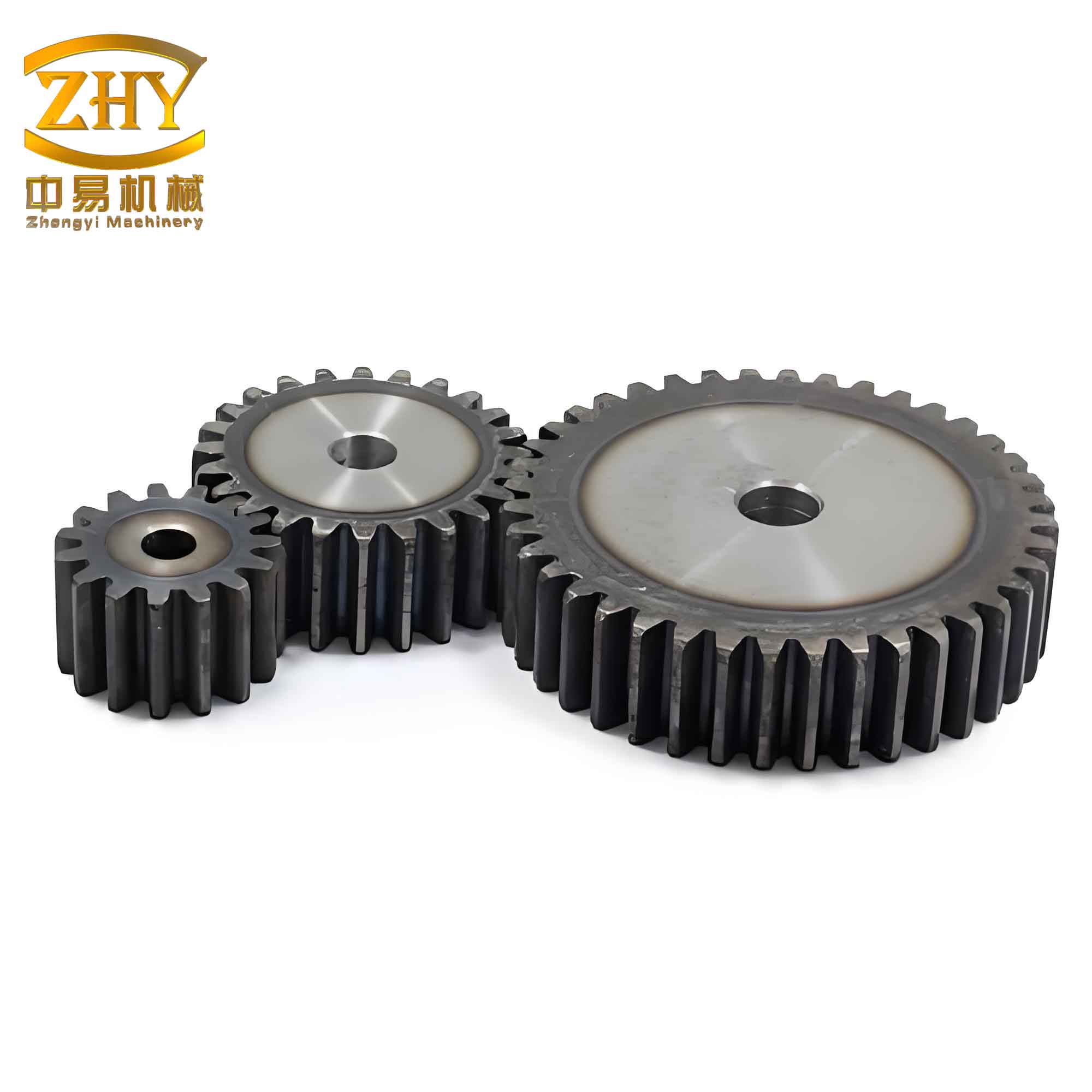
To facilitate understanding, the key parameters involved in the stiffness calculation for cylindrical gears are summarized in the table below, which highlights their definitions and roles in the potential energy method.
| Parameter | Symbol | Definition | Role in Stiffness Calculation |
|---|---|---|---|
| Young’s Modulus | \( E \) | Material stiffness property | Influences all stiffness components via elastic deformation |
| Poisson’s Ratio | \( \nu \) | Material lateral strain ratio | Affects shear and Hertzian stiffness |
| Face Width | \( L \) | Width of gear tooth along axis | Directly scales stiffness values in integrals |
| Base Circle Radius | \( r_b \) | Radius of base circle for involute | Determines geometric relationships in meshing |
| Pressure Angle | \( \alpha \) | Angle between line of action and tangent | Variable in integration for meshing position |
| Module | \( m \) | Gear size parameter | Ensures correct meshing conditions for cylindrical gears |
| Contact Ratio | \( \varepsilon \) | Ratio of meshing length to base pitch | Indicates number of tooth pairs in contact |
The model solving process involves integrating these stiffness components to obtain the total meshing stiffness for a pair of cylindrical gears. The total potential energy \( U_{\text{total}} \) is the sum of individual energies: $$ U_{\text{total}} = U_b + U_s + U_a + U_h $$. Alternatively, it can be expressed in terms of stiffness: $$ U_{\text{total}} = \frac{F^2}{2k} $$, where \( k \) is the total meshing stiffness. For a gear pair with active gear 1 and driven gear 2, the combined stiffness is given by: $$ \frac{1}{k} = \frac{1}{k_{b1}} + \frac{1}{k_{s1}} + \frac{1}{k_{a1}} + \frac{1}{k_{h1}} + \frac{1}{k_{b2}} + \frac{1}{k_{s2}} + \frac{1}{k_{a2}} + \frac{1}{k_{h2}} $$. However, this formulation may overestimate stiffness due to deformation from angular deflection at the tooth base. To account for this, the tooth foundation stiffness \( k_f \) is introduced, derived from parameters such as \( L^* \), \( P^* \), \( M^* \), and \( Q^* \), which relate to the gear body geometry and material properties. The modified total stiffness for cylindrical gears with a contact ratio \( \varepsilon \geq 1 \) becomes: $$ k_{\text{total}} = \sum_{i=1}^{n} \left( \frac{1}{k_{b1,i} + k_{s1,i} + k_{a1,i} + k_{h1,i} + k_{f1,i}} + \frac{1}{k_{b2,i} + k_{s2,i} + k_{a2,i} + k_{h2,i} + k_{f2,i}} \right)^{-1} $$, where \( n \) represents the number of tooth pairs simultaneously in mesh. This comprehensive approach ensures accurate stiffness evaluation over the entire meshing cycle, capturing the periodic variations inherent in cylindrical gears.
In agricultural machinery, such as the fruit tree seedling machine example, applying this potential energy method to cylindrical gears enables designers to optimize gear parameters for reduced vibration and noise. For instance, by calculating the time-varying meshing stiffness, one can identify critical points in the meshing cycle where stiffness drops, leading to dynamic instabilities. Adjustments like modifying the module, pressure angle, or face width of cylindrical gears can then be made to smooth stiffness fluctuations, enhancing overall system performance. The integration of advanced design concepts, including virtual prototyping and finite element analysis, complements this method by allowing for predictive assessments of gear behavior under operational loads. This synergy reduces development time and costs for agricultural machinery, while ensuring that cylindrical gears meet the rigorous demands of field applications. Moreover, the potential energy method’s ability to incorporate factors like material properties and environmental conditions makes it versatile for various gear designs, from simple spur cylindrical gears to more complex configurations.
To illustrate the practical application, consider a case study involving cylindrical gears in a tractor transmission system. Using the derived formulas, the meshing stiffness can be computed for different gear pairs, and the results can be tabulated to compare stiffness values under varying loads and speeds. For example, a table showing stiffness versus rotation angle for cylindrical gears with different modules reveals how stiffness varies during meshing, informing design choices for noise reduction. Additionally, sensitivity analyses can be conducted by altering parameters like Young’s modulus or Poisson’s ratio to assess their impact on stiffness, further refining the gear design process. Such detailed computations underscore the method’s utility in achieving high-precision agricultural machinery components.
In conclusion, through the application of the potential energy method, I have demonstrated a systematic approach to calculating the meshing stiffness of involute spur cylindrical gears, which are crucial in agricultural machinery. By combining material mechanics, elasticity theory, and gear dynamics principles, this study provides accurate stiffness formulas that account for shear, bending, axial compression, and Hertzian deformations. The derivation process, supported by geometric models and parameter tables, ensures that the method is both rigorous and applicable to real-world design scenarios. For cylindrical gears, this enables enhanced optimization, leading to quieter, more durable, and efficient transmission systems in agricultural equipment. Future research could explore extensions to helical or bevel cylindrical gears, or incorporate nonlinear effects for even greater accuracy. Ultimately, integrating such analytical techniques into agricultural machinery design fosters innovation, reduces costs, and promotes sustainable farming practices through improved mechanical performance.