
Involute spur cylindrical gears are fundamental components in power transmission systems across various industries, including automotive, aerospace, and heavy machinery, owing to their advantages of constant velocity ratio, high load-bearing capacity, and relative ease of manufacturing. However, during long-term service, factors such as manufacturing errors, assembly misalignments, and elastic deformations under load can lead to uneven load distribution across the gear tooth flank. This maldistribution often manifests as edge-loading or concentrated stress at specific points, resulting in premature failure modes like pitting, spalling, and bending fatigue. To mitigate these issues and enhance the meshing performance, transmission stability, and service life, tooth flank modification, particularly crowning, has become an essential design practice.
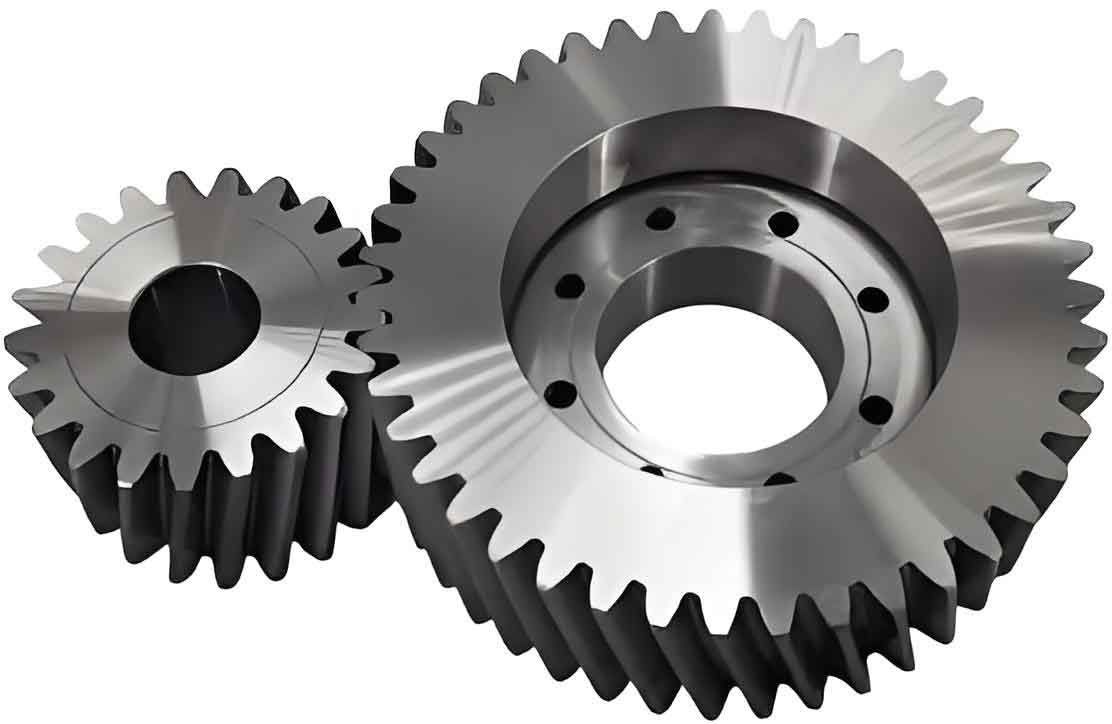
This study focuses on the investigation of drum-shaped tooth profile modification and its consequential impact on the contact mechanics and fatigue lifetime of parallel-axis involute spur cylindrical gears. A combined approach of three-dimensional modeling, finite element analysis (FEA), and fatigue life prediction is employed. The primary objectives are to: (1) establish geometric models for both unmodified and profile-modified spur cylindrical gears; (2) perform transient dynamic contact analysis to evaluate stress distributions under ideal and misaligned mounting conditions; and (3) predict the fatigue life of the gear teeth based on the calculated stress histories and material S-N data. The findings aim to provide a technical foundation for optimizing modification parameters to balance improved meshing characteristics with enhanced durability in spur cylindrical gear applications.
Geometric Modeling and Profile Modification Methodology for Cylindrical Gears
The foundational element of this analysis is the accurate geometric representation of the spur cylindrical gear pair. The standard involute tooth profile is generated based on five fundamental parameters: number of teeth (z), module (m), pressure angle (α), addendum coefficient ($$h_a^*$$), and dedendum coefficient ($$c^*$$). For this study, a symmetric gear pair is designed with the following specifications, adhering to standard gear design principles for spur cylindrical gears.
| Parameter | Symbol | Value | Unit |
|---|---|---|---|
| Number of Teeth (Driver/Driven) | $$z_1, z_2$$ | 40 | – |
| Module | m | 2 | mm |
| Pressure Angle | α | 20 | ° |
| Addendum Coefficient | $$h_a^*$$ | 1.0 | – |
| Dedendum Coefficient | $$c^*$$ | 0.25 | – |
| Face Width | b | 20 | mm |
From these basic parameters, key geometric dimensions are calculated: Pitch diameter $$d = m \cdot z = 80 \text{ mm}$$; Base diameter $$d_b = d \cdot \cos(\alpha) ≈ 75.18 \text{ mm}$$; Addendum $$h_a = h_a^* \cdot m = 2 \text{ mm}$$; Dedendum $$h_f = (h_a^* + c^*) \cdot m = 2.5 \text{ mm}$$; Tip diameter $$d_a = d + 2h_a = 84 \text{ mm}$$; Root diameter $$d_f = d – 2h_f = 75 \text{ mm}$$. The three-dimensional solid models of the gear pair are constructed using CAD software based on these dimensions, with appropriate fillets applied at the tooth root to reduce stress concentration.
Tooth crowning, a common modification for spur cylindrical gears, involves deliberately altering the ideal involute and/or lead profile to create a slightly convex tooth surface. This study implements a parabolic crowning modification along both the profile (tooth height) and lead (face width) directions. A local coordinate system is established on the tooth flank at the midpoint of the face width on the pitch circle, with the x-axis normal to the ideal involute surface, the y-axis along the profile direction, and the z-axis along the lead direction. The parabolic modification amount Δx at any point (y, z) is defined by the following equations:
For profile crowning:
$$ \Delta x_{profile}(y) = C_{\alpha} \left[ \frac{y – y_0}{L_{profile}} \right]^2, \quad \text{for } -(h_f – c) \le y \le h_a $$
For lead crowning:
$$ \Delta x_{lead}(z) = C_{\beta} \left[ \frac{z}{b/2} \right]^2, \quad \text{for } -b/2 \le z \le b/2 $$
Here, $$C_{\alpha}$$ and $$C_{\beta}$$ are the maximum crown amounts (in µm) at the ends of the active profile and the ends of the face width, respectively. $$y_0$$ is the profile coordinate at the modification symmetry point, and $$L_{profile}$$ is a characteristic length for profile scaling. The total modification at a point is the superposition of both components. Six modification cases are defined to investigate the effect of crowning magnitude, as summarized below.
| Modification Case | Maximum Profile Crown $$C_{\alpha}$$ (µm) | Maximum Lead Crown $$C_{\beta}$$ (µm) | Description |
|---|---|---|---|
| Case 1 | 0 | 0 | Unmodified (Baseline) |
| Case 2 | 2 | 2 | Light Crowning |
| Case 3 | 4 | 4 | Moderate Crowning |
| Case 4 | 6 | 6 | Medium Crowning |
| Case 5 | 8 | 8 | Heavy Crowning |
| Case 6 | 10 | 10 | Very Heavy Crowning |
Finite Element Modeling and Transient Dynamic Analysis
The three-dimensional CAD models of the spur cylindrical gear pairs for all six cases are imported into a commercial finite element analysis software, ANSYS, for subsequent mechanical analysis. The material assigned to the gears is 40Cr alloy steel, a common material for high-strength cylindrical gears. Its key properties are listed.
| Property | Value |
|---|---|
| Density (ρ) | 7870 kg/m³ |
| Young’s Modulus (E) | 211 GPa |
| Poisson’s Ratio (ν) | 0.277 |
| Yield Strength (σ_{0.2}) | 785 MPa |
| Tensile Strength (σ_b) | 980 MPa |
A high-quality tetrahedral mesh (10-node tetrahedron elements, Tet10) is generated for both gears. The mesh is significantly refined in the potential contact zones around the tooth flanks to accurately capture contact stresses. The contact between all mating tooth pairs is modeled as frictional surface-to-surface contact, with a Coulomb friction coefficient of 0.15. The finite element model characteristics for the different spur cylindrical gear pairs are summarized.
| Modification Case | Element Type | Number of Elements | Number of Nodes |
|---|---|---|---|
| Case 1 | Tet10 | 223,961 | 383,685 |
| Case 2 | Tet10 | 246,221 | 419,235 |
| Case 3 | Tet10 | 246,458 | 419,563 |
| Case 4 | Tet10 | 245,773 | 418,609 |
| Case 5 | Tet10 | 246,392 | 419,390 |
| Case 6 | Tet10 | 246,660 | 419,513 |
Transient dynamic analyses are performed to simulate the meshing process of the spur cylindrical gears. Two primary mounting scenarios are considered: Ideal Alignment and Parallel Axis Misalignment (Axial Offset). For the ideal case, the rotational axes of the driver and driven gears are perfectly parallel and aligned. Boundary conditions are applied as follows: The driver gear is assigned a constant rotational velocity of 2 rad/s about its axis, while a constant resistive torque of 15,000 N·mm is applied to the driven gear. All other translational and rotational degrees of freedom for both gear bodies are constrained appropriately.
For the misalignment analysis, a parallel axis offset is simulated by introducing a small angular misalignment (α_offset) between the gear axes. Four misalignment angles are investigated: 0.1°, 0.2°, 0.3°, and 0.4°. To ensure convergence under the potentially severe edge-loading conditions induced by misalignment, the applied resistive torque is slightly reduced to 14,000 N·mm for these cases. The analysis solves the equations of motion over a specified time period, capturing the time-varying contact forces, stresses, and deformations as multiple tooth pairs engage and disengage.
Analysis Results and Discussion for Spur Cylindrical Gears
1. Stress Analysis Under Ideal Mounting Conditions
The transient dynamic analysis provides detailed insight into the contact stress evolution on the flanks of the spur cylindrical gears. Under ideal mounting conditions, the unmodified gear pair (Case 1) exhibits a relatively uniform but wider stress distribution across the tooth flank during engagement. However, noticeable stress concentrations are observed near the root and pitch line regions of adjacent, non-meshing teeth, indicating the presence of meshing interference. The maximum von Mises equivalent stress for the unmodified spur cylindrical gear is approximately 107.37 MPa.
Introducing a light crowning modification (Case 2, $$C_{\alpha} = C_{\beta} = 2 \mu m$$) significantly alters the stress pattern. The contact area becomes more centralized on the tooth flank, effectively eliminating the interference observed in the unmodified case. The maximum stress reduces to about 103.13 MPa, representing an improvement. As the crowning amount increases through Cases 3 to 6, the contact area continues to shrink and become more concentrated towards the center of the tooth flank. Consequently, the maximum contact stress rises: 158.35 MPa for Case 3 (4 µm), 201.54 MPa for Case 4 (6 µm), 165.8 MPa for Case 5 (8 µm), and 247.52 MPa for Case 6 (10 µm). The non-monotonic increase, with a dip at Case 5, is attributed to a specific redistribution of root stress that slightly alleviates the flank pressure at that particular modification level. The general trend, however, confirms that while crowning effectively controls contact localization and eliminates edge-loading/ interference in ideally aligned spur cylindrical gears, it increases the magnitude of the peak contact pressure.
The time-history of contact stress for a single tooth through its mesh cycle further illustrates this effect. The unmodified gear shows a relatively smooth stress curve. Modified gears, starting from Case 2, exhibit higher peak stresses and greater fluctuation amplitudes during the double-tooth and single-tooth contact transitions. This increased dynamic loading factor is a direct consequence of the reduced contact area and altered load-sharing characteristics between tooth pairs in crowned spur cylindrical gears.
2. Fatigue Life Prediction Under Ideal Mounting
Fatigue life estimation is performed using the stress results from the transient analysis and the material S-N (Stress-Number of cycles) curve for 40Cr steel. The S-N relationship used for the spur cylindrical gear material is derived from experimental data and can be expressed by the following three-parameter equation:
$$ N_f = C (\sigma_m – \sigma_{ac})^{-m} $$
Where $$N_f$$ is the predicted fatigue life (cycles), $$\sigma_m$$ is the mean stress, and $$\sigma_{ac}$$, C, and m are material constants. For 40Cr steel, the fitted equation is:
$$ N_f = 1.82524 \times 10^{11} (\sigma_m – 250)^{-2.12613} $$
This relationship is applied locally based on the stress history at critical locations on the gear tooth.
The predicted service fatigue life for the spur cylindrical gears under ideal alignment is heavily influenced by the modification level. The unmodified gear pair (Case 1) achieves the highest predicted life of approximately 23.73 million cycles. As the crowning amount increases, the fatigue life decreases significantly: ~19.94 million cycles for Case 2, ~6.10 million for Case 3, ~2.30 million for Case 4, ~2.55 million for Case 5, and plummets to below 50,000 cycles for the heavily crowned Case 6. This trend correlates directly with the observed increase in peak contact stress. It demonstrates a critical trade-off in the design of spur cylindrical gears: modification improves meshing quality and eliminates interference but can drastically reduce contact fatigue life if the crown amount is excessive, due to elevated Hertzian contact pressures.
3. Effect of Axis Misalignment on Spur Cylindrical Gears
The presence of axis misalignment fundamentally changes the loading condition on spur cylindrical gears. For the unmodified gear pair (Case 1) with a 0.2° offset, severe edge-loading occurs. The contact patch shifts entirely to one end of the face width, resulting in a highly concentrated stress field with a maximum von Mises stress of 366.98 MPa, which is over three times higher than the ideal alignment case.
Profile modification proves highly effective in compensating for this misalignment. Even a light crown (Case 2, 2 µm) reduces the peak stress to 283.79 MPa and begins to draw the contact zone away from the edge. With moderate to heavy crowning (Cases 3-6), the contact area is successfully re-centered on the tooth flank. The peak stresses for these cases under 0.2° misalignment are substantially lower and more comparable to the ideal-case stresses for modified gears: 168.23 MPa (Case 3), 176.56 MPa (Case 4), 190.87 MPa (Case 5), and 189.94 MPa (Case 6). This demonstrates the primary benefit of lead crowning in spur cylindrical gears: to ensure tolerable load distribution even in the presence of unavoidable assembly errors or shaft deflections.
The sensitivity of maximum stress to misalignment angle varies with crown amount. For unmodified and lightly crowned spur cylindrical gears (Cases 1 & 2), stress increases sharply with increasing misalignment. For gears with sufficient crowning (Cases 3-6), the maximum stress remains relatively stable and much lower across the range of misalignment angles studied (0.1° to 0.4°), highlighting their robustness.
4. Fatigue Life Under Axis Misalignment
The fatigue life predictions under misaligned conditions reinforce the critical importance of appropriate modification for spur cylindrical gears. For unmodified gears, any misalignment catastrophically reduces life due to extreme edge stresses. For example, with a 0.4° offset, the life of an unmodified gear is negligible. A light crown (Case 2) offers some protection at small misalignments (life ~25 million cycles at 0.1° offset) but fails at larger offsets (life < 100,000 cycles at 0.4° offset).
Spur cylindrical gears with moderate to heavy crowning (Cases 3-6) show remarkable resilience. Their predicted fatigue lives remain high (on the order of millions to tens of millions of cycles) and are much less sensitive to the degree of misalignment. A gear with a 6 µm crown (Case 4), for instance, maintains a relatively consistent and high life across all misalignment angles up to 0.4°. This clearly indicates that an adequately chosen crown amount is not merely an optimization for ideal conditions but a necessary design feature to ensure reliable, long-term operation of spur cylindrical gears in real-world applications where perfect alignment cannot be guaranteed.
Conclusion
This comprehensive investigation into the drum-shaped profile modification of parallel-axis involute spur cylindrical gears reveals significant insights into the interplay between geometric design, contact mechanics, and fatigue performance. The study successfully employed finite element-based transient dynamics and fatigue analysis to evaluate six different crowning magnitudes under both ideal and misaligned mounting conditions.
The key conclusions are as follows: For perfectly aligned spur cylindrical gears, tooth crowning effectively eliminates meshing interference and localizes the contact area, improving kinematic performance. However, this comes at the cost of increased contact pressure, which leads to a substantial reduction in predicted contact fatigue life as the crown amount increases. The unmodified gear offers the highest fatigue life under ideal conditions.
The value of profile modification becomes unequivocal when considering practical assembly imperfections. In the presence of parallel axis misalignment, unmodified spur cylindrical gears suffer from severe edge-loading, resulting in excessively high contact stresses and virtually immediate fatigue failure. Introducing an appropriate level of combined lead and profile crowning dramatically mitigates this issue. It re-centers the load on the tooth flank, distributes stress more evenly, and renders the gear pair’s stress state and fatigue life relatively insensitive to the magnitude of misalignment within a practical range.
Therefore, the design of spur cylindrical gears requires a careful, application-specific balance. For systems where exceptional alignment precision can be maintained, minimal or no crowning may be optimal for maximum fatigue life. For the vast majority of industrial applications where some misalignment is inevitable, implementing a carefully calculated crown amount is essential. The optimal value is the minimum crown sufficient to compensate for expected misalignments and deformations, thereby maximizing the durability and reliability of the spur cylindrical gear transmission without unnecessarily sacrificing the fatigue life potential seen in the ideal, aligned state. This research provides a quantitative framework to guide that optimization process for spur cylindrical gears.