
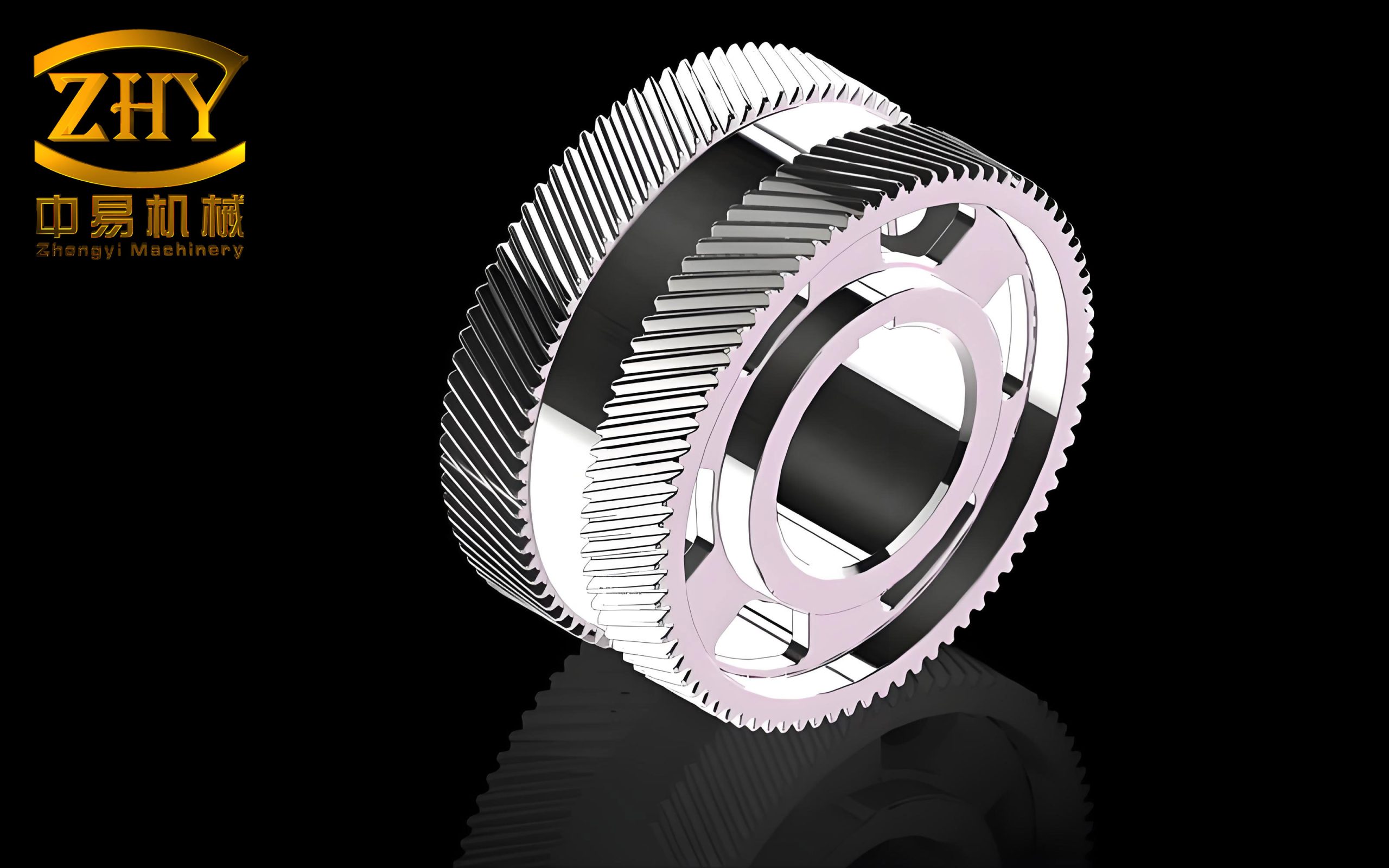
In my research, I focused on the steady-state structural response of a herringbone gear with a web configuration, a critical component in heavy-duty marine transmissions. The herringbone gear is known for its high load capacity and absence of axial thrust, making it ideal for large-scale equipment. However, its dynamic behavior under periodic loads—both in magnitude and position—poses significant challenges. To address this, I employed finite element theory integrated with a modal superposition method, using dynamic load excitations derived from a lumped-mass dynamic model of a marine herringbone gear reducer. My goal was to compute the steady-state response of the gear structure and investigate the influence of web thickness and rim thickness on its performance.
Modeling of the Herringbone Gear Structure
I began by establishing a parameterized solid model of a single tooth sector of the herringbone gear using Pro/Engineer. The basic parameters of the herringbone gear are listed in Table 1. The gear features a double-helical geometry, which I simplified into a cylindrical body with pitch circle diameter for easier mesh generation and cyclic loading. I created a 1/Z sector model (where Z is the number of teeth) to control element and node counts efficiently.
| Parameter | Value |
|---|---|
| Normal module, mn | 8 mm |
| Number of teeth, Z | 76 |
| Normal pressure angle, αn | 20° |
| Helix angle, β | 25° |
| Normal addendum coefficient, h*an | 1 |
| Normal clearance coefficient, c*n | 0.5 |
| Normal modification coefficient, xn | 0 |
| Face width, b | 200 mm |
| Bore diameter, d | 300 mm |
| Rim thickness, r | 30 mm |
| Web thickness, c | 60 mm |
The sector model was imported into ANSYS, where I meshed it with 168 elements and 450 nodes using SOLID45 elements. Through rotational replication, I obtained the full finite element model comprising 12,768 elements and 33,725 nodes. The material properties were defined as alloy steel as shown in Table 2.
| Property | Value |
|---|---|
| Element type | SOLID45 |
| Elastic modulus, E | 2.06 × 10⁵ MPa |
| Poisson’s ratio, ν | 0.3 |
| Density, ρ | 7.9 × 10³ kg/m³ |
Dynamic Load Excitation
The dynamic load history applied to the herringbone gear was obtained from a lumped-mass dynamic model of the planetary transmission system. This system consists of two stages: the first stage includes a sun gear (ms1), three planet gears (mp1j), a ring gear (mr1), and a planet carrier (mc1); the second stage includes a sun gear (ms2), three planet gears (mp2j), a ring gear (mr2), and a planet carrier (mc2). The first-stage carrier is fixed, and the second-stage ring gear is also fixed. Power enters through the first-stage sun gear and exits through the second-stage planet carrier. I extracted the dynamic load on the first-stage planet gear — a herringbone gear — as the excitation for my structural response analysis. The load history is shown in Figure 4 of the original text (not reproduced here), with dimensionless time on the abscissa and normal force on the ordinate.
Modal Analysis
Before computing the steady-state response, I performed a modal analysis of the herringbone gear structure. The displacement boundary condition was a full constraint on all nodes of the inner bore surface. I extracted the first 20 natural frequencies and mode shapes, which are listed in Table 3.
| Mode | Frequency | Mode | Frequency | Mode | Frequency | Mode | Frequency |
|---|---|---|---|---|---|---|---|
| 1 | 1373.6 | 6 | 1463.6 | 11 | 2128.1 | 16 | 2183.4 |
| 2 | 1373.6 | 7 | 1465.0 | 12 | 2130.1 | 17 | 3006.1 |
| 3 | 1373.9 | 8 | 1465.0 | 13 | 2183.4 | 18 | 3006.1 |
| 4 | 1373.9 | 9 | 1712.7 | 14 | 2183.4 | 19 | 3007.0 |
| 5 | 1463.6 | 10 | 1714.9 | 15 | 2183.4 | 20 | 3007.0 |
The excitation frequency from the dynamic model was 2255.19 Hz, which is close to the 16th natural frequency (2183.4 Hz). This proximity indicates a potential resonance risk, emphasizing the need for accurate steady-state response evaluation.
Steady-State Response Calculation
To obtain the steady-state response, I used the mode superposition method in ANSYS. The first 20 modes were selected as master modes. A damping ratio of 0.02 was assumed. The time step was determined to ensure adequate resolution of the highest mode of interest (2183.4 Hz). A common rule is to use a time step of 1/(20f), where f is the maximum frequency. Thus, the initial time step was:
$$\Delta t_1 = \frac{1}{20 \times 2183.4} = 2.29 \times 10^{-5} \ \text{s}$$
However, I also needed to resolve the dynamic load history, which had 30 force increments per tooth engagement per rotation. With 76 teeth, the total number of load steps per rotation was 2280. The resulting time step from the load history was:
$$\Delta t_2 = \frac{1}{2255.19 \times 76 \times 30} = 1.48 \times 10^{-5} \ \text{s}$$
Since Δt2 < Δt1, the load interpolation provided sufficient temporal resolution to excite the 16th mode. I applied the normal forces to two adjacent tooth flanks simultaneously to simulate the compressive loading condition, as shown in the boundary conditions (Figure 5, not reproduced). The displacement boundary remained full constraint on the bore nodes.
The transient analysis was performed over multiple rotational cycles (initially 10 cycles). After each solution, I extracted the circumferential displacement at 12 points on the rim face and used an external convergence program to check if the structure had reached a steady state. The steady-state condition was defined as:
$$\left| \frac{Y_i^{(N)} – Y_i^{(0)}}{Y_i^{(N)}} \right| \leq \varepsilon$$
where Yi(N) is the displacement at the end of the N-th cycle, Yi(0) is the displacement at the beginning of that cycle, and ε is a prescribed tolerance. If the condition was not met, I increased the number of cycles and repeated the transient analysis.
Through this iterative process, I obtained the steady-state response. For illustration, I present results for point A on the rim (circumferential displacement) and point B on the web (Von Mises stress). The specific locations are indicated in Figure 6 of the original document (not shown here).
Influence of Web Thickness on Steady-State Response
Keeping the rim thickness constant at r = 4.5 mn, I varied the web thickness c from 0.25b to 0.45b in increments of 0.05b. For each configuration, I recomputed the modal frequencies and the steady-state response. I observed that as web thickness increased, all natural frequencies increased monotonically. The increase per step ranged from 193.4 Hz to 248.6 Hz for higher modes, while the mode shapes remained qualitatively similar.
The circumferential displacement at point A and the Von Mises stress at point B were extracted and compared. The results are summarized in Table 4 and Table 5.
| Web thickness (c) | Max displacement (mm) | Change from previous |
|---|---|---|
| 0.25b | 0.012100 | – |
| 0.30b | 0.011569 | -4.39% |
| 0.35b | 0.008680 | -24.97% |
| 0.40b | 0.005870 | -32.37% |
| 0.45b | 0.004910 | -16.35% |
| Web thickness (c) | Max stress (MPa) | Change from previous |
|---|---|---|
| 0.25b | 12.6662 | – |
| 0.30b | 11.5690 | -8.66% |
| 0.35b | 19.1980 | +65.9% (increase) |
| 0.40b | 13.1440 | -31.53% |
| 0.45b | 10.2110 | -22.32% |
From the data, I found that increasing web thickness from 0.35b to 0.40b yielded the most significant reductions in both displacement (32.37%) and stress (31.53%). Therefore, a web thickness of 0.40b is recommended for this herringbone gear design, as it provides a good balance between stiffness and weight.
Influence of Rim Thickness on Steady-State Response
Next, I fixed the web thickness at c = 0.3b and varied the rim thickness r from 2.5mn to 4.5mn in steps of 0.5mn. The natural frequencies changed erratically with rim thickness, with maximum increases of 140.1 Hz and some decreases of 6.3 Hz. This indicates that rim thickness has a less predictable effect on modal frequencies compared to web thickness.
The steady-state response at point A and point B is summarized in Table 6 and Table 7.
| Rim thickness (r) | Max displacement (mm) | Change from previous |
|---|---|---|
| 2.5 mn | 0.017862 | – |
| 3.0 mn | 0.016553 | -7.33% |
| 3.5 mn | 0.012678 | -23.41% |
| 4.0 mn | 0.012455 | -1.76% |
| 4.5 mn | 0.012431 | -0.19% |
| Rim thickness (r) | Max stress (MPa) | Change from previous |
|---|---|---|
| 2.5 mn | 33.521 | – |
| 3.0 mn | 29.732 | -11.30% |
| 3.5 mn | 23.237 | -21.85% |
| 4.0 mn | 25.315 | +8.94% (slight increase) |
| 4.5 mn | 21.839 | -13.73% |
The most substantial reduction in displacement occurred when rim thickness increased from 3.0mn to 3.5mn (23.41% drop). Stress also dropped significantly (21.85%). Further increases beyond 3.5mn yielded diminishing returns. Thus, a rim thickness of 3.5mn appears to be the optimal choice for this herringbone gear under the given loading conditions.
Conclusion
In this study, I successfully computed the steady-state response of a herringbone gear with a web structure under simultaneous periodic variation of load magnitude and position using finite element analysis and an external convergence criterion. The mode superposition method proved effective in handling the transient dynamics.
My parametric study revealed that:
- Increasing web thickness consistently raises natural frequencies and generally reduces steady-state displacement and stress. The most effective region is from 0.35b to 0.40b, where both metrics drop by over 30%. Therefore, a web thickness of 0.40b is recommended.
- Rim thickness has a less monotonic effect. The optimal rim thickness is 3.5mn, as it provides the largest reduction in displacement (23.41%) and stress (21.85%) relative to thinner rims, with negligible benefits beyond that point.
These findings provide valuable guidelines for the design and modification of herringbone gear structures in heavy-duty applications, ensuring both strength and dynamic stability.