
The study of gear dynamics is fundamental to advancing the reliability, efficiency, and quiet operation of countless mechanical systems. Among various gear types, the spur and pinion pair represents a quintessential and widely utilized configuration for power transmission. While its geometry is conceptually straightforward, the dynamic behavior of a spur and pinion system is profoundly complex due to inherent nonlinearities. The presence of backlash, essential for lubrication and thermal expansion, introduces a piecewise-linear discontinuity that fundamentally alters the system’s response. Coupled with the periodic fluctuation of mesh stiffness arising from the changing number of tooth pairs in contact, these nonlinearities can lead to rich dynamic phenomena, including sub-harmonic oscillations, bifurcations, and chaos. Understanding these behaviors is not merely academic; it is crucial for predicting noise, vibration, harshness (NVH), dynamic loads, and ultimately, the fatigue life and operational safety of the geared system. This article presents a comprehensive nonlinear dynamic analysis of a single-stage spur and pinion gear pair, focusing on the interplay between internal parametric excitation from time-varying stiffness, internal forcing from transmission error, and the geometric nonlinearity of tooth backlash.
1. Dynamic Modeling of the Spur and Pinion Pair
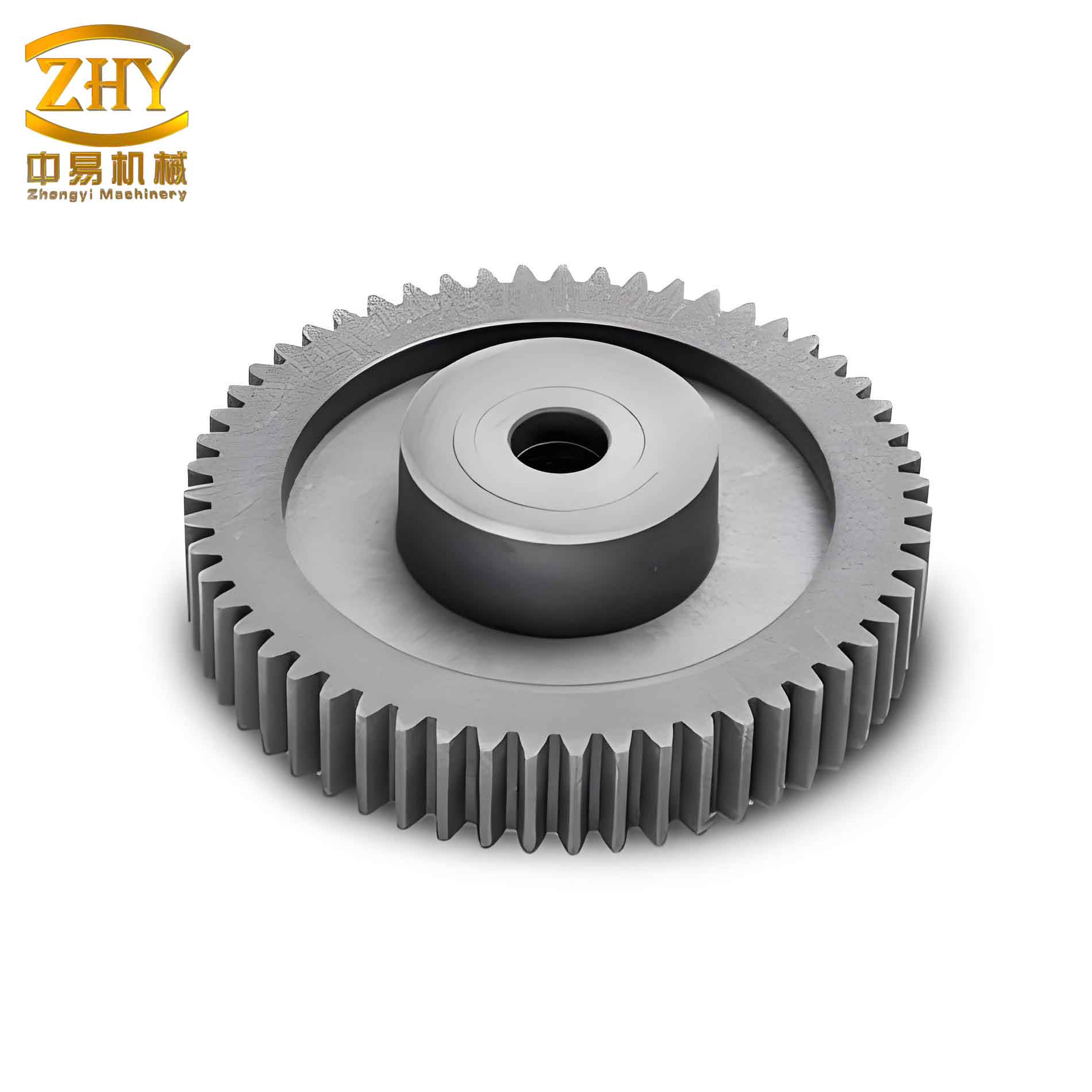
The foundation of any dynamic analysis is a representative mathematical model. For a spur and pinion system, we consider a pure torsional model, which is a valid and common simplification when the supporting shafts and bearings are sufficiently rigid. The model considers two gears, the pinion (driver) and the spur gear (driven), each with mass and rotary inertia, connected through a nonlinear mesh interface.
1.1 Governing Equations of Motion
The key dynamic variable is the relative displacement along the line of action between the two gears. This displacement, \( x(t) \), accounts for the gear rotations and the static transmission error, \( e(t) \), which represents geometric imperfections and deflections:
$$ x(t) = r_{b1}\theta_1(t) – r_{b2}\theta_2(t) – e(t) $$
where \( r_{b1} \) and \( r_{b2} \) are the base circle radii, and \( \theta_1(t) \) and \( \theta_2(t) \) are the angular displacements of the pinion and spur gear, respectively. The transmission error is typically modeled as a sinusoidal function of the mesh frequency \( \omega_h \):
$$ e(t) = e_a \sin(\omega_h t + \psi) $$
The heart of the nonlinearity lies in the displacement function \( f(x(t)) \), which models the backlash of magnitude \( 2b_h \), assumed symmetric about the ideal mesh position:
$$ f(x(t)) =
\begin{cases}
x(t) – b_h, & x(t) > b_h \\
0, & -b_h \le x(t) \le b_h \\
x(t) + b_h, & x(t) < -b_h
\end{cases} $$
This function describes three distinct states for the spur and pinion pair: contact on the drive side (positive force), loss of contact (rattle), and contact on the coast side (negative force). Applying Lagrange’s equations yields two coupled equations of motion for the pinion and spur gear. These can be combined into a single equation governing the relative mesh displacement \( x(t) \) by considering the equivalent mass \( m_e \) of the gear pair:
$$ m_e = \frac{1}{\frac{r_{b1}^2}{I_1} + \frac{r_{b2}^2}{I_2}} $$
The resulting nonlinear differential equation is:
$$ m_e \ddot{x}(t) + c_h \dot{x}(t) + k_h(t) f(x(t)) = F_m – m_e \ddot{e}(t) $$
Here, \( c_h \) is the mesh damping coefficient, \( k_h(t) \) is the time-varying mesh stiffness, and \( F_m \) is the average force transmitted along the line of action, derived from the input torque. The term \( -m_e \ddot{e}(t) \) acts as an internal displacement excitation. For analysis, it is convenient to non-dimensionalize the equation. Using the backlash \( b_h \) as the characteristic length and the average mesh stiffness \( k_m \) to define the natural frequency \( \omega_n = \sqrt{k_m / m_e} \), we introduce:
$$ X = \frac{x}{b_h}, \quad \tau = \omega_n t, \quad \Omega_h = \frac{\omega_h}{\omega_n}, \quad \zeta = \frac{c_h}{2 m_e \omega_n}, \quad \bar{k}_h(\tau) = \frac{k_h(t)}{k_m}, \quad F_m’ = \frac{F_m}{b_h k_m}, \quad F_{ah} = \frac{e_a}{b_h} $$
The non-dimensional equation of motion for the spur and pinion system becomes:
$$ \ddot{X}(\tau) + 2\zeta \dot{X}(\tau) + \bar{k}_h(\tau) f(X(\tau)) = F_m’ + F_{ah}\Omega_h^2 \sin(\Omega_h \tau + \phi_h) $$
where the non-dimensional backlash function is:
$$ f(X) =
\begin{cases}
X – 1, & X > 1 \\
0, & -1 \le X \le 1 \\
X + 1, & X < -1
\end{cases} $$
This forms the core dynamic model for our spur and pinion analysis.
1.2 Modeling Time-Varying Mesh Stiffness
The time-varying mesh stiffness \( k_h(t) \) is a critical internal parametric excitation for the spur and pinion pair. Its fluctuation stems from the changing number of tooth pairs in contact as the gears rotate, which is governed by the contact ratio \( \epsilon \). A precise calculation must account for bending, shear, Hertzian contact deformation, and the fillet foundation effect. Using a potential energy method, the stiffness for a single tooth pair can be computed as a function of the contact position. The total mesh stiffness is the sum of the stiffnesses of all tooth pairs in simultaneous contact.
For a spur and pinion pair with standard involute profiles, the stiffness variation is periodic with the mesh cycle. Rather than approximating it with a simple sinusoid, a more accurate representation is a piecewise constant function that reflects the distinct stiffness levels during single-pair and double-pair contact periods. The typical waveform resembles a rectangular pulse. The non-dimensional stiffness can be modeled as:
$$ \bar{k}_h(\tau) =
\begin{cases}
1 + a, & 0 \le \tau \text{ mod } T_h < (\epsilon – 1)T_h \\
1 – b, & (\epsilon – 1)T_h \le \tau \text{ mod } T_h < T_h
\end{cases} $$
where \( T_h = 2\pi/\Omega_h \) is the non-dimensional mesh period, \( a \) represents the added stiffness during double-pair contact, and \( b \) represents the reduced stiffness during single-pair contact, relative to the mean \( k_m \). The values of \( a \) and \( b \) depend on the gear geometry (number of teeth, pressure angle, etc.). The following table summarizes the effect of gear ratio on the contact ratio and approximate stiffness parameters for a sample spur and pinion set (Pinion Teeth, \( z_1 = 34 \)):
| Spur Gear Teeth (\( z_2 \)) | Contact Ratio (\( \epsilon \)) | Parameter \( a \)** | Parameter \( b \)** |
|---|---|---|---|
| 34 | ~1.65 | 0.116 | 0.414 |
| 44 | ~1.78 | 0.125 | 0.395 |
| 54 | ~1.88 | 0.131 | 0.382 |
This piecewise model more faithfully captures the parametric excitation experienced by the spur and pinion system compared to a simple harmonic approximation.
2. Numerical Analysis Methodology
To investigate the complex dynamics of the nonlinear spur and pinion model, numerical integration is indispensable. The non-dimensional state-space form of the system is given by setting \( x_1 = X \) and \( x_2 = \dot{X} \):
$$
\begin{aligned}
\dot{x_1} &= x_2 \\
\dot{x_2} &= F_m’ + F_{ah}\Omega_h^2 \sin(\Omega_h \tau + \phi_h) – \bar{k}_h(\tau) f(x_1) – 2\zeta x_2
\end{aligned}
$$
This system is integrated using a variable-step 4th-5th order Runge-Kutta (RK45) algorithm to handle the stiffness and discontinuities accurately. Transient effects are discarded, and the steady-state response is analyzed using dynamic tools:
- Phase Portraits: Plots of \( x_2 \) vs. \( x_1 \) revealing the trajectory geometry.
- Poincaré Maps: Sections of the phase space sampled at the period of the mesh excitation \( T_h \). A finite number of points indicates periodic motion, while a structured collection of points suggests quasi-periodicity, and a fractal or dense set indicates chaos.
- FFT Spectra: Fast Fourier Transforms of the time history \( x_1(\tau) \) to identify dominant frequency components.
- Bifurcation Diagrams: The cornerstone of parametric analysis. A system parameter (e.g., \( \Omega_h \) or \( \zeta \)) is varied adiabatically, and the steady-state values of \( x_1 \) at the Poincaré section are plotted. This reveals transitions (bifurcations) between different types of motion.
The following baseline parameters are used for the spur and pinion analysis unless stated otherwise: \( F_m’ = 0.1 \), \( F_{ah} = 0.2 \), \( \phi_h = 0 \), \( \epsilon = 1.68 \), \( a = 0.116 \), \( b = 0.414 \), \( \zeta = 0.02 \).
3. Dynamic Response to Mesh Frequency Variation
The internal excitation frequency, represented by the non-dimensional mesh frequency \( \Omega_h \), is a primary parameter influencing the spur and pinion dynamics. The bifurcation diagram for \( \Omega_h \) varying from 0.7 to 1.7 reveals a rich tapestry of nonlinear behavior.
| Frequency Range (\( \Omega_h \)) | Observed Motion | Characteristics |
|---|---|---|
| 0.700 – 0.799 | Period-1 | Single closed orbit in phase portrait; single point in Poincaré map; discrete spectrum at \( n\Omega_h \). |
| 0.799 (Bifurcation) | Period-Doubling | Transition point from Period-1 to Period-2 motion. |
| 0.799 – 0.865 | Period-2 | Two distinct closed loops; two points in Poincaré map; spectrum includes \( n\Omega_h/2 \). |
| 0.865 (Bifurcation) | Period-Doubling | Transition from Period-2 to Period-4 motion. |
| 0.865 – 1.028 | Period-4 | Four closed loops; four points in Poincaré map; spectrum includes \( n\Omega_h/4 \). |
| 1.028 (Bifurcation) | Period-Halving | Reverse bifurcation from Period-4 back to Period-2. |
| 1.028 – 1.191 | Period-2 | Stable two-period motion re-established. |
| 1.191 – 1.459 | Complex Zone | Contains higher-periodic windows (e.g., Period-3, Period-6) and chaotic bands. Motion is highly sensitive to initial conditions. |
| ~1.219 | Chaos | Strange attractor in phase space; fractal-like point set in Poincaré map; continuous broadband spectrum. |
| 1.459 – 1.555 | Period-2 | Emergence of stable period-2 motion from the chaotic region. |
| 1.555 – 1.700 | Period-1 | Final return to fundamental harmonic response. |
The sequence clearly demonstrates a classic period-doubling route to chaos as \( \Omega_h \) increases, followed by a reverse period-halving route out of chaos. The presence of a chaotic region for the spur and pinion system near primary resonances underscores the potential for erratic, noise-generating motion under specific operating conditions. The complex zone also contains periodic windows, such as a stable period-3 orbit, which satisfy \( 3\Omega_h T_h = 2\pi m \) for some integer \( m \), demonstrating the intricate structure of the parameter space.
4. Influence of Mesh Damping
Mesh damping \( \zeta \) is a critical factor in suppressing nonlinear instabilities in the spur and pinion pair. Its effect is studied by fixing \( \Omega_h = 0.7 \) (originally a period-1 motion at \( \zeta=0.02 \)) and varying \( \zeta \) from 0 to 0.025.
| Damping Range (\( \zeta \)) | Observed Motion | Description |
|---|---|---|
| 0.000 – 0.00275 | Chaotic | Very low damping allows complex, aperiodic motion. Phase portrait is a filled region; Poincaré map is a dense cloud of points. |
| 0.00275 (Bifurcation) | Crisis | Sudden transition from a chaotic attractor to a periodic attractor (Period-3). |
| 0.00275 – 0.0165 | Period-3 | Three intertwined loops in phase space; three isolated points in Poincaré map; discrete spectrum at \( n\Omega_h/3 \). |
| 0.0165 (Bifurcation) | Period-Halving | Transition from Period-3 motion directly to Period-1 motion (a saddle-node or similar bifurcation). |
| 0.0165 – 0.0250 | Period-1 | Smooth, harmonic-dominant response restored. |
This analysis reveals that for this specific spur and pinion configuration and excitation frequency, even a small amount of damping (\( \zeta > 0.0165 \)) is sufficient to quench complex nonlinear oscillations and maintain a simple periodic response. However, in the very low damping regime, the system exhibits inherent chaotic tendencies. This highlights the crucial role of material damping, lubricant squeeze-film damping, and other loss mechanisms in stabilizing the operation of a spur and pinion drive.
5. Analysis of Gear Mesh Impact States
Beyond classifying the periodicity of motion, it is vital to diagnose the physical contact condition between the spur and pinion teeth. The backlash function \( f(X) \) defines three operational regimes, which correspond to different impact states that critically affect wear, noise, and load distribution.
- No-Impact (Continuous Contact): The relative displacement remains always greater than 1 or always less than -1, meaning the teeth never separate. The force is always positive or always negative. This is the ideal state for smooth operation but is often unattainable due to dynamic overshoot.
- Single-Sided Impact (Rattle): The relative displacement oscillates across one boundary of the backlash zone (e.g., between values >1 and values within [-1,1]). The teeth separate and re-impact on the same flank (drive side). This is a common source of acoustic noise.
- Double-Sided Impact (Clatter): The relative displacement oscillates across both boundaries of the backlash zone (e.g., from >1 to <-1). The teeth separate and impact alternately on the drive and coast sides. This is the most severe condition, generating high冲击 loads and significant noise.
The impact state for a given steady-state response can be determined from its maximum and minimum displacements over a cycle. Let \( X_{min} \) and \( X_{max} \) be the global extrema of \( X(\tau) \). The state criteria are:
$$
\begin{aligned}
&\text{No-Impact:} & & X_{min} \ge 1 \quad \text{(Drive-side)} \quad \text{or} \quad X_{max} \le -1 \quad \text{(Coast-side)} \\
&\text{Single-Sided Impact:} & & (X_{min} < 1 \quad \text{and} \quad X_{min} \ge -1) \quad \text{and} \quad X_{max} \ge 1 \\
&\text{Double-Sided Impact:} & & X_{min} < -1 \quad \text{and} \quad X_{max} > 1
\end{aligned}
$$
Applying this analysis to the period-1 solution at \( \Omega_h = 0.7 \), \( \zeta=0.02 \), and mapping the impact state for a grid of initial conditions in the \( (X_0, \dot{X}_0) \) plane reveals a critical insight. Even for a globally stable periodic attractor, the basin of attraction—the set of initial conditions leading to that final motion—can be partitioned into regions leading to different physical impact states. The final periodic orbit is unique, but depending on initial transients (e.g., startup conditions), the system may settle into a periodic motion that involves single-sided or even double-sided impacts. This demonstrates that the dynamic response of a spur and pinion pair is not only parameter-dependent but also history-dependent. Predicting the impact state requires knowledge of both system parameters and initial conditions.
6. Conclusions and Engineering Implications
The nonlinear dynamic analysis of a spur and pinion gear pair with backlash and time-varying mesh stiffness reveals a system capable of exhibiting a wide spectrum of behaviors, from simple harmonic motion to complex chaos. The primary findings are synthesized as follows:
- Parameter-Dependent Routes to Complexity: The mesh frequency \( \Omega_h \) acts as a primary bifurcation parameter. The system follows a period-doubling cascade into chaos and subsequently undergoes a reverse cascade to periodic motion as frequency increases. This identifies critical speed ranges where the spur and pinion operation may become highly unpredictable and noisy.
- Critical Role of Damping: Mesh damping \( \zeta \) is a powerful stabilizing factor. Even modest damping levels can suppress chaotic and high-periodic motions, collapsing the response to a simple period-1 orbit. This underscores the importance of incorporating damping accurately in models and considering it in design.
- Multi-State Impact Behavior: The steady-state motion of the spur and pinion can correspond to different physical impact regimes (no-impact, single-sided, double-sided). The attained regime can depend on the initial conditions, indicating that the same gearbox may exhibit different noise and wear characteristics depending on its startup history.
- Modeling Fidelity: Representing the time-varying mesh stiffness as a piecewise-constant function, reflective of the contact ratio, provides a more physically grounded parametric excitation than a simple harmonic function, leading to more credible dynamic predictions.
The engineering implications are significant. Designers of spur and pinion systems must perform nonlinear dynamic analysis across the intended operating speed range to avoid parameter regions associated with bifurcations and chaos. Damping should be maximized within practical limits through material selection and lubrication design. Furthermore, dynamic simulations should consider a range of initial conditions to assess the risk of entering severe double-sided impact states during transient events like startup or torque reversal. This comprehensive understanding moves beyond static load ratings and traditional harmonic analysis, enabling the design of quieter, more reliable, and longer-lasting spur and pinion gear drives.