
In my years of experience as a mechanical engineer, I have frequently encountered and designed spiral gears, which are crucial components in various machinery due to their ability to transmit motion between non-parallel shafts smoothly and efficiently. Spiral gears, often referred to as helical gears when considering their tooth geometry, offer significant advantages over straight-cut gears, including reduced noise, higher load capacity, and improved durability. This article delves into the intricate details of spiral gears, focusing on their design principles, methods for judging rotation direction, and precise calculations involved in their application. I will share insights from practical scenarios, utilizing formulas and tables to summarize key concepts, ensuring that readers gain a thorough understanding of how to work with spiral gears effectively. Throughout this discussion, I will emphasize the importance of spiral gears in modern engineering, highlighting their role in systems ranging from automotive transmissions to industrial machinery.
To begin, let’s define what spiral gears are. Spiral gears are a type of gear where the teeth are cut at an angle to the axis of rotation, forming a helix pattern. This helical design allows for gradual engagement of teeth, resulting in smoother and quieter operation compared to spur gears. In my work, I often distinguish between different types of spiral gears, such as single helical gears, double helical gears (herringbone gears), and crossed helical gears, each serving specific purposes based on torque requirements and spatial constraints. The fundamental parameters of spiral gears include the module, pressure angle, helix angle, and number of teeth, all of which influence their performance. For instance, the helix angle, typically denoted by $\beta$, plays a critical role in determining the axial thrust generated during operation. In many applications, spiral gears are preferred for their ability to handle higher speeds and loads, making them indispensable in precision equipment.
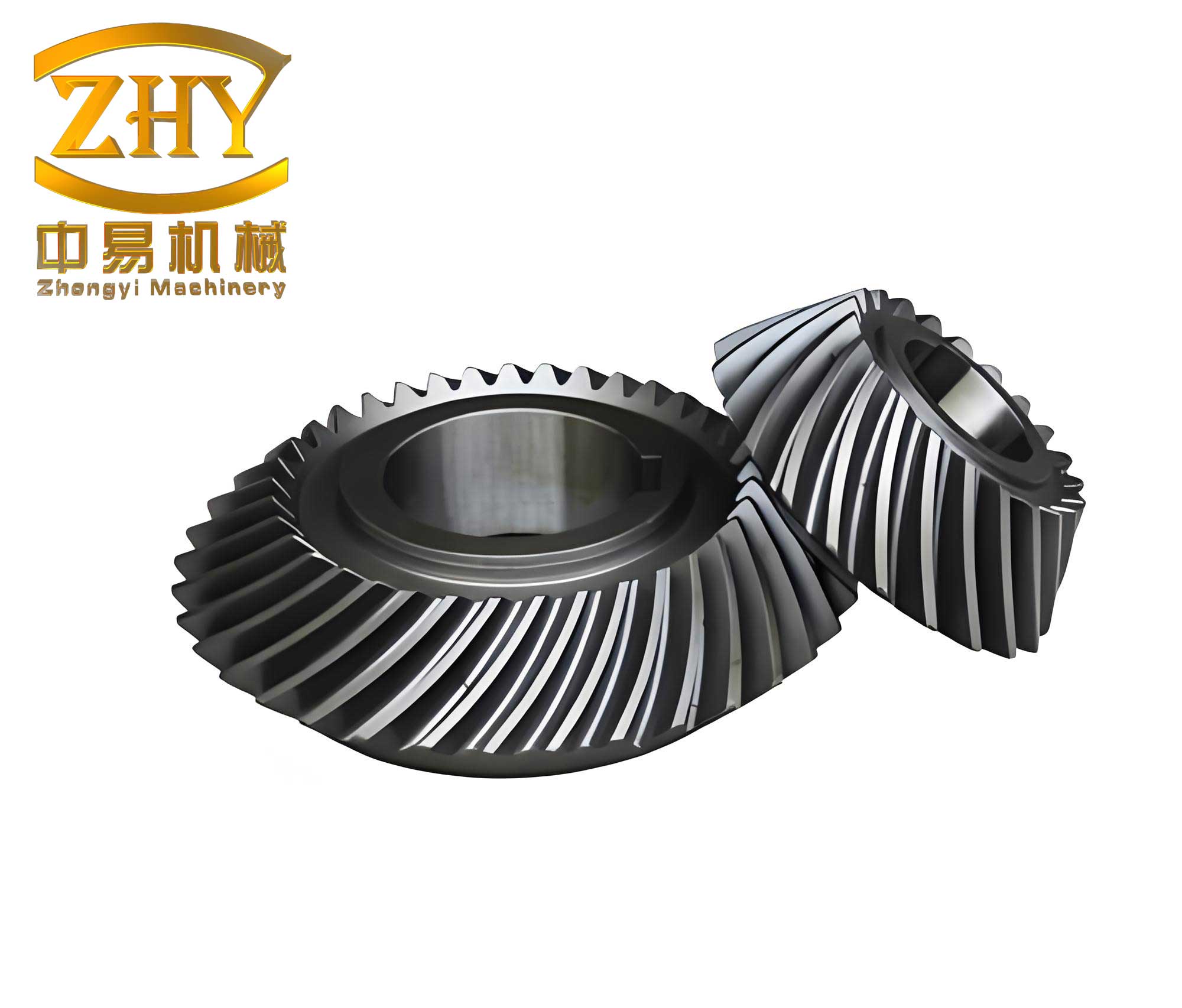
One of the most challenging aspects of working with spiral gears is judging their rotation direction, especially in complex assemblies where multiple gears interact. Based on my observations, the direction of rotation for spiral gears can be determined using hand rules: the right-hand rule for right-handed spiral gears and the left-hand rule for left-handed spiral gears. This method is essential for ensuring correct assembly and functionality, particularly in systems requiring specific directional outputs. To elaborate, for a right-handed spiral gear, if you extend your right hand with the thumb perpendicular to the fingers, align the fingers with the rotation direction at the meshing point, and point them toward the gear’s center, the thumb will indicate the tangential direction of the mating gear’s rotation. Conversely, for left-handed spiral gears, use the left hand in a similar manner. This principle applies not only to spiral gears but also to worm gears, which are a specialized form of spiral gears used for high reduction ratios. I have found that mastering this judgment technique is vital for troubleshooting and designing efficient gear trains, as it prevents errors that could lead to mechanical failure or inefficiency.
In terms of calculations, spiral gears involve several mathematical formulas to ensure precise dimensions and performance. For example, the normal module $m_n$ and transverse module $m_t$ are related by the helix angle $\beta$ through the equation: $$m_t = \frac{m_n}{\cos \beta}.$$ This relationship is crucial for designing gears that mesh correctly without interference. Additionally, the center distance $a$ between two spiral gears can be calculated using: $$a = \frac{(z_1 + z_2) m_t}{2 \cos \beta},$$ where $z_1$ and $z_2$ are the numbers of teeth on the gears. Such formulas help in optimizing gear pairs for specific applications, such as in gearboxes where space is limited. To illustrate the importance of these calculations, I often refer to practical examples, like the design of spiral gears for a conveyor system, where even minor errors in helix angle can lead to misalignment and increased wear. Moreover, the axial force $F_a$ generated by spiral gears can be derived from: $$F_a = F_t \tan \beta,$$ where $F_t$ is the tangential force. This force must be accounted for in bearing selection to prevent premature failure. Throughout my career, I have relied on these equations to design reliable spiral gear systems, emphasizing the need for accuracy in engineering drawings and manufacturing processes.
To further clarify the design parameters and their interrelationships, I have compiled a table summarizing key formulas and variables for spiral gears. This table serves as a quick reference for engineers working on gear design projects.
| Parameter | Symbol | Formula | Description |
|---|---|---|---|
| Normal Module | $m_n$ | Given or specified based on load | Module measured perpendicular to tooth direction |
| Transverse Module | $m_t$ | $m_t = \frac{m_n}{\cos \beta}$ | Module measured in the plane of rotation |
| Helix Angle | $\beta$ | Typically between 15° and 30° | Angle of tooth inclination relative to axis |
| Center Distance | $a$ | $a = \frac{(z_1 + z_2) m_t}{2 \cos \beta}$ | Distance between gear centers |
| Axial Force | $F_a$ | $F_a = F_t \tan \beta$ | Force along the gear axis due to helix |
| Tangential Force | $F_t$ | $F_t = \frac{2T}{d}$ | Force tangent to pitch circle, where $T$ is torque and $d$ is pitch diameter |
Building on these fundamentals, I want to discuss a specific application where spiral gears are critical: in the context of sheet metal forming processes, such as deep drawing. Although this might seem unrelated, the precision required in calculating blank dimensions for deep drawing shares similarities with gear design, as both involve geometric transformations and material considerations. For instance, in deep drawing, the corrected blank diameter $D$ for a cylindrical part can be derived using formulas that account for material thinning and elongation. In my practice, I have adapted such principles to ensure that spiral gears are manufactured with minimal waste and optimal performance. Consider the formula for the corrected blank diameter: $$D = \sqrt{d^2 + 4dh – 0.5 \Delta h},$$ where $d$ is the part diameter, $h$ is the height, and $\Delta h$ is the height increment due to thinning. This equation mirrors the iterative calculations often used in spiral gear design to adjust for tolerances and deflections. By applying similar logic, engineers can refine gear tooth profiles to achieve desired meshing characteristics, especially when dealing with high-precision spiral gears in aerospace or automotive systems.
Another important aspect is the comparison between spiral gears and other gear types. In many projects, I have evaluated the trade-offs between spiral gears, spur gears, and bevel gears to select the most suitable option. The following table highlights key differences, emphasizing why spiral gears are often preferred in demanding applications.
| Gear Type | Noise Level | Load Capacity | Efficiency | Typical Applications |
|---|---|---|---|---|
| Spiral Gears | Low (due to gradual engagement) | High (distributed load) | High (up to 98%) | Transmissions, pumps, conveyors |
| Spur Gears | High (sudden tooth contact) | Moderate (concentrated stress) | High (simple design) | Low-speed machinery, clocks |
| Bevel Gears | Moderate (depending on design) | Moderate to High | High (for straight bevels) | Differential drives, power tools |
From this comparison, it’s evident that spiral gears excel in scenarios where noise reduction and high torque transmission are paramount. In my designs, I often specify spiral gears for systems like wind turbine gearboxes or marine propulsion units, where reliability and efficiency are critical. The helical teeth of spiral gears allow for multiple teeth to be in contact simultaneously, distributing loads more evenly and reducing stress concentrations. This characteristic is quantified by the contact ratio, which for spiral gears is higher than for spur gears, leading to smoother operation and longer service life. The contact ratio $C_r$ can be approximated using: $$C_r = \frac{\sqrt{(r_a^2 – r_b^2)} + \sqrt{(R_a^2 – R_b^2)} – a \sin \phi_t}{p_t},$$ where $r_a$ and $r_b$ are the addendum and base radii of the pinion, $R_a$ and $R_b$ are for the gear, $a$ is the center distance, $\phi_t$ is the transverse pressure angle, and $p_t$ is the transverse pitch. Such detailed calculations ensure that spiral gears perform optimally under varying loads.
To provide a concrete example, let’s consider the design of spiral gears for a rotary actuator used in robotics. In this case, the gears must transmit motion from a motor to an output shaft with a 90-degree orientation change, requiring crossed helical gears. The initial specifications include a torque of 50 Nm, a speed of 1000 rpm, and a desired reduction ratio of 5:1. Using the formulas mentioned earlier, I calculated the necessary module and helix angle. For instance, assuming a helix angle $\beta = 20^\circ$ and a normal module $m_n = 2 \text{ mm}$, the transverse module is: $$m_t = \frac{2}{\cos 20^\circ} \approx 2.13 \text{ mm}.$$ Then, the pitch diameter $d$ for the pinion with $z_1 = 20$ teeth is: $$d = m_t \times z_1 = 2.13 \times 20 = 42.6 \text{ mm}.$$ The center distance $a$ for mating with a gear of $z_2 = 100$ teeth is: $$a = \frac{(20 + 100) \times 2.13}{2 \cos 20^\circ} \approx 135.8 \text{ mm}.$$ These values were verified through simulation to ensure minimal backlash and efficient power transmission. This example underscores how spiral gears can be tailored to meet specific requirements, leveraging their helical design for compact and reliable solutions.
In addition to design calculations, the manufacturing of spiral gears requires attention to detail. Processes like hobbing or shaping are used to cut the helical teeth, and heat treatment is applied to enhance hardness and wear resistance. From my experience, quality control during production is essential, as deviations in helix angle or tooth profile can lead to increased noise and vibration. I often use coordinate measuring machines (CMMs) to inspect spiral gears, checking parameters like lead error and tooth flank deviation. The lead error $\Delta L$ for a spiral gear can be expressed as: $$\Delta L = L_{\text{actual}} – L_{\text{theoretical}},$$ where $L$ is the lead, defined as the axial advancement per revolution. For a spiral gear, the lead is related to the helix angle and pitch diameter by: $$L = \pi d \tan \beta.$$ By monitoring such errors, manufacturers can correct tooling settings to produce high-precision spiral gears that meet industry standards, such as AGMA or ISO grades.
Furthermore, the lubrication of spiral gears is a critical factor in their longevity. Due to the sliding action along the helix, spiral gears generate more heat than spur gears, necessitating effective lubrication to reduce friction and wear. In my projects, I recommend using high-viscosity oils or greases with extreme pressure additives. The film thickness $h$ in the gear contact can be estimated using the Dowson-Higginson equation: $$h = 2.65 \frac{(U \eta)^{0.7} R^{0.43}}{E’^{0.03} W^{0.13}},$$ where $U$ is the rolling speed, $\eta$ is the lubricant viscosity, $R$ is the effective radius, $E’$ is the equivalent modulus of elasticity, and $W$ is the load per unit width. This ensures that spiral gears operate within elastohydrodynamic lubrication regimes, minimizing metal-to-metal contact. Regular maintenance schedules, including oil analysis, help in detecting early signs of wear in spiral gear systems, preventing catastrophic failures.
Another fascinating application of spiral gears is in watchmaking, where miniaturized spiral gears, often called helical gears, are used to transmit motion between tiny components with high precision. Here, the helix angle is kept small to minimize axial thrust, and materials like brass or stainless steel are employed for corrosion resistance. I have consulted on such projects, where tolerances are in the micrometer range, and the silence of operation is paramount. The design principles remain the same, but scaled down, demonstrating the versatility of spiral gears across industries. For instance, the torque transmission in a watch gear train can be modeled using: $$T = F_t \times r,$$ where $r$ is the pitch radius, and $F_t$ is derived from the mainspring force. This highlights how spiral gears enable precise timekeeping by ensuring smooth engagement between teeth.
In conclusion, spiral gears are indispensable components in mechanical engineering, offering superior performance through their helical tooth design. From judging rotation direction using hand rules to performing detailed calculations for module and center distance, mastering spiral gears requires a blend of theoretical knowledge and practical experience. Throughout this article, I have shared insights from my work, emphasizing the importance of accurate formulas and tables in designing reliable gear systems. Whether in heavy machinery or precision instruments, spiral gears continue to play a vital role, and their optimization through advanced materials and manufacturing techniques will drive future innovations. As I reflect on my career, I am continually amazed by the elegance and efficiency of spiral gears, and I encourage fellow engineers to delve deeper into their study to harness their full potential in diverse applications.