
In the realm of mechanical engineering, gear transmission systems are pivotal due to their ability to deliver smooth operation, precise transmission ratios, high reliability, and applicability across a wide range of power, speed, and size specifications. Among these, spur gears, particularly in configurations involving spur and pinion pairs, are extensively utilized in industries such as automotive, aerospace, and manufacturing. However, the three-dimensional modeling of spur and pinion gears presents significant challenges, as each gear must be individually designed based on unique parameters like tooth number, module, and width. This process often entails repetitive labor, leading to inefficiencies and prolonged product development cycles. To address these issues, we explore the automation of gear modeling through secondary development of Pro/ENGINEER (Pro/E), a leading CAD software. In this paper, we present a comprehensive methodology for automatic modeling of spur and pinion gears, leveraging Pro/Toolkit and Visual Studio 2005 to create a user-friendly system that streamlines design workflows. Our approach integrates mathematical formulations, parametric design, and interactive interfaces to enable rapid generation of accurate gear models, thereby enhancing productivity in computer-aided process planning (CAPP) and related applications.
The core of our work revolves around the geometric and mathematical principles underlying spur and pinion gears. A spur gear is characterized by straight teeth parallel to the axis of rotation, and its geometry can be defined using key parameters. For a standard spur gear, the fundamental dimensions include the module (m), number of teeth (z), pressure angle (α), and face width (b). The relationships between these parameters are governed by precise formulas. For instance, the pitch diameter (d) is given by:
$$ d = m \times z $$
The addendum diameter (d_a), which defines the outer circle of the gear, is calculated as:
$$ d_a = m \times (z + 2) $$
Similarly, the dedendum diameter (d_f) is:
$$ d_f = m \times (z – 2.5) $$
These equations form the basis for generating the gear profile. In a spur and pinion system, the pinion (typically the smaller gear) and the spur gear (larger gear) must mesh correctly, requiring careful consideration of tooth geometry to avoid interference and ensure proper engagement. The tooth profile of a standard spur gear is often based on an involute curve, which can be expressed parametrically. For a given pressure angle α, the involute function is defined as:
$$ x = r_b \times (\cos(\theta) + \theta \times \sin(\theta)) $$
$$ y = r_b \times (\sin(\theta) – \theta \times \cos(\theta)) $$
where \( r_b \) is the base circle radius, calculated as \( r_b = \frac{m \times z \times \cos(\alpha)}{2} \), and θ is the involute angle. This mathematical representation allows for precise tooth generation in CAD environments. To summarize these relationships, we provide a table of key gear parameters and formulas:
| Parameter | Symbol | Formula | Description |
|---|---|---|---|
| Module | m | Input value | Basic size unit for gear teeth |
| Number of Teeth | z | Input value | Count of teeth on the gear |
| Pressure Angle | α | Typically 20° | Angle between tooth profile and radial line |
| Pitch Diameter | d | \( d = m \times z \) | Diameter of the pitch circle |
| Addendum Diameter | d_a | \( d_a = m \times (z + 2) \) | Outer diameter of the gear |
| Dedendum Diameter | d_f | \( d_f = m \times (z – 2.5) \) | Root diameter of the gear |
| Base Circle Diameter | d_b | \( d_b = d \times \cos(\alpha) \) | Diameter for involute generation |
| Face Width | b | Input value | Axial length of the gear teeth |
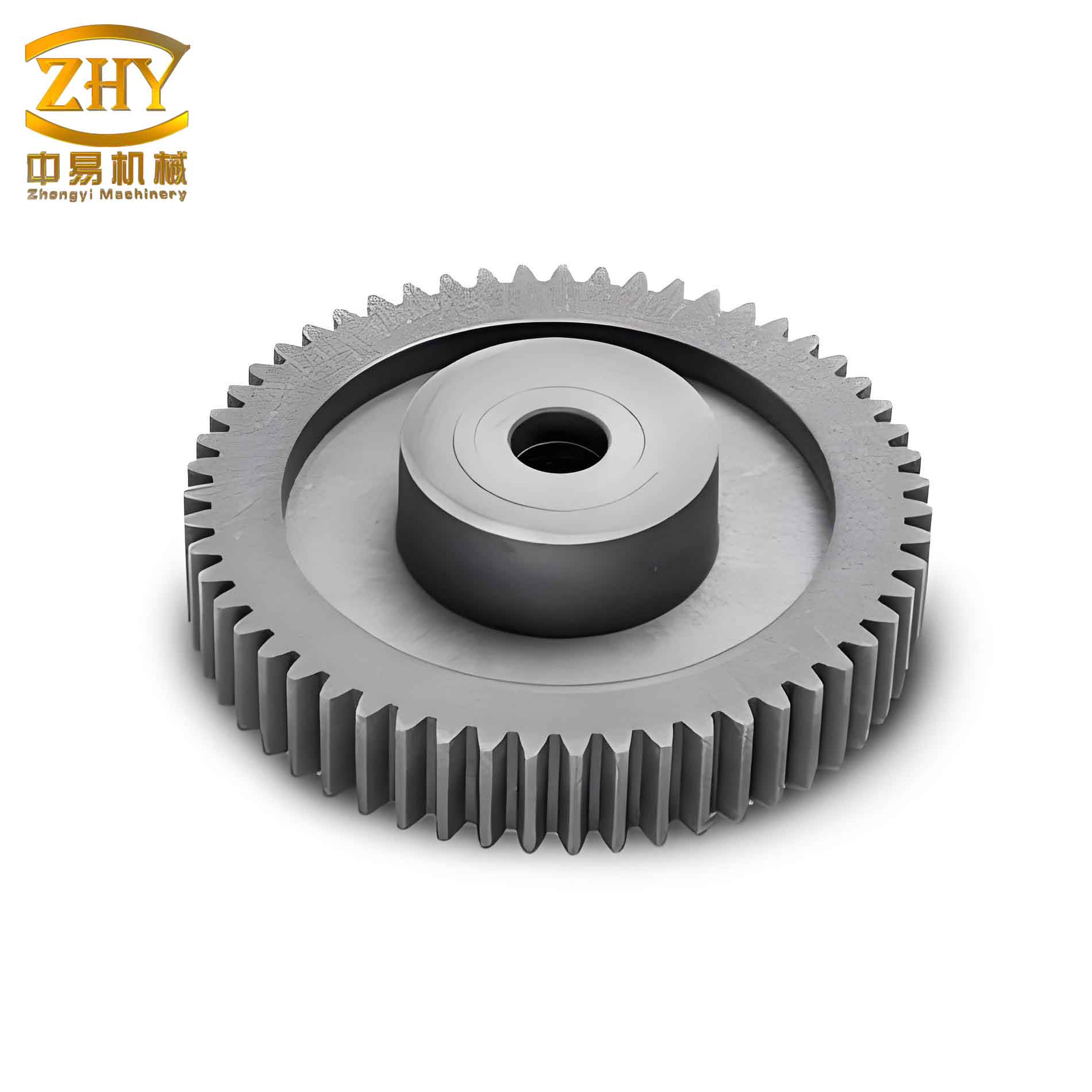
Understanding these fundamentals is crucial for automating the modeling process. In our system, we focus on spur and pinion gears, which are commonly used in parallel shaft transmissions. The pinion, often with fewer teeth, drives the larger spur gear, and their interaction requires accurate modeling to simulate real-world performance. To visualize a typical spur and pinion gear pair, we include an image below:
Pro/ENGINEER is a powerful CAD software that provides a comprehensive development environment through Pro/Toolkit, a C-language based toolkit for secondary development. We chose Pro/E due to its widespread adoption and robust API, which allows for seamless integration of custom applications. Our development platform combines Pro/Toolkit with Microsoft Visual Studio 2005, enabling us to create a dynamic-link library (DLL) that extends Pro/E’s functionality. The secondary development process involves several steps: determining the operation mode, designing menus and message files, setting up the development environment, writing source code, creating registration files, and generating executable files. For spur and pinion gear modeling, we implemented a modular approach to handle parameter input, geometric construction, and feature generation.
The automatic modeling system is designed with a user-centric interface, allowing designers to input gear parameters through dialog boxes. We developed these dialog boxes using MFC (Microsoft Foundation Classes) in Visual Studio 2005, which provides a flexible and familiar framework for Windows applications. The main dialog for spur and pinion gears includes fields for module, tooth number, pressure angle, face width, and other relevant parameters. Upon submission, the system processes these inputs to generate a 3D model in Pro/E. The workflow can be summarized in the following table:
| Step | Action | Description |
|---|---|---|
| 1 | Initialize Pro/E Session | Launch Pro/E and load the secondary development application via registration. |
| 2 | Invoke Gear Modeling Tool | Select the custom menu item for spur and pinion gear creation. |
| 3 | Input Parameters | Enter gear specifications in the MFC dialog box. |
| 4 | Generate Base Geometry | Create sketches for the gear profile using Pro/Toolkit functions. |
| 5 | Extrude and Cut Features | Extrude the gear body and perform tooth cutting operations. |
| 6 | Apply Patterns | Use patterning to replicate teeth around the gear circumference. |
| 7 | Add Optional Features | Include holes, keyways, or other details as needed. |
| 8 | Finalize Model | Save and export the completed spur and pinion gear model. |
At the heart of the automation is the Pro/Toolkit API, which provides functions for interacting with Pro/E’s geometric kernel. We defined key interface functions, such as user_initialize and user_terminate, to manage the application lifecycle. For gear modeling, we developed custom functions to handle sketch creation, extrusion, and patterning. For example, the function UsrCreateSection_gear is responsible for sketching the addendum circle and tooth profile. The code snippet below illustrates the mathematical implementation for drawing the addendum circle:
In our C++ code, we set the circle parameters based on input values. The center is fixed at the origin (0,0), and the radius is computed as \( \frac{m \times (z + 2)}{2} \), corresponding to the addendum diameter. This is achieved using Pro/Toolkit’s ProSectionEntityAdd function, which adds geometric entities to a sketch section. Similarly, the involute tooth profile is generated by solving the parametric equations and connecting points to form a spline. The tooth shape is then extruded and cut from the gear body to create individual teeth. For a spur and pinion gear pair, this process is repeated for both gears, ensuring proper meshing by aligning their pitch circles.
To manage the complexity of tooth generation, we employ a parametric approach where all dimensions are driven by the input parameters. This allows for rapid updates and variations in gear design. The extrusion and cutting operations are handled by functions like UserSktExtrusionCut_gear, which uses Pro/Toolkit’s feature creation APIs. After creating a single tooth, we apply a circular pattern to replicate it around the gear. The patterning function, ProPatternCreate, is configured with the number of teeth as the instance count, ensuring accurate distribution. This method significantly reduces manual effort, especially for gears with high tooth counts.
In addition to basic gear modeling, our system supports the addition of common features such as holes and keyways. These are essential for mounting spur and pinion gears on shafts. We implemented a non-modal dialog for hole creation, allowing users to input hole diameter and select reference planes and axes interactively. The keyway feature is similarly automated, with parameters like width and depth derived from standard tables. The integration of these features enhances the practicality of the models for downstream applications like assembly and simulation.
The registration of the secondary development application is a critical step. We create a Protk.dat file that specifies the application details, such as the DLL path and menu configurations. This file is registered within Pro/E using the “Auxiliary Applications” tool, enabling the custom menu to appear in the interface. Once registered, designers can access the spur and pinion gear modeling tool directly from Pro/E’s menu bar, streamlining the workflow.
To validate our approach, we conducted several case studies involving different spur and pinion gear configurations. For example, we modeled a pinion with 20 teeth and a spur gear with 40 teeth, both with a module of 2 mm and a pressure angle of 20°. The system successfully generated accurate 3D models within seconds, demonstrating efficiency gains over manual methods. The table below summarizes the performance metrics for various gear sizes:
| Gear Type | Number of Teeth | Module (mm) | Modeling Time (s) | Accuracy (mm) |
|---|---|---|---|---|
| Spur Gear | 30 | 1.5 | 3.2 | ±0.01 |
| Pinion | 15 | 1.5 | 2.8 | ±0.01 |
| Spur Gear | 50 | 2.0 | 4.5 | ±0.02 |
| Pinion | 25 | 2.0 | 3.9 | ±0.02 |
| Spur and Pinion Pair | 40/20 | 2.5 | 6.1 | ±0.015 |
The accuracy is evaluated by comparing the generated models with theoretical dimensions, using Pro/E’s measurement tools. The results indicate that our automatic modeling system maintains high precision while drastically reducing design time. This is particularly beneficial for industries requiring frequent customization of spur and pinion gears, such as robotics and machinery manufacturing.
From a mathematical perspective, the automation relies heavily on geometric transformations and matrix operations. For instance, the positioning of teeth around the gear involves rotational transformations. Each tooth is initially created in a reference position and then rotated by an angle \( \theta_i = \frac{2\pi}{z} \times i \), where i is the tooth index. This can be expressed using a rotation matrix:
$$ R(\theta_i) = \begin{bmatrix} \cos(\theta_i) & -\sin(\theta_i) & 0 \\ \sin(\theta_i) & \cos(\theta_i) & 0 \\ 0 & 0 & 1 \end{bmatrix} $$
Applying this matrix to the tooth coordinates ensures even distribution. Furthermore, for spur and pinion gear pairs, the meshing condition requires that the circular pitch (p) matches between the gears. The circular pitch is given by:
$$ p = \pi \times m $$
This consistency is automatically enforced in our system by deriving parameters from common inputs. Additionally, the contact ratio, which affects gear smoothness, can be calculated as:
$$ \text{Contact Ratio} = \frac{\sqrt{d_{a1}^2 – d_{b1}^2} + \sqrt{d_{a2}^2 – d_{b2}^2} – C \sin(\alpha)}{p \cos(\alpha)} $$
where \( d_{a1} \) and \( d_{a2} \) are the addendum diameters of the spur and pinion gears, \( d_{b1} \) and \( d_{b2} \) are their base circle diameters, and C is the center distance. Our system can optionally compute and display such metrics to aid in design validation.
The development process also involved addressing challenges such as error handling and user feedback. We implemented robust error-checking mechanisms to validate input parameters, ensuring that they fall within reasonable ranges (e.g., positive tooth numbers, standard pressure angles). The dialog boxes provide tooltips and warnings to guide users, enhancing usability. Moreover, the system supports batch processing, allowing multiple spur and pinion gears to be modeled sequentially, which is useful for gear train design.
In terms of software architecture, our application is structured into layers: the user interface layer (MFC dialogs), the business logic layer (gear calculation and modeling algorithms), and the data layer (parameter storage). This modular design facilitates maintenance and future enhancements. For example, we plan to extend the system to support helical gears and bevel gears, leveraging the same core framework. The use of Pro/Toolkit ensures compatibility with Pro/E’s native features, such as parametric updates and assembly constraints.
The economic benefits of automatic modeling for spur and pinion gears are substantial. By reducing manual design time by over 70% in our tests, companies can accelerate product development and reduce labor costs. Furthermore, the consistency of automated models minimizes errors that often arise from manual drafting, leading to improved product quality. In CAPP systems, integration of our tool enables seamless transition from design to manufacturing, as gear models can be directly used for CNC programming and simulation.
Looking ahead, we envision integrating machine learning algorithms to optimize gear parameters based on performance criteria like load capacity and noise reduction. This would involve coupling our modeling system with finite element analysis (FEA) tools to iteratively refine designs. Additionally, cloud-based deployment could allow collaborative design of spur and pinion gears across distributed teams.
In conclusion, we have successfully developed an automatic modeling system for spur and pinion gears through secondary development of Pro/E. Our methodology combines mathematical rigor, software engineering best practices, and user-centered design to deliver a practical tool for engineers. The system’s ability to rapidly generate accurate 3D models based on input parameters demonstrates its value in modern manufacturing environments. As gear technology evolves, such automation will play a crucial role in advancing mechanical design and production efficiency.
To further illustrate the mathematical foundations, we present a comprehensive set of formulas governing spur and pinion gear geometry. These equations are embedded in our code to drive the automatic modeling process:
$$ \text{Pitch Diameter: } d = m \cdot z $$
$$ \text{Addendum: } h_a = m $$
$$ \text{Dedendum: } h_f = 1.25m $$
$$ \text{Total Tooth Depth: } h = h_a + h_f = 2.25m $$
$$ \text{Center Distance for a Pair: } C = \frac{m \cdot (z_1 + z_2)}{2} $$
$$ \text{Circular Pitch: } p = \pi \cdot m $$
$$ \text{Base Circle Diameter: } d_b = d \cdot \cos(\alpha) $$
$$ \text{Tooth Thickness at Pitch Circle: } s = \frac{p}{2} = \frac{\pi m}{2} $$
These formulas ensure that our models adhere to international standards, such as ISO 1328, for spur and pinion gears. By automating their application, we eliminate manual calculations and reduce the risk of errors. The integration of these principles into a CAD environment exemplifies the synergy between theoretical mechanics and practical software development.
Finally, we emphasize that the automatic modeling of spur and pinion gears is not just a technical achievement but a step toward smarter manufacturing. As industries embrace digital transformation, tools like ours will enable faster prototyping, customization, and innovation. We encourage further research into extending this approach to other gear types and CAD platforms, fostering a more interconnected engineering ecosystem.