
In the realm of mechanical engineering and manufacturing, the advent of computer-aided design (CAD) has revolutionized traditional processes. Design automation, often considered the initial phase of CAD, involves inputting product performance and specification requirements as raw data into a computer. Subsequently, the entire design process is automatically carried out by the computer following pre-programmed routines, ultimately outputting the necessary data. For complex components like spiral bevel gears, manual calculations are not only time-consuming but also prone to errors, hindering the rapid development of new products. Thus, embracing design automation technology becomes a crucial shortcut to enhance efficiency and precision.
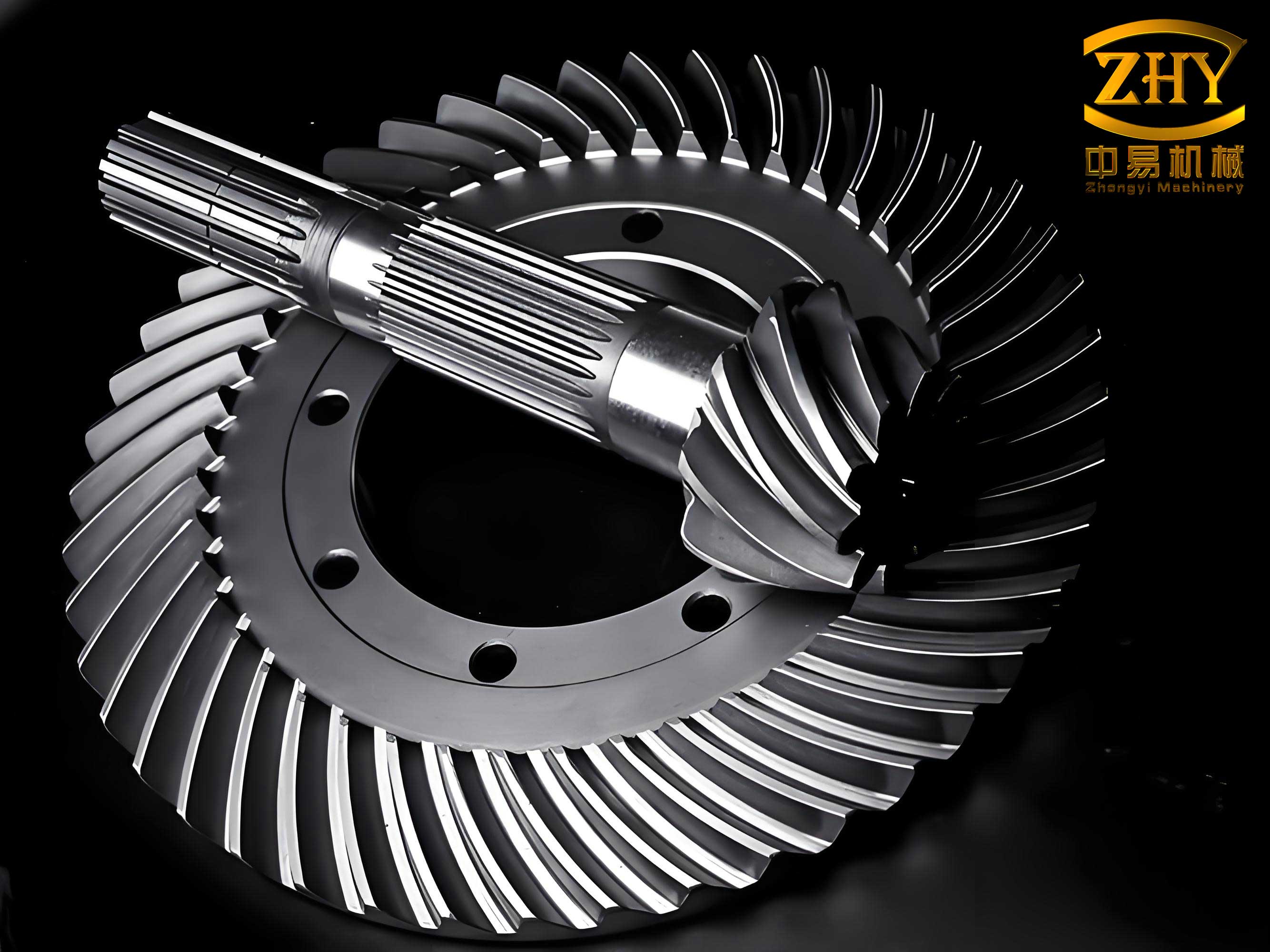
From my perspective, having worked extensively on gear design and manufacturing, the implementation of computerized systems for spiral bevel gear cutting calculations is a transformative step. Spiral bevel gears are essential in power transmission systems where non-parallel shafts intersect, commonly found in automotive differentials, aerospace applications, and industrial machinery. Their complex geometry, characterized by curved teeth and varying angles, makes the cutting process particularly challenging. Traditional methods rely heavily on manual adjustments and empirical charts, leading to inconsistencies and prolonged lead times. Therefore, developing automated calculation programs tailored for spiral bevel gears is not just a luxury but a necessity in modern manufacturing.
Based on our experiences, when crafting applications for design automation, several principles must be adhered to ensure reliability and effectiveness. First, diagnostic measures should be incorporated to verify program correctness. The foundation of automatic computation lies in the program’s infallibility; thus, self-checking mechanisms are imperative. Second, adopting a modular structure over nested configurations is advisable. Modular design facilitates easier modifications, expansions, and maintenance, enhancing the program’s longevity. Third, algorithms should be prioritized over stored charts or tables. This approach simplifies the program, conserves memory, reduces input workload, and improves computational accuracy. Fourth, essential human-computer interaction features must be included. Terminal displays and print outputs should utilize both text and numbers, preferably in a user-friendly language, to guide operators seamlessly.
To illustrate these principles, I will delve into a specific instance: the automation of cutting adjustment calculations for spiral bevel gears. This process is one of the most intricate aspects of gear machining, involving determining the settings for the cutting tool and the gear generator machine. By integrating design automation, we can significantly boost speed and accuracy. We developed a program package for spiral bevel gear cutting adjustment calculations, adhering to the software design guidelines mentioned above. This package, validated through production, has proven highly effective, delivering precise results and drastically reducing computation time.
The program is composed of multiple modules, written in an algorithmic language, and executable on microcomputers. It computes the adjustment data for the tool and the gear milling machine during the tooth cutting of spiral bevel gears. The control center is a main control program that orchestrates the activation of various functional programs. All programs employ a modular architecture, categorized into main programs and common subroutines. Common subroutines are subordinate to main programs and can be conveniently invoked when needed. This hierarchical structure ensures clarity, ease of debugging, maintenance, modification, portability, and expansion.
The workflow of the program is straightforward. Upon initiating the main control program, the screen displays a functional menu in plain language. Based on the operator’s response, the main control program loads and starts a specific functional program. This functional program then displays its content and initializes coefficients and chart constants. Subsequently, the program performs a self-diagnostic check. It computes a set of predefined parameters and compares the cumulative sum with a standard value. If discrepancies arise, the program halts and notifies the operator; otherwise, it proceeds to prompt for input items. The operator inputs seven original parameters for a pair of spiral bevel gears via the keyboard. The program validates these data; if errors or out-of-range values are detected, it requests re-entry. If valid, the program enters the computation phase. After calculations, the main program calls a printing subroutine to output the results. The program then pauses, awaiting the next set of gear parameters, cycling continuously.
To exemplify, consider a pair of mating spiral bevel gears used in a spline shaft milling machine. We aim to process them on a gear generator using the single-side method. The seven original parameters are input into the microcomputer, and within seconds, the adjustment table for the machine is automatically printed. In contrast, manual computation by a skilled technician would take approximately three days, with lower accuracy. This stark comparison underscores the efficacy of computerized calculation for spiral bevel gears.
Delving deeper into the technicalities, the geometry of spiral bevel gears involves numerous parameters that influence the cutting process. Key factors include module, pressure angle, spiral angle, number of teeth, face width, and shaft angle. The cutting adjustments depend on these parameters, and their interrelationships can be expressed through mathematical formulas. Below, I present some fundamental equations and tables to elucidate the calculations involved in spiral bevel gear cutting.
The basic geometry of spiral bevel gears can be described using the following formulas. The pitch diameter $d$ for a gear with number of teeth $z$ and module $m$ is given by:
$$ d = m \cdot z $$
The spiral angle $\beta$ at the mean point is critical for tooth curvature and affects the cutting tool settings. The relationship between spiral angle, pitch cone angle $\delta$, and face width $b$ can be approximated as:
$$ \tan \beta = \frac{\pi \cdot d \cdot \sin \delta}{b} $$
For cutting adjustments, the machine settings such as cradle angle, tool tilt, and machine center to back are derived from these geometric parameters. The calculation of these adjustments often involves iterative methods or look-up tables, but our program replaces tables with algorithms to enhance precision.
One essential aspect is the determination of the cutting tool parameters, particularly for the single-side method. The tool radius $r_t$, pressure angle $\alpha_n$, and blade group selection must be computed. The effective radius $r_e$ for spiral bevel gears is influenced by the spiral angle and can be expressed as:
$$ r_e = \frac{d}{2 \cos \beta} $$
Moreover, the machine settings like the rolling ratio $R_r$ and the feed rate $F$ are derived from the gear geometry and desired tooth thickness. The tooth thickness $s$ at the mean point is related to the module and backlash $j$:
$$ s = \frac{\pi m}{2} – j $$
To illustrate the input and output data, let’s consider a sample pair of spiral bevel gears. The following table summarizes the seven original parameters required for the calculation:
| Input Item | Pinion (Small Gear) | Gear (Large Gear) |
|---|---|---|
| Number of Teeth (z) | 15 | 45 |
| Module (m) [mm] | 4.0 | 4.0 |
| Pressure Angle (α) [degrees] | 20 | 20 |
| Spiral Angle (β) [degrees] | 35 | 35 |
| Shaft Angle (Σ) [degrees] | 90 | 90 |
| Face Width (b) [mm] | 30 | 30 |
| Hand of Spiral | Right | Left |
Upon inputting these parameters, the program computes the adjustment data for the gear generator. The output includes various settings such as cradle angle, tool pivot distance, and feed gears. Below is a simplified version of the adjustment table generated by the program:
| Adjustment Item | Pinion Cutting | Gear Cutting |
|---|---|---|
| Cradle Angle (θ_c) [degrees] | 75.2 | 14.8 |
| Tool Tilt Angle (θ_t) [degrees] | 2.5 | 2.5 |
| Machine Center to Back (C_b) [mm] | 120.5 | 115.3 |
| Feed Gear Ratio (R_f) | 1:1.5 | 1:1.5 |
| Tool Radius (r_t) [mm] | 76.2 | 76.2 |
| Blade Group | Group A | Group A |
The calculations behind these adjustments involve complex derivations. For instance, the cradle angle θ_c is related to the pitch cone angle δ and spiral angle β. A simplified formula for the pinion is:
$$ θ_c = \delta_p + \arcsin\left(\frac{\sin \beta}{\cos \alpha_n}\right) $$
where $\delta_p$ is the pinion pitch cone angle. Similarly, the tool tilt angle θ_t accounts for the tooth curvature and is given by:
$$ θ_t = \arctan\left(\frac{\tan \beta}{\cos \delta}\right) $$
These formulas are embedded within the program’s algorithms, ensuring accurate computations without relying on static tables.
Another critical aspect is the diagnosis module. The program incorporates a self-checking routine that verifies its integrity. For example, it computes a test case with known parameters and compares the results to a benchmark. Let $T$ be the set of test parameters, and $S$ be the cumulative sum of computed adjustments. The program ensures that:
$$ S = \sum_{i=1}^{n} a_i = S_0 $$
where $a_i$ are the adjustment values, and $S_0$ is the predefined standard sum. If $S \neq S_0$, the program flags an error and halts. This diagnostic measure is crucial for maintaining reliability in automated systems for spiral bevel gears.
The modular structure of the program allows for easy updates. For instance, if new cutting methods or machine types are introduced, only specific modules need modification. This flexibility is vital for adapting to evolving manufacturing technologies. Moreover, the use of algorithms over charts reduces memory usage. In traditional methods, extensive look-up tables for spiral bevel gears consume significant storage, but our program calculates values on-the-fly using mathematical models.
Human-computer interaction is enhanced through intuitive prompts and displays. The program guides the operator through input steps, reducing the likelihood of errors. For example, when entering the spiral angle for spiral bevel gears, the program validates that it falls within typical ranges (e.g., 0° to 45°). If an outlier is entered, such as 50°, the program prompts for re-entry, ensuring data integrity.
To further elaborate on the benefits, let’s compare the performance of computerized calculation versus manual methods for spiral bevel gears. The table below summarizes key metrics:
| Metric | Computerized Calculation | Manual Calculation |
|---|---|---|
| Time Required | ~7 seconds | ~3 days |
| Accuracy | High (consistent) | Moderate (prone to errors) |
| Repeatability | Excellent | Variable |
| Ease of Modification | Easy (modular updates) | Difficult (recalculation needed) |
| Resource Usage | Low memory (algorithms) | High (charts and tables) |
This comparison highlights the transformative impact of computerization. Beyond speed and accuracy, automated calculation liberates engineers from tedious tasks, allowing them to focus on creative and analytical aspects of gear design. For spiral bevel gears, this means more time can be devoted to optimizing tooth contact patterns, noise reduction, and load distribution.
In terms of mathematical depth, the cutting process for spiral bevel gears involves differential geometry. The tooth surface is defined by a set of parametric equations. For a right-hand spiral bevel gear, the coordinates of a point on the tooth surface can be expressed as:
$$ x = r(\theta) \cos \theta, \quad y = r(\theta) \sin \theta, \quad z = f(\theta) $$
where $r(\theta)$ is the radius function, and $f(\theta)$ describes the spiral path. The curvature and torsion of this surface influence the cutting tool trajectory. The program uses numerical methods to solve these equations, ensuring precise tool paths.
Furthermore, the adjustment calculations account for machine-specific parameters. For example, the gear generator may have limitations on cradle rotation or tool movement. The program incorporates these constraints into its algorithms, providing feasible settings. This adaptability is crucial for practical applications in workshops.
To ensure robustness, the program includes error-handling routines. If input parameters lead to mathematically impossible configurations for spiral bevel gears, such as negative tooth thickness, the program detects this and alerts the operator. This proactive approach prevents wasted resources on faulty setups.
The evolution of such computerized systems aligns with Industry 4.0 trends, where digital twins and simulation play key roles. By integrating cutting calculation programs with CAD/CAM software, we can create a seamless workflow from design to production for spiral bevel gears. This integration further enhances efficiency and quality control.
In conclusion, the computerization of cutting calculations for spiral bevel gears represents a significant advancement in gear manufacturing. By adhering to principles like diagnostic checks, modular design, algorithm-based computations, and user-friendly interfaces, we can develop reliable and efficient systems. The instance discussed demonstrates how a microcomputer-based program can reduce calculation time from days to seconds while improving accuracy. This not only solves issues of speed and precision but also empowers engineers to engage in higher-level creative tasks. As technology progresses, further enhancements such as artificial intelligence and real-time monitoring could be incorporated, pushing the boundaries of what’s possible in spiral bevel gear production. The future of gear manufacturing lies in embracing such automated solutions, ensuring competitiveness and innovation in the global market.
Throughout this discussion, I have emphasized the importance of spiral bevel gears in various industries and how computerized calculation methods can transform their manufacturing. By leveraging mathematical formulas, modular programming, and intuitive interfaces, we can achieve design automation that meets the demands of modern production. The journey from manual calculations to automated systems is not just about efficiency; it’s about enabling engineers to explore new frontiers in gear design and application. Spiral bevel gears, with their complex geometry, serve as a perfect candidate for such technological integration, paving the way for more advanced and reliable power transmission systems.