
In my extensive experience with mechanical design, gear transmission stands out as one of the most critical forms of power transmission, especially when dealing with spur and pinion arrangements. The spur and pinion gear pair is ubiquitous in machinery due to its simplicity and efficiency. This article delves into the detailed derivation of tooth thickness at any arbitrary point on a standard spur gear tooth profile. Understanding these calculations is fundamental for assessing gear strength, load capacity, and overall performance. I will guide you through the mathematical foundations, emphasizing the importance of the spur and pinion configuration in practical applications.
Gear drives, particularly spur and pinion systems, are prized for their high transmission accuracy, broad adaptability, and ease of manufacturing. Compared to other transmission methods, spur and pinion gears offer several advantages: they can transmit power across a wide range of speeds and loads, maintain precise speed ratios, operate with high efficiency, and have a long service life. However, their manufacturing and installation require high precision, making the calculation of tooth dimensions, such as thickness, crucial. In this discussion, I focus on standard spur gears, where the teeth are straight and parallel to the axis of rotation. The spur and pinion setup is often used in applications where noise is not a primary concern, but reliability and power transmission are paramount.
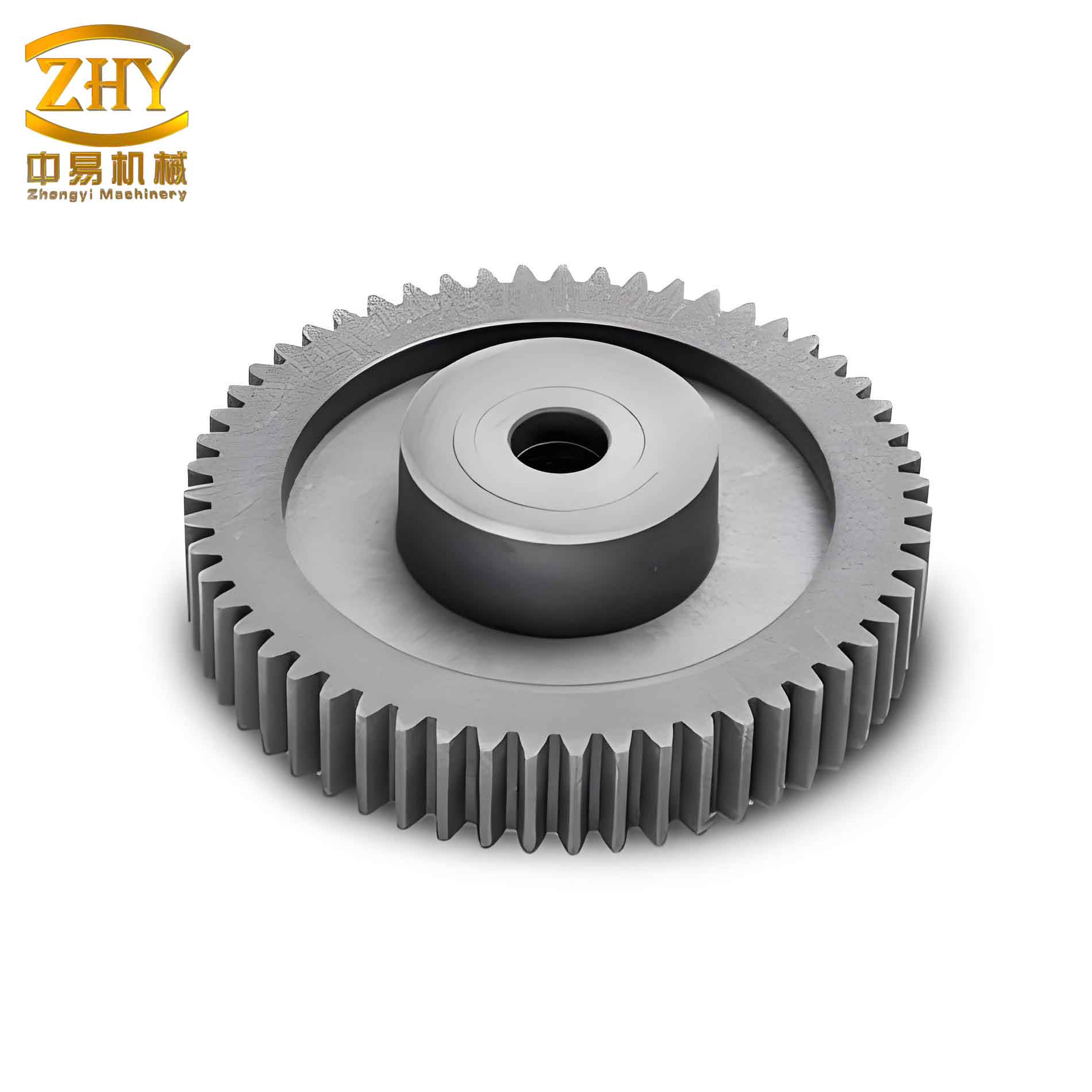
The basic requirements for gear transmission, especially in spur and pinion pairs, include constant transmission ratio and adequate load-bearing capacity. For a spur and pinion gear set, the instantaneous transmission ratio must remain constant to avoid vibrations and noise. This is achieved through the involute tooth profile, which ensures that the common normal at the point of contact always passes through a fixed point on the line connecting the centers. Additionally, the transmission capability of a spur and pinion gear depends heavily on tooth size, primarily determined by the module. The tooth thickness, particularly at the root, influences bending strength; thus, accurate calculation is essential for design.
To begin, let’s review the terminology and basic parameters of a standard spur gear. In a spur and pinion system, the gear with fewer teeth is often called the pinion, while the larger one is the spur gear. Key components include the tip circle (outermost circle), root circle (innermost circle), pitch circle (reference circle for standard module and pressure angle), and base circle (generates the involute profile). The radial distance from the pitch circle to the tip circle is the addendum, and to the root circle is the dedendum. The fundamental parameters are: number of teeth (z), module (m), and pressure angle (α). For standard spur gears, the pressure angle is typically 20°, and the module follows standard series, as shown in Table 1.
| First Series | Second Series |
|---|---|
| 0.1, 0.12, 0.15, 0.2, 0.25, 0.3, 0.4, 0.5, 0.6, 0.8, 1, 1.25, 1.5, 2, 2.5, 3, 4, 5, 6, 8, 10, 12, 16, 20, 25, 32, 40, 50 | 0.35, 0.7, 0.9, 1.75, 2.25, 2.75, (3.25), 3.5, (3.75), 4.5, 5.5, (6.5), 7, 9, (11), 14, 18, 22, 28, (30), 36, 45 |
Other parameters include the addendum coefficient (h∗a) and clearance coefficient (c∗). For standard full-depth teeth, h∗a = 1 and c∗ = 0.25. The pitch diameter is d = mz, and the base circle diameter is db = d cos α = mz cos α. The tooth thickness on the pitch circle, denoted as s, is half the circular pitch p, where p = πm. Thus, s = πm/2. This forms the basis for calculating thickness at other points.
Now, I derive the tooth thickness on the base circle, a critical step for understanding involute geometry. Consider a single tooth symmetrically arranged around the pitch circle. Let points B and G be the intersections of the tooth flanks with the pitch circle, and D be the midpoint of arc BG. The left flank involute meets the base circle at point C, and the tooth symmetry line intersects the base circle at E. The pressure line at B is tangent to the base circle at A. The angle ∠BOA is the pressure angle α. Define γ as the angle subtended by arc BD at the center, β as the angle for arc AE, and θ as the involute spread angle at D. From gear geometry:
Pitch radius: $$ R = \frac{mz}{2} $$
Base radius: $$ R_b = \frac{mz \cos \alpha}{2} $$
Circular pitch: $$ p = \pi m $$
Pitch tooth thickness: $$ s = \frac{p}{2} = \frac{\pi m}{2} $$
Thus, arc BD is half of s: $$ \overset{\frown}{BD} = \frac{s}{2} = \frac{\pi m}{4} $$
From the involute property, the length of the generating line equals the arc length on the base circle. Line AB is tangent to the base circle at A, so $$ \overline{AB} = \overset{\frown}{AC} = R \sin \alpha = \frac{mz \sin \alpha}{2} $$. The angle γ can be found from the ratio of arc BD to the pitch circumference: $$ \frac{\overset{\frown}{BD}}{2\pi R} = \frac{\gamma}{2\pi} $$, leading to $$ \gamma = \frac{\pi}{2z} $$. Then, β = α – γ = α – π/(2z). Arc AE on the base circle is $$ \overset{\frown}{AE} = R_b \beta = \frac{1}{2} mz \cos \alpha \left( \alpha – \frac{\pi}{2z} \right) $$.
Since $$ \overline{AB} = \overset{\frown}{AC} $$, arc CE is: $$ \overset{\frown}{CE} = \overline{AB} – \overset{\frown}{AE} = \frac{1}{2} mz \sin \alpha – \frac{1}{2} mz \cos \alpha \left( \alpha – \frac{\pi}{2z} \right) $$. This arc represents half the base tooth thickness. Simplifying:
$$ \overset{\frown}{CE} = \frac{1}{2} m \cos \alpha \left[ z (\tan \alpha – \alpha) + \frac{\pi}{2} \right] $$
Therefore, the base tooth thickness Sb is twice this value:
$$ S_b = 2 \overset{\frown}{CE} = m \cos \alpha \left( \frac{\pi}{2} + z \cdot \text{inv} \alpha \right) $$
where inv α = tan α – α is the involute function. This formula is essential for subsequent calculations in spur and pinion gear design.
The involute function plays a key role in gear geometry. For any point K on the involute, with pressure angle αk, the spread angle θk is defined as θk = inv αk = tan αk – αk. This arises from the involute generation: if a line rolls on the base circle without slipping, the length of the line from the point of tangency to the involute point equals the arc length on the base circle. Mathematically, for base radius rb, $$ \overline{BK} = r_b \tan \alpha_k $$ and $$ \overset{\frown}{AB} = r_b (\theta_k + \alpha_k) $$, so θk = tan αk – αk. This function is tabulated for convenience in gear design manuals.
To find the tooth thickness at any arbitrary point K on the involute profile, with radius Rk and pressure angle αk, I start from the base tooth thickness. Let γ be the angle subtended by the base thickness at the center: $$ \gamma = \frac{S_b}{R_b} = \frac{m \cos \alpha \left( \frac{\pi}{2} + z \cdot \text{inv} \alpha \right)}{\frac{1}{2} m z \cos \alpha} = \frac{2 \left( \frac{\pi}{2} + z \cdot \text{inv} \alpha \right)}{z} $$. Then, the angle β corresponding to half the tooth thickness at point K is: $$ \beta = \frac{\gamma}{2} – \theta_k = \frac{\pi}{2z} + \text{inv} \alpha – \text{inv} \alpha_k $$. Thus, the tooth thickness at K is:
$$ S_k = R_k \cdot 2\beta = R_k \left( \frac{\pi}{z} + 2(\text{inv} \alpha – \text{inv} \alpha_k) \right) $$
Since s/R = π/z, this can be rewritten as:
$$ S_k = s \frac{R_k}{R} – 2 R_k (\text{inv} \alpha_k – \text{inv} \alpha) $$
This general formula allows calculating thickness at any point on the involute, crucial for stress analysis in spur and pinion gears.
Next, I analyze the tooth thickness at the root circle. For a standard spur gear, the root diameter is df = m(z – 2.5) when h∗a = 1 and c∗ = 0.25. The base diameter is db = mz cos α. The radial distance from the pitch circle to the base circle, which I term the base addendum hb, is: $$ h_b = \frac{d – d_b}{2} = \frac{1}{2} mz (1 – \cos \alpha) $$. If hb ≥ hf (where hf = 1.25m is the dedendum height), then the root circle lies outside the base circle, meaning the entire tooth profile is involute. This occurs when z ≥ 41.454 for α = 20°. Thus, for gears with 42 or more teeth, the root thickness can be calculated using the involute formula.
Let αf be the pressure angle at the root circle. From geometry, cos αf = Rb / Rf = (z cos α)/(z – 2.5). Then, αf = arccos[z cos α/(z – 2.5)]. The spread angle at the root is θf = inv αf = tan αf – αf. Using similar derivation as before, the angle subtended by half the root thickness is: $$ 2\beta = \frac{\pi}{z} – 2(\text{inv} \alpha_f – \text{inv} \alpha) $$. Hence, the root tooth thickness Sf is:
$$ S_f = R_f \cdot 2\beta = R_f \left( \frac{\pi}{z} – 2(\text{inv} \alpha_f – \text{inv} \alpha) \right) = s \frac{R_f}{R} – 2 R_f (\text{inv} \alpha_f – \text{inv} \alpha) $$
For gears with fewer teeth (z < 42), the root circle is inside the base circle, so the profile near the root is a trochoid or fillet curve produced by the cutting tool. This non-involute portion does not engage in meshing but provides clearance and oil storage. In such cases, the root thickness is not given by this formula; instead, the critical section for bending stress is determined by methods like the 30° tangent or parabola method. This is particularly important in spur and pinion design, where the pinion often has fewer teeth and is more susceptible to failure.
To illustrate the variation in tooth thickness, I compare values at different points for spur gears with module m = 3 mm and pressure angle α = 20°, for various tooth numbers. Table 2 shows the pitch thickness s, thickness at a point with pressure angle 15° (denoted S15), base thickness Sb, and root thickness Sf (for z ≥ 42). These calculations highlight how thickness increases from tip to root and with tooth number, affecting gear strength.
| Number of Teeth (z) | Pitch Thickness (s) | Thickness at αk = 15° (S15) | Base Thickness (Sb) | Root Thickness (Sf) |
|---|---|---|---|---|
| 20 | 4.7123 | 5.0950 | 5.2683 | – |
| 25 | 4.7123 | 5.2227 | 5.4783 | – |
| 30 | 4.7123 | 5.3504 | 5.6883 | – |
| 35 | 4.7123 | 5.4781 | 5.8983 | – |
| 40 | 4.7123 | 5.6058 | 6.1084 | – |
| 45 | 4.7123 | 5.7335 | 6.3184 | 6.3072 |
The table confirms that for a given module and pressure angle, tooth thickness at any fixed point (except the pitch circle) increases with tooth number. For a given gear, thickness increases from the tip toward the root. This has implications for design: for example, in a spur and pinion pair, the pinion typically has fewer teeth and thus thinner teeth at the root, making it the critical component for bending stress. Therefore, calculating these thicknesses accurately is vital for ensuring durability.
In practical spur and pinion gear design, tooth thickness calculations extend beyond basic geometry. For instance, the measurement of gear teeth often uses the chordal thickness or span measurement (also known as Witz measurement). The formula for span measurement over k teeth involves the base tooth thickness: $$ W_k = (k-1) p_b + S_b $$, where pb is the base circular pitch, given by pb = π m cos α. Substituting Sb, we get: $$ W_k = (k-1) \pi m \cos \alpha + m \cos \alpha \left( \frac{\pi}{2} + z \cdot \text{inv} \alpha \right) $$. This formula is directly applied in quality control for spur and pinion gears.
Moreover, tooth thickness modifications, such as addendum modification or profile shifting, are common in spur and pinion systems to avoid undercut, improve strength, or adjust center distance. These modifications alter the tooth thickness at various circles. For a modified spur gear, the pitch circle is redefined, and the thickness calculation must account for the shift coefficient x. The modified pitch tooth thickness becomes: $$ s’ = \frac{\pi m}{2} + 2 x m \tan \alpha $$. This affects the base thickness and subsequent calculations. In such cases, the involute function usage remains similar, but the parameters change. Designers of spur and pinion gears must carefully consider these aspects to optimize performance.
Another important consideration is the contact ratio in spur and pinion meshing. The contact ratio depends on the tooth profiles and the lengths of the approach and recess arcs. Tooth thickness influences the starting and ending points of contact. A minimum contact ratio of 1.2 is typically required for smooth operation. Using the thickness formulas, one can determine the active tooth profiles and ensure adequate overlap.
From a manufacturing perspective, knowing tooth thickness is essential for gear cutting processes like hobbing or shaping. The cutter must be positioned correctly to achieve the desired thickness. For spur and pinion gears produced in large quantities, tolerance on tooth thickness is specified to ensure proper backlash and meshing. Standards such as AGMA or ISO provide guidelines for these tolerances.
In conclusion, the calculation of tooth thickness at any point on a standard spur gear tooth is a fundamental aspect of gear design. Through detailed derivation, I have shown how to compute thickness on the base circle, at arbitrary involute points, and at the root circle. These calculations rely heavily on the involute function and gear parameters like module, tooth number, and pressure angle. For spur and pinion gear pairs, these calculations are critical for strength assessment, load capacity determination, and ensuring reliable transmission. I encourage designers to master these derivations to deepen their understanding and apply them effectively in practical scenarios. The interplay between geometry and performance in spur and pinion gears underscores the importance of precision in mechanical engineering.
To further elaborate, let’s consider some numerical examples. Suppose we have a spur and pinion set with module m = 2 mm, pinion tooth count zp = 20, gear tooth count zg = 40, and pressure angle α = 20°. For the pinion, pitch radius Rp = m zp / 2 = 20 mm, base radius Rb_p = Rp cos α = 18.7939 mm. Pitch tooth thickness s = πm/2 = 3.1416 mm. Base tooth thickness Sb_p = m cos α (π/2 + zp inv α) = 2 cos 20° (π/2 + 20 × 0.014904) = 1.8794 × (1.5708 + 0.2981) = 3.514 mm. Now, to find thickness at a point with radius Rk = 22 mm (on the addendum), we first find αk: cos αk = Rb_p / Rk = 18.7939 / 22 = 0.85427, so αk = 31.32°, inv αk = tan 31.32° – 31.32° × π/180 = 0.6089 – 0.5465 = 0.0624 rad. Then, Sk = s (Rk/Rp) – 2 Rk (inv αk – inv α) = 3.1416 × (22/20) – 2 × 22 × (0.0624 – 0.014904) = 3.4558 – 44 × 0.0475 = 3.4558 – 2.09 = 1.3658 mm. This shows how thickness decreases toward the tip. Similar calculations can be done for the gear. This example illustrates the practical use of the formulas in spur and pinion design.
Additionally, I should discuss the impact of tooth thickness on gear mesh stiffness and dynamics. In spur and pinion systems, varying tooth thickness along the profile affects the elastic deflection under load, which in turn influences vibration and noise. Accurate thickness data allows for finite element analysis to predict stress distributions and fatigue life. For high-speed spur and pinion applications, such as in automotive transmissions, these considerations are paramount.
Finally, it’s worth noting that while this article focuses on standard spur gears, the principles extend to other gear types, such as helical or bevel gears, with appropriate modifications. However, the spur and pinion configuration remains a cornerstone in mechanical design due to its simplicity and effectiveness. I hope this comprehensive treatment aids engineers and students in grasping the nuances of gear tooth geometry and its calculations.