
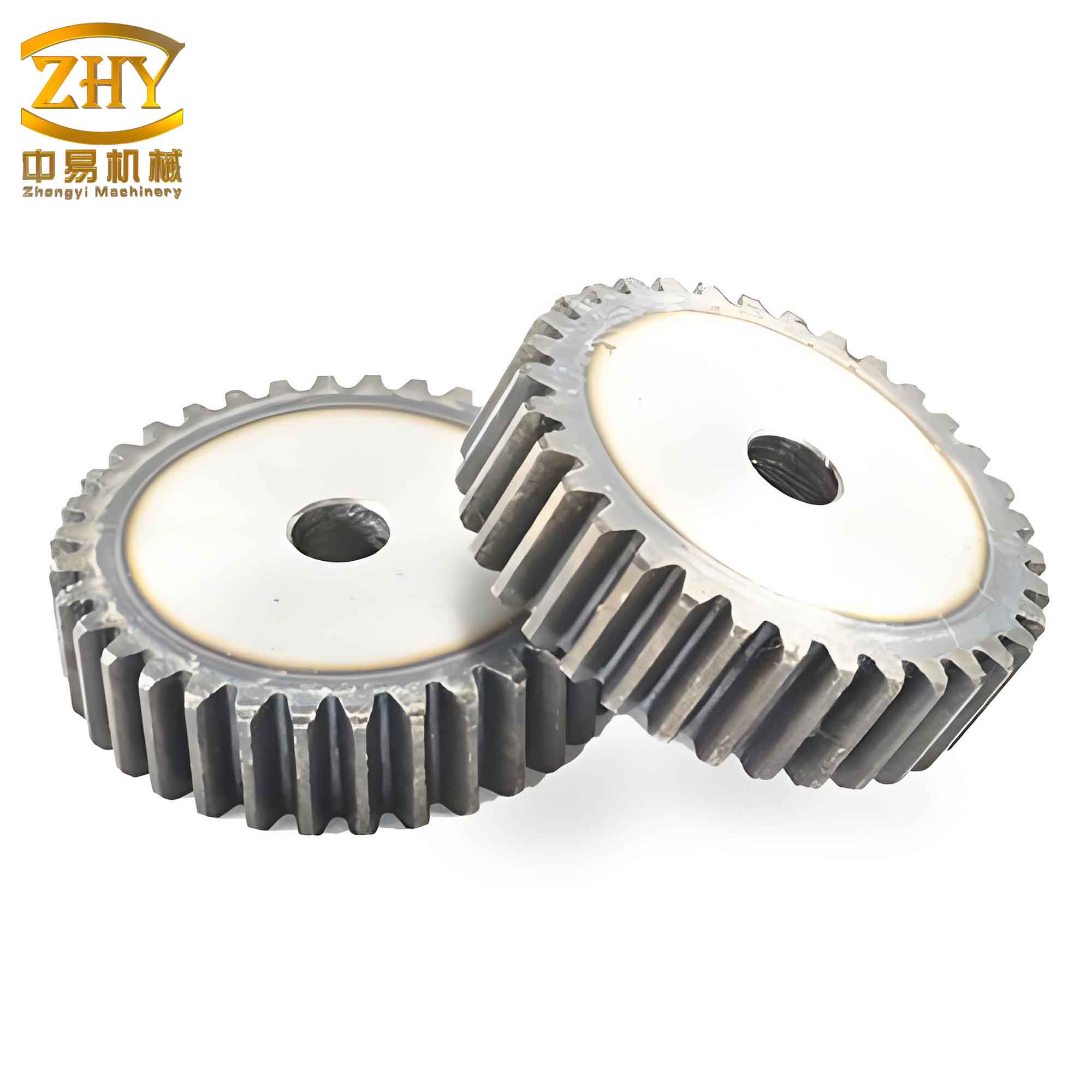
In modern mechanical systems, spur and pinion gears play a critical role in transmitting power and motion with high efficiency. However, during manufacturing and operational service, internal flaws such as porosity, inclusions, and cracks can develop within these gears, posing significant risks to equipment safety and reliability. As an engineer specializing in non-destructive testing, I have focused on developing advanced methods to detect these hidden defects. Ultrasonic testing, with its high sensitivity, deep penetration, and precise defect localization, offers a promising solution. Yet, the complex geometry of spur and pinion gears makes manual ultrasonic inspection challenging and inefficient. In this work, we propose an automated ultrasonic testing system based on an XY motion platform, specifically designed for the internal flaw detection in spur and pinion gears. This approach not only enhances detection accuracy but also improves efficiency through optimized scanning paths and real-time signal processing. Throughout this article, we will delve into the methodology, mathematical modeling, software implementation, and experimental validation, consistently emphasizing the application to spur and pinion gears to underscore their importance in industrial applications.
The presence of internal flaws in spur and pinion gears can lead to catastrophic failures if undetected. These defects often originate from manufacturing processes like casting or forging, or from fatigue during operation. Traditional inspection methods, such as visual or magnetic particle testing, are limited to surface defects. In contrast, ultrasonic waves can penetrate deep into the material, providing insights into the internal structure. Our research leverages pulse-echo longitudinal wave ultrasonic testing in an immersion setup, where both the transducer and the gear are submerged in a water couplant. This non-contact method ensures consistent coupling and reduces operator dependency. The core innovation lies in the automated scanning system, which uses an XY motion platform to move the ultrasonic transducer along a pre-planned path that conforms to the gear’s tooth profile. This allows for comprehensive coverage of the gear’s internal volume, specifically targeting areas prone to flaws in spur and pinion gears. The system integrates motion control, ultrasonic signal acquisition, and data analysis to achieve high-precision flaw detection and visualization.
The automated ultrasonic testing system for spur and pinion gears comprises several key components: an ultrasonic transducer mounted on a probe holder, an XY motion platform driven by servo motors, a servo driver, and an industrial computer equipped with a motion controller and an ultrasonic data acquisition card. The industrial computer orchestrates the entire process, synchronizing transducer movement with signal capture. During scanning, the transducer emits ultrasonic pulses into the gear material, and reflected echoes from interfaces (e.g., front surface, flaws, back surface) are recorded as A-scan waveforms. These waveforms are processed in real-time to extract defect features, enabling C-scan imaging for flaw visualization. This integrated setup is particularly effective for spur and pinion gears due to their symmetrical tooth profiles, which allow for systematic path planning. We have designed the system to handle various gear sizes and parameters, ensuring versatility in industrial settings.
Path planning is crucial for efficient and accurate inspection of spur and pinion gears. Given the tooth profile complexity, a zigzag scanning path within a single tooth space is adopted. This path minimizes redundant scanning and avoids areas where ultrasonic beams might interact with gear boundaries, which could cause signal interference. The zigzag pattern consists of concentric arcs connected by straight lines, covering the entire tooth region from the tip to the root. To generalize this approach, we define key parameters: gear module \(m\), number of teeth \(z\), addendum circle radius \(r_a\), dedendum circle radius \(r_f\), base circle radius \(r_b\), and scanning width \(b\). The scanning width corresponds to the transducer’s beam coverage, and the path is offset by \(b/2\) from the tooth boundaries to ensure full material penetration. Below is a table summarizing the gear parameters used in path calculation for spur and pinion gears:
| Parameter | Symbol | Description |
|---|---|---|
| Module | \(m\) | Gear size parameter |
| Number of Teeth | \(z\) | Total teeth on gear |
| Addendum Radius | \(r_a\) | Radius to tooth tip |
| Dedendum Radius | \(r_f\) | Radius to tooth root |
| Base Radius | \(r_b\) | Radius for involute generation |
| Scanning Width | \(b\) | Ultrasonic beam width |
| Pressure Angle | \(\alpha\) | Angle defining tooth shape |
To compute the zigzag path coordinates, we establish a Cartesian coordinate system with the gear’s rotation center \(O\) as the origin. The path consists of points along arcs at radii \(r_k\), where \(k\) indexes the arcs from the outermost to innermost. For points on the involute portion of a tooth, the coordinates \((x_{i,j}, y_{i,j})\) for the \(i\)-th tooth and \(j\)-th point are derived from gear geometry. The tooth thickness \(s_k\) at radius \(r_k\) is given by:
$$
s_k = s \frac{r_k}{r} – 2 r_k (\text{inv} \alpha_k – \text{inv} \alpha)
$$
where \(s\) is the standard tooth thickness at the pitch circle:
$$
s = \left( \frac{\pi}{2} + 2x \tan \alpha \right) m
$$
Here, \(x\) is the profile shift coefficient, and \(\text{inv} \alpha_k\) is the involute function:
$$
\text{inv} \alpha_k = \tan \alpha_k – \alpha_k, \quad \alpha_k = \arccos \left( \frac{r_b}{r_k} \right)
$$
The arc length \(l\) along the scanning path at radius \(r_k\) is:
$$
l = s_k – b
$$
Thus, the angle \(\theta_k\) from the X-axis to the point is:
$$
\theta_k = \frac{l}{2 r_k}
$$
Finally, the coordinates for the first tooth (\(i=1\)) are:
$$
x_{1,j} = r_k \cos \theta_k, \quad y_{1,j} = r_k \sin \theta_k
$$
For other teeth, we apply a rotation transformation:
$$
x_{i,j} = x_{1,j} \cos \phi_i – y_{1,j} \sin \phi_i, \quad y_{i,j} = x_{1,j} \sin \phi_i + y_{1,j} \cos \phi_i
$$
where \(\phi_i = 2\pi (i-1)/z\). For points on the gear rim, coordinates are simply \((r_k’, 0)\) for radius \(r_k’\). This mathematical framework ensures precise path generation tailored to spur and pinion gears, enabling automated scanning without manual intervention.
Ultrasonic signal analysis is the cornerstone of defect detection in spur and pinion gears. The A-scan waveform \(w(n)\) represents the echo amplitude over time:
$$
w(n) = \{ f(i) \mid i = 1, 2, \dots, n \}
$$
where \(n\) is the total number of sampling points, and \(f(i)\) is the amplitude at point \(i\). Key features include the positions and energies of defect echoes. The distance between two consecutive echoes (e.g., front surface echo and defect echo) is calculated as:
$$
d = \frac{c (p – e)}{2 f_s}
$$
Here, \(c\) is the ultrasonic velocity in the gear material, \(f_s\) is the sampling frequency, and \(e\) and \(p\) are the indices of the echo start points. This distance helps localize flaws within the spur and pinion gear. To quantify echo energy, we model waveform edges (rise or fall segments) as linear segments. For a rise edge from point \(p\) to \(q\), the segment is:
$$
y[f(p), f(q)] = \left\{ f(i) \mid f(i) = \frac{f(q) – f(p)}{q – p} (i – p) + f(p), \quad i = p, p+1, \dots, q \right\}
$$
The energy of this edge is approximated by:
$$
\sum_{i=p}^{q} f(i)^2 = (q – p + 1) \left[ f(p)^2 + f(p)[f(q) – f(p)] + \frac{(2q – 2p + 1)[f(q) – f(p)]^2}{6(q – p)} \right]
$$
By summing energies across all edges of a defect echo, we obtain a robust energy metric for flaw characterization. This approach compresses A-scan data while preserving essential defect information, facilitating real-time processing for spur and pinion gear inspection.
Defect visualization through C-scan imaging transforms ultrasonic data into intuitive color maps. Each scanning point is assigned a color based on the defect echo energy, creating a 2D projection of internal flaws. We define an energy sequence \(E_1 \leq E_2 \leq \dots \leq E_n\) with uniform intervals \(\Delta E_i\), and a color table \(C_1, C_2, \dots, C_n\) in RGB space. The mapping is:
$$
\{E_1, \dots, E_n\} \mapsto \{C_1, \dots, C_n\} \subset \mathbb{R} \times \mathbb{G} \times \mathbb{B}
$$
For spur and pinion gears, we typically use 4 to 8 color levels to represent flaw severity, with red hues indicating high-energy defects (e.g., cracks) and blue hues for low-energy regions (e.g., healthy material). This visualization aids inspectors in quickly identifying critical areas in spur and pinion gears. The table below outlines a sample color mapping scheme for defect energy in spur and pinion gear inspection:
| Energy Level | Color (RGB) | Defect Severity |
|---|---|---|
| Low (E1) | (0, 0, 255) | No defect |
| Medium-Low (E2) | (0, 128, 255) | Minor porosity |
| Medium (E3) | (0, 255, 255) | Inclusions |
| Medium-High (E4) | (255, 255, 0) | Small cracks |
| High (E5) | (255, 0, 0) | Large cracks |
Software development is essential for integrating motion control and ultrasonic signal processing. We created a custom application using Visual C++ 6.0 with MFC, which comprises two main modules: scanning motion control and ultrasonic signal acquisition. The motion control module interfaces with a GT-400-SV-PCI motion controller to drive the XY platform. Users input gear parameters (e.g., \(m, z, \alpha, b\)) and scanning speed \(v\), and the software calculates the zigzag path coordinates in real-time. Commands are sent to the motion controller’s buffer to execute multi-segment coordinated movements, ensuring smooth transducer traversal across the spur and pinion gear. The ultrasonic module utilizes a commercial ultrasonic card library for A-scan capture and processing. OpenGL is employed for rendering C-scan images. The software architecture enables seamless operation, from path planning to flaw visualization, specifically optimized for spur and pinion gears. Key features include parameter configuration, real-time A-scan display, and automated report generation, making it suitable for industrial quality control of spur and pinion gears.
To validate our method, we conducted experiments on a spur and pinion gear specimen with known artificial flaws. The gear had a module \(m = 10\), teeth \(z = 8\), and profile shift coefficient \(x = 0.5\). Artificial defects of diameters 1 mm, 2 mm, 3 mm, and 5 mm were embedded at various depths. The ultrasonic transducer had a center frequency of 5 MHz, and scanning was performed with a width \(b = 3\) mm and speed \(v = 2.5\) mm/s. We compared our zigzag scanning approach with a conventional “gear rotation + radial feed” method. Results showed that our method reduced scanning time by approximately 40% (706 seconds vs. 1178 seconds), thanks to the optimized path that avoids non-inspectable areas like tooth gaps. The C-scan image clearly revealed all four artificial defects, demonstrating the system’s capability to detect flaws as small as 1 mm in projection plane. This experiment underscores the efficacy of automated ultrasonic testing for spur and pinion gears, providing both time savings and high detection accuracy.
The mathematical models for path planning and signal analysis are further elaborated to ensure robustness. For spur and pinion gears with non-standard profiles, we incorporate transition curve equations. If the base radius \(r_b\) is greater than the dedendum radius \(r_f\), the tooth profile includes both involute and transition curves. The transition curve coordinates \((x_{1,j}, y_{1,j})\) as functions of \(r_k\) are expressed as:
$$
x_{1,j} = G_x(r_k), \quad y_{1,j} = G_y(r_k)
$$
where \(G_x\) and \(G_y\) depend on the manufacturing method (e.g., hobbling or shaping). This generalization allows our system to handle various spur and pinion gear types. Additionally, we enhance signal processing by applying noise reduction filters, such as wavelet denoising, to improve signal-to-noise ratio in noisy industrial environments. The defect localization accuracy is quantified by the uncertainty in distance calculation:
$$
\Delta d = \frac{c}{2 f_s} \Delta p
$$
where \(\Delta p\) is the uncertainty in echo start index. For typical values (\(c = 5900\) m/s in steel, \(f_s = 100\) MHz, \(\Delta p = 1\)), \(\Delta d \approx 0.03\) mm, which is sufficient for most applications in spur and pinion gears.
In discussion, we analyze the advantages of our automated system over manual methods for spur and pinion gears. Manual inspection is labor-intensive and prone to human error, especially in complex geometries. Our automated approach ensures consistent transducer positioning and data acquisition, leading to reproducible results. The zigzag path minimizes scan area, reducing inspection time without compromising coverage. Moreover, the immersion setup eliminates coupling variability, enhancing signal stability. Compared to other automated methods like phased array ultrasonics, our system is cost-effective and easier to implement for routine inspection of spur and pinion gears. However, limitations exist: the current setup is primarily sensitive to defects oriented perpendicular to the ultrasonic beam (i.e., along the gear axis). For oblique flaws, we plan to incorporate angle-beam transducers in future work. Additionally, the system’s speed can be increased by optimizing motion algorithms, potentially reaching up to 100 mm/s for high-throughput inspection of spur and pinion gears.
Future research directions include extending the system to helical and bevel gears, which have more complex geometries than spur and pinion gears. We also aim to integrate machine learning algorithms for automatic flaw classification, using deep learning models trained on ultrasonic data from spur and pinion gears. This could further reduce inspection time and improve reliability. Another avenue is real-time 3D imaging using tomography techniques, providing volumetric views of internal flaws in spur and pinion gears. These advancements will bolster the role of ultrasonic testing in predictive maintenance and quality assurance for gear-intensive industries.
In conclusion, we have developed and validated an automated ultrasonic testing system for detecting internal flaws in spur and pinion gears. The key contributions include a zigzag scanning path tailored to gear tooth profiles, mathematical models for path computation and signal analysis, and a software platform for integrated control and visualization. Experimental results confirm the system’s ability to detect sub-millimeter defects with high efficiency. This work underscores the importance of non-destructive testing in ensuring the reliability of spur and pinion gears, which are ubiquitous in automotive, aerospace, and industrial machinery. By automating the inspection process, we pave the way for safer and more durable mechanical systems, highlighting the enduring relevance of spur and pinion gears in engineering applications.
The methodologies described here are grounded in principles of acoustics, mechanics, and computer science. To further illustrate the mathematical framework, we present additional formulas for gear geometry and ultrasonic wave propagation. For instance, the ultrasonic reflection coefficient at a flaw interface in spur and pinion gears can be modeled as:
$$
R = \frac{Z_2 – Z_1}{Z_2 + Z_1}
$$
where \(Z_1\) and \(Z_2\) are acoustic impedances of the gear material and flaw (e.g., air in porosity), respectively. This affects echo amplitude and thus defect detectability. Another important aspect is the beam spread in the immersion medium, given by:
$$
\theta_b = \arcsin\left( \frac{1.22 \lambda}{D} \right)
$$
where \(\lambda\) is wavelength and \(D\) is transducer diameter. This influences the scanning width \(b\) for spur and pinion gears. Overall, our holistic approach combines theoretical rigor with practical implementation, offering a robust solution for the non-destructive evaluation of spur and pinion gears.