
As a mechanical engineer specializing in CAD/CAM/CAE systems, I have extensively utilized Unigraphics NX for its high reliability and diverse design functionalities, particularly in the realm of mechanical transmission components. Among these, spur and pinion gears are ubiquitous in various machinery, and achieving precise modeling through parametric design is crucial for efficiency and accuracy. In this article, I will share my detailed methodology for the parametric design of cylindrical involute spur gears using UGNX, emphasizing the use of expressions, sketching, and feature operations to create fully parameterized models. This approach not only streamlines the design process but also ensures that modifications to key parameters, such as module and tooth count, automatically update the entire geometry, facilitating rapid prototyping and customization.
Parametric design fundamentally revolves around defining a model through constraints and parameters, allowing for the generation of a family of similar parts by altering a set of driving variables. In UGNX, this is achieved through two primary mechanisms: program-driven and dimension-driven methods. Program-driven design involves establishing mathematical relationships between geometric features and input parameters, which are then encoded into the system to generate models automatically. Dimension-driven design, on the other hand, enables dynamic updates to the geometry as dimensional values are changed, providing a flexible design environment. For spur and pinion gears, this means that once the core parameters are defined, the entire gear model—from the齿廓 to the 3D extrusion—can be controlled and modified seamlessly, reducing manual intervention and minimizing errors.
To implement parametric design for spur gears in UGNX, the first step is to define the fundamental gear parameters. These parameters serve as the foundation for all subsequent geometric constructions. Below is a table summarizing the key parameters and their typical symbols, which I use in UGNX expressions:
| Parameter | Symbol in UGNX | Description | Typical Value Range |
|---|---|---|---|
| Number of Teeth | z | Total teeth on the spur gear or pinion | 10 to 100+ |
| Module | m | Ratio of pitch diameter to tooth count, defining tooth size | 1 mm to 10 mm |
| Pressure Angle | ak | Angle between the tooth profile and radial line at pitch point | 20° (standard) |
| Addendum Coefficient | ha | Factor for addendum height relative to module | 1.0 (standard) |
| Dedendum Coefficient | c | Factor for dedendum depth relative to module | 0.25 (standard) |
| Gear Thickness | h | Axial width of the spur gear or pinion | Varies based on application |
In UGNX, all variables must be predefined using expressions. I typically assign initial values to these parameters using alphanumeric combinations, such as setting m = 3 for module or z = 30 for tooth count. This ensures that the system recognizes them as driving parameters for the model. For instance, to define the base geometry of a spur gear, I establish the following expressions to control the diameters of key circles:
$$d = m \times z$$ // Pitch diameter
$$d_a = d + 2 \times h_a \times m$$ // Addendum circle diameter
$$d_b = d \times \cos(ak)$$ // Base circle diameter
$$d_f = d – 2 \times m \times (h_a + c)$$ // Dedendum circle diameter
These expressions are entered into UGNX’s expression editor, where they become live formulas that update automatically when any parameter changes. For example, if I adjust the module m, all diameters recalculate, ensuring consistency in the gear geometry. This parametric linkage is essential for designing spur and pinion gears that must mesh perfectly in transmission systems.
With the parameters set, I proceed to sketch the基准 curves on the XC-YC plane. Using the sketch module in UGNX, I draw four concentric circles representing the addendum, pitch, base, and dedendum circles. Through dimensional constraints, I link their diameters to the expressions da, d, db, and df, respectively. Geometric constraints ensure that all circles share a common center, establishing a robust foundation for the gear profile. This step is critical because any misalignment here could lead to inaccuracies in the final spur gear or pinion model.
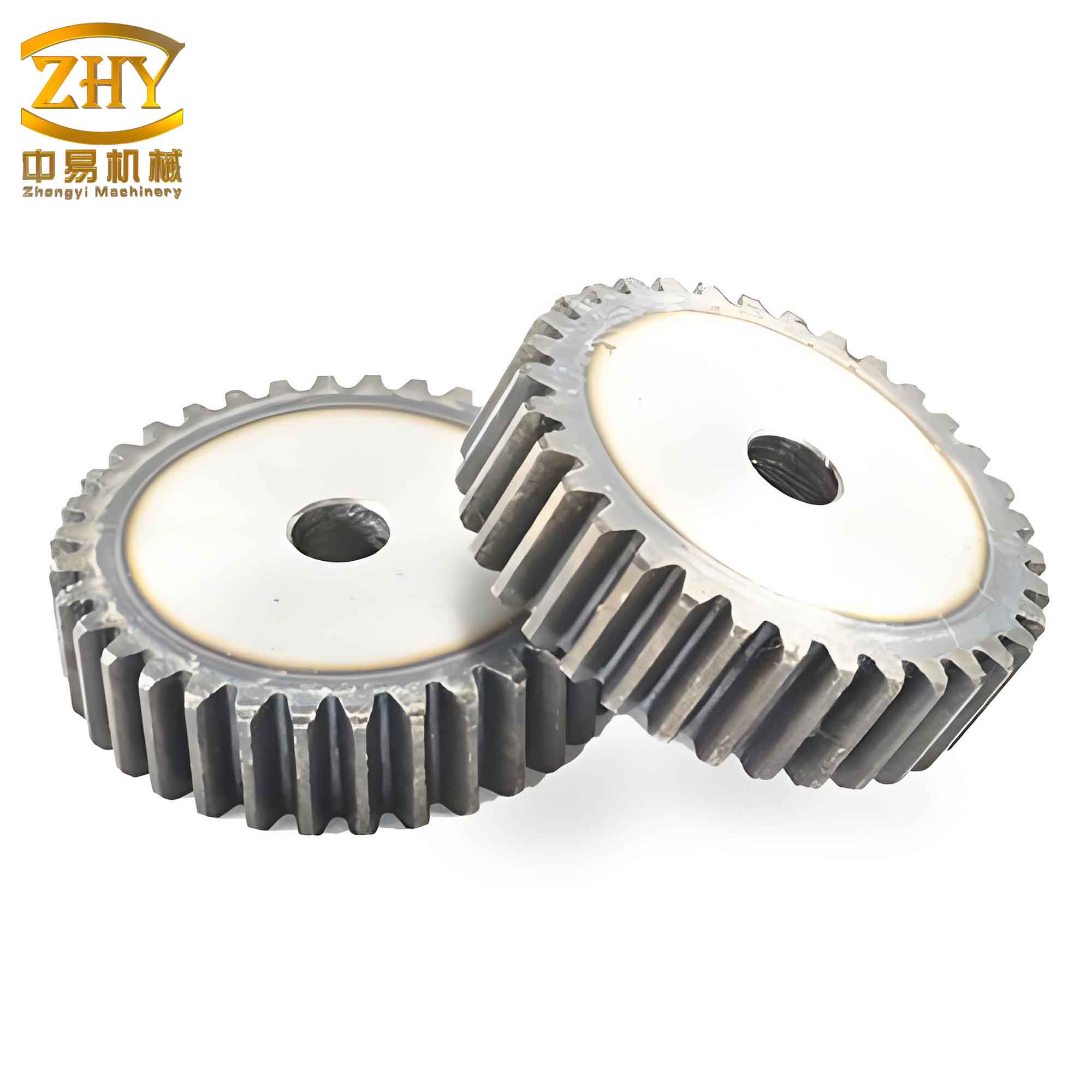
The formation of the involute tooth profile is the core of spur gear modeling. The involute curve defines the shape of each tooth, ensuring smooth engagement and power transmission. In UGNX, I generate the involute using parametric equations derived from gear theory. The standard involute equations in Cartesian coordinates are:
$$x = r_b \times (\cos(\theta) + \theta \times \sin(\theta))$$
$$y = r_b \times (\sin(\theta) – \theta \times \cos(\theta))$$
where \( r_b = \frac{d_b}{2} \) is the base radius, and \( \theta \) is the involute angle parameter. I input these equations into UGNX’s law curve tool or expression-based curve generator to create a precise involute segment. For a single tooth, I typically generate two symmetric involute curves: one for the left flank and one for the right flank. This approach mirrors the actual machining processes like hobbing or shaping, where the gear tooth is formed by sweeping an involute profile.
However, tooth profile generation varies based on the number of teeth. For spur gears with fewer teeth (e.g., \( z < 41 \)), the base circle may be larger than the dedendum circle, causing the involute curve to not intersect the dedendum circle directly. This results in an open profile that cannot be extruded into a solid. To address this, I use a hybrid method: I draw a straight line to connect the endpoint of the involute to the dedendum circle, ensuring tangency between the line and the involute. This approximation introduces minimal error while maintaining parametric control. In contrast, for spur gears with \( z \geq 41 \), the involute naturally extends to the dedendum circle, allowing for a closed profile without additional lines. The table below summarizes this design strategy:
| Tooth Count (z) | Profile Condition | Modeling Approach | Accuracy Consideration |
|---|---|---|---|
| z < 41 | Base circle > Dedendum circle | Use straight line to connect involute to dedendum circle | High accuracy with proper tangency constraints |
| z ≥ 41 | Base circle ≤ Dedendum circle | Direct involute-dedendum closure | Exact geometric representation |
Once the tooth profile is defined, I move to 3D modeling. I start by extruding the dedendum or addendum circle to create a cylindrical blank representing the gear body. Then, I use the sketched tooth profile—comprising the involute segments, connecting lines (if needed), and circle arcs—to extrude either a single tooth or a tooth cavity. Boolean operations, such as unite or subtract, help integrate this into the blank. For instance, if I extrude the tooth profile as a solid, I unite it with the blank to form a single tooth; if I extrude it as a cavity, I subtract it to create a gap. This stepwise construction ensures that each feature remains parametrically linked.
To complete the spur gear or pinion, I employ the pattern feature command in UGNX. After creating one tooth, I array it circularly around the gear axis. The number of instances is set to \( z \), and the angular spacing is \( \frac{360}{z} \) degrees. This operation replicates the tooth geometry efficiently, producing a full gear set. Following the array, I apply fillets to the tooth roots to reduce stress concentrations. The fillet radius is typically defined as \( R = 0.38 \times m \), based on engineering standards. Importantly, I perform the fillet operation after patterning to maintain parametric associativity; otherwise, the fillet feature might not propagate correctly across all teeth.
Parameterized control in UGNX offers multiple avenues for modifying spur gear designs. I can directly edit the expressions in the UGNX editor, change parameters via an imported spreadsheet, or use the part navigator to update values. For example, to switch from a spur gear with \( z = 24 \) to one with \( z = 30 \), I simply adjust the tooth count parameter, and the entire model—including tooth profile, array count, and diameters—updates automatically. This flexibility is invaluable for iterative design processes, where multiple variations of a pinion or spur gear must be evaluated for performance and fit.
Below is a comprehensive table listing key expressions and their roles in the parametric design of spur gears. These formulas encapsulate the geometric relationships that drive the model:
| Expression Name | Formula | Purpose |
|---|---|---|
| Pitch Diameter | $$d = m \times z$$ | Defines the reference diameter for tooth spacing |
| Addendum Diameter | $$d_a = d + 2 \times h_a \times m$$ | Sets the outer diameter of the spur gear or pinion |
| Base Diameter | $$d_b = d \times \cos(ak)$$ | Determines the starting point of the involute curve |
| Dedendum Diameter | $$d_f = d – 2 \times m \times (h_a + c)$$ | Defines the root diameter for tooth clearance |
| Tooth Thickness Angle | $$\theta_t = \frac{\pi}{z}$$ | Calculates the angular pitch for tooth array |
| Fillet Radius | $$R_f = 0.38 \times m$$ | Specifies the root fillet size for stress relief |
During my experience, I have encountered several pitfalls that can hinder parametric design. First, the involute curve must be inserted before entering the sketch environment; otherwise, it may not be visible for referencing. If needed, I adjust the feature order in the part navigator to resolve this. Second, fillet radii must be compatible with the tooth geometry—excessive radii might interfere with adjacent teeth, especially in fine-pitch spur and pinion gears. I always verify fillet applicability after patterning. Third, unit consistency in expressions is paramount; mixing millimeters and inches, for instance, can cause calculation errors. I standardize on metric units throughout. Lastly, while UGNX expressions support comments, direct中文 input may cause issues, so I use English annotations or import expression files in .epx format for complex setups.
The advantages of this parametric approach are profound. Traditional gear modeling often involves manual drawing and adjustments, which are time-consuming and prone to errors. By leveraging UGNX’s expression and sketching tools, I achieve full parameterization, enabling rapid generation of accurate spur gear models. This is particularly beneficial for custom gear designs, where parameters like module or pressure angle vary based on application requirements. For example, in automotive transmissions, pinion gears often require specific tooth counts and profiles to optimize torque and speed ratios; with parametric design, I can swiftly iterate through design options without rebuilding the model from scratch.
To further illustrate the parametric relationships, consider the mathematical derivation of tooth thickness. On the pitch circle, the arc tooth thickness \( s \) can be expressed as:
$$s = \frac{m \times \pi}{2}$$
This assumes standard spur gears with no profile shift. However, in modified gears, additional parameters like addendum modification coefficient \( x \) come into play, altering the tooth geometry. The parametric framework in UGNX can accommodate such variations by extending the expression set. For instance, the addendum diameter with profile shift becomes:
$$d_a = d + 2 \times m \times (h_a + x)$$
By incorporating \( x \) as a variable, I can model non-standard spur and pinion gears for specialized applications, such as noise reduction or increased load capacity.
In conclusion, the integration of UGNX’s parametric tools with gear theory enables precise and efficient design of cylindrical spur gears. From defining basic parameters to generating involute profiles and performing 3D operations, every step is controlled through expressions, ensuring that the model responds dynamically to changes. This methodology not only enhances design accuracy but also accelerates the development cycle for mechanical systems reliant on spur and pinion gears. As CAD/CAM/CAE systems evolve, parametric design will continue to be a cornerstone of advanced engineering, empowering designers to tackle complex challenges with confidence and creativity.