
The transmission of mechanical power relies fundamentally on the precise and efficient meshing of gear pairs. Among various gear types, the involute spur and pinion stands out due to its simplicity in manufacturing, constant pressure angle ensuring smooth velocity ratio, and high load-carrying capacity. These attributes make it indispensable in applications ranging from automotive transmissions to industrial machinery. However, during long-term service, the repeated rolling and sliding contact between meshing teeth leads to inevitable phenomena such as friction, wear, and pitting. This degradation manifests as increased vibration, noise, and a subsequent decline in transmission efficiency and positional accuracy. Furthermore, inherent manufacturing inaccuracies or assembly misalignments can cause uneven load distribution across the tooth face, leading to premature failure through mechanisms like bending fatigue at the root or contact fatigue (pitting) on the flank.
To mitigate these issues and enhance the performance and longevity of gear drives, tooth surface modification, commonly referred to as crowning or profile modification, is a critical design practice. The primary objective is to deliberately alter the ideal involute or tooth lead profile to compensate for deflections under load, assembly errors, and manufacturing imperfections. For a spur and pinion set, modifications are typically applied in two directions: profile modification (along the height of the tooth) and lead modification (along the width of the tooth). A common and effective form is drum modification, where the tooth surface is slightly convex. This intentional deviation from the perfect geometric form aims to localize the contact area, prevent edge loading, reduce stress concentrations, and minimize transmission error fluctuations, thereby improving meshing smoothness and fatigue resistance.
This study focuses on a comprehensive investigation into the effects of combined profile and lead drum modification on the contact mechanics and, more importantly, the bending fatigue life of a parallel-axis involute spur gear pair. The analysis is conducted under two critical scenarios: ideal installation (perfect alignment) and practical installation involving shaft misalignment (axis offset). By employing advanced finite element analysis (FEA) techniques, including transient dynamics and fatigue life prediction modules, we quantify the interplay between modification magnitude, contact stress distribution, and service life. The goal is to provide actionable insights for optimizing spur and pinion design, balancing the benefits of improved meshing against the potential risks of increased localized stress due to excessive modification.
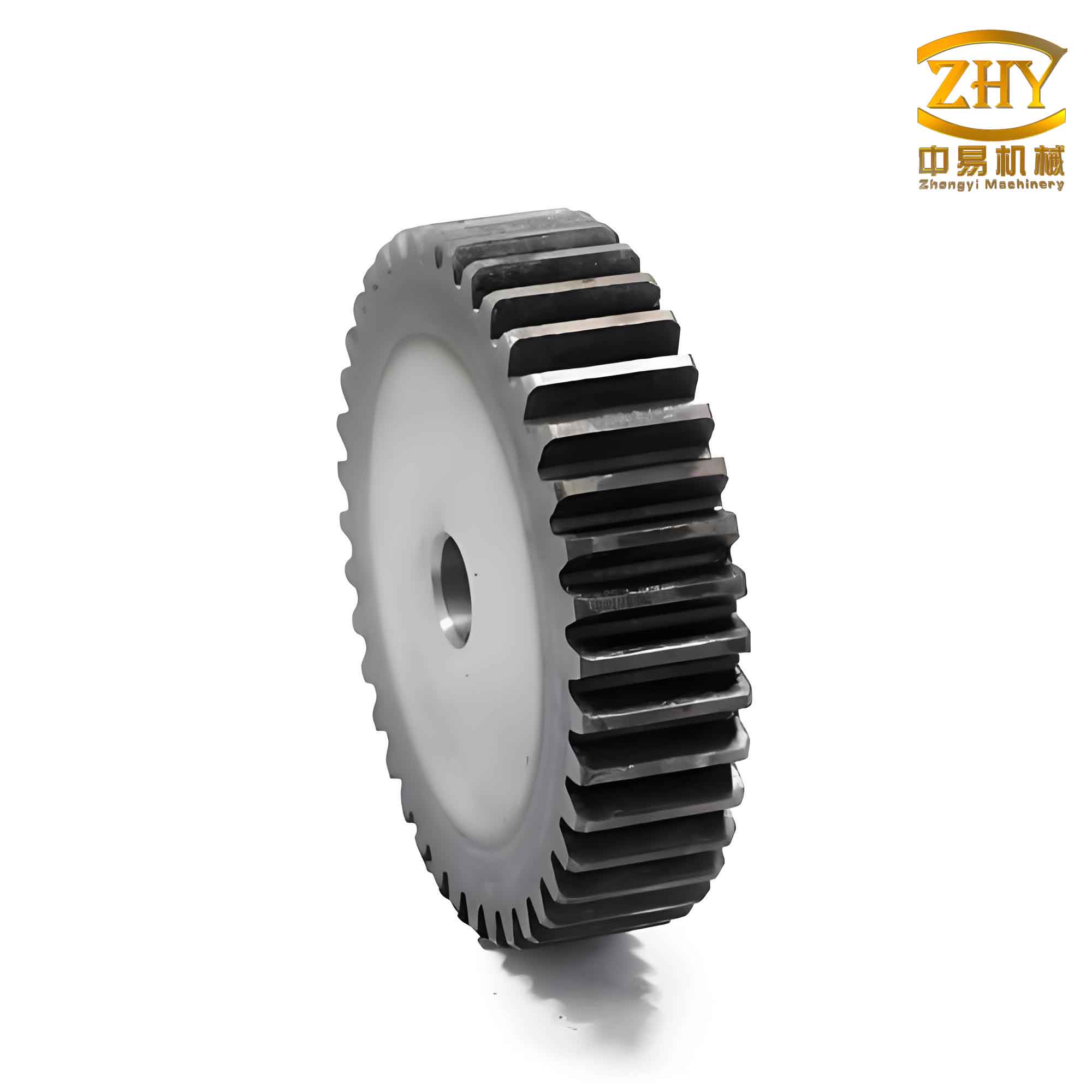
Geometric Modeling and Modification Strategy for the Spur and Pinion
The foundation of any accurate mechanical analysis is a precise geometric model. The standard involute tooth profile for a spur gear is generated from a base circle. The Cartesian coordinates $(x_k, y_k)$ of any point $K$ on the involute curve are given by:
$$
x_k = r_b \sin u_k – r_b u_k \cos u_k
$$
$$
y_k = r_b \cos u_k + r_b u_k \sin u_k
$$
where $r_b$ is the base circle radius and $u_k$ is the parameter representing the sum of the roll angle $\theta_k$ and the pressure angle $\alpha_k$ at point $K$, i.e., $u_k = \theta_k + \alpha_k$.
For this study, a symmetric spur and pinion pair was designed with identical geometry for both driving and driven gears. The key design parameters are summarized in the table below. The material selected for both gears is 40Cr alloy steel, a common choice for high-strength gearing applications due to its favorable mechanical properties.
| Parameter | Symbol | Value | Unit |
|---|---|---|---|
| Number of Teeth | $z_1 = z_2 = z$ | 40 | – |
| Module | $m$ | 2 | mm |
| Pressure Angle | $\alpha$ | 20 | ° |
| Addendum Coefficient | $h_a^*$ | 1.0 | – |
| Dedendum Coefficient | $c^*$ | 0.25 | – |
| Face Width | $b$ | 20 | mm |
| Pitch Diameter | $d = mz$ | 80 | mm |
| Base Circle Diameter | $d_b = d \cos\alpha$ | 75.18 | mm |
| Addendum | $h_a = h_a^* m$ | 2.0 | mm |
| Dedendum | $h_f = (h_a^* + c^*) m$ | 2.5 | mm |
| Tip Diameter | $d_a = d + 2h_a$ | 84 | mm |
| Root Diameter | $d_f = d – 2h_f$ | 75 | mm |
Using these parameters, the three-dimensional solid model of the spur and pinion pair was created in SolidWorks. The involute profile was generated mathematically, extruded, and patterned to form the complete gear geometry. Fillet radii (0.5 mm) were applied at the tooth root to reduce stress concentration in that critical region.
The core of this investigation lies in the application of drum modification. A parabolic curve was chosen for both profile and lead modifications due to its smooth transition. A local coordinate system is established on the tooth surface with its origin $O$ at the intersection of the pitch cylinder and the tooth centerline. The $x$-axis is along the outward tooth surface normal, the $y$-axis is along the profile direction (from root to tip), and the $z$-axis is along the lead direction (across the face width).
The modification amount $\Delta x$ (deviation from the perfect involute surface along the normal direction) is defined by the following parabolic equations:
Profile Modification (along y-axis):
$$
\Delta x = \Delta x_{max,\alpha} \left[ \frac{(y + y_0)}{y_0} \right]^2, \quad -y_0 \leq y \leq h_a
$$
where $\Delta x_{max,\alpha} = C_\alpha$ is the maximum profile modification (at tip and root), $y_0 = h_f – c = 2 \text{ mm}$ defines the symmetric point, $h_f$ is dedendum, $c$ is clearance, and $h_a$ is addendum.
Lead Modification (along z-axis):
$$
\Delta x = \Delta x_{max,\beta} \left[ \frac{z}{z_0} \right]^2, \quad -z_0 \leq z \leq z_0
$$
where $\Delta x_{max,\beta} = C_\beta$ is the maximum lead modification (at gear faces), and $z_0 = b/2 = 10 \text{ mm}$ is half the face width.
To systematically study the influence of modification magnitude, six distinct modification cases were defined, ranging from an unmodified reference case to progressively larger drum modifications. The modification parameters for the spur and pinion set are listed below:
| Modification Case | Max. Profile Mod. $C_\alpha$ (µm) | Max. Lead Mod. $C_\beta$ (µm) |
|---|---|---|
| Mod 1 (Unmodified) | 0 | 0 |
| Mod 2 | 2 | 2 |
| Mod 3 | 4 | 4 |
| Mod 4 | 6 | 6 |
| Mod 5 | 8 | 8 |
| Mod 6 | 10 | 10 |
The modified tooth surfaces were generated in CAD by superimposing these parabolic deviations onto the perfect involute surface, ensuring a smooth, crowned profile on both flanks of each tooth in the spur and pinion.
Finite Element Analysis Methodology: Transient Dynamics and Fatigue
The three-dimensional CAD models of both unmodified and modified spur and pinion pairs were imported into ANSYS for finite element analysis. A high-fidelity transient dynamic analysis was performed to capture the realistic stress history during meshing. The material properties for 40Cr alloy steel were assigned as follows: Density $\rho = 7870 \text{ kg/m}^3$, Young’s Modulus $E = 211 \text{ GPa}$, Poisson’s ratio $\nu = 0.277$, Yield Strength $\sigma_{0.2} = 785 \text{ MPa}$, and Ultimate Tensile Strength $\sigma_b = 980 \text{ MPa}$.
A high-order 10-node tetrahedral (Tet10) element was selected for meshing due to its ability to model complex geometries with good accuracy. A critical step was mesh refinement in the potential contact zones on all tooth flanks to resolve the high stress gradients. The table below shows the resulting mesh statistics for the different spur and pinion models, confirming a consistently high level of discretization.
| Modification Case | Element Type | Number of Elements | Number of Nodes |
|---|---|---|---|
| Mod 1 | Tet10 | 223,961 | 383,685 |
| Mod 2 | Tet10 | 246,221 | 419,235 |
| Mod 3 | Tet10 | 246,458 | 419,563 |
| Mod 4 | Tet10 | 245,773 | 418,609 |
| Mod 5 | Tet10 | 246,392 | 419,390 |
| Mod 6 | Tet10 | 246,660 | 419,513 |
The boundary and loading conditions were set to simulate one complete meshing cycle. Both gears were constrained to rotate only about their central axis (Z-axis). A constant angular velocity of $2 \text{ rad/s}$ was applied to the driving spur gear. A resisting torque of $T = 15000 \text{ N·mm}$ was applied to the driven pinion for the ideal alignment case. For the misalignment cases, this torque was slightly reduced to $14000 \text{ N·mm}$ to ensure numerical convergence under the more severe contact conditions. The contact between all mating tooth flanks was defined as frictional, with a coefficient of $\mu = 0.15$. The transient analysis was solved with a time step of 1 second, divided into multiple sub-steps to accurately capture the stress variations.
Subsequent to the transient dynamic analysis, a fatigue life prediction was performed using the ANSYS Fatigue Tool module. This required the S-N (Stress-Life) curve data for the 40Cr material. The S-N curve characterizes the relationship between the cyclic stress amplitude and the number of cycles to failure. For 40Cr steel, the three-parameter S-N curve model provides a good fit:
$$
N_f = C (\sigma_m – \sigma_{ac})^{-m}
$$
where $N_f$ is the fatigue life (cycles to failure), $\sigma_m$ is the mean stress, $\sigma_{ac}$ is the fatigue limit parameter, and $C$ and $m$ are material constants. Based on experimental data regression, the following S-N equation was used for the spur and pinion fatigue analysis:
$$
N_f = 1.82524 \times 10^{11} (\sigma_m – 250)^{-2.12613}
$$
Here, stress is in MPa. This model was implemented within the fatigue module to predict the service life of the gear teeth based on the stress histories obtained from the transient simulation.
Results and Discussion: Ideal Installation
Under conditions of perfect alignment, the transient contact stress analysis reveals clear trends related to modification. For the unmodified spur and pinion (Mod 1), the contact pattern shows stress distribution across a larger area of the engaged tooth flank and extends to adjacent non-engaged teeth, indicating pronounced meshing interference. The maximum von Mises stress is approximately 107.37 MPa, primarily concentrated near the pitch line and the tooth root.
Introducing a modest drum modification (Mod 2, $C_\alpha = C_\beta = 2 \mu m$) immediately improves the meshing condition. The interference is significantly reduced, and the contact area localizes towards the center of the tooth face. The maximum stress slightly decreases to 103.13 MPa, representing a 3.95% reduction. This demonstrates the primary benefit of light modification: alleviating edge contact and interference to achieve a more favorable load distribution.
As the modification magnitude increases further (Mod 3 to Mod 6), the contact area continues to shrink and becomes more centralized. While this effectively eliminates interference, it also reduces the nominal contact area. Consequently, for most cases, the contact pressure and the resulting maximum von Mises stress begin to rise. For instance, in Mod 3 ($4 \mu m$), the stress increases to 158.35 MPa; in Mod 4 ($6 \mu m$), it reaches 201.54 MPa; and in Mod 6 ($10 \mu m$), it peaks at 247.52 MPa. An exception is observed in Mod 5 ($8 \mu m$), where a larger stressed area at the tooth root leads to a slightly lower maximum stress of 165.8 MPa compared to Mod 4 and Mod 6. This non-monotonic behavior highlights the complex interaction between contact localization and bulk stress distribution in a modified spur and pinion.
The transient contact stress versus time curves further illustrate this dynamic. The unmodified gear exhibits relatively stable, low-amplitude stress fluctuations. With modification, the stress levels and the amplitude of fluctuation generally increase, signifying a more dynamic but localized load transfer. The trade-off becomes evident: modification enhances meshing smoothness by reducing interference but at the cost of increased peak contact stresses.
This trade-off directly impacts the predicted bending fatigue life. The fatigue analysis results under ideal installation are summarized below:
| Modification Case | Max. Modification (µm) | Predicted Fatigue Life (Cycles) |
|---|---|---|
| Mod 1 | 0 | 2.373 × 10⁷ |
| Mod 2 | 2 | 1.994 × 10⁷ |
| Mod 3 | 4 | 6.105 × 10⁶ |
| Mod 4 | 6 | 2.299 × 10⁶ |
| Mod 5 | 8 | 2.551 × 10⁶ |
| Mod 6 | 10 | < 5.0 × 10⁴ |
The trend is clear: under perfect alignment, the unmodified spur and pinion achieves the highest fatigue life. Any amount of modification reduces the life, with the reduction becoming severe for large modification values (e.g., Mod 6). This is because the primary failure driver under ideal conditions is the bending stress at the root. While light modification (Mod 2) slightly reduces maximum stress, it also introduces stress concentration at the center of the face width. For larger modifications, the significant increase in peak contact and bending stress dominates, drastically shortening the life. This finding is crucial: excessive modification intended to improve performance can be detrimental to durability in a perfectly aligned system.
Results and Discussion: Installation with Axis Offset (Misalignment)
Real-world installations often involve some degree of misalignment. This study considered shaft axis offsets of 0.1°, 0.2°, 0.3°, and 0.4°. The impact on an unmodified spur and pinion is severe. For example, with a 0.2° offset, the contact pattern shifts dramatically to one edge of the tooth face, creating a highly localized stress concentration. The maximum von Mises stress soars to 366.98 MPa for the unmodified case, making early failure very likely.
The value of tooth modification becomes unequivocally apparent under these conditions. Even a small modification (Mod 2, $2 \mu m$) begins to counteract the misalignment, pulling the contact zone away from the edge and reducing the maximum stress to 283.79 MPa for the 0.2° offset case. As the modification amount increases, this corrective effect strengthens. For Mod 3 ($4 \mu m$), the stress drops to 168.23 MPa; for Mod 4 ($6 \mu m$) to 176.56 MPa; and for Mod 6 ($10 \mu m$) to 189.94 MPa. The contact area transitions from a distorted edge-loaded patch to a more centralized, regular ellipse.
The following table illustrates the maximum von Mises stress for different modification cases under a 0.2° axis offset, demonstrating the stress-mitigating effect of drum modification on the spur and pinion:
| Modification Case | Max. Modification (µm) | Max. Von Mises Stress at 0.2° Offset (MPa) |
|---|---|---|
| Mod 1 | 0 | 366.98 |
| Mod 2 | 2 | 283.79 |
| Mod 3 | 4 | 168.23 |
| Mod 4 | 6 | 176.56 |
| Mod 5 | 8 | 190.87 |
| Mod 6 | 10 | 189.94 |
The corresponding fatigue life predictions tell a compelling story. For the unmodified gear, fatigue life plummets in the presence of misalignment. However, with sufficient modification, the life can be recovered and even maintained at a high level across a range of misalignments. The results for a 0.2° offset are indicative:
- Mod 1 (0µm): Life is severely compromised (very low).
- Mod 2 (2µm): Life improves but remains sensitive to offset magnitude.
- Mod 3, 4, 5, 6 (4-10µm): These cases show robust fatigue lives, often in the order of $10^7$ cycles, demonstrating insensitivity to the misalignment. The modification effectively “absorbs” the geometric error, recenters the load, and prevents the catastrophic edge-stress concentration that would otherwise cause rapid failure in the spur and pinion set.
This establishes a critical design principle: the optimal modification for a spur and pinion is not a fixed value but is dependent on the expected operating conditions, particularly alignment tolerance. For a precision-aligned system, minimal or no modification might yield the longest life. For systems with anticipated or unavoidable misalignment, a deliberate, sufficiently large drum modification is essential to ensure reliability and achieve the desired service life.
Conclusions
This comprehensive finite element study on drum modification of parallel-axis involute spur gears leads to several key conclusions regarding their contact mechanics and fatigue performance:
- Modification Under Ideal Alignment: For a perfectly aligned spur and pinion, the unmodified design offers the highest predicted bending fatigue life. While light modification (e.g., 2 µm) can reduce meshing interference and slightly lower peak stress, any modification tends to localize stress. With increasing modification magnitude, the contact area shrinks, leading to significantly higher contact pressures and root bending stresses, which in turn drastically reduce fatigue life. Excessive modification (e.g., 10 µm) can be particularly detrimental under ideal conditions.
- Modification Under Shaft Misalignment: In the presence of axis offset, the role of modification is reversed and becomes critically important. An unmodified spur and pinion suffers severe edge loading, resulting in extreme stress concentration and very low fatigue life. Applying drum modification effectively counteracts the misalignment by recentering the contact load on the tooth face. Modification amounts in the range of 4 µm to 10 µm demonstrated excellent robustness, maintaining high fatigue lives across a range of misalignment angles (0.1° to 0.4°) by eliminating destructive edge contact.
- Design Trade-off and Recommendation: The design of a spur and pinion involves a fundamental trade-off controlled by modification. The primary benefit of modification is the improvement of meshing conditions (reduced interference, smoother transmission) and, most importantly, robustness to assembly and operational errors. The cost is a potential increase in localized stress, which can lower the fatigue limit under perfect conditions.
- For applications with high-precision alignment and minimal deflection, minimal or very light modification is recommended to maximize fatigue life.
- For the vast majority of practical applications where some misalignment is expected, a deliberate, moderate level of combined profile and lead drum modification (e.g., 4-8 µm) is essential. This provides the necessary tolerance to geometric imperfections, ensuring even load distribution, preventing premature failure, and ultimately extending the reliable service life of the spur and pinion drive system.
This analysis provides a quantitative framework for selecting modification parameters based on expected alignment conditions and desired performance goals, contributing to the optimized and reliable design of involute spur gear transmissions.