
The reliable operation of mechanical power transmission systems is fundamentally dependent on the integrity of their constituent parts. Among these, gears stand as critical components, with their design and manufacturing quality directly dictating the performance, efficiency, and longevity of the broader machinery. A primary failure mode for gears, especially spur and pinion gears subjected to cyclic loading, is bending fatigue fracture originating at the tooth root. The service life of a gear is inversely proportional to a high power (often cited as the sixth power) of the maximum bending stress it experiences. Consequently, the accurate calculation of tooth root bending strength is not merely an academic exercise but a vital engineering necessity for ensuring durability and preventing catastrophic failures.
Historically, the calculation of gear bending stress relied on analytical formulas derived from strength of materials principles. The seminal work by Lewis, which modeled the gear tooth as a cantilever beam and introduced the concept of a form factor, laid the foundation. The Lewis formula provides a baseline estimate:
$$\sigma_F = \frac{F_t}{b m} Y_F = \frac{6 F_t h \cos\alpha}{b m^2 \cos\alpha}$$
where \(\sigma_F\) is the nominal bending stress, \(F_t\) is the tangential force, \(b\) is the face width, \(m\) is the module, \(Y_F\) is the Lewis form factor, \(h\) is the distance from the force to the critical section, and \(\alpha\) is the pressure angle. Modern standards extend this by incorporating various correction factors (\(K\), \(Y_{Sa}\), etc.) for load distribution, stress concentration, and other effects, yielding formulas like:
$$\sigma_F = \frac{K F_t}{b m} Y_{Fa} Y_{Sa}$$
While instrumental, these analytical methods involve significant simplifications regarding load application and root geometry, leading to approximations that may not capture the true, localized stress state, particularly for complex or highly loaded spur and pinion gears.
The advent of computational numerical methods, primarily the Finite Element Method (FEM), revolutionized gear analysis. FEM allows for the modeling of the precise gear geometry and the application of realistic loads and boundary conditions. By discretizing the gear domain into a mesh of simple elements (e.g., triangles, quadrilaterals), it solves the governing equations of elasticity numerically. This provides a detailed picture of the stress and displacement fields, overcoming many limitations of pure analytical approaches. However, FEM introduces its own set of challenges. The computer-aided design (CAD) model of a spur and pinion gear, defined precisely using splines like NURBS, must be approximated (“meshed”) by piecewise polynomial elements. This process can be time-consuming, error-prone, and often requires extensive user intervention to ensure mesh quality. Furthermore, the standard Lagrangian basis functions used in FEM typically guarantee only C0 continuity (continuous displacement, discontinuous stress) across element boundaries, which can lead to less smooth stress fields, especially with coarse meshes or near geometric features like the tooth root fillet.
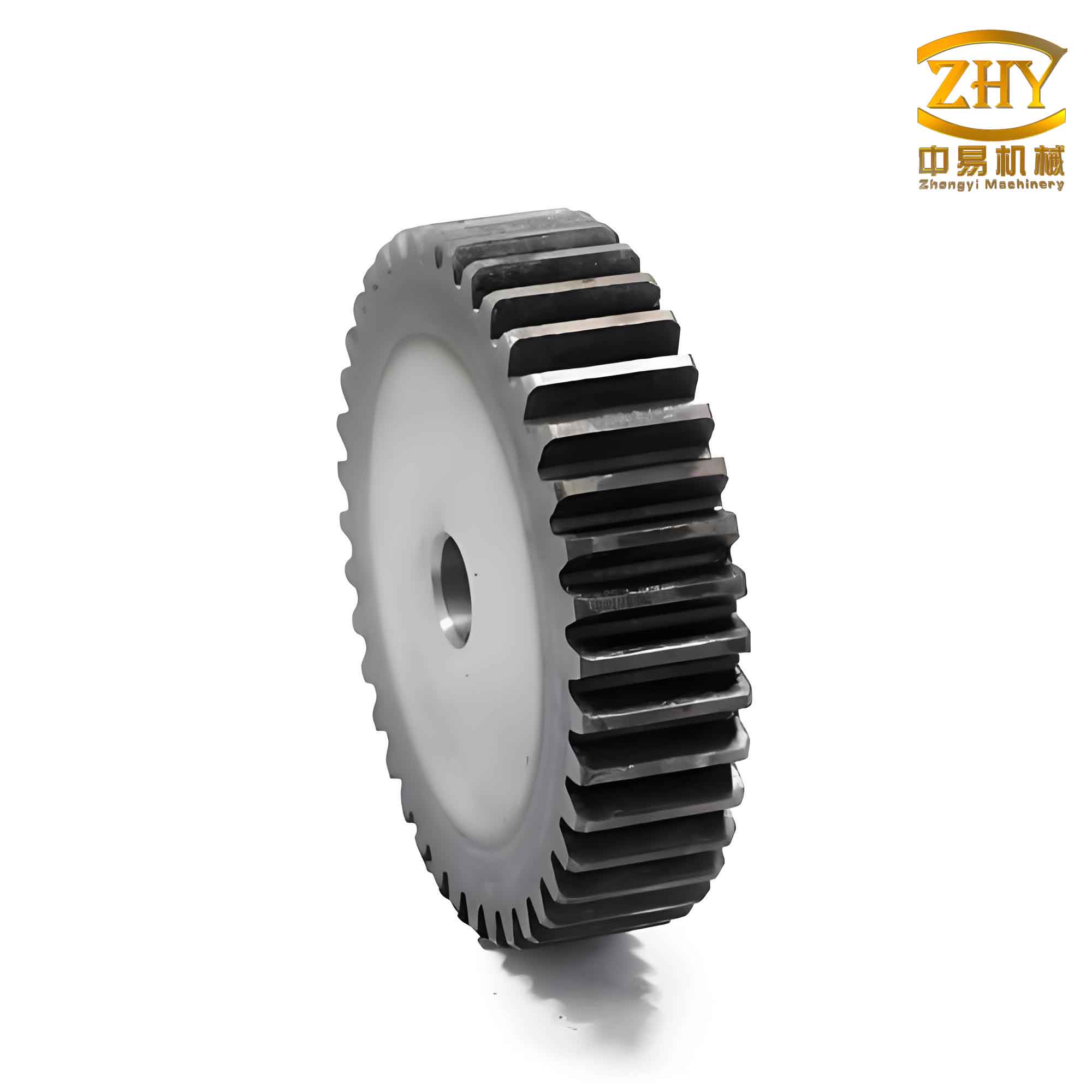
Isogeometric Analysis (IGA), introduced by Hughes et al., presents a paradigm shift by bridging the gap between geometric design and engineering analysis. The core idea of IGA is to use the same basis functions for both representing the geometry and approximating the physical solution fields. For most CAD systems, this means employing Non-Uniform Rational B-Splines (NURBS). A NURBS surface of degree \(p\) in the \(\xi\) direction and degree \(q\) in the \(\eta\) direction is defined by:
$$\mathbf{S}(\xi, \eta) = \sum_{i=1}^{n} \sum_{j=1}^{m} R_{i,j}^{p,q}(\xi, \eta) \mathbf{P}_{i,j}$$
where \(\mathbf{P}_{i,j}\) are the control points, and \(R_{i,j}^{p,q}(\xi, \eta)\) are the rational basis functions:
$$R_{i,j}^{p,q}(\xi, \eta) = \frac{N_{i,p}(\xi) M_{j,q}(\eta) w_{i,j}}{\sum_{\hat{i}=1}^{n} \sum_{\hat{j}=1}^{m} N_{\hat{i},p}(\xi) M_{\hat{j},q}(\eta) w_{\hat{i},\hat{j}}}$$
Here, \(N_{i,p}\) and \(M_{j,q}\) are B-spline basis functions defined on knot vectors \(\Xi\) and \(\mathrm{H}\), and \(w_{i,j}\) are weights. The exact CAD geometry of a spur and pinion gear is inherently described in this form. In IGA, the displacement field \(\mathbf{u}^h\) within this gear is approximated using the same NURBS basis functions:
$$\mathbf{u}^h(\xi, \eta) = \sum_{A=1}^{n_{cp}} R_A(\xi, \eta) \mathbf{d}_A$$
where \(\mathbf{d}_A\) are the control variables (analogous to nodal displacements in FEM) and \(n_{cp}\) is the number of control points. This approach offers profound advantages: it eliminates geometric discretization error, as the analysis is performed directly on the exact model; it facilitates higher-order continuity (Cp-1) which leads to smoother stress results; and it streamlines the design-through-analysis workflow by avoiding the meshing bottleneck. For analyzing the bending strength of spur and pinion gears, IGA allows for a more precise and potentially more efficient evaluation of the critical root stresses.
The fundamental mathematical framework for linear elastostatic analysis, common to both FEM and IGA, is the principle of virtual work. The weak form governing the equilibrium of the gear body \(\Omega\) is:
$$\int_{\Omega} \delta \boldsymbol{\epsilon} : \boldsymbol{\sigma} \, d\Omega = \int_{\Omega} \delta \mathbf{u} \cdot \mathbf{b} \, d\Omega + \int_{\Gamma_t} \delta \mathbf{u} \cdot \mathbf{t} \, d\Gamma$$
where \(\boldsymbol{\epsilon}\) and \(\boldsymbol{\sigma}\) are the strain and stress tensors, \(\mathbf{b}\) is the body force, \(\mathbf{t}\) is the surface traction on boundary \(\Gamma_t\), and \(\delta \mathbf{u}\) is a virtual displacement. For a linear elastic material, \(\boldsymbol{\sigma} = \mathbf{D} \boldsymbol{\epsilon}\), where \(\mathbf{D}\) is the constitutive matrix. Substituting the IGA approximation \(\mathbf{u}^h\) into this formulation leads to a system of linear equations:
$$\mathbf{K} \mathbf{d} = \mathbf{F}$$
Here, \(\mathbf{K}\) is the global stiffness matrix assembled from element contributions:
$$\mathbf{K}_{AB} = \int_{\Omega^e} \mathbf{B}_A^T \mathbf{D} \mathbf{B}_B \, d\Omega$$
where \(\mathbf{B}_A\) is the strain-displacement matrix for control point \(A\), containing derivatives of the NURBS basis functions. \(\mathbf{F}\) is the global force vector. The implementation involves defining the geometry (knot vectors, control points, weights), performing numerical integration over parametric “elements” defined by knot spans, and applying boundary conditions (fixed constraints at the bore, applied forces at the tooth tip). The process for analyzing a spur and pinion gear using IGA can be summarized as follows:
- Acquire the exact NURBS-based CAD model of the spur and pinion gear.
- Define material properties (Young’s modulus \(E\), Poisson’s ratio \(\nu\)).
- Apply boundary conditions (fix all degrees of freedom at the gear’s inner diameter).
- Apply load conditions (distribute the tangential and radial components of the mesh force to control points on the loaded tooth flank or tip).
- Perform numerical integration and assemble the global system \(\mathbf{K} \mathbf{d} = \mathbf{F}\).
- Solve the system for the control point displacements \(\mathbf{d}\).
- Post-process to compute strains and stresses throughout the spur and pinion gear model.
To validate and demonstrate the efficacy of IGA for spur and pinion gear analysis, a comparative study is conducted. A standard spur gear with the following parameters is analyzed:
| Parameter | Symbol | Value | Unit |
|---|---|---|---|
| Module | \(m_n\) | 2 | mm |
| Number of Teeth | \(Z\) | 30 | – |
| Face Width | \(b\) | 15 | mm |
| Pressure Angle | \(\alpha_n\) | 20 | ° |
| Young’s Modulus | \(E\) | 210,000 | MPa |
| Poisson’s Ratio | \(\nu\) | 0.3 | – |
A torque of 30 kN·m is applied, resulting in a tangential force \(F_t\) and a normal force \(F_n\) applied at the tooth tip. Three analysis methods are compared:
- Traditional Analytical Method: Using the modified Lewis formula with factors \(K=1.1\), \(Y_{Fa}=2.52\), \(Y_{Sa}=1.625\).
- Finite Element Analysis: Performed using a commercial code with both linear (4-node) and quadratic (8-node) plane stress elements. Two meshes with different refinement levels are used.
- Isogeometric Analysis: Implemented using quadratic NURBS basis functions directly on the exact gear geometry.
The primary output of interest is the maximum von Mises stress at the tooth root fillet. The results are compiled below:
| Analysis Method | Maximum Root Stress (MPa) | Notes |
|---|---|---|
| Traditional Formula | 150.15 | Based on simplified cantilever model. |
| FEM (Linear Elements, Coarse) | 137.7 | ~9,060 elements. |
| FEM (Quadratic Elements, Fine) | 139.1 | ~18,452 elements. |
| Isogeometric Analysis (Quadratic NURBS) | 141.3 | Exact geometry, no mesh. |
The stress contours from the IGA and the refined FEM are qualitatively similar, showing the stress concentration at the root. However, a key observation is the smoothness of the stress field. The IGA result, leveraging C1-continuous quadratic NURBS, produces a stress distribution that is inherently smoother than the C0-continuous FEM field, even with quadratic elements. This is a direct consequence of using higher-continuity basis functions.
The convergence trend is clear: as the FEM mesh is refined (increasing element count and order), the maximum stress value approaches the IGA result. In essence, the IGA solution can be viewed as a limit case of an infinitely refined, high-order FEM analysis performed on the exact geometry. The traditional formula yields a conservative but less accurate estimate, as it cannot resolve the complex stress state at the root fillet. Another critical metric is computational efficiency, particularly the time spent on model preparation. A significant portion of the FEM workflow is dedicated to mesh generation, a step entirely avoided in IGA.
| Analysis Stage | FEM (Fine Mesh) | IGA | Notes |
|---|---|---|---|
| Geometry Processing / Meshing | 29.9 s | 0 s | IGA uses exact CAD model. |
| Solution Time | 4.3 s | 3.4 s | Similar system size. |
| Total Time | 34.2 s | 3.4 s | IGA offers a ~10x speed-up in pre-processing. |
This stark contrast highlights one of IGA’s major advantages for analyzing components like spur and pinion gears: the dramatic reduction in model preparation overhead. The analysis of spur and pinion gear bending strength using Isogeometric Analysis presents a compelling advancement over traditional methods. IGA successfully unifies design and analysis by employing the exact NURBS geometry from CAD as the computational basis. For the case of a standard spur gear, IGA delivers results that are more precise than simplified analytical formulas and converges to a solution that refined FEM approaches. The inherent high-order continuity of NURBS basis functions yields smoother and potentially more accurate stress fields, which is crucial for fatigue life prediction where stress gradients matter. Most significantly, IGA eliminates the tedious and often problematic mesh generation step, offering substantial gains in workflow efficiency. This is particularly relevant for the design optimization of spur and pinion gears, where numerous analyses are required. While commercial IGA tools are still emerging, the methodology demonstrates clear theoretical and practical benefits. Future work naturally extends to three-dimensional analysis of spur and pinion gears, simulation of dynamic and contact loading conditions, and integration into full-system multi-physics simulations, promising even more powerful capabilities for the engineering of reliable gear transmissions.