
The process of gear meshing is deceptively complex. As a practitioner engaged in the repair and restoration of mechanical drive systems, I often encounter scenarios where damaged spur gears need to be replaced. The challenge is not merely to fabricate a new gear, but to precisely determine its original design parameters to ensure the restored assembly operates with smooth meshing, optimal load-bearing capacity, and minimal noise. This task becomes particularly intricate when dealing with displacement gears, especially those conforming to the American Diametral Pitch system, where the standard module values differ from the more common metric module system.
I recently faced such a challenge with a set of three interconnected spur gears from a valve actuator. The system consisted of a small driving pinion, an intermediate gear, and a large driven gear. The pinion and intermediate gear showed severe wear and excessive backlash, leading to noise and tooth damage during operation, while the mesh between the intermediate and large gear remained in good condition. This disparity signaled that a simple like-for-like replacement based on visual inspection was insufficient. A full parametric analysis was required. The success of the repair hinged on accurate measurement and correct calculation of the original gear specifications. The following account details my systematic approach to this problem, emphasizing the critical steps and analytical decisions involved in mapping and calculating diametral pitch displaced spur gears.
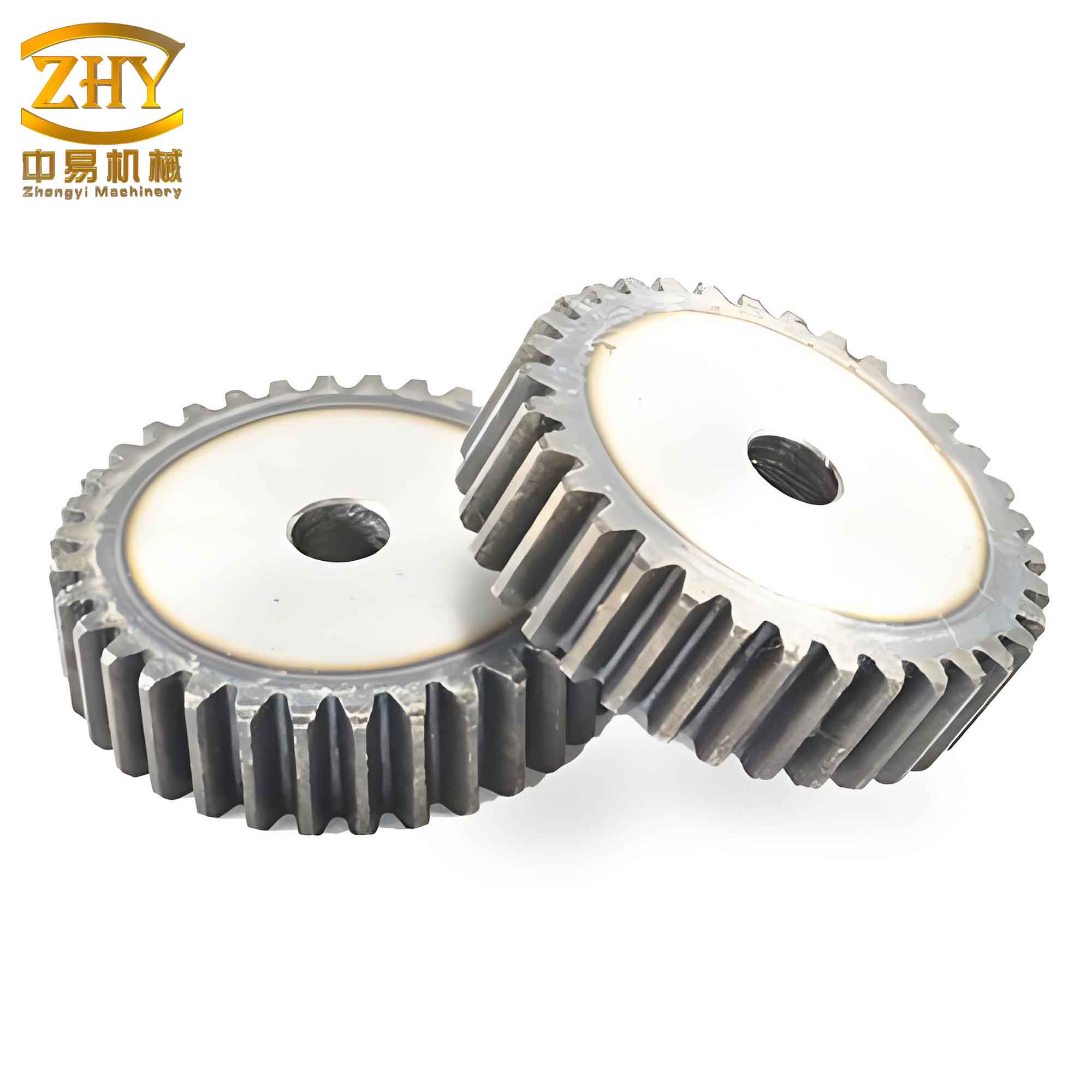
Initial Data Acquisition and Measurement Techniques
The first and most crucial phase is the meticulous collection of physical data from the existing gears. Precision here is paramount, as any significant error will propagate through all subsequent calculations.
Tooth Count (Z)
Counting teeth seems trivial but requires care, especially for gears with high tooth counts. For the pinion and intermediate gear, the counts were straightforward: Z1 = 12 and Z2 = 25. For the large gear with Z3 = 88, I employed a methodical approach: marking the first tooth and then making subsequent marks at every tenth tooth. This systematic counting prevents confusion and ensures accuracy, forming the foundational integer parameter for all geometric calculations related to this spur and pinion set.
Center Distance (A)
The center distance is the distance between the axes of two mating gears. Direct measurement between gear shafts is prone to error due to shaft play and misalignment. A more reliable method is to measure the distance between the bore holes of the gear housing, provided the bores are undamaged. Using precision calipers, I measured the distances between the housing bores. For the pinion and intermediate gear pair, the measured center distance was A_meas1 = 48.84 mm. For the intermediate and large gear pair, it was A_meas2 = 143.56 mm. This indirect measurement provides a more accurate representation of the operating center distance for the spur and pinion assembly.
Tip Diameter (Da)
The tip or addendum circle diameter is sensitive to wear on the tooth flanks but usually remains intact at the very crest. Measurement is simple for even-numbered tooth counts. The pinion (Z1=12) and large gear (Z3=88) both have even teeth, allowing for direct measurement: Da1_meas = 38.24 mm, Da3_meas = 228.48 mm.
For the intermediate gear with an odd tooth count (Z2=25), a direct caliper measurement does not yield the true diameter; it gives the distance from one tooth tip to the groove between two teeth on the opposite side, which is smaller. The true tip diameter is calculated using a correction factor K:
$$ D_a = D_{meas} \times K $$
The factor K depends on the number of teeth. For Z=25, from standard reference tables, K ≈ 1.0020.
Therefore:
$$ D_{a2} = 68.40 \, \text{mm} \times 1.0020 \approx 68.53 \, \text{mm} $$
A reference table for such coefficients is indispensable for accurate spur gear metrology.
| Number of Teeth (Z) | Correction Factor (K) | Number of Teeth (Z) | Correction Factor (K) |
|---|---|---|---|
| 5 | 1.0515 | 17 | 1.0043 |
| 7 | 1.0257 | 19 | 1.0034 |
| 9 | 1.0154 | 21 | 1.0028 |
| 11 | 1.0103 | 23 | 1.0023 |
| 13 | 1.0073 | 25 | 1.0020 |
| 15 | 1.0055 | 27 | 1.0017 |
Base Pitch (Pb) via Span Measurement
Perhaps the most critical measurement is that of the base pitch. The base pitch is the distance between parallel lines tangent to the involute profiles of adjacent teeth on the base circle. It is a fundamental property defined solely by the module (or diametral pitch) and the pressure angle, independent of tooth count or displacement. Therefore, determining it correctly is key to identifying the basic gear parameters of the spur and pinion.
Since a base pitch measuring instrument was not available, I used the span measurement method. The span measurement, or measurement of the common tangent (common normal) length over N teeth, allows for an indirect calculation of the base pitch. The principle is that the difference between the span measurement over N teeth and over (N-1) teeth equals the base pitch.
$$ L_N = (N-1) \cdot P_b + s_b $$
$$ P_b = L_N – L_{N-1} $$
Where \( L_N \) is the span measurement over N teeth and \( s_b \) is the base tooth thickness. The beauty of this method is that the difference cancels out the tooth thickness term, leaving only the base pitch.
Selecting the correct number of teeth to span (N) is vital. The caliper must contact the tooth flanks near the middle of the profile height. An empirical formula is used:
$$ N = \frac{\alpha}{180^\circ} \cdot Z + 0.5 \quad \text{(for standard gears)} $$
Since the pressure angle (α) was unknown at this stage, I iteratively used common values (14.5°, 15°, 20°, 22.5°) to estimate N. For α=20°, the calculated N for the pinion was approximately 2. For accuracy, multiple measurements were taken. However, for the 12-tooth pinion, spanning 2 teeth caused the caliper to contact near the root, and spanning 3 teeth contacted near the tip, both less than ideal. This was the first strong indication that this pinion was not a standard spur gear but likely a significantly displaced (modified) one.
I proceeded with multiple measurements for all three gears to gather data. The following tables summarize the span measurements and the derived base pitch values.
| Measurement # | L3 (mm) | L2 (mm) | Pb1 = L3 – L2 (mm) |
|---|---|---|---|
| 1 | 20.58 | 12.84 | 7.74 |
| 2 | 20.64 | 12.96 | 7.68 |
| 3 | 20.62 | 12.90 | 7.72 |
| 4 | 20.56 | 12.80 | 7.76 |
| 5 | 20.60 | 12.90 | 7.70 |
| Average | 20.60 | 12.88 | 7.72 |
| Measurement # | L4 (mm) | L3 (mm) | Pb2 = L4 – L3 (mm) |
|---|---|---|---|
| 1 | 26.78 | 19.14 | 7.64 |
| 2 | 26.70 | 19.12 | 7.58 |
| 3 | 26.88 | 19.14 | 7.74 |
| 4 | 26.70 | 19.08 | 7.62 |
| 5 | 26.72 | 19.10 | 7.62 |
| Average | 26.756 | 19.116 | 7.640 |
| Measurement # | L10 (mm) | L9 (mm) | Pb3 = L10 – L9 (mm) |
|---|---|---|---|
| 1 | 71.64 | 64.16 | 7.48 |
| 2 | 71.68 | 64.16 | 7.52 |
| 3 | 71.70 | 64.20 | 7.50 |
| 4 | 71.62 | 64.16 | 7.46 |
| 5 | 71.66 | 64.14 | 7.52 |
| Average | 71.66 | 64.164 | 7.496 |
The averaged base pitch values were inconsistent: Pb1=7.72 mm, Pb2=7.64 mm, Pb3=7.50 mm. According to the fundamental law of gear meshing, the base pitch of two mating spur and pinion gears must be identical. The discrepancy indicated measurement difficulties, particularly with the low-tooth-count gears where proper caliper contact was hard to achieve. The large gear, with its high tooth count, offered the most stable and reliable measurement conditions. Its derived base pitch of Pb3 ≈ 7.50 mm was therefore adopted as the most credible value.
The base pitch is calculated theoretically as:
$$ P_b = \pi m \cos \alpha \quad \text{or} \quad P_b = \frac{\pi}{P_d} \cos \alpha $$
Where \( m \) is the module (mm) and \( P_d \) is the diametral pitch (teeth per inch). Consulting a base pitch table for standard pressure angles, the value closest to 7.50 mm is found for:
$$ m = 2.54 \, \text{mm} \, (P_d = 10 \, \text{teeth/inch}) \quad \text{and} \quad \alpha = 20^\circ $$
$$ P_b = \pi \times 2.54 \times \cos(20^\circ) \approx 7.498 \, \text{mm} $$
This was a pivotal discovery. The module 2.54 mm (equivalent to a diametral pitch of 10) is not part of the ISO metric module series but is standard in the American Diametral Pitch system. Thus, the gear set was confirmed to be designed to this standard.
Parametric Calculation and Displacement Analysis
With the tentative basic parameters—Diametral Pitch Pd=10 (m=2.54 mm), pressure angle α=20°—the next step was to perform calculations for a standard gear set and compare them with the measured values. This comparison reveals the nature and extent of any profile displacement.
Standard Gear Calculations
For standard spur gears with no profile shift, the following formulas apply:
$$ \text{Standard Center Distance:} \quad A_{std} = \frac{(Z_1 + Z_2) \cdot m}{2} $$
$$ \text{Tip Diameter:} \quad D_a = (Z + 2h_a^*) \cdot m $$
Where \( h_a^* \) is the addendum coefficient, typically 1.0 for full-depth teeth.
Calculating for the pinion-intermediate pair (Z1=12, Z2=25):
$$ A_{std1} = \frac{(12+25) \times 2.54}{2} = 46.99 \, \text{mm} \quad (\text{vs. measured } A_{meas1}=48.84 \, \text{mm}) $$
$$ D_{a1\_std} = (12 + 2 \times 1.0) \times 2.54 = 35.56 \, \text{mm} \quad (\text{vs. measured } D_{a1}=38.24 \, \text{mm}) $$
$$ D_{a2\_std} = (25 + 2 \times 1.0) \times 2.54 = 68.58 \, \text{mm} \quad (\text{vs. measured } D_{a2}=68.53 \, \text{mm}) $$
The discrepancies for the pinion are significant: both the center distance and the tip diameter are larger than the standard values. This is a clear signature of a positive profile shift (positive addendum modification) applied to the pinion. The intermediate gear’s tip diameter matches the standard calculation almost perfectly, suggesting it is a standard, non-displaced spur gear.
For the intermediate-large pair (Z2=25, Z3=88):
$$ A_{std2} = \frac{(25+88) \times 2.54}{2} = 143.51 \, \text{mm} \quad (\text{vs. measured } A_{meas2}=143.56 \, \text{mm}) $$
$$ D_{a3\_std} = (88 + 2 \times 1.0) \times 2.54 = 228.60 \, \text{mm} \quad (\text{vs. measured } D_{a3}=228.48 \, \text{mm}) $$
The near-perfect match of center distance and tip diameter confirms that the intermediate and large gears form a standard spur gear pair with no displacement. The system thus consists of a displaced pinion meshing with a standard intermediate gear, which in turn meshes with a standard large gear.
Determining Displacement Parameters for the Pinion
The analysis now focuses on the pinion-intermediate gear mesh. For a gear pair with profile shift, the operating pressure angle (mesh angle, α_w) differs from the standard pressure angle (α). It can be derived from the measured center distance using the fundamental equation of involute meshing:
$$ A_{meas} \cos \alpha_w = A_{std} \cos \alpha $$
For the pinion pair:
$$ 48.84 \times \cos \alpha_w = 46.99 \times \cos(20^\circ) $$
$$ \cos \alpha_w \approx 0.9040 \Rightarrow \alpha_w \approx 25.30^\circ \, (25^\circ 18′) $$
This increased operating pressure angle is a direct consequence of the positive displacement increasing the center distance.
The total sum of the profile shift coefficients (x1 + x2) for the pair is calculated using the involute function:
$$ \text{inv}(\alpha) = \tan \alpha – \alpha $$
$$ x_1 + x_2 = \frac{Z_1 + Z_2}{2 \tan \alpha} \left( \text{inv}(\alpha_w) – \text{inv}(\alpha) \right) $$
Using inv(20°) ≈ 0.014904 and inv(25.3°) ≈ 0.032285:
$$ x_{\Sigma} = x_1 + x_2 = \frac{12 + 25}{2 \times \tan(20^\circ)} \times (0.032285 – 0.014904) \approx 0.82 $$
Since the intermediate gear (Z2) is standard, its shift coefficient x2 = 0. Therefore, the pinion’s shift coefficient is:
$$ x_1 \approx 0.82 $$
This large positive shift is expected for a 12-tooth pinion to avoid severe undercutting during generation. The minimum shift to avoid undercutting is approximately:
$$ x_{min} \approx \frac{17 – Z}{17} = \frac{17 – 12}{17} \approx 0.294 $$
Our calculated x1 = 0.82 is well above this, confirming the necessity of a significant displacement for this spur and pinion combination.
We can now separate the total shift into the center distance modification coefficient (y) and the tip shortening coefficient (Δy).
$$ y = \frac{A_{meas} – A_{std}}{m} = \frac{48.84 – 46.99}{2.54} \approx 0.728 $$
$$ \Delta y = x_{\Sigma} – y = 0.82 – 0.728 = 0.092 $$
The coefficient Δy ensures proper backlash and standard radial clearance by slightly reducing the addendum of the shifted gears.
Recalculating Pinion Dimensions
With all coefficients known, the actual dimensions of the displaced pinion can be calculated. Assuming standard addendum coefficient \( h_a^* = 1 \) and tip clearance coefficient \( c^* = 0.25 \):
$$ \text{Addendum:} \quad h_{a1} = (h_a^* + x_1 – \Delta y)m = (1 + 0.82 – 0.092) \times 2.54 \approx 4.39 \, \text{mm} $$
$$ \text{Dedendum:} \quad h_{f1} = (h_a^* + c^* – x_1)m = (1 + 0.25 – 0.82) \times 2.54 \approx 1.09 \, \text{mm} $$
$$ \text{Whole Depth:} \quad h_1 = h_{a1} + h_{f1} \approx 5.48 \, \text{mm} $$
$$ \text{Tip Diameter:} \quad D_{a1\_calc} = m \cdot Z_1 + 2 h_{a1} = (2.54 \times 12) + (2 \times 4.39) \approx 39.26 \, \text{mm} $$
The calculated tip diameter (39.26 mm) is notably larger than the measured value (38.24 mm). This discrepancy required investigation. A check of the tooth tip thickness revealed the cause. For a heavily shifted pinion, the tooth can become pointed. The tip thickness is given by:
$$ s_a = D_a \left( \frac{\pi}{2Z} + \frac{2x \tan \alpha}{Z} + \text{inv} \alpha – \text{inv} \alpha_a \right) $$
Where \( \alpha_a \) is the pressure angle at the tip circle. Calculation showed the theoretical tip thickness was extremely small (~0.44 mm). It is common practice in such cases to slightly reduce the tip diameter by machining to increase the tip thickness for practical strength and to avoid a sharp edge. The measured tip diameter of 38.24 mm likely reflects this post-shift tip trimming, a crucial practical consideration when manufacturing or repairing such a spur and pinion set.
The span measurement for the displaced pinion must also account for the shift. The formula becomes:
$$ L_{N\_actual} = m \cos \alpha \left[ \pi (N – 0.5) + Z \, \text{inv} \alpha \right] + 2 x m \sin \alpha $$
For the pinion, with N=3 (determined iteratively for the shifted profile):
$$ L_{3\_calc} \approx 20.60 \, \text{mm} $$
This closely matches the average measured value of 20.60 mm, providing strong validation for the calculated displacement coefficient.
| Parameter | Symbol | Calculated Value | Measured Value | Notes |
|---|---|---|---|---|
| Diametral Pitch | P_d | 10 [1/in] | – | Derived from Base Pitch |
| Module | m | 2.54 mm | – | m = 25.4 / P_d |
| Pressure Angle | α | 20° | – | Derived from Base Pitch |
| Profile Shift Coefficient | x1 | 0.82 | – | Calculated from Center Distance |
| Tip Diameter | Da1 | 39.26 mm (Theoretical) | 38.24 mm | Difference due to tip trimming |
| Span over 3 teeth | L3 | 20.60 mm | 20.60 mm | Validates shift calculation |
| Operating Pressure Angle | α_w | 25.3° | – | For pinion-intermediate mesh |
Contact Ratio Verification
A critical performance indicator for any spur and pinion mesh is the contact ratio (ε), which must be greater than 1 (typically >1.2 for smooth operation). It is calculated as:
$$ \epsilon = \frac{1}{2\pi} \left[ Z_1 (\tan \alpha_{a1} – \tan \alpha_w) + Z_2 (\tan \alpha_{a2} – \tan \alpha_w) \right] $$
Where \( \alpha_{a1} \) and \( \alpha_{a2} \) are the tip pressure angles of the pinion and gear, respectively. For the calculated dimensions, the contact ratio for the pinion-intermediate pair was approximately 1.26, which is acceptable. I also explored the consequence of adding one tooth to the pinion (Z1=13) to reduce the needed shift. While this lowered the shift coefficient, it also reduced the contact ratio to below 1.0, which is unacceptable. Therefore, the original design with Z1=12 and high positive displacement was validated as the necessary solution for this compact spur and pinion drive.
Establishing Manufacturing Specifications and Tolerances
Determining the basic parameters is only half the task for a successful repair. To manufacture a replacement pinion that functions correctly within the system, its engineering drawing must specify not only dimensions but also the required accuracy. Gear accuracy is generally defined in four aspects, each controlled by specific tolerance parameters.
- Kinematic Accuracy (Single-Flank Accuracy): Ensures the gear transmits motion with minimal angular deviation. Key inspection items are:
- Radial Runout (Fr): The maximum variation in the distance from the tooth space (or a fixed chord) to the gear’s axis of rotation. It controls the eccentricity of the tooth ring relative to the bore.
- Span Measurement Variation (Fw): The difference between the maximum and minimum span measurement over the specified number of teeth on the same gear. It controls tooth spacing uniformity relative to the axis of rotation.
Both Fr and Fw must be controlled to ensure kinematic accuracy, as they address different error sources (bore mounting error and tooth generation error, respectively).
- Running Smoothness (Double-Flank Accuracy): Minimizes vibration and noise from speed variations during tooth engagement. Key items are:
- Profile Form Error (ff): The allowable deviation of the actual involute profile from the theoretical one within the working depth.
- Base Pitch Deviation (fpb): The allowable difference between the actual base pitch and the theoretical base pitch for adjacent teeth.
Controlling both ensures smooth transition of load from one tooth pair to the next in the spur and pinion mesh.
- Contact Pattern: Ensures sufficient area for load transmission across the tooth face width.
- Helix Angle Deviation (Fβ): The allowable deviation of the actual tooth direction (lead) from the theoretical direction across the face width. This ensures proper axial contact.
- Backlash (jn): The intentional clearance between non-working flanks of mating teeth to allow for lubrication, thermal expansion, and prevent binding. It is controlled by the tooth thickness tolerance.
For this valve actuator application, which is manually operated and low-speed, high precision was not the primary driver. Durability and smooth meshing were more important. Therefore, I selected a balanced accuracy grade of 8 for kinematic accuracy and 9 for smoothness and contact, with a standard backlash designation. Consulting relevant tolerance tables (e.g., ISO 1328 or AGMA 2000) yields the following tolerance values for a gear of this size and module:
| Aspect | Grade | Inspection Item | Symbol | Tolerance Value (µm) |
|---|---|---|---|---|
| Kinematic Accuracy | 8 | Radial Runout Tolerance | Fr | 50 |
| Span Measurement Variation | Fw | 30 | ||
| Running Smoothness | 9 | Profile Form Tolerance | ff | 30 |
| Base Pitch Deviation | ±fpb | ±25 | ||
| Contact Pattern | 9 | Helix Angle Deviation | Fβ | 30 |
| Backlash | – | Tooth Thickness Limit | jn | Standard (Dc) |
The material selection for the replacement pinion should consider wear resistance and moderate strength. A common choice for such applications is medium carbon steel like AISI 1045 (or its equivalent), subjected to a quenching and tempering (QT) heat treatment to achieve a bulk hardness in the range of 220-250 HB. This provides a good balance of toughness and wear resistance for the spur and pinion components operating under intermittent manual loads.
Conclusion
The successful mapping and calculation of diametral pitch displaced spur gears is a systematic process that blends precise measurement with analytical geometry. This case study of a three-gear system underscores several critical lessons. First, never assume a gear set is standard; discrepancies between measured and standard center distances or tip diameters are immediate indicators of profile displacement. Second, the base pitch, best measured via span measurement on the gear with the highest tooth count, is the most reliable key to unlocking the fundamental module and pressure angle. Third, for American system gears, one must be conversant with the diametral pitch series. Fourth, large positive displacement is often necessary for low-tooth-count pinions to avoid undercutting, but it must be checked for excessive pointing, which may necessitate tip relief in the final manufacturing step. Finally, defining the gear is not complete without specifying the appropriate accuracy grades and tolerances based on its functional requirements.
By following this structured approach—meticulous data collection, iterative calculation of shift parameters, verification of critical performance metrics like contact ratio, and final specification of manufacturing tolerances—a repair technician or engineer can confidently reverse-engineer and specify replacement components. This ensures that the restored spur and pinion drive will regain its intended performance, characterized by smooth operation, adequate load capacity, and long service life, thereby closing the loop on a complex but manageable mechanical puzzle.