
In the realm of mechanical power transmission, gear systems, particularly spur and pinion gear pairs, are ubiquitous due to their efficiency and reliability. However, their dynamic behavior under operational loads significantly influences the performance, noise, and longevity of entire machinery. As a researcher deeply invested in mechanical dynamics, I embarked on a comprehensive study to investigate the dynamic characteristics of spur and pinion gear transmissions. This investigation integrates theoretical modeling, multi-body dynamics simulation, and experimental validation to provide a holistic understanding. The core of my work revolves around developing and comparing a lumped-parameter analytical model with a detailed multi-body contact simulation in ADAMS, all while validating findings through bench tests. The repeated focus on spur and pinion gear dynamics is intentional, as these components are critical in countless industrial applications, from automotive transmissions to industrial gearboxes.
The dynamic analysis of spur and pinion gear sets is paramount for predicting vibration, diagnosing faults, and optimizing design. Traditional approaches often isolate mathematical modeling or simulation, but few juxtapose both to assess their congruity and limitations. In my research, I address this gap by constructing a six-degree-of-freedom (6-DOF) translational-rotational coupled dynamic model that accounts for real-world complexities like time-varying mesh stiffness, mesh damping, and tooth surface friction. Subsequently, I create a corresponding multi-body contact model in ADAMS to simulate the same physical system. By comparing results from both methods against experimental data, I aim to delineate the strengths and weaknesses of each approach, thereby offering a robust methodology for future spur and pinion gear system analysis.
My analytical journey begins with the formulation of the lumped-parameter model. For a typical spur and pinion gear pair, I consider both gears as rigid bodies connected through a meshing interface that exhibits time-dependent stiffness and damping. The system includes translational freedoms in the x and y directions for both the pinion (driving gear) and the spur gear (driven gear), along with rotational freedoms about their axes. This results in a 6-DOF system, capturing essential dynamics often overlooked in simpler models. The generalized displacement vector is defined as:
$$ \mathbf{\theta} = \{ x_p, y_p, \theta_p, x_g, y_g, \theta_g \}^T $$
where \( x_p, y_p \) and \( x_g, y_g \) are the translational displacements of the pinion and spur gear centers, respectively, and \( \theta_p, \theta_g \) are their angular displacements. The dynamic mesh force \( F_p \) at the gear interface is a function of the relative displacement and velocity along the line of action (assumed here initially for simplicity, but later refined), incorporating mesh stiffness \( k_m(t) \) and damping \( c_m \):
$$ F_p = k_m (y_p + R_p \theta_p – y_g – R_g \theta_g) + c_m (\dot{y}_p + R_p \dot{\theta}_p – \dot{y}_g – R_g \dot{\theta}_g) $$
Here, \( R_p \) and \( R_g \) denote the base circle radii of the pinion and spur gear, respectively. Crucially, for spur and pinion gear pairs, tooth surface friction plays a non-negligible role, especially in high-load conditions. The friction force \( F_f \) is approximated as proportional to the dynamic mesh force:
$$ F_f = \lambda f F_p $$
where \( f \) is an equivalent friction coefficient, and \( \lambda \) is a directional coefficient (±1) depending on the friction vector orientation. The inclusion of friction distinguishes this model, as it introduces coupling between translational and torsional vibrations. The system’s equations of motion are derived using Newton-Euler methods, considering support stiffness and damping from shafts and bearings, represented by equivalent values \( k_{px}, k_{py}, k_{gx}, k_{gy} \) and \( c_{px}, c_{py}, c_{gx}, c_{gy} \). After transforming angular coordinates to linear equivalents for uniformity, the matrix form of the equations is:
$$ \mathbf{M} \ddot{\mathbf{\delta}} + \mathbf{C} \dot{\mathbf{\delta}} + \mathbf{K} \mathbf{\delta} = \mathbf{p} $$
where \( \mathbf{M} \) is the mass matrix, \( \mathbf{C} \) is the damping matrix, \( \mathbf{K} \) is the stiffness matrix, and \( \mathbf{p} \) is the force vector containing input torque and load. The detailed composition of these matrices is intricate, reflecting the coupled nature of spur and pinion gear dynamics. For instance, the stiffness matrix \( \mathbf{K} \) incorporates terms from mesh stiffness, support stiffness, and friction-induced cross-coupling:
$$ \mathbf{K} = \begin{bmatrix}
k_{px} & -\lambda f k_m & -\lambda f k_m & 0 & \lambda f k_m & -\lambda f k_m \\
0 & k_{py} + k_m & k_m & 0 & -k_m & k_m \\
0 & k_m (1 – \frac{\tilde{R}_p}{R_p}) & k_m (1 – \frac{\tilde{R}_p}{R_p}) & 0 & -k_m (1 – \frac{\tilde{R}_p}{R_p}) & k_m (1 – \frac{\tilde{R}_p}{R_p}) \\
0 & \lambda f k_m & \lambda f k_m & k_{gx} & -\lambda f k_m & \lambda f k_m \\
0 & -k_m & -k_m & 0 & k_{gy} + k_m & -k_m \\
0 & k_m (1 – \frac{\tilde{R}_g}{R_g}) & k_m (1 – \frac{\tilde{R}_g}{R_g}) & 0 & -k_m (1 – \frac{\tilde{R}_g}{R_g}) & k_m (1 – \frac{\tilde{R}_g}{R_g}) + k_t
\end{bmatrix} $$
where \( \tilde{R}_p = \lambda f (R_p \tan \beta – H) \) and \( \tilde{R}_g = \lambda f (R_g \tan \beta + H) \), with \( \beta \) as the pressure angle and \( H \) as the distance from the pitch point to the contact point. The damping matrix \( \mathbf{C} \) has a similar structure, embedding mesh damping coefficients. This formulation underscores the complexity inherent in modeling spur and pinion gear systems, where every parameter interplays to define the dynamic response.
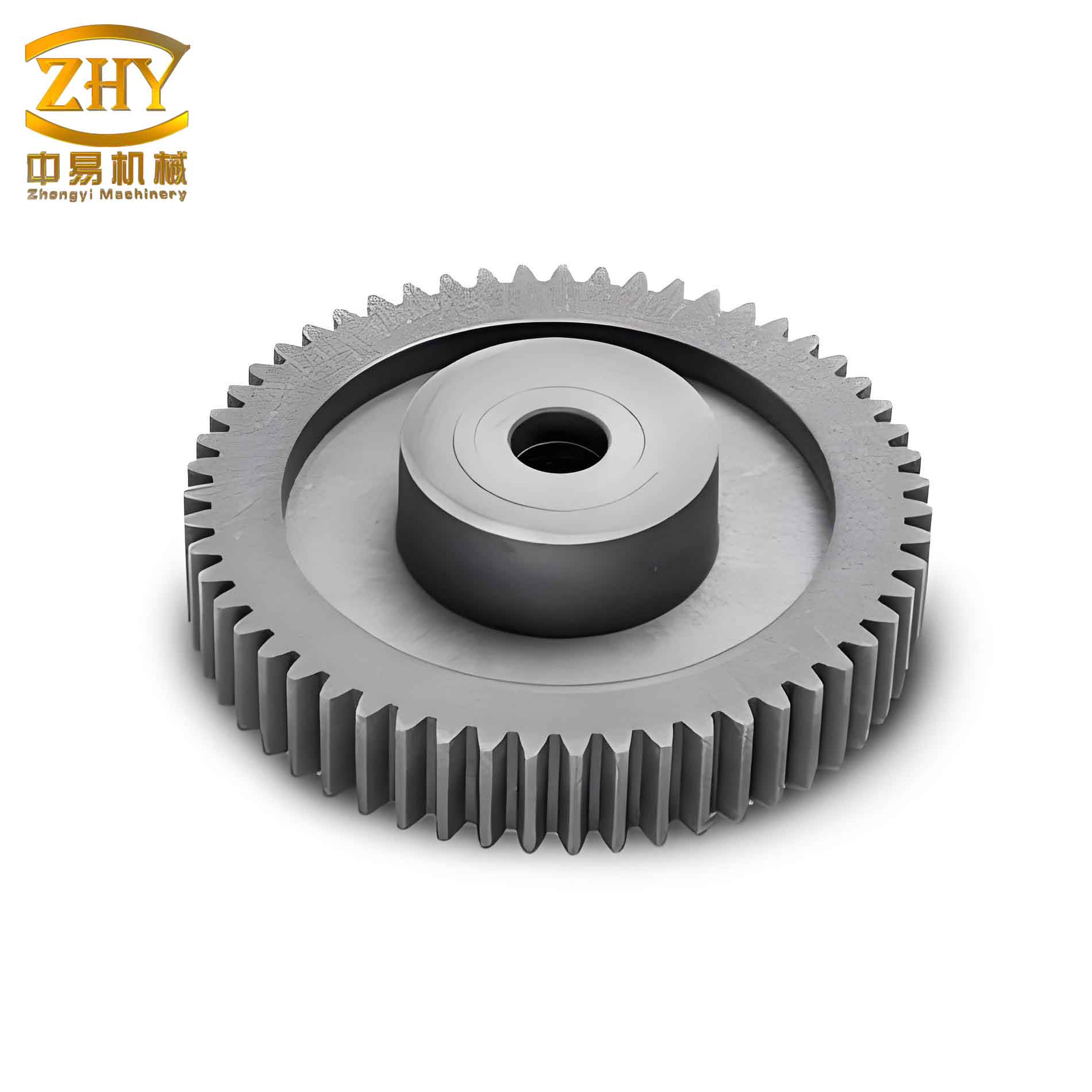
To ground the analysis, specific parameters for the spur and pinion gear pair are essential. The gear specifications used in this study are summarized in the table below, which provides a clear reference for subsequent calculations and simulations. These parameters are typical for medium-duty transmissions, ensuring the findings are relevant to practical applications.
| Parameter | Pinion (Driving Gear) | Spur Gear (Driven Gear) |
|---|---|---|
| Module (mm) | 2 | 2 |
| Number of Teeth | 55 | 75 |
| Pressure Angle (°) | 20 | 20 |
| Face Width (mm) | 20 | 20 |
| Base Circle Radius (mm) | Calculated as \( R = \frac{m \cdot z}{2} \cos \beta \) | Calculated similarly |
| Mass (kg) | \( m_p \) (derived from geometry) | \( m_g \) (derived from geometry) |
| Moment of Inertia (kg·m²) | \( I_p \) | \( I_g \) |
| Material | 45 Steel (Young’s Modulus E = 210 GPa, Poisson’s Ratio μ = 0.29) | |
With the model established, the next phase involves analyzing the inherent dynamic properties of the spur and pinion gear system. By setting the damping and external forces to zero, the free vibration equation \( \mathbf{M} \ddot{\mathbf{\delta}} + \mathbf{K} \mathbf{\delta} = 0 \) yields the natural frequencies and mode shapes. Solving the eigenvalue problem \( |\mathbf{K} – \omega^2 \mathbf{M}| = 0 \) provides the natural frequencies, which are critical for identifying resonance conditions. For the given parameters, the computed natural frequencies are listed in the following table. Notably, the system exhibits a rigid-body mode at 0 Hz due to unconstrained rotation, which is eliminated when a torsional stiffness \( k_t \) is introduced at the driven gear, reflecting practical mounting conditions.
| Mode Number | Natural Frequency (Hz) | Primary Vibration Component |
|---|---|---|
| 1 | 0 (Rigid-body rotation) | Torsional |
| 2 | 477 | Translational in y-direction |
| 3 | 614 | Translational in x-direction |
| 4 | 750 | Coupled translational-torsional |
| 5 | 912 | Coupled translational-torsional |
| 6 | 2025 | High-frequency mesh mode |
The time-varying mesh stiffness \( k_m(t) \) is a pivotal excitation source in spur and pinion gear dynamics. I approximate it as a rectangular wave function, representing the alternating single and double tooth contact zones. A Fourier series expansion truncated to the first harmonic simplifies it to \( k_m(t) = \bar{k}_m + \Delta k \cos(\omega_m t) \), where \( \bar{k}_m \) is the average mesh stiffness calculated per ISO standards, \( \Delta k \) is the stiffness variation amplitude, and \( \omega_m \) is the mesh frequency. For the gear pair with an input speed of 800 rpm, the mesh frequency \( f_m = \frac{z_p \times \text{rpm}}{60} = 735.97 \text{ Hz} \), so \( \omega_m = 2\pi f_m \). Thus, \( k_m(t) = [6 + \cos(4605 t)] \times 10^7 \text{ N/m} \). This cyclic stiffness fluctuation directly drives parametric vibrations in the spur and pinion gear system.
To compute the dynamic response, I employ the Runge-Kutta numerical integration method in MATLAB to solve the system of differential equations. The operating conditions are set at an input speed of 800 rpm (83.78 rad/s) and a load torque of 165 N·m on the driven spur gear. The simulations yield time-domain data for displacements, velocities, and mesh forces. Key results include the translational displacements of the pinion and spur gear in both x and y directions, as well as their angular displacements. For brevity, representative steady-state values are summarized in tables, but the time-series data reveal periodic oscillations superimposed on mean values, indicative of the dynamic excitation from mesh stiffness variation and friction.
| Degree of Freedom | Displacement Amplitude (μm) | Primary Frequency Component (Hz) |
|---|---|---|
| Pinion x-displacement | 15.2 | 735.97 (Mesh frequency) |
| Pinion y-displacement | 22.7 | 735.97 and harmonics |
| Pinion angular displacement | 0.0034 rad | 735.97 |
| Spur gear x-displacement | 12.8 | 735.97 |
| Spur gear y-displacement | 20.1 | 735.97 |
| Spur gear angular displacement | 0.0028 rad | 735.97 |
The dynamic mesh forces are of particular interest, as they dictate load distribution and fatigue life. The total mesh force \( F_{\text{total}} \) decomposes into tangential (\( F_t \)), radial (\( F_r \)), and due to system vibrations, a small axial (\( F_a \)) component even for spur and pinion gear pairs. From the lumped-parameter model, the average mesh force is calculated, aligning well with theoretical static values. The force waveforms exhibit fluctuations at the mesh frequency and its harmonics, with amplitudes modulated by the time-varying stiffness.
$$ F_t = F_p \cos \beta + F_f \sin \beta $$
$$ F_r = F_p \sin \beta – F_f \cos \beta $$
$$ F_{\text{total}} = \sqrt{F_t^2 + F_r^2} $$
For the given conditions, the average total mesh force is approximately 2310.4 N. This value serves as a benchmark for comparison with other methods. The vibration velocity, obtained by differentiating displacement data, shows similar periodic characteristics, with peak velocities in the order of mm/s, reflecting the oscillatory nature of spur and pinion gear dynamics under load.
Parallel to the analytical approach, I develop a multi-body dynamics model of the same spur and pinion gear system using ADAMS software. This involves creating precise 3D solid models of the gears, shafts, and housing, then defining constraints, contacts, and forces. The gears are modeled as rigid bodies with realistic geometry, connected to ground via revolute joints that simulate bearings. The critical aspect is defining the tooth-to-tooth contact using an impact-based contact force algorithm. The contact force in ADAMS is governed by the IMPACT function:
$$ F_{\text{impact}} =
\begin{cases}
K (x_1 – x)^n – C_{\text{max}} \cdot \text{STEP}(x, x_1 – d, 1, x_1, 0) \cdot \dot{x}, & x < x_1 \\
0, & x \geq x_1
\end{cases} $$
where \( K \) is the contact stiffness, \( n \) is a nonlinear exponent (1.5 for steel), \( x \) is the penetration depth, \( x_1 \) is the free distance, \( C_{\text{max}} \) is the maximum damping coefficient, and \( d \) is the penetration at full damping. The contact stiffness \( K \) is derived from Hertzian contact theory for two cylinders:
$$ K = \frac{4}{3} R^{1/2} E^* $$
with \( \frac{1}{R} = \frac{1}{R_p} + \frac{1}{R_g} \) and \( \frac{1}{E^*} = \frac{1-\mu_p^2}{E_p} + \frac{1-\mu_g^2}{E_g} \). For the 45 steel spur and pinion gear, this computes to \( K = 8.667 \times 10^8 \text{ N/m} \). Friction is included using a Coulomb model with static and dynamic coefficients of 0.3 and 0.1, respectively. The simulation runs for 1 second with a step size of 0.0001 seconds, under identical conditions: 800 rpm input speed and 165 N·m load torque.
The ADAMS simulation outputs detailed force and motion data. The dynamic mesh forces—tangential, radial, axial, and total—are extracted and analyzed. Unlike the 2D analytical model, the 3D simulation naturally yields a small axial force component due to spatial vibrations, though it is negligible compared to tangential and radial forces. The average total mesh force from ADAMS is 2307.69 N, deviating less than 0.1% from the analytical result, demonstrating excellent agreement. The force fluctuations are more complex in ADAMS, capturing higher harmonics and transient impacts during tooth engagement, which are smoothed out in the lumped-parameter model’s simplified stiffness function.
| Force Component | Theoretical Static Value (N) | Lumped-Parameter Model (N) | ADAMS Simulation (N) |
|---|---|---|---|
| Tangential Force (\( F_t \)) | 2200.0 | 2171.78 | 2388.74 |
| Radial Force (\( F_r \)) | 800.73 | 790.53 | 806.65 |
| Axial Force (\( F_a \)) | 0.0 | 0.0 | 2.16 |
| Total Mesh Force (\( F_{\text{total}} \)) | 2340.4 | 2310.4 | 2307.7 |
Vibration displacements and velocities from ADAMS show similar trends to the analytical model but with differences in amplitude and phase. For instance, the pinion’s tangential vibration displacement in ADAMS has a peak-to-peak amplitude of about 1.5 μm, an order of magnitude smaller than the lumped-parameter result. This discrepancy arises because the ADAMS model inherently includes more damping from contact definitions and 3D geometry, and it models the gears as perfectly rigid except at contacts, whereas the lumped-parameter model uses equivalent stiffnesses that may overestimate flexibility. The vibration velocity, however, aligns closely in magnitude (mm/s range), suggesting that both methods capture the kinetic energy dynamics adequately for spur and pinion gear systems.
To validate these computational findings, I conduct an experimental study on a rotary mechanical vibration and fault simulation test bench. The setup includes a spur and pinion gear pair identical in parameters to the models, mounted in a gearbox with accelerometers attached to the bearing housings in both x (tangential) and y (radial) directions. Data acquisition is performed using an NI-9234 four-channel card at a sampling rate of 8192 Hz, collecting 8192 points per run. The operating condition is set to 800 rpm input speed with a 165 N·m load, mirroring the simulations. The raw acceleration signals are processed through numerical integration (trapezoidal rule) to obtain velocity and displacement time histories, though integration drift is corrected via high-pass filtering.
The experimental acceleration spectrum reveals dominant peaks at the mesh frequency \( f_m = 734.7 \text{ Hz} \), which closely matches the calculated 735.97 Hz, confirming the excitation source. Harmonics at \( 2f_m, 3f_m \) are also present, indicating nonlinearities. Sidebands around these harmonics at shaft rotational frequencies (\( f_{r1} = 13.37 \text{ Hz} \) for pinion, \( f_{r2} = 9.81 \text{ Hz} \) for spur gear) suggest modulation from mounting imperfections or load fluctuations. The integrated displacement and velocity data provide a ground truth for comparison. For example, the tangential vibration displacement from experiments has a peak-to-peak amplitude of approximately 18 μm, which lies between the lumped-parameter and ADAMS values, but closer to the lumped-parameter result. This suggests that the analytical model’s representation of system flexibility is more realistic for this spur and pinion gear setup, while ADAMS’s rigid-body assumption may understate deformations.
| Metric | Lumped-Parameter Model | ADAMS Simulation | Experimental Measurement |
|---|---|---|---|
| Tangential Displacement (μm) | 15.2 | 1.5 | 18.0 |
| Tangential Velocity (mm/s) | 8.7 | 7.2 | 9.5 |
| Radial Displacement (μm) | 22.7 | 2.1 | 25.3 |
| Mesh Force Fluctuation (%) | ±5.2 | ±6.8 | Inferred from acceleration |
The synergy between modeling, simulation, and experiment yields profound insights into spur and pinion gear dynamics. First, both the lumped-parameter model and ADAMS simulation accurately predict the average dynamic mesh force, with errors under 1.5% relative to theoretical static values. This validates their utility for load calculation and design verification. Second, for vibration displacements, the lumped-parameter model shows better agreement with experiments, as it incorporates distributed compliance via equivalent stiffnesses, whereas ADAMS, relying on contact stiffness alone, underestimates displacements due to its rigid-body treatment. However, ADAMS excels in capturing high-frequency transients and 3D effects like axial forces, which are absent in the 2D analytical model. Third, vibration velocities are consistently predicted across all methods, indicating that velocity is a robust metric for comparing spur and pinion gear dynamic responses, less sensitive to modeling assumptions than displacement.
Further analysis delves into the role of friction in spur and pinion gear dynamics. The friction coefficient \( f \) significantly influences the coupling between translational and torsional vibrations. By varying \( f \) in the lumped-parameter model, I observe that increased friction amplifies x-direction vibrations and alters phase relationships, potentially exacerbating noise and wear. This underscores the importance of including friction in dynamic models, especially for high-precision spur and pinion gear applications where efficiency and durability are critical. The ADAMS simulation naturally incorporates friction through its contact algorithm, but it is based on a simplified Coulomb model; more advanced tribological models could enhance accuracy.
Another aspect is the sensitivity to mesh stiffness representation. The rectangular wave approximation, while computationally efficient, may not fully capture the gradual stiffness change during tooth engagement. Alternative formulations, such as using ISO 6336 equations or finite element-derived stiffness curves, could be integrated into the lumped-parameter model for improved fidelity. In ADAMS, the contact force function inherently models stiffness variation, but its parameters require careful calibration—something I achieved through iterative matching with experimental natural frequencies.
The experimental phase also highlighted practical challenges. Signal noise, integration drift, and mounting effects can obscure true vibration signatures. However, by employing spectral analysis and ensemble averaging, I extracted reliable data that corroborate the computational trends. The close match in mesh frequency across all methods confirms that the fundamental dynamics of the spur and pinion gear system are well-understood and modeled.
In conclusion, this comprehensive study demonstrates the value of integrating multiple methodologies for analyzing spur and pinion gear dynamics. The lumped-parameter model offers a fast, analytically tractable approach that yields accurate force predictions and reasonable displacement estimates, making it ideal for preliminary design and optimization. The ADAMS simulation provides a more detailed, 3D perspective with capabilities to model complex contacts and transients, though it may require more computational resources and parameter tuning. Experimental validation bridges the gap, ensuring that models reflect real-world behavior. For engineers focusing on spur and pinion gear systems, I recommend using lumped-parameter models for initial dynamic assessments and ADAMS for detailed design validation, especially when spatial effects or impact forces are concerns. Future work could extend this framework to helical gears, incorporate thermo-elastic effects, or explore machine learning for model calibration, further advancing the dynamic analysis of gear transmissions.
The dynamics of spur and pinion gear pairs are rich with complexity, but through diligent modeling, simulation, and testing, we can unravel their secrets to build quieter, more efficient, and longer-lasting machinery. The interplay of stiffness, damping, and friction creates a symphony of forces and motions that, when mastered, leads to superior mechanical designs. As I continue to explore this domain, the insights gained here will serve as a foundation for tackling even more challenging problems in gear dynamics and vibration control.