
As fundamental transmission components, gears significantly influence the quality and performance of mechanical products. The precise calculation and analysis of gear loading are paramount for their optimization, directly contributing to improved transmission performance, reduced vibration and noise, and enhanced meshing characteristics. Traditional methods for checking gear contact and bending stress, based on classical mechanics, often suffer from being time-consuming and computationally intensive. This study explores the stress state of meshing gears using the finite element analysis (FEA) software ABAQUS. A simplified five-tooth model is established, and the simulation results are referenced against the classical Hertzian contact model. The influence of key parameters, namely the friction coefficient and the radial extension distance of the tooth root fillet, on the stress results is systematically analyzed to provide a theoretical basis for the optimal design of spur and pinion gear systems.
The geometry of an involute spur and pinion gear is defined by a standard set of parameters. The involute profile ensures conjugate action with a constant velocity ratio. The fundamental geometric relationships for a standard spur and pinion gear are governed by the following equations, where the pinion is typically the smaller driving gear.
The base circle diameter is given by:
$$d_b = d \cdot \cos(\alpha)$$
where \(d\) is the pitch circle diameter and \(\alpha\) is the pressure angle.
The addendum (outside) diameter is:
$$d_a = d + 2h_a$$
where \(h_a\) is the addendum, usually equal to the module \(m\).
The dedendum (root) diameter is:
$$d_f = d – 2h_f$$
where \(h_f\) is the dedendum, typically \(1.25m\).
The center distance between the spur and pinion gear is:
$$a = \frac{d_1 + d_2}{2} = \frac{m(Z_1 + Z_2)}{2}$$
where \(Z_1\) and \(Z_2\) are the number of teeth on the pinion and gear, respectively.
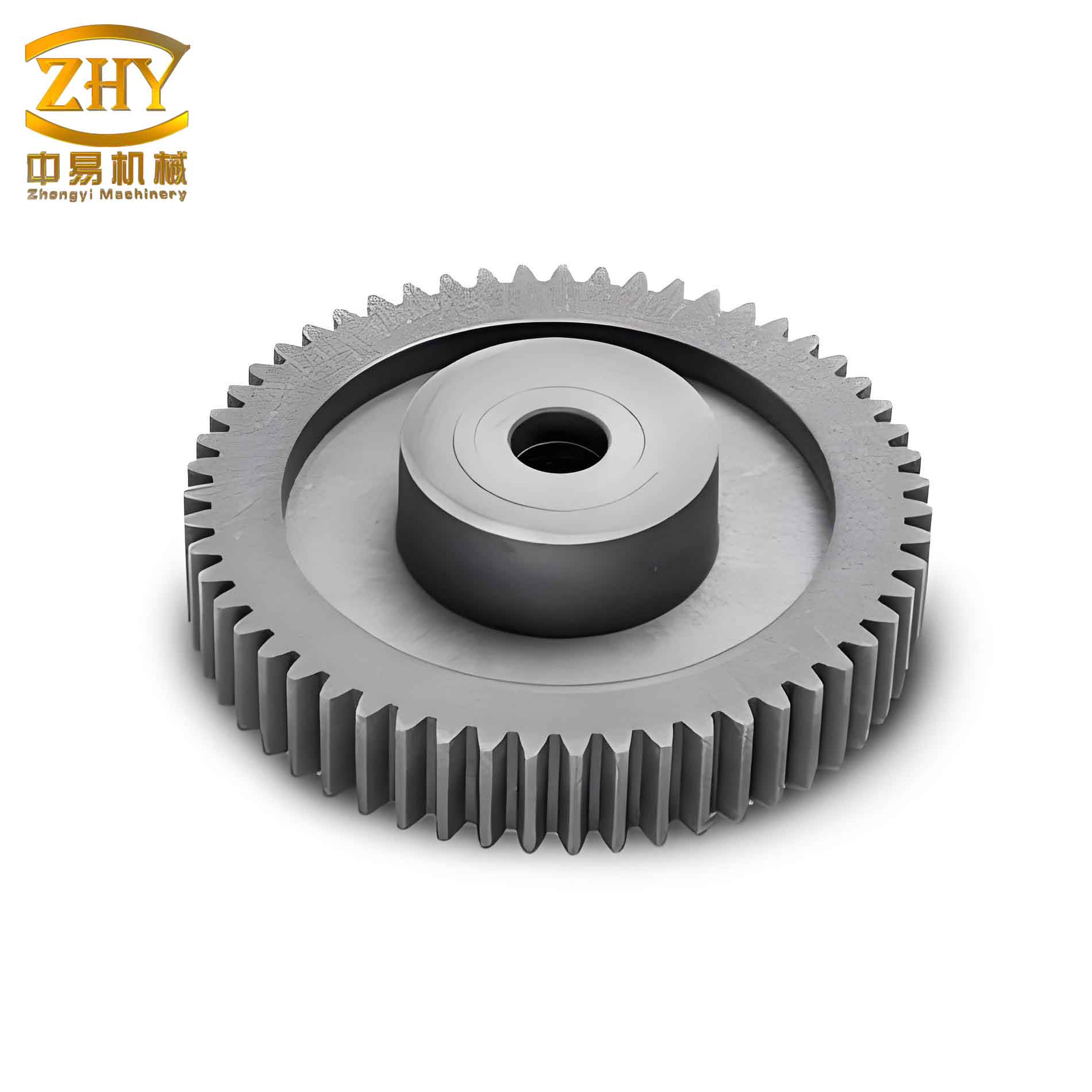
Contact between mating gear teeth is fundamentally a non-conformal contact problem. The classical approach for estimating the maximum contact pressure between two elastic cylinders, which approximates the contact between gear teeth, is provided by Hertzian contact theory. For two parallel cylinders of length \(L\), the half-width \(b\) of the contact area and the maximum contact pressure \(p_0\) are given by:
$$b = \sqrt{\frac{4F}{\pi L} \cdot \frac{\frac{1-\nu_1^2}{E_1} + \frac{1-\nu_2^2}{E_2}}{\frac{1}{R_1} + \frac{1}{R_2}}}$$
$$p_0 = \frac{2F}{\pi b L}$$
where \(F\) is the normal load, \(E\) is Young’s modulus, \(\nu\) is Poisson’s ratio, and \(R\) is the radius of curvature. For a spur and pinion gear pair, the radii of curvature at the pitch point are \(R_1 = (d_1/2)\sin\alpha\) and \(R_2 = (d_2/2)\sin\alpha\).
In practical gear design, the Hertzian stress formula is adapted and augmented with several correction factors to account for gear geometry, shared load among multiple teeth, and material properties. The standard formula for contact stress \(\sigma_H\) is:
$$\sigma_H = Z_H \cdot Z_E \cdot Z_\varepsilon \cdot \sqrt{ \frac{K F_t}{b d_1} \cdot \frac{u+1}{u} }$$
where:
\(Z_H\) is the zone factor,
\(Z_E\) is the elasticity factor,
\(Z_\varepsilon\) is the contact ratio factor,
\(K\) is the application factor,
\(F_t\) is the nominal tangential load at the reference circle,
\(b\) is the face width,
\(d_1\) is the pinion reference diameter,
\(u\) is the gear ratio \(Z_2/Z_1\).
The parameters for the specific spur and pinion gear model analyzed in this study, which are based on referenced literature, are summarized in the table below. The traditional calculation using the adapted Hertz formula yields a maximum contact stress of approximately 1029 MPa.
| Parameter | Value |
|---|---|
| Young’s Modulus, E (GPa) | 206 |
| Poisson’s Ratio, ν | 0.3 |
| Module, m (mm) | 2 |
| Number of Teeth (Pinion), Z1 | 25 |
| Number of Teeth (Gear), Z2 | 83 |
| Face Width, b (mm) | 17 |
| Pressure Angle, α (°) | 20 |
| Driving Torque on Pinion (N·mm) | 95000 |
| Meshing Type | External |
| Symbol | Parameter | Value |
|---|---|---|
| K | Load Factor | 1.2 |
| Z_H | Zone Factor | 2.5 |
| Z_E | Elasticity Factor (MPa½) | 189.8 |
| Z_ε | Contact Ratio Factor | 0.872 |
| b | Face Width (mm) | 17 |
| d1 | Pinion Pitch Diameter (mm) | 50 |
| u | Gear Ratio (Z2/Z1) | 3.32 |
| F_t | Tangential Force (N) | 3800 |
To perform an efficient yet accurate finite element analysis of the spur and pinion gear, a simplified model strategy is employed. Research indicates that the stress field is localized. The circumferential influence spans approximately three teeth, and the radial influence extends about 2 to 3 times the module (m) from the tooth root. Therefore, a five-tooth segment model is created for both the pinion and the gear. The geometry is truncated radially inward from the tooth root circle by a distance δ0 to form the inner boundary of the model. The initial analysis uses δ0 = 2.5m (5 mm), which aligns with handbook recommendations for such a spur and pinion gear. This simplification drastically reduces the model size and computational time while maintaining result accuracy in the critical tooth contact and root regions.
The material is defined as linear elastic with properties listed in Table 1. A crucial step is defining the interaction between the tooth flanks of the pinion and gear. A surface-to-surface contact pair is established. The contact normal behavior is defined as “Hard” contact, allowing separation after contact. The tangential behavior is defined using the penalty friction formulation with a specified coefficient of friction μ, which is varied in a parameter study. A master-slave algorithm is assigned, typically with the finer-meshed or smaller surface as the slave. For the quasi-static analysis, a rotational displacement (corresponding to the driving torque) is applied to the pinion’s reference point, which is coupled to its inner hole. The gear’s reference point is constrained in all rotational degrees of freedom. The inner cylindrical surfaces of both gear segments are constrained using encastre (fixed) boundary conditions, assuming rigidity compared to the teeth.
The mesh is a critical factor for stress convergence, especially in contact problems. A fine, structured mesh is generated in the contact region and the tooth root fillet. The element type used is C3D8R (an 8-node linear brick, reduced integration, hourglass control), which provides a good balance of accuracy and efficiency for contact analyses. A mesh sensitivity study should be conducted to ensure the results are independent of further mesh refinement. The analysis step is a static, general step with nonlinear geometry (NLGeom) activated to account for changes in contact area.
The finite element analysis provides a comprehensive stress distribution that is difficult to obtain analytically. For the quasi-static analysis of the spur and pinion gear model with a friction coefficient μ=0.1, the maximum contact stress is found to be approximately 1209 MPa. This value is about 17% higher than the 1029 MPa predicted by the simplified traditional formula. The location of maximum contact stress is near the transition region between the active involute profile and the root fillet, which corresponds to the point where single pair tooth contact often occurs and the radius of curvature is relatively small. The stress contour clearly shows the elliptical pressure distribution characteristic of Hertzian contact, but modified by the complex gear tooth geometry. The bending stress at the tooth root is also obtained simultaneously, with a maximum value identified at the critical fillet section.
Friction at the contacting tooth flanks of a spur and pinion gear, though often neglected in simplified models, can influence the stress state. The contact is no longer pure rolling but involves sliding, especially away from the pitch point. To investigate this effect, five different friction coefficients (μ = 0, 0.05, 0.07, 0.10, 0.15) were analyzed. The results indicate that the friction coefficient has a noticeable but not dramatic effect on the maximum contact stress for this spur and pinion gear configuration under static loading. The stress increases monotonically with increasing friction.
| Friction Coefficient, μ | Maximum Contact Stress, σ_H (MPa) |
|---|---|
| 0.00 | 1040 |
| 0.05 | 1048 |
| 0.07 | 1050 |
| 0.10 | 1050 |
| 0.15 | 1055 |
The increase is more pronounced when friction is introduced from a zero-friction state. The primary mechanism is that friction introduces shear tractions on the contact surface, which superimpose on the normal Hertzian pressure, slightly altering the subsurface stress field and the location of the maximum equivalent (von Mises) stress. For the design of a robust spur and pinion gear system, considering a reasonable friction coefficient (e.g., 0.05-0.15 for lubricated steel contacts) is advisable for a more conservative stress estimate.
The radial distance δ0, by which the model is truncated inward from the tooth root circle, represents the boundary condition for the tooth cantilever. An insufficient δ0 can artificially constrain the tooth’s bending deformation, leading to an underestimation of root stress (stress stiffening). Conversely, an excessively large δ0 unnecessarily increases model size. Five different values of δ0 (1m, 1.5m, 2m, 2.5m, 3m) were simulated to study their effect on the maximum bending stress at the tooth root of the pinion in the spur and pinion gear pair.
The results show a clear trend: the calculated maximum bending stress increases significantly as δ0 increases from 1m to 2.5m. This is because a larger δ0 allows the tooth to bend more freely, better reflecting the actual deformation state. The rate of increase diminishes as δ0 grows. The difference in stress between δ0 = 2.5m and δ0 = 3m is very small (less than 1%), indicating that the solution has converged with respect to this parameter. This convergence validates the choice of δ0 = 2.5m for accurate bending stress analysis in this spur and pinion gear.
| Radial Extension Distance, δ0 | Maximum Bending Stress, σ_b (MPa) |
|---|---|
| 1 m | 353 |
| 1.5 m | 402 |
| 2 m | 430 |
| 2.5 m | 458 |
| 3 m | 462 |
The bending stress at the root of a spur and pinion gear tooth can be estimated using the Lewis formula, which models the tooth as a cantilever beam:
$$\sigma_b = \frac{F_t}{b m Y}$$
where \(Y\) is the Lewis form factor, which depends on the tooth shape and the point of load application. The FEA provides a more accurate distribution, showing stress concentration at the root fillet which the Lewis formula approximates with the form factor.
This study demonstrates the effectiveness of finite element analysis using ABAQUS for the comprehensive static stress evaluation of involute spur and pinion gear systems. The FEA results provide detailed insights beyond traditional analytical methods. The maximum contact stress from FEA was found to be higher than that calculated by the standardized Hertz-based formula, highlighting the value of FEA for accurate, localized stress prediction in critical regions of the spur and pinion gear.
The parameter studies yield two key conclusions for modeling and designing spur and pinion gears. First, the coefficient of friction has a measurable, gradually increasing effect on the calculated maximum contact stress. Including a realistic friction coefficient (e.g., μ=0.1) in the analysis leads to a more conservative and physically accurate result. Second, the radial extension distance δ0 of the gear model from the tooth root circle significantly impacts the calculated bending stress. A distance of at least 2.5 times the module (δ0 ≥ 2.5m) is necessary for the bending stress results to converge, which aligns with established engineering handbook recommendations for spur and pinion gear analysis.
Future work on spur and pinion gear analysis could involve dynamic meshing simulation to capture time-varying loads and impact effects, thermo-mechanical coupling to analyze the effects of frictional heat generation, and fatigue life prediction based on the computed stress fields. Furthermore, topology optimization of the gear web structure or micro-geometry modifications (such as tip and root relief) could be performed directly based on the FEA model to enhance the performance and longevity of the spur and pinion gear system.