
In the realm of mechanical power transmission, the spur and pinion gear stands as a fundamental and ubiquitous component. Its efficiency, reliability, and compact design make it indispensable in automotive systems, industrial machinery, and countless other applications. Traditional manufacturing routes for these gears often involve extensive machining from wrought stock, a process characterized by significant material waste, high energy consumption, and the potential disruption of favorable grain flow lines within the metal. Consequently, near-net-shape forming technologies have been vigorously pursued. Among these, cold forging and extrusion offer compelling advantages, including superior material utilization, enhanced mechanical properties due to work hardening and continuous grain flow, and high production rates.
This analysis focuses on the forward extrusion process as a viable route for forming a specific type of hollow, high-modulus spur and pinion gear. The geometry of such a spur and pinion gear presents a unique challenge: achieving complete, precise filling of the complex tooth profile while managing the substantial forming loads associated with cold working high-strength materials. The forward extrusion process, where a billet is forced through a stationary die to take on the die’s cross-sectional shape, is particularly suited for producing axisymmetric parts with significant changes in cross-section. For a hollow spur and pinion gear, this involves the radial outward flow of material from a simpler cylindrical billet into the intricate cavities that define the gear teeth.
The primary advantage of forward extrusion over closed-die forging for a spur and pinion gear lies in the evolution of forming load. In closed-die forging, the load increases dramatically as the contact area between the workpiece and the complex die cavity grows. In contrast, during forward extrusion, after an initial peak required to initiate plastic flow, the load often stabilizes or increases only gradually, reducing the peak stress on the tooling and potentially extending die life. This work, therefore, is dedicated to a detailed numerical and experimental investigation into optimizing the forward extrusion process parameters for manufacturing a robust and precise spur and pinion gear.
Process Fundamentals and Numerical Modeling Strategy
The successful extrusion of a spur and pinion gear hinges on the controlled radial flow of material. The process setup, in its idealized form, consists of a punch (or upper die), a hollow cylindrical billet, a stationary die containing the negative impression of the spur and pinion gear teeth, and a central mandrel or core rod that defines the internal bore of the gear. The punch advances, applying pressure to the billet. The metal, constrained between the punch face and the die, is forced to flow. Since the axial exit is blocked by the die land, the material flows radially outward, filling the tooth cavities in the die. The mandrel ensures the internal diameter is maintained and prevents uncontrolled inward flow.
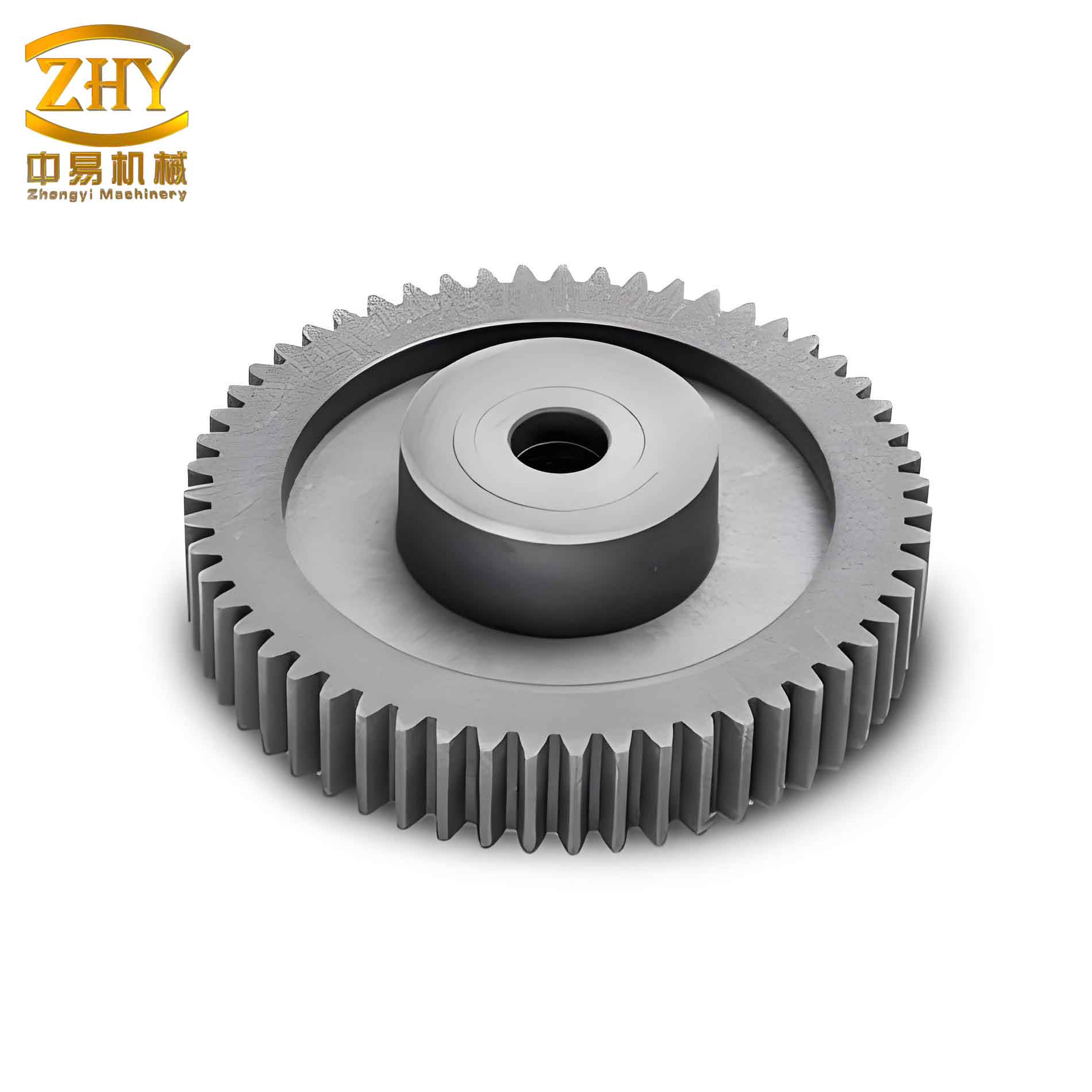
The core of this investigation is built upon a robust numerical simulation framework using a commercial finite element method (FEM) software, DEFORM-3D. Given the axisymmetry of the workpiece (a hollow cylinder) and the cyclic symmetry of the target spur and pinion gear (with 16 teeth), a 1/8th sector model was constructed to drastically reduce computational expense without sacrificing accuracy. This model comprises three main components:
- Workpiece (Billet): Modeled as a plastic, deformable body. The material assigned is AISI 4120 (20CrMo), a low-alloy steel commonly used for high-strength gears. Its flow stress behavior at room temperature (20°C) is critical and was defined within the software’s material library. The initial mesh consisted of approximately 40,000 tetrahedral elements, with local mesh refinement applied in regions anticipating severe deformation, such as the area near the die entry.
- Die and Punch: Modeled as rigid bodies. This is a standard simplification when the elastic deformation of the tooling is negligible compared to the large plastic deformation of the workpiece. The critical die feature is the entry angle, or approach angle, denoted by $ \theta $. This is the angle of the conical surface that guides the material from the initial billet diameter into the final tooth-profile bearing zone.
- Boundary Conditions & Friction: The die is fixed. The punch moves downward with a prescribed velocity. A shear friction model is applied at all tool-workpiece interfaces, with a friction factor (m) of 0.12, representing good lubrication conditions typical for cold forging. The simulation is conducted isothermally at 20°C.
The initial billet diameter ($d_0$) is a fundamental preform design parameter. It must contain sufficient volume to fill the entire spur and pinion gear cavity without causing excessive flash or end scrap. A common empirical relationship links the billet diameter to the gear geometry:
$$ d_0 = k \cdot m \cdot z $$
where $m$ is the gear module, $z$ is the number of teeth, and $k$ is an empirical billet diameter coefficient, typically greater than 1. The optimization of $k$ (and hence $d_0$) is a key objective.
Critical Process Parameters: A Systematic Analysis
The forming outcome for the spur and pinion gear is highly sensitive to specific process parameters. Through systematic simulation, we can quantify their impact on forming load, material flow, and final part quality.
1. Influence of Die Entry Angle ($\theta$)
The die entry angle, $ \theta $, is perhaps the most influential geometric parameter in an extrusion process. It governs the transition zone where the material undergoes a drastic change in flow direction from axial to radial. Convention suggests a range of 45° to 65° for many extrusion processes. To validate and refine this for our specific spur and pinion gear, simulations were conducted with $ \theta $ values of 25°, 35°, 45°, 55°, 65°, and 75°.
Forming Load Analysis: The load-stroke curves reveal a clear trend. For all angles, there is an initial sharp rise in load as plastic yielding begins. Subsequently, the curves diverge.
$$ P_{max} = f(\theta, \sigma_f, \mu, R) $$
Where $P_{max}$ is the maximum forming load, $\sigma_f$ is the flow stress of the material, $\mu$ is the friction coefficient, and $R$ is the reduction ratio. While a smaller $ \theta $ creates a longer deformation zone which can reduce redundant work (internal shear deformation not contributing to shape change), it also increases the contact area between the billet and the die wall, thereby increasing frictional resistance. The simulation results show that the peak load generally increases with $ \theta $. The 25° die exhibits the lowest peak load, while the 75° die requires the highest. However, the load for angles 45° and above shows less dramatic variation in the steady-state phase of extrusion.
Material Flow and Defect Formation: The entry angle critically affects the flow pattern, leading to two primary forms of material waste: the “end cover” or “backward extrusion cap” at the top, and the “collapse angle” or “unfilled root” at the bottom of the extruded spur and pinion gear. As $ \theta $ decreases, the radial flow is less direct, causing more material to be pushed axially backward, forming a longer end cover ($H$). Simultaneously, a larger dead metal zone forms at the die corner, leading to a more pronounced collapse angle ($h$), where the tooth root is not completely filled. The following table summarizes the simulated results:
| Die Entry Angle, $\theta$ (°) | Max. Forming Load (kN) | Collapse Length, $h$ (mm) | End Cover Length, $H$ (mm) | Tooth Fill Quality |
|---|---|---|---|---|
| 25 | ~2100 | ~38 | ~8 | Poor root fill |
| 35 | ~2400 | ~18 | ~12 | Moderate root fill |
| 45 | ~2600 | ~3 | ~15 | Complete, sharp fill |
| 55 | ~2750 | ~2.5 | ~16 | Complete fill |
| 65 | ~2900 | ~2.2 | ~16.5 | Complete fill |
| 75 | ~3100 | ~2.0 | ~17 | Complete fill, high load |
The data shows a clear trade-off. While a smaller $ \theta $ (25°, 35°) reduces load, it results in unacceptable tooth root filling (large $h$) and material loss. For $ \theta \geq 45° $, the tooth fill is complete and sharp. However, the collapse length $h$ diminishes only marginally beyond 45°, while the forming load continues to climb significantly. Therefore, from a holistic perspective of minimizing load (for tool life and press capacity) and minimizing material waste while ensuring perfect form, $ \theta = 45° $ is identified as the optimal compromise for this spur and pinion gear geometry.
2. Influence of Initial Billet Diameter ($d_0$)
With the optimal die angle ($ \theta = 45° $) established, the focus shifts to the initial billet preparation. The billet diameter coefficient $k$ directly determines the starting volume. An undersized billet ($k$ too small) will lead to underfill of the tooth tips. An oversized billet ($k$ too large) increases the required forming load, may cause overfill defects, and results in a thicker end cover that must be machined away, negating the near-net-shape benefit. Simulations were run with billet diameters derived from $k$ values of 1.15, 1.18, 1.20, and 1.22 (for m=4, z=16, the nominal gear diameter is 64mm).
The key metrics are the final fill state at the tip and flank of the spur and pinion gear tooth, and the peak forming load. A “fill ratio” can be conceptually defined for monitoring:
$$ F_{ratio} = \frac{A_{filled}}{A_{cavity}} \times 100\% $$
where $A_{filled}$ is the projected contact area between the workpiece and the die tooth cavity in simulation, and $A_{cavity}$ is the total area of the cavity. While the software provides detailed nodal tracking, a qualitative summary from simulation observations is presented below:
| Billet Diameter Coefficient, $k$ | Approx. Billet OD (mm) | Tooth Tip Fill | Tooth Flank Fill | Relative Forming Load | End Cover Thickness |
|---|---|---|---|---|---|
| 1.15 | 73.6 | Underfilled | Good | Low | Thin |
| 1.18 | 75.5 | Complete | Excellent | Medium | Moderate |
| 1.20 | 76.8 | Complete | Excellent | High | Thick |
| 1.22 | 78.1 | Complete (potential over-stress) | Excellent | Very High | Very Thick |
The results indicate that a $k$ value around 1.18 provides the optimal balance, yielding a billet with an outer diameter of approximately 75.6mm. This diameter supplies just enough material to ensure complete filling of the entire spur and pinion gear tooth profile without generating excessive load or waste material in the end cap. This finding aligns well with established empirical knowledge for gear extrusion preform design.
3. Analysis of Strain Distribution and Microstructural Implications
Beyond shape filling, cold working imparts significant strain, which refines the microstructure and enhances strength. The effective strain distribution within the successfully extruded spur and pinion gear (with $\theta=45°$, $d_0=75.6mm$) is highly informative. The strain is not uniform. The highest effective strain values are observed in the tooth regions, particularly at the pitch line and dedendum, where the material undergoes the most severe radial extension and shear. The region near the central mandrel shows lower strain due to the constraint against inward flow. The strain in the main body of the gear is relatively uniform and high, promising a consistent work-hardened state.
This heterogeneous yet controlled strain distribution is beneficial. The high strain in the teeth directly enhances their surface hardness and wear resistance, which are critical for the performance of any spur and pinion gear set. The continuous grain flow lines from the gear body into the tooth root, a hallmark of forming processes, significantly improve fatigue resistance compared to a cut gear where the grain structure is interrupted.
Experimental Validation and Process Realization
To substantiate the numerical findings, a physical tooling set was manufactured and a series of extrusion trials were conducted. The die insert, responsible for forming the spur and pinion gear teeth, was machined from a high-performance tool steel (65Nb) and heat-treated to a hardness of 60 HRC to withstand the high contact pressures. Its working surface was meticulously polished to the sub-micron level ($R_a < 0.2 \mu m$) to minimize friction and facilitate material flow. Given the high stresses involved, a prestressed double-layer container design was employed for the die assembly to impose beneficial compressive residual stresses on the core insert.
The punch was also a modular assembly, incorporating a central mandrel aligned with the die bore. AISI 4120 steel tubes were prepared as billets, with an outer diameter of 76.0 mm, matching the optimized simulation parameter. The trials were performed on a 3.15 MN hydraulic press. A phosphate-stearate coating was applied to the billets to provide excellent lubrication and prevent galling.
The extruded spur and pinion gear components were successfully produced. Visual and coordinate measurement machine (CMM) inspection confirmed that the gear teeth were fully formed with sharp corners and accurate profiles. The length of the collapse angle at the bottom of the gear was measured to be approximately 2.5 mm, which showed excellent agreement with the simulation prediction for the 45° die angle. The presence of the end cap was as anticipated, and its volume was consistent with the predicted material surplus. The successful experiment conclusively demonstrated the feasibility of the forward extrusion process for manufacturing this hollow, high-modulus spur and pinion gear. The close correlation between simulated and experimental outcomes validates the FEM model as a powerful tool for process design and optimization for such components.
Discussion and Broader Implications for Gear Manufacturing
The successful application of forward extrusion to this spur and pinion gear opens avenues for manufacturing similar axisymmetric, hollow gear forms. The process is particularly attractive for medium-to-high volume production runs where the cost of precision tooling can be amortized. The key takeaways for process designers targeting a spur and pinion gear are:
- Die Entry Angle is a Critical Compromise: The optimal angle ($\theta \approx 45°$) balances the competing factors of forming load and material waste (collapse angle and end cap). A generalized formula for the ideal $\theta$ might be expressed as a function of the reduction ratio and friction:
$$ \theta_{opt} \propto \arctan\left(\frac{\mu}{R}\right) $$
though it requires empirical constants for specific materials and geometries like a spur and pinion gear. - Preform Design is Paramount: The initial billet diameter must be calculated precisely using the relation $d_0 = k \cdot m \cdot z$, with $k$ typically between 1.18 and 1.20 for successful forward extrusion of a spur and pinion gear. Slight adjustments may be needed based on the specific tooth geometry and corner radii.
- Mandrel is Essential for Hollow Gears: The central mandrel is not merely for sizing the bore; it is a critical flow-control element. It prevents inward buckling or folding of the tube and ensures that the deformation energy is directed efficiently into radial flow to fill the spur and pinion gear teeth.
- Superior Properties are Inherent: The process naturally yields a spur and pinion gear with enhanced mechanical properties. The cold work increases yield and tensile strength. More importantly, the grain flow lines contour the tooth profile, dramatically increasing bending fatigue strength at the critical tooth root fillet—a major advantage over machined gears.
Future work could explore hybrid processes, such as performing a forward extrusion to near-net shape followed by a very light sizing or calibration stroke to eliminate the minor collapse angle entirely. Furthermore, investigating the extrusion of helical or bevel gear forms, though more complex due to lack of axisymmetry, would be a logical and valuable extension of this technology for other types of spur and pinion gear systems. The integration of advanced die materials and coatings could further push the limits of this process, allowing for the extrusion of even higher-strength materials into precise spur and pinion gear forms.
In conclusion, the forward extrusion process, when optimized through systematic numerical simulation and careful tooling design, presents a highly efficient and quality-driven route for the manufacture of high-performance, hollow spur and pinion gears. It stands as a testament to the potential of advanced metal forming to replace traditional subtractive methods, offering gains in material efficiency, component performance, and overall manufacturing sustainability.