
As power transmission systems evolve towards higher speeds and power densities, the challenge of vibration reduction and noise suppression becomes paramount for achieving efficient, quiet, and durable spur and pinion gear operation. In engineering practice, manufacturing tolerances, assembly variations, and changing operational environments introduce inherent randomness into the comprehensive transmission error and the microscopic topography of gear tooth surfaces. This stochastic nature leads to complex dynamic behaviors in gear systems. The tooth surface topography directly influences friction characteristics, with friction generally increasing with surface roughness. Furthermore, transmission error and tooth surface friction parameters interact. The dynamic characteristics of spur and pinion gear transmissions under the combined influence of these random factors remain inadequately defined. Therefore, investigating gear dynamics that account for the randomness of both transmission error and tooth surface friction parameters provides crucial theoretical support for subsequent reliability analysis and dynamic optimization of spur and pinion gear drives.
1. Introduction and Literature Context
Extensive theoretical and experimental research has been conducted by scholars worldwide on the vibration characteristics of gear systems under various excitations. A significant body of work focuses on the influence of deterministic and random errors on gear system dynamics. These studies often synthesize comprehensive gear errors based on deterministic harmonic functions, modeling them as internal excitations within the dynamic equations. Research has shown that such errors can excite vibrations at the meshing frequency and its harmonics, potentially leading to increased dynamic loads and noise. However, a common limitation in many of these studies is the omission of friction effects at the tooth interface, which is a significant source of excitation, especially in high-load conditions.
Concurrently, another research stream has deeply explored the role of tooth surface friction in gear dynamics. Models incorporating time-varying friction forces, often based on constant or empirically derived friction coefficients, have been developed to study their impact on dynamic transmission error, bearing forces, and system stability. These studies highlight that friction can introduce nonlinearities and additional frequency components, particularly sub-harmonics, into the system response. To better understand the interplay between friction and dynamics, recent investigations have begun to consider the stochastic nature of parameters influencing gear friction. Surface roughness, which is inherently random due to manufacturing processes, affects the instantaneous friction coefficient and the real contact conditions along the path of contact. Some studies have employed statistical methods or fractal theory to model surface roughness and its effect on friction and gear dynamics, treating roughness as a random process.
Recent advancements involve synthesizing the effects of both random error and stochastic friction. For instance, studies have incorporated random surface roughness into gear dynamics models to examine its interaction with static transmission error. Others have developed methods to compute friction forces and moments that account for the relative vibratory displacement of the spur and pinion gear, combined with geometric error. Despite this progress, two main characteristics are observed in the current state of research: Firstly, many models use deterministic methods to synthesize gear errors while modeling friction with time-varying yet deterministic parameters, not fully capturing their intrinsic randomness. Secondly, few models comprehensively analyze the combined, simultaneous impact of the randomness inherent in both transmission error and key tooth surface friction parameters (like the coefficient of friction and the instantaneous radius of curvature) on the overall vibration characteristics of the spur and pinion gear system.
To address this gap, this work integrates principles from probability statistics with the lumped mass method. Key parameters—namely, the comprehensive transmission error, the tooth surface friction coefficient, and the meshing radius of curvature—are mathematically characterized as random variables. A three-degree-of-freedom bending-torsional coupled vibration model for a spur and pinion gear pair is established, explicitly incorporating the randomness of these parameters. The dynamic equations are solved numerically, and the vibration responses are analyzed to elucidate the influence of each source of randomness on the system’s behavior. This model offers a more realistic representation of the actual spur and pinion gear transmission process and provides a theoretical foundation for the dynamic design and optimization of gear transmission systems.
2. Dynamic Model of a Spur and Pinion Gear Pair Considering Stochastic Error and Friction
The lumped mass method is employed to establish a three-degree-of-freedom bending-torsional coupled dynamic model for a spur and pinion gear pair. As shown in the schematic, each gear (pinion \( p \) and gear \( g \)) has three degrees of freedom: translations in the \( x \) and \( y \) directions, and rotation \( \theta \) about its axis. The coordinate system is defined with the line of centers along the x-axis. The displacement vector for the mass points is:
$$ \mathbf{q} = [ x_p, y_p, \theta_p, x_g, y_g, \theta_g ]^T $$
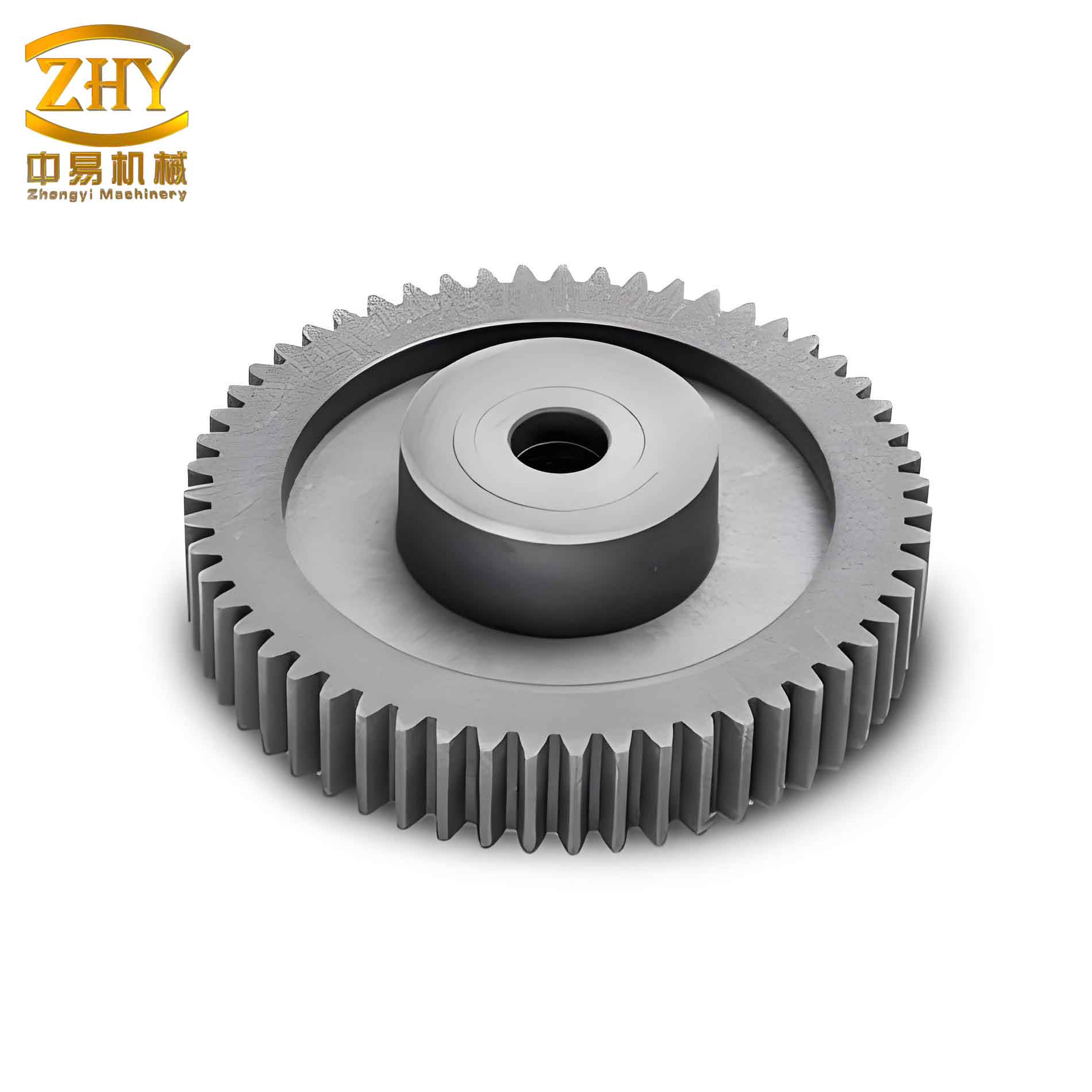
Considering tooth surface friction, time-varying mesh stiffness \(k_m(t)\), and random transmission error \(e(t)\), the equations of motion for the spur and pinion gear system are derived as follows:
$$
\begin{aligned}
m_p \ddot{x}_p + k_{xp} x_p + \sin\alpha \, k_m(t) \delta(t) &= F_f(t) \sin\alpha \\
m_p \ddot{y}_p + k_{yp} y_p + \cos\alpha \, k_m(t) \delta(t) &= -F_f(t) \cos\alpha \\
I_p \ddot{\theta}_p + R_p(t) k_m(t) \delta(t) &= T_p(t) \\
m_g \ddot{x}_g + k_{xg} x_g – \sin\alpha \, k_m(t) \delta(t) &= -F_f(t) \sin\alpha \\
m_g \ddot{y}_g + k_{yg} y_g – \cos\alpha \, k_m(t) \delta(t) &= F_f(t) \cos\alpha \\
I_g \ddot{\theta}_g – R_g(t) k_m(t) \delta(t) &= -T_g(t)
\end{aligned}
$$
The dynamic transmission error \( \delta(t) \) along the line of action is given by:
$$ \delta(t) = \sin\alpha (x_p – x_g) + \cos\alpha (y_p – y_g) + R_p(t)\theta_p – R_g(t)\theta_g + e(t) $$
Where:
- \( m_p, m_g \): masses of the pinion and gear.
- \( I_p, I_g \): mass moments of inertia of the pinion and gear.
- \( k_{xp}, k_{yp}, k_{xg}, k_{yg} \): equivalent support stiffnesses in the x and y directions.
- \( \alpha \): pressure angle.
- \( T_p(t), T_g(t) \): input and output torques.
- \( k_m(t) \): time-varying mesh stiffness.
- \( F_f(t) \): time-varying friction force on the tooth flank, modeled as \( F_f(t) = \mu(t) k_m(t) \delta(t) \).
- \( \mu(t) \): time-varying and stochastic coefficient of friction.
- \( R_p(t), R_g(t) \): time-varying and stochastic radii of curvature at the instantaneous contact point for the pinion and gear, respectively.
- \( e(t) \): comprehensive transmission error, modeled as a stochastic process.
The model parameters for the example spur and pinion gear pair studied in this analysis are listed in Table 1.
| Parameter | Pinion (p) | Gear (g) |
|---|---|---|
| Number of Teeth | 33 | 26 |
| Mass (kg) | 10.6 | 7.43 |
| Module (mm) | 7 | 7 |
| Moment of Inertia (kg·mm²) | 147670 | 61426 |
| Pressure Angle (°) | 20 | 20 |
| Face Width (mm) | 69 | 69 |
| Input Speed (rpm) | 2000 | – |
| Input Torque (N·m) | 2340.7 | – |
The time-varying mesh stiffness \(k_m(t)\) is a critical internal excitation. For this spur and pinion gear pair, it is calculated using a potential energy method (e.g., the Weber energy method) which accounts for the variable number of tooth pairs in contact and the changing tooth compliance. The resulting stiffness profile is periodic with the gear mesh frequency. A numerical integration approach yields the stiffness curve, which typically exhibits a parabolic-like shape within each mesh cycle, transitioning at points of contact change. The fundamental frequency of this stiffness variation is the meshing frequency \(f_m = (n_p \times N_p) / 60\), where \(n_p\) is the pinion speed in rpm and \(N_p\) is the number of pinion teeth. For the given parameters, \(f_m \approx 1100\) Hz.
3. Stochastic Analysis of Error and Tooth Surface Friction Parameters
3.1 Modeling Random Transmission Error
Gear transmission error arises primarily from profile (form) error and pitch error. The deterministic component of the comprehensive transmission error for a spur and pinion gear pair is often modeled as a sinusoidal function over one mesh cycle, representing the first harmonic of the error:
$$ e_i(t) = e_m + E_i \sin(\omega_m t + \phi_i) $$
where \(e_m\) is the mean error, \(E_i\) is the amplitude, \(\omega_m\) is the mesh frequency in rad/s, and \(\phi_i\) is the initial phase.
However, profile and pitch errors are consequences of manufacturing processes and are inherently random and independent. They vary across different teeth and along the tooth profile. Therefore, a more realistic model treats the total error \(e(t)\) as the sum of a deterministic harmonic component and a stochastic component:
$$ e(t) = e_i(t) + \xi_e(t) $$
We assume the stochastic component \(\xi_e(t)\) follows a Gaussian (normal) distribution with zero mean and a specified variance. This variance can be related to the quality grade of the spur and pinion gear. According to gear accuracy standards (e.g., AGMA or ISO), the permissible deviations for a given grade define a statistical range. For a Grade 6 spur and pinion gear, the deterministic amplitude \(E_i\) can be taken from standard tolerance tables, while the random component \(\xi_e(t)\) is modeled as Gaussian white noise with a variance representative of the process variability. In this analysis, \(\xi_e(t)\) is a sequence with zero mean and a variance of \(5 \times 10^{-7}\) m². Figure 1 conceptually illustrates such a random error signal superimposed on a deterministic harmonic.
3.2 Tooth Surface Friction Parameters under the Influence of Random Error
The friction force on the tooth flank of the spur and pinion gear is modeled as \(F_f(t) = \mu(t) F_N(t)\), where \(F_N(t)=k_m(t)\delta(t)\) is the dynamic normal load. The friction coefficient \(\mu(t)\) is not constant. It depends on lubrication regime, sliding velocity, surface temperature, and critically, the surface roughness. Surface roughness is a random property resulting from the finishing process (grinding, honing, etc.). Consequently, the instantaneous friction coefficient possesses stochastic characteristics. We model it as:
$$ \mu(t) = \mu_0 + \sigma_\mu \xi_\mu(t) $$
where \(\mu_0\) is a nominal or mean friction coefficient (e.g., 0.109), \(\sigma_\mu\) is the standard deviation representing the intensity of randomness (e.g., 0.05), and \(\xi_\mu(t)\) is a zero-mean, unit-variance Gaussian random process.
The radii of curvature \(R_p(t)\) and \(R_g(t)\) at the instantaneous contact point are also affected by random surface topography. The geometric distance \(s(t)\) from the pitch point to the instantaneous contact point varies along the path of contact. In a perfect gear, this is a deterministic function. However, surface deviations and errors cause the actual contact point to fluctuate randomly around its nominal position. Therefore, we model \(s(t)\) as:
$$ s(t) = s_\mu + \xi_s(t) $$
where \(s_\mu\) is the nominal mean distance calculated from perfect gear geometry, and \(\xi_s(t)\) is a Gaussian random variable. The instantaneous radii of curvature are then:
$$ R_p(t) = r_{bp} \tan\alpha + s(t), \quad R_g(t) = r_{bg} \tan\alpha – s(t) $$
where \(r_{bp}\) and \(r_{bg}\) are the base circle radii of the spur pinion and gear, respectively. The nominal value \(s_\mu\) can be derived from the geometry of the approach and recess segments of the path of contact for a spur and pinion gear pair. For a point \(D\) on the path of contact, its distance from the pinion center \(O_p\) can be found using the law of cosines in triangle \(O_p O_g D\), where \(O_g\) is the gear center. Knowing the distance \(l_{O_pD}\), \(s_\mu = l_{O_pD} – r_p\), where \(r_p\) is the pinion pitch radius. This geometric model links the random fluctuation \(\xi_s(t)\) directly to the contact mechanics.
The parameters governing the stochastic behavior are summarized in Table 2.
| Stochastic Parameter | Symbol | Model | Description |
|---|---|---|---|
| Transmission Error | \(e(t)\) | \(e_i(t) + \xi_e(t)\) | Combines deterministic harmonic error with Gaussian white noise. |
| Friction Coefficient | \(\mu(t)\) | \(\mu_0 + \sigma_\mu \xi_\mu(t)\) | Nominal value plus a Gaussian random fluctuation. |
| Contact Point Position | \(s(t)\) | \(s_\mu + \xi_s(t)\) | Nominal geometric position plus a Gaussian random fluctuation, affecting \(R_p(t)\) and \(R_g(t)\). |
4. Analysis of Dynamic Response Characteristics
To investigate the vibration characteristics of the spur and pinion gear pair considering the randomness of error and friction, the system of differential equations (1) is solved numerically. A fourth-order fixed-step Runge-Kutta integration scheme is employed with a time step of 0.00015 s to ensure accuracy and stability. The simulation is run for a sufficient duration to capture steady-state behavior and allow for statistical analysis.
The dynamic responses—specifically the translational accelerations (\(\ddot{x}_i, \ddot{y}_i\)) and torsional angular accelerations (\(\ddot{\theta}_i\))—are obtained for both the pinion and the gear. A representative time-domain plot of these accelerations under the influence of all stochastic parameters would show oscillatory signals whose amplitudes are modulated by the time-varying stiffness and perturbed by the random excitations. Typically, the acceleration amplitudes in the y-direction (line-of-action direction) are larger than those in the x-direction (off-line-of-action). The torsional vibrations of the spur pinion and gear are closely coupled and show significant energy at the mesh frequency. Due to the random excitations, the signals appear “noisy” rather than purely periodic.
Statistical features of these responses provide insight into the intensity of vibration. Table 3 presents the calculated standard deviations for the acceleration responses of the example spur and pinion gear pair.
| Gear | \(\sigma_{\ddot{x}}\) (mm/s²) | \(\sigma_{\ddot{y}}\) (mm/s²) | \(\sigma_{\ddot{\theta}}\) (rad/s²) |
|---|---|---|---|
| Pinion (Driving) | 5.51 | 15.13 | 0.125 |
| Gear (Driven) | 7.87 | 21.59 | 0.238 |
The results indicate that the driven gear exhibits larger vibration amplitudes (higher standard deviation) in all directions compared to the driving pinion. For each individual gear, the vibration level in the y-direction (line of action) is significantly higher than in the x-direction. This aligns with the primary forcing direction of the mesh stiffness and friction excitations in the spur and pinion gear system.
For a more detailed frequency-domain analysis, the Power Spectral Density (PSD) of the vibration signals is computed. The PSD reveals the distribution of signal power across different frequencies. Under the given operating conditions, the dominant peaks in the vibration spectra are expected at the mesh frequency \(f_m\) (1100 Hz) and its harmonics (e.g., 2200 Hz). These are excitations from the periodic mesh stiffness variation and the deterministic component of the error. However, due to the convolution effect between the mesh stiffness, the stochastic friction, and the random error, the spectrum exhibits a more complex structure. Sidebands appear around the main meshing frequency peaks. Furthermore, the random excitations introduce a continuous broadband spectral component, indicating that the system’s response is not purely tonal but has a stochastic, “noisy” character. This broadband noise is a key signature of the influence of the random parameters on the spur and pinion gear dynamics.
5. Influence Analysis of Individual Randomness Sources
5.1 Impact of Random Transmission Error
To isolate the effect of random transmission error, a comparative analysis is performed. Two cases are simulated for the same spur and pinion gear pair: Case A considers the full stochastic error model \(e(t) = e_i(t) + \xi_e(t)\). Case B considers only the deterministic error component \(e(t) = e_i(t)\), with the stochastic part \(\xi_e(t)\) set to zero. The friction parameters are kept deterministic in both cases for this comparison.
The time-domain acceleration signals from Case B appear as relatively smooth, periodic waveforms. In contrast, the signals from Case A show significant random fluctuations superimposed on the periodic pattern, leading to a much more erratic appearance. Quantitatively, the standard deviation of the acceleration responses increases substantially when random error is included. As shown in Table 4, the increase is approximately 65% across all response directions for the pinion. This uniform increase suggests that the random error excitation broadly energizes all modes of vibration in the spur and pinion gear system.
| Response Direction | With Random Error (\(\sigma_A\)) | Deterministic Error Only (\(\sigma_B\)) | Increase (\((\sigma_A-\sigma_B)/\sigma_B \times 100\%\)) |
|---|---|---|---|
| x-direction | 5.51 mm/s² | 3.34 mm/s² | 65.0% |
| y-direction | 15.13 mm/s² | 9.16 mm/s² | 65.2% |
| Torsional (\(\theta\)) | 0.1254 rad/s² | 0.0759 rad/s² | 65.2% |
In the frequency domain, the PSD for Case B shows distinct, sharp peaks at \(f_m\) and \(2f_m\). The PSD for Case A also shows these peaks, but they are broader and have higher amplitude. More importantly, the spectrum exhibits a raised noise floor across a wide frequency range and more pronounced sideband structures. At the fundamental mesh frequency (1100 Hz) and its first harmonic (2200 Hz), the vibration amplitude increases by over 100% and 50%, respectively, due to the random error. The phase portrait, which plots velocity against displacement for a degree of freedom, changes from a clean, closed limit cycle in the deterministic case to a scattered, cloud-like structure in the stochastic case. This indicates a transition from periodic motion to a more chaotic or random orbital motion, highlighting the strong destabilizing interference of random error on the dynamic stability of the spur and pinion gear system.
5.2 Impact of Random Tooth Surface Friction Parameters
Next, the influence of randomness in tooth surface friction parameters is analyzed. A comparison is made between two scenarios, both subject to the same random transmission error: Case C treats the friction coefficient \(\mu(t)\) and the contact radius parameter \(s(t)\) as random variables according to the models in Section 3.2. Case D treats them as constant, deterministic values (\(\mu(t)=\mu_0, s(t)=s_\mu\)).
The time-domain responses show that the acceleration curves in Case C have more intense and frequent fluctuations compared to Case D. The randomness in friction parameters injects an additional layer of stochastic disturbance. Statistical analysis, presented in Table 5, confirms this observation. The standard deviation of the vibration responses increases by approximately 27% when friction parameters are modeled as random variables. This increase is significant but notably smaller than the 65% increase caused by random error, suggesting that, for this specific spur and pinion gear system, transmission error randomness is the more dominant source of dynamic disturbance.
| Response Direction | Random Friction Params (\(\sigma_C\)) | Deterministic Friction Params (\(\sigma_D\)) | Increase (\((\sigma_C-\sigma_D)/\sigma_D \times 100\%\)) |
|---|---|---|---|
| x-direction | 6.99 mm/s² | 5.51 mm/s² | 26.8% |
| y-direction | 19.20 mm/s² | 15.13 mm/s² | 26.9% |
| Torsional (\(\theta\)) | 0.1591 rad/s² | 0.1254 rad/s² | 26.8% |
The frequency spectrum under random friction parameters (Case C) shows the same primary peaks at \(f_m\) and \(2f_m\) as Case D. However, the peaks are higher in amplitude. The modulation sidebands are more developed, and the broadband noise floor is further elevated. The amplitude increase at the peak frequencies is substantial, around 40-50%. The phase portrait under random friction also becomes more diffused and disordered compared to the case with deterministic friction, though the effect might be less extreme than that caused by random error alone. This demonstrates that the randomness in tooth surface friction independently complicates the dynamic response of the spur and pinion gear pair, adding to the overall stochastic nature of the system.
6. Conclusions
This analysis investigated the vibration characteristics of a spur and pinion gear pair by developing a dynamic model that incorporates the randomness of key excitation sources. The following conclusions are drawn:
- Integrated Stochastic Modeling: A methodology integrating probability statistics with lumped parameter modeling was successfully implemented. The comprehensive transmission error, tooth surface friction coefficient, and the instantaneous meshing radius of curvature were mathematically characterized as random variables. An existing geometric model was adapted to establish a mathematical mapping between random error and the stochastic contact parameters in the spur and pinion gear pair.
- Dynamic Model and Response: A three-degree-of-freedom bending-torsional coupled vibration model for a spur and pinion gear transmission was established, explicitly incorporating the randomness of both error and friction parameters. The model equations were solved numerically, and the resulting vibration responses were analyzed. The comparative analysis clearly delineated the individual and collective influences of these stochastic excitations.
- Effects of Randomness on Vibration Characteristics: The presence of random transmission error significantly amplifies the vibration acceleration responses and enhances their random variability. The random nature of tooth surface friction parameters also increases vibration amplitudes and contributes to the stochastic character of the response. Both sources of randomness transform the frequency spectrum from a series of distinct tonal peaks to a more complex profile with elevated broadband noise and pronounced sidebands. Similarly, phase portraits evolve from orderly limit cycles to scattered, cloud-like formations. These changes indicate a substantial increase in the dynamic instability and complexity of the spur and pinion gear system. Among the two sources, the randomness in transmission error was found to exert a stronger interfering effect on the system’s dynamic stability for the studied configuration.
The developed model offers a more realistic representation of spur and pinion gear dynamics by accounting for fundamental stochastic excitations present in real-world applications. The findings provide valuable theoretical insights and a modeling framework that can inform the dynamic design, tolerance specification, and condition monitoring strategies for reliable and quiet spur and pinion gear transmissions.