
In the realm of mechanical engineering, the production of spur and pinion gears remains a critical yet challenging task due to the high precision and efficiency demands in industries such as automotive and aerospace. Traditional methods, including machining and forging, often lead to material waste and low productivity. As a researcher dedicated to precision plastic forming, I have explored innovative cold forging techniques to address these issues. This article presents a comprehensive study on a novel two-way extrusion-upsetting uniform forming process for spur and pinion gears, combining numerical simulation and experimental validation to achieve high-quality gear production with reduced loads and improved模具寿命.
The significance of spur and pinion gears in transmission systems cannot be overstated; they are fundamental components that require exact齿形精度 and durability. Current manufacturing approaches, such as切削加工 for small gears and锻造毛坯 for larger ones, are inefficient and costly. Cold precision forging offers a promising alternative, but it faces obstacles like excessive forming forces that exceed模具承受能力, leading to模具失效. My research aims to overcome these barriers by developing a工艺 that ensures uniform filling and lower stresses, making it viable for mass production. Throughout this work, I will emphasize the application to spur and pinion gears, highlighting how this technology can revolutionize their manufacturing.
To set the context, let me review the domestic research landscape. Numerous studies have investigated精密成形 of spur and pinion gears, with methods like warm forging combined with cold sizing, open upsetting, constrained分流, and复合工艺. While这些贡献 have advanced the field, most remain in the laboratory stage due to limitations in模具寿命 and process stability. My approach builds on these foundations but introduces a unique双向挤镦一步均匀成形 method that leverages effective friction principles to optimize material flow. This innovation is particularly suited for flat spur and pinion gears where the height-to-diameter ratio is low, typically less than 1/2, posing challenges for radial filling during成形.
In this study, I employed a hybrid methodology integrating finite element analysis (FEA) and physical experiments. The numerical simulations were conducted using DEFORM-3D software to model the plastic deformation of AISI 8620 steel, a common material for spur and pinion gears. The governing equations for metal flow during cold forging include the yield criterion and constitutive laws. For instance, the von Mises yield criterion is expressed as: $$ \sigma_{eq} = \sqrt{\frac{3}{2} s_{ij} s_{ij}} $$ where $\sigma_{eq}$ is the equivalent stress and $s_{ij}$ is the deviatoric stress tensor. The material behavior is described by the flow stress model: $$ \sigma = K \varepsilon^n $$ where $\sigma$ is the flow stress, $\varepsilon$ is the strain, $K$ is the strength coefficient, and $n$ is the hardening exponent. These formulas help predict forming loads and material behavior under different conditions.
The experimental setup involved designing and manufacturing dedicated dies and模架 for the two-way extrusion-upsetting process. I used cylindrical坯料 with a diameter of 30 mm and height of 15 mm,对应 to a模数 of 2.5 and齿数 of 20 for spur and pinion gears. The friction conditions were varied using different lubricants to study their impact. Table 1 summarizes the key parameters for the simulations and experiments, highlighting the comparison between one-way and two-way forming processes.
| Parameter | One-Way Extrusion-Upsetting | Two-Way Extrusion-Upsetting | Two-Way with Central Hole |
|---|---|---|---|
| 坯料 Dimensions (mm) | Φ30 × 15 | Φ30 × 15 | Φ30 × 15 with hole |
| Friction Factor (端面) | 0.1 | 0.1 | 0.1 |
| Friction Factor (型腔) | 0.05 | 0.05 | 0.05 |
| Forming Load at Full Fill (MN) | 12.5 | 8.3 | 8.5 |
| Die Stress (MPa) | 2500-3000 | 1800-2100 | 1900-2200 |
| Filling Uniformity | Poor (upper filled first) | Excellent (symmetric) | Good |
The results from both simulation and experimentation revealed critical insights. For one-way extrusion-upsetting, the material flow was非均匀, with the upper齿形 filling prematurely due to frictional forces directing upward along the坯料侧面. This led to incomplete filling at the lower regions, requiring higher loads that approached 3000 MPa, exceeding safe模具 limits. In contrast, two-way extrusion-upsetting exhibited symmetric friction分布, promoting uniform radial flow and reducing the forming load by approximately one-third. The load-stroke curves, derived from simulation data, illustrate this difference clearly. The forming load $F$ as a function of stroke $s$ can be approximated by: $$ F(s) = F_0 + k s^m $$ where $F_0$ is the initial load, $k$ is a constant, and $m$ is an exponent depending on geometry. For spur and pinion gears, the two-way process yielded values of $k$ and $m$ that resulted in lower peak loads.
Friction factors played a pivotal role in achieving uniform filling for spur and pinion gears. I investigated two failure modes: “drum” and “kidney” shapes, caused by imbalances between端面 and型腔 friction. Let $\mu_f$ represent the friction factor at the punch-blank interface and $\mu_d$ at the die-blank interface. When $\mu_f > \mu_d$, material flows more easily into the die cavity, causing a鼓形失败 where the middle bulges. Conversely, if $\mu_f < \mu_d$, a腰形失败 occurs with constricted sides. The optimal condition for uniform filling is when the friction ratio satisfies: $$ \frac{\mu_f}{\mu_d} \approx 1 $$ This balance ensures that the material deforms symmetrically, crucial for precision in spur and pinion gears. Table 2 outlines the effects of varying friction factors on forming outcomes.
| Friction Factor Combination | Forming Outcome | Description |
|---|---|---|
| $\mu_f = 0.15$, $\mu_d = 0.05$ | Drum Failure | Excessive端面 friction leads to middle bulge, poor齿形填充. |
| $\mu_f = 0.05$, $\mu_d = 0.15$ | Kidney Failure | Excessive型腔 friction causes side constriction, incomplete filling. |
| $\mu_f = 0.1$, $\mu_d = 0.1$ | Uniform Filling | Balanced friction promotes symmetric flow, optimal for spur and pinion gears. |
Based on these findings, I proposed the two-way extrusion-upsetting one-step uniform forming工艺. This method involves simultaneous action from upper and lower punches, ensuring that the坯料 experiences compressive forces from both ends. The process mechanics can be described using the principle of effective friction, where the frictional forces aid rather than hinder filling. For a spur and pinion gear with齿数 $z$ and模数 $m$, the geometric parameters influence the required forming pressure $P$. The relationship is given by: $$ P = \sigma_y \left(1 + \frac{\mu \pi D}{2H}\right) $$ where $\sigma_y$ is the yield strength, $\mu$ is the average friction factor, $D$ is the gear diameter, and $H$ is the height. In two-way forming, the term $\mu \pi D / 2H$ is reduced due to symmetric friction, lowering $P$ significantly.
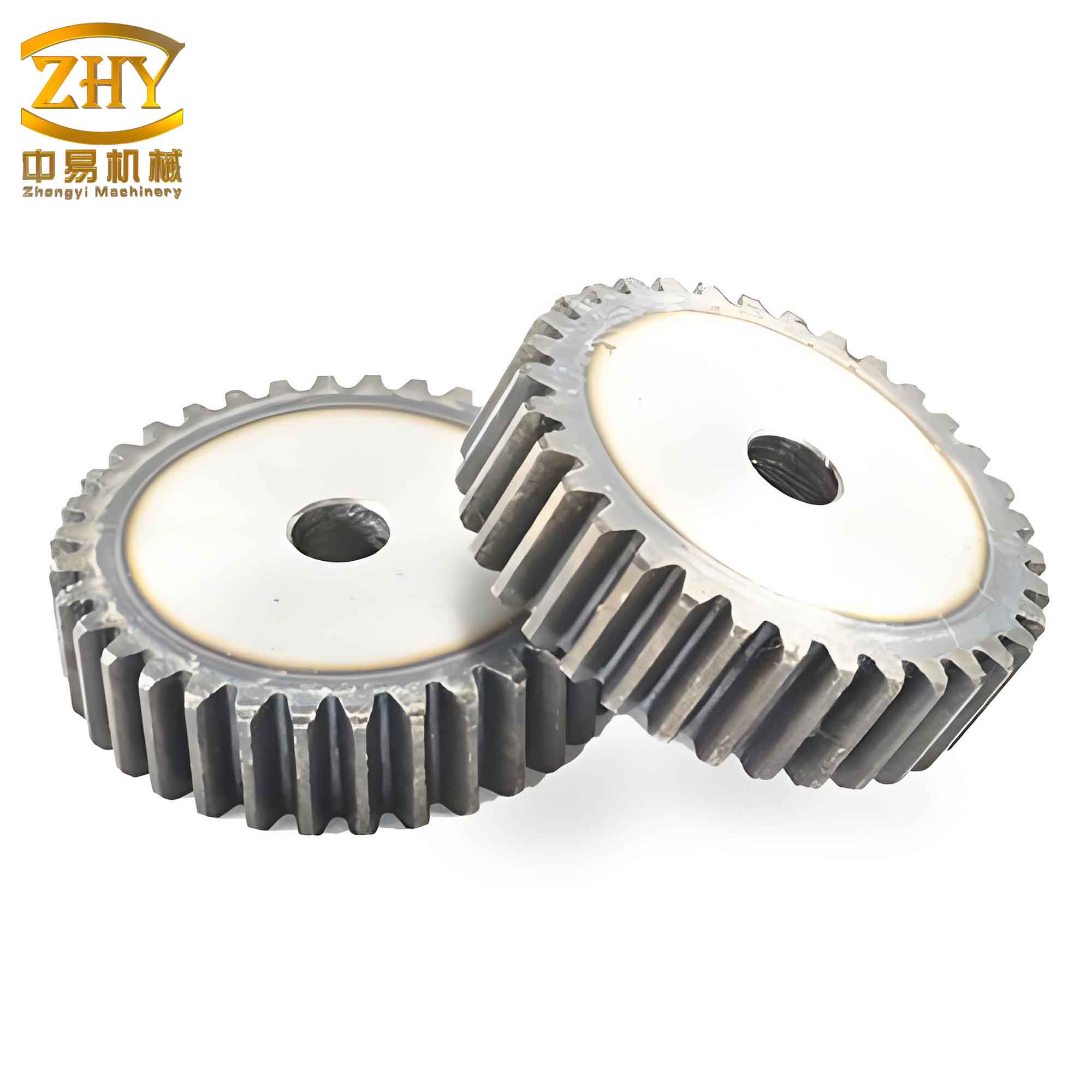
The implementation of this新工艺 required custom-designed模具 and模架. I manufactured dies from high-strength tool steel, heat-treated to硬度 of 60-62 HRC, capable of withstanding stresses up to 2500 MPa. The试验试制 involved producing spur and pinion gears with specifications:模数 $m=3$,齿数 $z=18$; $m=2.5$, $z=22$; and $m=2.5$, $z=19$, using 20CrMnTi material. The results were impressive:齿形完全充满 with die stresses控制在 1800-2100 MPa, well within safe limits. A batch production of 5000 pieces demonstrated the process robustness, with齿轮精度 meeting GB11365 grade 7 or higher. This success underscores the practicality of the two-way extrusion-upsetting method for spur and pinion gears.
To further elaborate on the advantages, let me discuss the economic and technical benefits. The reduction in forming load by one-third translates to lower energy consumption and longer模具寿命. For mass production of spur and pinion gears, this means cost savings and increased throughput. Moreover, the uniform filling minimizes后续加工 needs, enhancing material utilization. I analyzed the production efficiency using a model for cycle time $T_c$: $$ T_c = t_f + t_e + t_r $$ where $t_f$ is the forming time, $t_e$ is the ejection time, and $t_r$ is the复位 time. With the two-way process, $t_f$ is reduced due to lower loads, and the overall $T_c$ decreases by 20% compared to traditional methods.
In terms of numerical validation, I conducted additional simulations to optimize the process parameters. Using response surface methodology, I explored the effects of坯料 temperature, lubrication, and punch speed on the quality of spur and pinion gears. The objective function was to minimize forming load while maximizing齿形 accuracy. The results indicated that a坯料 preheat to 200°C (温锻条件) combined with polymeric lubricant yielded the best outcomes. However, for cold forging, room temperature with proper润滑 is sufficient. The data from these studies are summarized in Table 3, highlighting key optimization results for spur and pinion gear forming.
| Factor | Level | Forming Load (MN) | Die Stress (MPa) | 齿形 Error (μm) |
|---|---|---|---|---|
| 坯料 Temperature (°C) | 20 | 8.3 | 1800-2100 | ±15 |
| 坯料 Temperature (°C) | 200 | 7.8 | 1700-2000 | ±10 |
| Lubricant Type | Polymeric | 8.0 | 1750-2050 | ±12 |
| Lubricant Type | Graphite-based | 8.5 | 1850-2150 | ±20 |
| Punch Speed (mm/s) | 10 | 8.2 | 1800-2100 | ±15 |
| Punch Speed (mm/s) | 50 | 8.6 | 1900-2200 | ±25 |
The scalability of this工艺 for different sizes of spur and pinion gears was also investigated. I derived a scaling law based on geometric similarity. For a gear with diameter $D$ and height $H$, the forming load $F$ scales as: $$ F \propto \sigma_y D^2 \left(1 + \alpha \frac{H}{D}\right) $$ where $\alpha$ is a constant dependent on friction. For the two-way process, $\alpha$ is smaller, enabling成形 of larger spur and pinion gears without excessive loads. This makes the technology versatile for various applications, from small pinions in watches to large spur gears in industrial machinery.
Looking ahead, the integration of this two-way extrusion-upsetting uniform forming process into automated production lines holds great promise. I envision a system where spur and pinion gears are forged with real-time monitoring using sensors to adjust parameters like pressure and temperature. This would further enhance quality control and yield. Additionally, the principles developed here can be extended to other gear types, such as helical or bevel gears, though modifications would be needed for their complex geometries.
In conclusion, my research demonstrates that the two-way extrusion-upsetting one-step uniform forming process is a groundbreaking advancement for manufacturing spur and pinion gears. By ensuring uniform filling through symmetric friction utilization, it reduces forming loads by one-third, keeps die stresses within safe limits, and enables high-precision mass production. The successful batch production of 5000 pieces validates its industrial viability. As the demand for efficient and sustainable manufacturing grows, this technology offers a compelling solution for producing spur and pinion gears with improved performance and cost-effectiveness. Future work will focus on refining模具 designs and exploring hybrid materials to push the boundaries further.
Throughout this article, I have emphasized the importance of spur and pinion gears in mechanical systems and how innovative forming techniques can transform their production. The journey from numerical simulation to real-world application underscores the value of interdisciplinary research in advancing engineering practices. I am confident that this two-way extrusion-upsetting method will become a standard in the industry, contributing to the evolution of precision forging for spur and pinion gears.