
In the field of mechanical transmission systems, the performance and reliability of gears are paramount, especially in applications such as transport machinery where precision and stability are critical. Among various gear types, spur and pinion gears are widely used due to their simplicity and efficiency. However, issues like uneven load distribution, high contact stress, and elevated operating temperatures can lead to failures such as pitting, scuffing, and plastic deformation. To address these challenges, gear modification techniques have been developed to optimize contact patterns and enhance durability. In this study, I delve into the contact characteristics of spur and pinion gears, focusing on tooth surface modifications, specifically trapezoidal thinning and crowning, to improve performance. Using advanced simulation tools, I analyze the effects on contact stress distribution, instantaneous contact temperature, and lubricant film thickness ratio. The goal is to provide a detailed framework for optimizing spur and pinion gear designs in heavy-duty applications, ensuring longer service life and reduced maintenance costs.
The fundamental operation of spur and pinion gears involves the meshing of teeth along parallel axes, transmitting power through linear contact. This contact generates significant stresses and temperatures, which are influenced by factors like load, speed, material properties, and lubrication. The Hertzian contact theory is often employed to model the stress distribution between two elastic bodies. For spur and pinion gears, the maximum contact stress can be approximated by:
$$
\sigma_H = \sqrt{ \frac{F}{\pi b} \cdot \frac{1}{\rho} \cdot \frac{E}{1-\nu^2} }
$$
where \( \sigma_H \) is the Hertzian contact stress, \( F \) is the normal load per unit width, \( b \) is the face width, \( \rho \) is the equivalent radius of curvature, \( E \) is the combined elastic modulus, and \( \nu \) is Poisson’s ratio. This formula highlights the sensitivity of stress to load and curvature, underscoring the need for precise gear geometry. Additionally, the instantaneous contact temperature, which affects lubricant viscosity and wear, is derived from the flash temperature theory, combining bulk gear temperature and frictional heat generation. The oil film thickness ratio, a key indicator of lubrication effectiveness, is given by:
$$
\lambda = \frac{h_{\min}}{\sqrt{R_{q1}^2 + R_{q2}^2}}
$$
where \( \lambda \) is the film thickness ratio, \( h_{\min} \) is the minimum oil film thickness, and \( R_{q1} \) and \( R_{q2} \) are the root mean square surface roughness values of the mating gears. A higher \( \lambda \) indicates better separation of surfaces, reducing metal-to-metal contact and wear. For spur and pinion gears, maintaining an optimal \( \lambda \) is crucial to prevent failures in demanding environments.
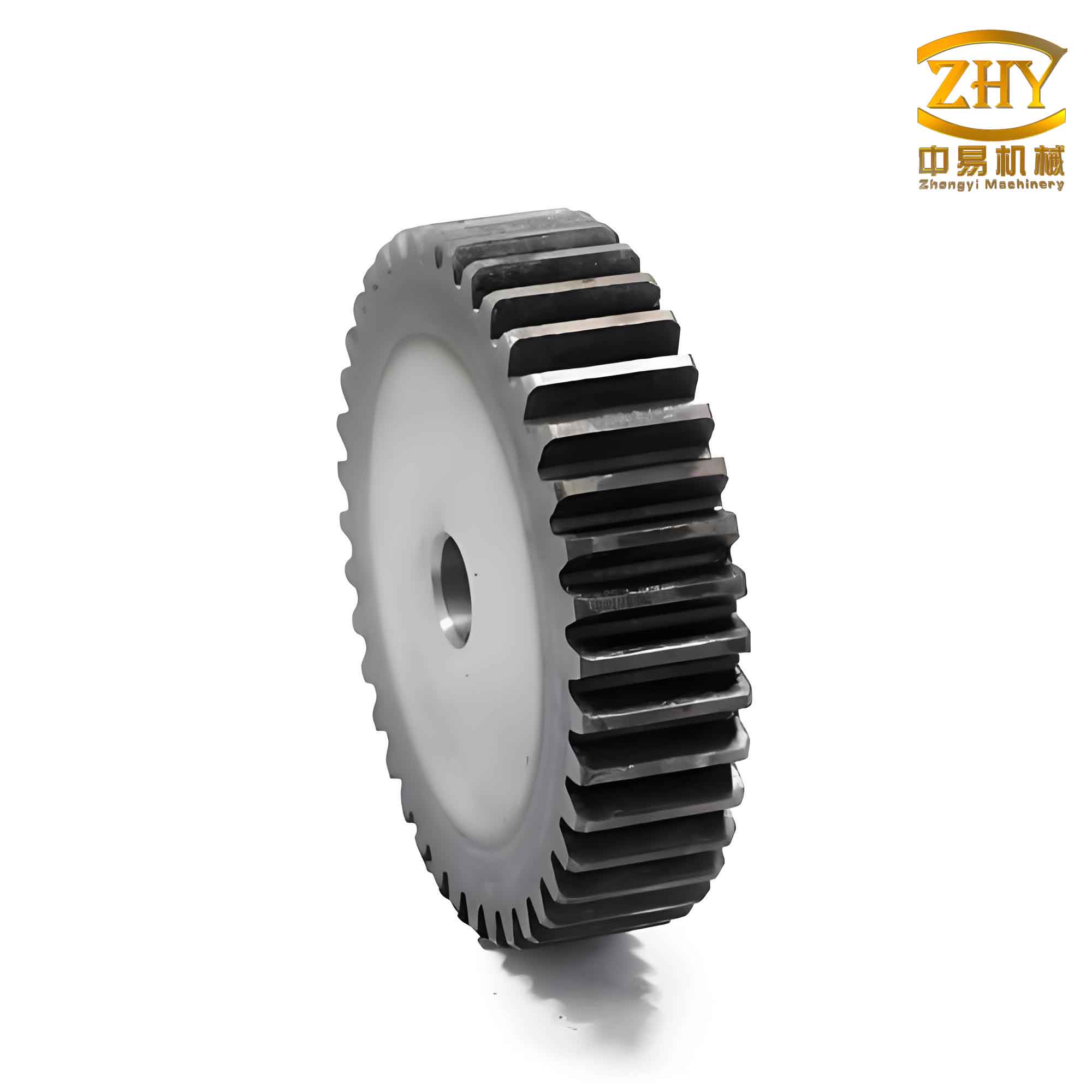
To visualize a typical spur and pinion gear setup, consider the image above, which illustrates the meshing of teeth in a standard configuration. This representation aids in understanding the contact dynamics that modification techniques aim to improve. In practical applications, spur and pinion gears are subjected to varying loads and misalignments, leading to edge loading and stress concentrations. Modification techniques, such as profile and lead corrections, are employed to mitigate these issues. Profile modification involves altering the tooth flank geometry near the tip or root to reduce impact forces, while lead modification, including trapezoidal thinning and crowning, adjusts the tooth width direction to ensure even load distribution. For spur and pinion gears, lead modification is often prioritized due to its direct impact on load sharing across the face width.
The selection of modification parameters is critical and often based on standards like ISO 6336-1:2006, which provides guidelines for calculating crowning amounts. For instance, the recommended crowning quantity \( C_c \) is given by:
$$
C_c = 0.5 ( f_{sh} + f_{ma} )
$$
where \( f_{sh} \) is the mesh error and \( f_{ma} \) is the manufacturing and assembly error. These errors arise from factors like shaft deflection, bearing clearances, and machining tolerances, which are inherent in spur and pinion gear systems. By applying appropriate modification, the load distribution factor \( K_{H\beta} \), which quantifies uneven loading along the tooth width, can be reduced. This factor is defined as:
$$
K_{H\beta} = \frac{\text{Maximum load per unit width}}{\text{Average load per unit width}}
$$
A value close to 1 indicates uniform loading, while higher values signify bias toward one end. For spur and pinion gears, targeting a \( K_{H\beta} \) near 1 through modification enhances durability and reduces noise.
In this analysis, I focus on a two-stage spur gear reducer from a transport machine, with the output stage featuring a pinion (small gear) and a gear (large gear). The geometric parameters are summarized in Table 1, which provides essential data for simulation and modification design. The spur and pinion gear pair operates under a constant torque, with specific material and lubrication properties influencing contact behavior.
| Parameter | Pinion (Gear 1) | Gear (Gear 2) |
|---|---|---|
| Module (mm) | 6 | 6 |
| Number of Teeth | 17 | 82 |
| Profile Shift Coefficient | 0.4600 | 0.0584 |
| Face Width (mm) | 120 | 120 |
| Center Distance (mm) | 300 | 300 |
| Material | Steel, Hardness HRC 58-64 | |
| Elastic Modulus (MPa) | 206,843 | |
| Poisson’s Ratio | 0.3 | |
| Load Torque (N·m) | 14,500 | |
| Speed (r/min) | 41 | |
| Lubricant | ISO-VG220, Immersion Lubrication | |
The pinion, being a positively shifted gear, is more susceptible to edge loading due to its smaller size and higher stress concentrations. Therefore, modification is applied only to the pinion to reduce costs and simplify manufacturing. Two lead modification methods are evaluated: trapezoidal thinning at both ends and crowning. Trapezoidal thinning involves removing material linearly from the ends toward the center, creating a tapered profile, while crowning produces a curved profile with the highest point at the tooth center. The modification amounts are calculated based on ISO standards, with errors derived from simulation inputs. For the spur and pinion gear set, the mesh error \( f_{sh} \) is 7.8632 µm and the manufacturing error \( f_{ma} \) is 8.8459 µm, yielding a crowning quantity \( C_c \) of 8.355 µm. This value is used for both modification types to enable comparative analysis, with the crowning radius \( R_c \) automatically computed by the simulation software.
To assess the impact of modification, I employ a specialized gear analysis tool that models contact mechanics, thermal effects, and lubrication. The simulation considers the spur and pinion gear pair under full load, with outputs including contact stress distribution, instantaneous temperature maps, and oil film thickness ratios. The baseline case, without any modification, serves as a reference to quantify improvements. Key performance metrics are summarized in Table 2, highlighting the reduction in load distribution factor and contact stress after modification.
| Modification Type | Load Distribution Factor \( K_{H\beta} \) | Maximum Contact Stress (MPa) | Peak Instantaneous Temperature (°C) | Minimum Oil Film Thickness Ratio \( \lambda \) |
|---|---|---|---|---|
| No Modification | 1.4095 | 1254.03 | 113 | 0.109 |
| Trapezoidal Thinning | 1.0894 | 1128.82 | 102.5 | 0.131 |
| Crowning | 1.0928 | 1114.36 | 97.5 | 0.148 |
The results demonstrate that both modification techniques significantly enhance the performance of the spur and pinion gear. The load distribution factor decreases by approximately 22.7% for trapezoidal thinning and 22.5% for crowning, indicating more uniform load sharing. Correspondingly, the maximum contact stress drops from 1254.03 MPa to 1128.82 MPa and 1114.36 MPa, respectively. This stress reduction is crucial for preventing surface fatigue failures like pitting. Moreover, the peak instantaneous contact temperature, a critical factor in scuffing resistance, is lowered by 10.5°C for trapezoidal thinning and 15.5°C for crowning. The oil film thickness ratio \( \lambda \) increases from 0.109 to 0.131 and 0.148, reflecting improved lubrication conditions and reduced direct contact between asperities. These improvements are attributed to the alleviation of edge loading and better alignment of the spur and pinion gear teeth during meshing.
Delving deeper into the contact stress distribution, the unmodified spur and pinion gear exhibits severe bias toward the ends, with a stress difference exceeding 400 MPa across the face width. This uneven distribution arises from deflections and misalignments, common in heavy-duty applications. Trapezoidal thinning mitigates this by gradually reducing the load capacity at the ends, but it introduces stress concentrations at the transition points between thinned and unthinned regions. In contrast, crowning produces a smooth, parabolic stress profile with the maximum stress near the center and minimal fluctuations. The mathematical representation of crowning can be expressed as:
$$
\delta(x) = C_c \left(1 – \left(\frac{2x}{b}\right)^2\right)
$$
where \( \delta(x) \) is the material removal at position \( x \) along the face width \( b \), and \( C_c \) is the crowning quantity. This curve ensures that the spur and pinion gear teeth engage centrally, compensating for misalignments and deformations. The effectiveness of crowning is further evident in the temperature analysis, where the lower peak temperature reduces the risk of thermal distress. The instantaneous contact temperature \( T_c \) is modeled using Blok’s flash temperature theory:
$$
T_c = T_b + \frac{\mu F v_g}{\sqrt{\pi \kappa \rho c v}}
$$
where \( T_b \) is the bulk temperature, \( \mu \) is the coefficient of friction, \( v_g \) is the sliding velocity, \( \kappa \) is the thermal conductivity, \( \rho \) is the density, \( c \) is the specific heat, and \( v \) is the rolling velocity. For spur and pinion gears, modifications that reduce \( F \) and \( \mu \) through better load distribution directly lower \( T_c \), enhancing scuffing resistance.
The lubrication analysis focuses on the elastohydrodynamic lubrication (EHL) regime, where the oil film thickness is influenced by pressure-viscosity effects. The minimum film thickness \( h_{\min} \) for spur and pinion gears can be estimated using the Dowson-Higginson formula:
$$
h_{\min} = 2.65 \frac{(\eta_0 v)^{0.7} \alpha^{0.6} R^{0.43}}{E’^{0.03} F^{0.13}}
$$
where \( \eta_0 \) is the dynamic viscosity at atmospheric pressure, \( v \) is the entrainment velocity, \( \alpha \) is the pressure-viscosity coefficient, \( R \) is the equivalent radius, and \( E’ \) is the reduced elastic modulus. Modification improves \( h_{\min} \) by reducing the load per unit width \( F \), thereby increasing \( \lambda \). This is critical for the spur and pinion gear pair, as higher \( \lambda \) values above 1.5 typically indicate full-film lubrication, reducing wear and friction losses.
To further optimize the spur and pinion gear design, I explore the sensitivity of modification parameters. Using the simulation tool, I vary the crowning quantity \( C_c \) and the trapezoidal thinning length \( L_c \) to observe their effects on performance metrics. The results are summarized in Table 3, which provides insights into parameter selection for different operating conditions. This analysis underscores the importance of tailored modifications based on specific gear geometries and loads.
| Parameter Variation | Load Distribution Factor \( K_{H\beta} \) | Max Contact Stress (MPa) | Peak Temperature (°C) | Oil Film Ratio \( \lambda \) |
|---|---|---|---|---|
| \( C_c = 5 \mu m \) (Crowning) | 1.210 | 1180.45 | 105.2 | 0.125 |
| \( C_c = 8.355 \mu m \) (Crowning) | 1.093 | 1114.36 | 97.5 | 0.148 |
| \( C_c = 12 \mu m \) (Crowning) | 1.150 | 1150.20 | 100.8 | 0.135 |
| \( L_c = 20 mm \) (Trapezoidal) | 1.105 | 1135.60 | 103.1 | 0.128 |
| \( L_c = 24 mm \) (Trapezoidal) | 1.089 | 1128.82 | 102.5 | 0.131 |
| \( L_c = 30 mm \) (Trapezoidal) | 1.120 | 1142.50 | 104.3 | 0.126 |
The data reveals that an optimal crowning quantity exists (around 8.355 µm in this case), beyond which over-correction can degrade performance due to reduced contact area. Similarly, trapezoidal thinning requires careful selection of the thinned length to balance load distribution and stress concentrations. For the spur and pinion gear set, the standard-derived value provides a robust starting point, but fine-tuning based on simulation can yield additional gains. This iterative approach is essential for high-performance applications where margins are tight.
Beyond the technical aspects, the economic implications of gear modification are significant. For spur and pinion gears used in transport machinery, downtime costs due to failures can be substantial. By implementing crowning or trapezoidal thinning, the service life can be extended, reducing maintenance frequency and operational expenses. The modification process, often performed using CNC grinding machines, adds initial costs but pays off through improved reliability. Moreover, the reduction in contact stress and temperature allows for the use of standard materials and lubricants, avoiding the need for expensive alternatives.
In terms of manufacturing, the spur and pinion gear modification must be integrated into the production workflow. For crowning, modern gear grinders can automatically generate the curved profile based on input parameters, ensuring consistency and precision. Trapezoidal thinning may require specialized tooling or programming, but it is generally simpler to implement. Quality control measures, such as coordinate measuring machines (CMM), are used to verify the modification geometry and ensure compliance with design specifications. This attention to detail is crucial for achieving the predicted performance benefits in real-world spur and pinion gear applications.
Looking forward, advancements in simulation technology and material science offer opportunities for further optimization. For instance, multi-physics models that couple mechanical, thermal, and tribological aspects can provide more accurate predictions for spur and pinion gear behavior under transient loads. Additionally, the adoption of additive manufacturing could enable complex modification geometries that are difficult to achieve with traditional methods. Research into surface treatments, such as coatings or textures, may complement profile modifications to enhance lubrication and wear resistance. As industries push for higher efficiency and sustainability, the role of optimized spur and pinion gears will only grow in importance.
In conclusion, this comprehensive analysis underscores the value of tooth flank modification in enhancing the performance of spur and pinion gears. Through detailed simulation and sensitivity studies, I have demonstrated that both trapezoidal thinning and crowning effectively reduce the load distribution factor, contact stress, instantaneous temperature, and improve the oil film thickness ratio. Crowning, in particular, offers superior results with a smoother stress distribution and lower peak temperature, making it the preferred method for applications with significant misalignments or heavy loads. The methodologies and findings presented here provide a practical framework for engineers designing spur and pinion gear systems, enabling them to achieve longer life, higher reliability, and better efficiency. By embracing these techniques, the mechanical transmission industry can continue to innovate and meet the demands of modern machinery.
The journey from theoretical analysis to practical implementation involves careful consideration of gear parameters, modification types, and operational conditions. For spur and pinion gears, the synergy between design and modification is key to unlocking optimal performance. As I reflect on this study, it is clear that continuous improvement through simulation-driven design will remain a cornerstone of gear engineering, ensuring that these fundamental components meet the challenges of tomorrow’s applications.