
In my extensive experience with mechanical transmission systems, I have observed that spur and pinion gears are fundamental components in various industrial machinery, particularly in coal mining equipment. These gears, characterized by their straight teeth and parallel axes, play a crucial role in transmitting power and motion efficiently. However, their operational environment in mining is often harsh, subjecting them to significant cyclic loads that can lead to fatigue failure. This article delves into a comprehensive study of the bending fatigue performance of spur and pinion gears, aiming to provide reliable data for design optimization and enhance the safety and reliability of mining gear systems. The focus is on experimental analysis, statistical evaluation, and the integration of numerical simulation to predict and improve fatigue life.
The fatigue behavior of spur and pinion gears is primarily governed by bending stresses at the tooth root. During meshing, each tooth undergoes cyclic loading, leading to stress concentration in the fillet region. The maximum bending stress, often the initiating point for fatigue cracks, can be approximated using the Lewis formula, but more precise models consider factors like load distribution and geometry. The fundamental bending stress equation for a spur gear tooth is given by:
$$ \sigma_b = \frac{F_t}{b m_n Y_F Y_S Y_\beta} $$
where \( \sigma_b \) is the bending stress, \( F_t \) is the tangential force, \( b \) is the face width, \( m_n \) is the normal module, \( Y_F \) is the form factor, \( Y_S \) is the stress correction factor, and \( Y_\beta \) is the helix angle factor (for spur gears, \( Y_\beta = 1 \)). For spur and pinion gears, the interaction between the pinion (smaller gear) and the spur gear (larger gear) is critical, as the pinion typically experiences higher stress due to fewer teeth. The bending fatigue limit is influenced by material properties, surface treatments, and residual stresses. For instance, introducing compressive residual stresses at the tooth root can significantly enhance fatigue resistance by offsetting tensile stresses, as shown in the following relation for effective stress:
$$ \sigma_{eff} = \sigma_{bending} – \sigma_{residual} $$
where \( \sigma_{eff} \) is the net tensile stress, \( \sigma_{bending} \) is the applied bending stress, and \( \sigma_{residual} \) is the compressive residual stress. This principle is vital for designing durable spur and pinion gears for heavy-duty applications.
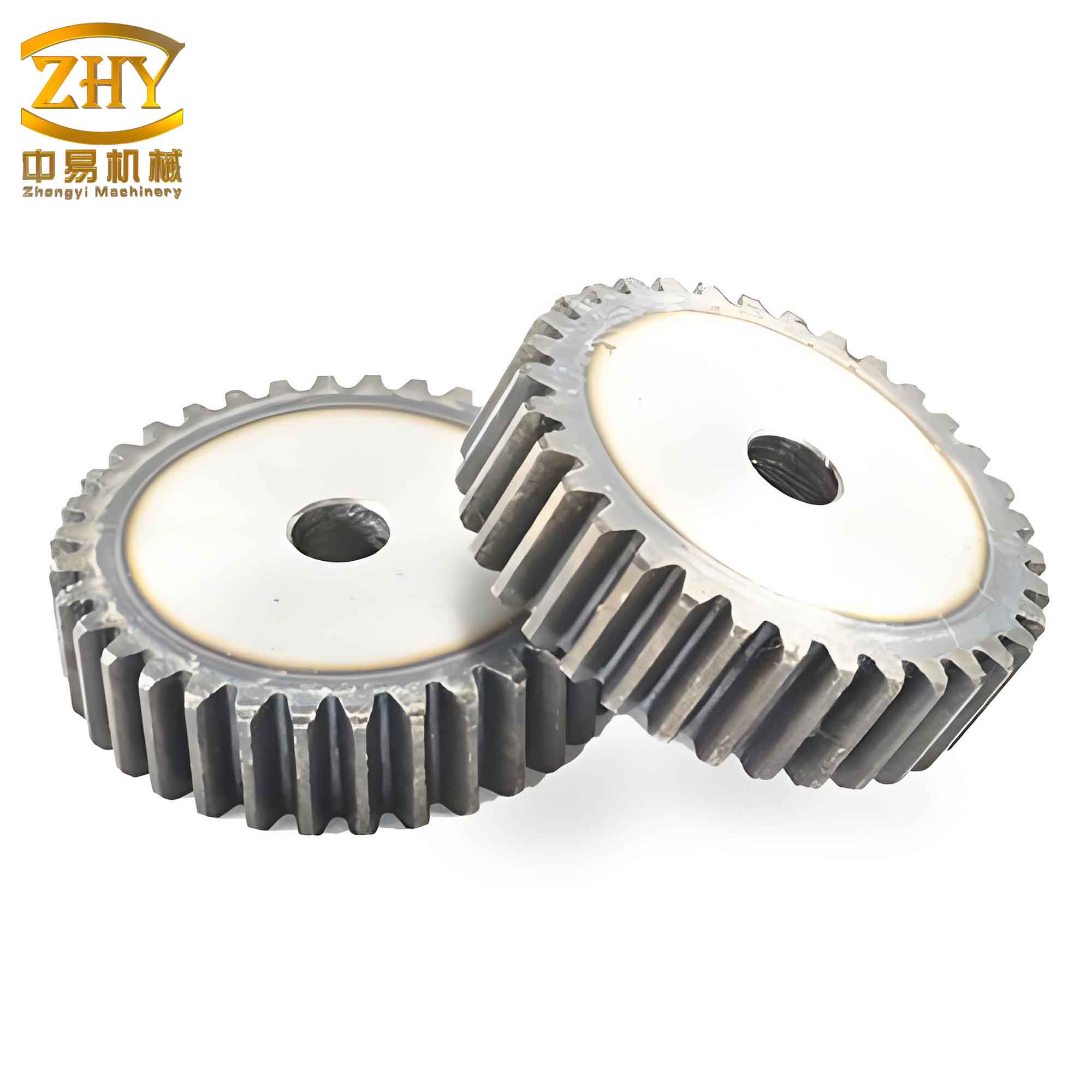
To systematically evaluate the fatigue characteristics, I conducted bending fatigue tests on spur gears made of 40Cr steel, a common material for mining machinery. The test gears were standard involute spur gears, designed according to relevant standards. The parameters of the spur and pinion gears used in the study are summarized in the table below, highlighting key geometrical and material properties.
| Parameter | Value for Spur Gear | Value for Pinion Gear | Unit |
|---|---|---|---|
| Module (m) | 4.5 | 4.5 | mm |
| Number of Teeth (z) | 33 | 16 | – |
| Face Width (b) | 14 | 14 | mm |
| Pressure Angle (α) | 20° | 20° | degree |
| Material | 40Cr | 40Cr | – |
| Hardness (HBS) | 274 (tooth surface), 282 (root) | 280 (tooth surface), 285 (root) | – |
| Surface Roughness (Ra) | 30 | 30 | μm |
The fatigue testing was performed using a pulsating load method on a high-frequency fatigue testing machine. The setup involved applying a cyclic load to a single tooth or double teeth of the spur gear, simulating the actual loading conditions in service. The load was applied through a压头 (indenter) while the gear was stationary, ensuring controlled stress conditions. The test apparatus, compliant with standard gear testing methods, allowed for precise measurement of load and cycle count until failure. The loading frequencies ranged from 140 to 150 Hz, enabling accelerated fatigue testing. For spur and pinion gears, it is essential to consider the load-sharing characteristics; in this experiment, the load was evenly distributed using a self-aligning fixture.
The bending fatigue life of spur and pinion gears exhibits significant scatter due to material inhomogeneity, manufacturing tolerances, and surface conditions. To account for this variability, I analyzed the fatigue life data using statistical methods. The Weibull distribution is widely recognized for modeling fatigue life, as it can capture the shape of failure data. The three-parameter Weibull distribution function for survival probability \( P \) (reliability) is expressed as:
$$ P(N) = \exp\left[-\left(\frac{N – N_0}{N_a – N_0}\right)^b\right] $$
where \( N \) is the fatigue life in cycles, \( N_0 \) is the location parameter (minimum life), \( N_a \) is the scale parameter (characteristic life), and \( b \) is the shape parameter (Weibull slope). By taking double logarithms, this can be linearized:
$$ \ln\left[\ln\left(\frac{1}{P}\right)\right] = b \ln(N – N_0) – b \ln(N_a – N_0) $$
Letting \( Y = \ln[\ln(1/P)] \) and \( X = \ln(N – N_0) \), the equation becomes \( Y = bX + B \), where \( B = -b \ln(N_a – N_0) \). Using least squares regression on experimental data, I estimated the parameters for different stress levels. The table below presents the Weibull parameters and correlation coefficients for the spur gear tested at four bending stress levels.
| Bending Stress (MPa) | Location Parameter \( N_0 \) (cycles) | Scale Parameter \( N_a \) (cycles) | Shape Parameter \( b \) | Correlation Coefficient \( r \) |
|---|---|---|---|---|
| 293.69 | 1.2 × 10⁵ | 5.8 × 10⁶ | 2.15 | 0.97 |
| 275.35 | 2.5 × 10⁵ | 8.3 × 10⁶ | 1.98 | 0.96 |
| 256.78 | 3.8 × 10⁵ | 1.2 × 10⁷ | 1.87 | 0.95 |
| 238.24 | 5.0 × 10⁵ | 1.8 × 10⁷ | 1.76 | 0.95 |
The high correlation coefficients (all above 0.95) indicate that the fatigue life of these spur and pinion gears follows the three-parameter Weibull distribution closely. This statistical model is crucial for predicting reliability and designing for specific life requirements in mining applications. For instance, the probability of survival at a given life can be calculated, aiding in risk assessment. The relationship between stress and life is further described by the P-S-N curve (Probability-Stress-Life), which incorporates reliability levels. A generalized formula for the S-N curve with reliability is:
$$ \sigma = C \cdot N^{-k} \cdot \left[ \ln\left(\frac{1}{P}\right) \right]^{1/b} $$
where \( \sigma \) is the stress amplitude, \( C \) and \( k \) are material constants, and \( P \) is the reliability. This equation underscores the importance of reliability-driven design for spur and pinion gears.
Prior to physical testing, numerical simulation using finite element analysis (FEA) is invaluable for optimizing test parameters and reducing the number of preliminary trials. In my approach, I employed FEA to determine the appropriate loading forces for the spur gear teeth, ensuring that the applied stresses matched the target levels. The gear tooth was modeled as a 3D solid, and meshing was refined at the root fillet to capture stress concentration. The boundary conditions simulated the fixture setup, with constraints applied to the gear bore and a distributed load on the tooth flank. The maximum principal stress was used as the criterion for bending fatigue. The stress distribution from FEA for a load corresponding to 275.35 MPa is illustrated conceptually; the results showed that the maximum stress occurred at the tooth root, validating the experimental setup. The use of FEA allows for efficient iteration of design parameters, such as fillet radius or material grade, to enhance the fatigue performance of spur and pinion gears.
The integration of experimental data and numerical models provides a robust framework for fatigue life prediction. For spur and pinion gears, factors like misalignment, lubrication, and temperature also influence fatigue. However, in this study, the focus was on fundamental bending fatigue under controlled conditions. The findings demonstrate that 40Cr steel spur gears exhibit a predictable fatigue behavior, with Weibull shape parameters indicating moderate dispersion. This knowledge is essential for implementing finite-life design and reliability-centered maintenance in mining machinery. For example, based on the Weibull parameters, the maintenance schedule for spur and pinion gears in a coal conveyor system can be optimized to prevent unexpected failures.
In conclusion, the fatigue analysis of spur and pinion gears through experimental testing and statistical evaluation offers critical insights for improving the durability of mining transmission systems. The use of Weibull distribution to model life data enables reliability predictions, while finite element simulation facilitates pre-test optimization. These methodologies contribute to safer and more efficient operation of coal mining equipment, ultimately reducing downtime and preventing accidents. Future work could explore the effects of surface treatments, such as shot peening, on the fatigue limit of spur and pinion gears, or extend the analysis to variable amplitude loading conditions. As mining machinery evolves, continued research on gear fatigue will remain pivotal for advancing mechanical reliability and performance.
To further elaborate on the practical implications, consider the design of a spur and pinion gear set for a mining crusher. The pinion, being smaller, is more susceptible to fatigue; thus, its design must account for higher stress cycles. Using the derived P-S-N curves, engineers can specify materials and geometries that ensure a reliability of, say, 99% over the intended service life. Additionally, the table below summarizes key recommendations for enhancing the bending fatigue resistance of spur and pinion gears based on this study:
| Aspect | Recommendation for Spur Gear | Recommendation for Pinion Gear |
|---|---|---|
| Material Selection | Use 40Cr with controlled hardness gradients | Consider alloy steels with higher fatigue strength |
| Heat Treatment | Induce compressive residual stresses at tooth root | Apply carburizing or nitriding for surface hardness |
| Geometry Optimization | Increase fillet radius to reduce stress concentration | Optimize tooth profile for even load distribution |
| Manufacturing Quality | Maintain low surface roughness (Ra < 20 μm) | Ensure precise tooth alignment and minimal runout |
| Maintenance Strategy | Monitor vibration and perform periodic inspections | Replace pinion gears at predicted fatigue life intervals |
The mathematical modeling of fatigue also involves crack propagation analysis. For spur and pinion gears, once a crack initiates at the tooth root, it may grow under cyclic stress until fracture. The Paris law describes this growth rate:
$$ \frac{da}{dN} = C (\Delta K)^m $$
where \( da/dN \) is the crack growth rate, \( \Delta K \) is the stress intensity factor range, and \( C \) and \( m \) are material constants. Integrating this law helps estimate remaining life after crack detection, which is crucial for condition-based maintenance of critical spur and pinion gear systems in mining.
In summary, the comprehensive approach combining experimentation, statistical analysis, and numerical simulation provides a solid foundation for advancing the fatigue performance of spur and pinion gears. This research underscores the importance of data-driven design in ensuring the reliability and safety of mining machinery, where gear failures can lead to costly downtime and hazardous situations. By continuously refining these methods, we can contribute to more resilient industrial systems and support the sustainable operation of coal mining infrastructure.