
In the realm of mechanical power transmission, gears play a pivotal role, with spur and pinion gears being among the most widely utilized configurations. The performance and longevity of these gears are critically influenced by the temperature generated at the tooth contact interface during meshing. Elevated contact temperatures, primarily resulting from frictional forces, are a leading cause of surface distress such as scuffing and pitting, which can precipitate catastrophic failure. Therefore, a profound understanding of tooth surface contact temperature, its distribution, and the factors governing it is indispensable for designing reliable gear systems. This study embarks on a comprehensive investigation into the tooth surface contact temperature of spur and pinion gears, integrating theoretical derivation, numerical computation, and experimental validation. We focus on elucidating the effects of operational parameters like rotational speed, torque, lubricant viscosity, and backlash under various lubrication regimes.
The foundational theory for analyzing flash temperatures in contacting bodies was established by Blok. We base our theoretical framework on this seminal work, extending it to model the transient thermal phenomena in spur and pinion gears. The total contact temperature at any point during meshing is considered to be the sum of the bulk temperature of the gear body and the instantaneous flash temperature arising at the asperity contact points. The fundamental equation is expressed as:
$$T_C(t) = T_B + T_f(t)$$
Here, $T_C(t)$ represents the total contact temperature, $T_B$ is the constant bulk temperature after thermal equilibrium, and $T_f(t)$ is the time-dependent flash temperature. The flash temperature for a spur and pinion gear pair is derived from Blok’s postulate and is given by:
$$T_f(t) = \frac{\xi \, \mu(t) \, p_e(t) \, |v_1(t) – v_2(t)|}{\left( g_1 \sqrt{\rho_1 c_1 v_1(t)} + g_2 \sqrt{\rho_2 c_2 v_2(t)} \right) B(t)}$$
where $\xi$ is a temperature rise coefficient (taken as 0.83 for spur gears), $\mu(t)$ is the instantaneous coefficient of friction, $p_e(t)$ is the normal load per unit face width, $v_i(t)$ are the tangential velocities at the contact point, $g_i$, $\rho_i$, and $c_i$ are the thermal conductivity, density, and specific heat capacity of the gear materials, respectively, and $B(t)$ is the half-width of the Hertzian contact band. The time dependence underscores the dynamic nature of the meshing process in spur and pinion gears.
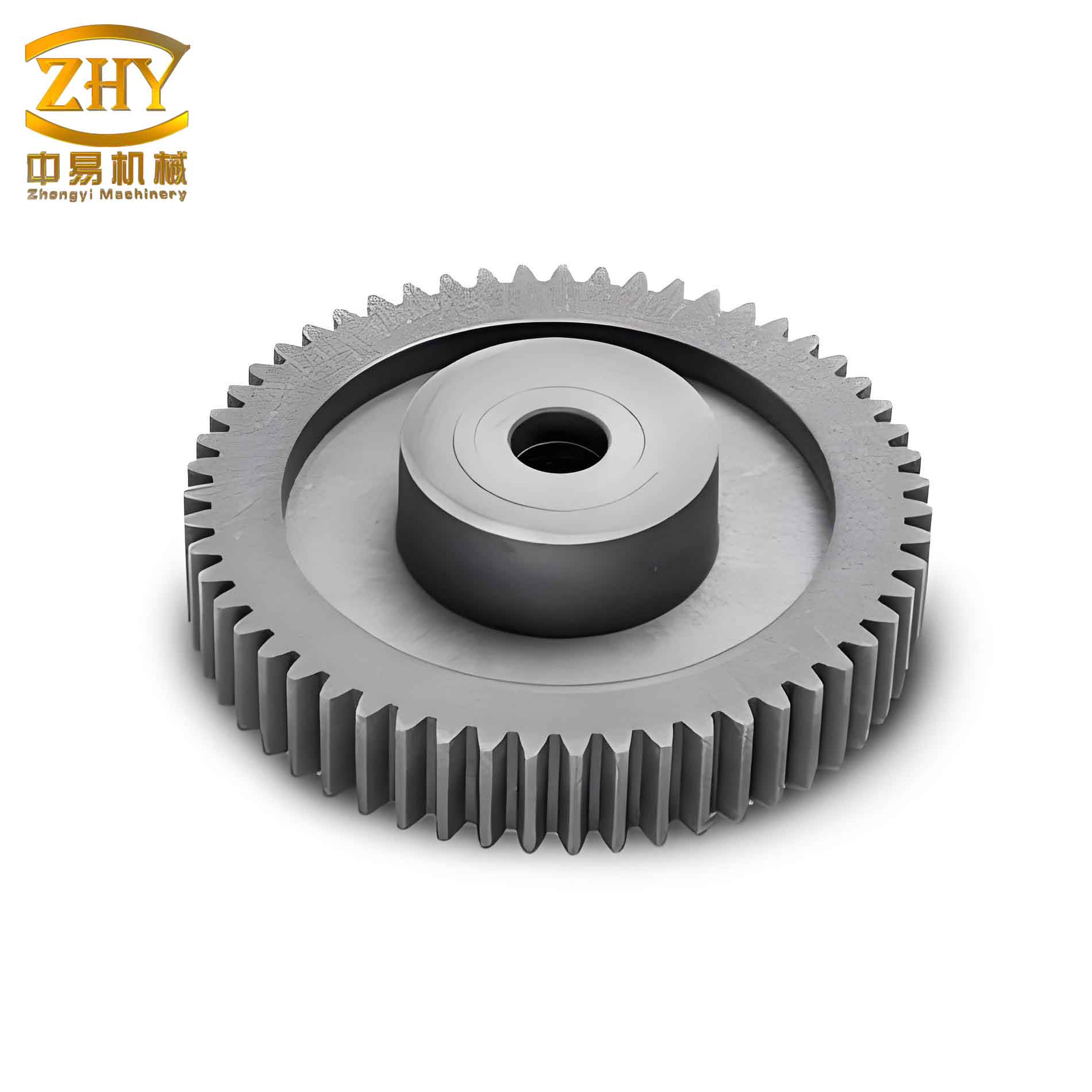
The kinematics of spur and pinion gear meshing are central to calculating the time-varying terms. The tangential velocity $v_i(t)$ for the pinion (index 1) and the spur gear (index 2) is a function of the angular velocity $\omega_i$ and the distance from the gear center to the contact point $r_{ci}(t)$:
$$v_i(t) = \omega_i \, r_{ci}(t) \sin(\alpha_i(t))$$
with $\omega_i = 2\pi n_i$, where $n_i$ is the rotational speed in revolutions per second. The pressure angle $\alpha_i(t)$ and distance $r_{ci}(t)$ evolve as the contact point moves along the line of action. The normal load per unit width $p_e(t)$ is derived from the transmitted torque $T$:
$$p_e(t) = \frac{T}{b \, r_{c1}(t) \cos(\alpha)}$$
where $b$ is the face width and $\alpha$ is the standard pressure angle. The Hertzian contact half-width $B(t)$ is calculated using classical elasticity theory:
$$B(t) = \psi \sqrt{ \frac{4 p_e(t) R(t)}{\pi} \left( \frac{1-\nu_1^2}{E_1} + \frac{1-\nu_2^2}{E_2} \right) }$$
Here, $\psi \approx 1.128$, $\nu_i$ and $E_i$ are Poisson’s ratio and Young’s modulus, and $R(t)$ is the equivalent radius of curvature at the contact point, defined as $R(t) = \frac{R_1(t) R_2(t)}{R_1(t) + R_2(t)}$.
A critical component of the model is the coefficient of friction $\mu(t)$, which is highly dependent on the lubrication regime present between the contacting teeth of the spur and pinion gear. We consider four distinct states: elastohydrodynamic lubrication (EHL), mixed lubrication, boundary lubrication, and dry contact. Each regime has a unique formulation for $\mu(t)$.
For the EHL regime, the friction coefficient is a complex function of operating conditions and lubricant properties:
$$\mu_{E}(t) = e^{f(s(t), F_{hz}(t), \eta_0, S_{av})} F_{hz}(t)^{b_2} |s(t)|^{b_3} v_e(t)^{b_6} \eta_0^{b_7} R(t)^{b_8}$$
where $f(\cdot) = b_1 + b_4 |s(t)| F_{hz}(t) \lg(\eta_0) + b_5 e^{-|s(t)| F_{hz}(t) \lg(\eta_0)} + b_9 S_{av}$. The terms $s(t)=\frac{v_s(t)}{v_e(t)}$ is the slide-to-roll ratio, $v_s(t)=|v_1(t)-v_2(t)|$ is the sliding velocity, $v_e(t)=\frac{|v_1(t)+v_2(t)|}{2}$ is the entrainment velocity, $F_{hz}(t)$ is the Hertzian contact stress, $\eta_0$ is the dynamic viscosity of the lubricant at ambient conditions, and $S_{av}$ is the average surface roughness. The coefficients $b_1$ through $b_9$ are empirical regression constants.
Under mixed lubrication conditions, the friction coefficient for the spur and pinion gear interface is given by:
$$\mu_{m}(t) = 0.0127 \times \frac{1.13}{1.13 – S_{av}} \lg\left( \frac{29700 \, p_e(t)}{\eta_0 v_s(t) v_e(t)^2} \right)$$
In the boundary lubrication regime, the friction coefficient depends on the gear kinematics and an average friction value:
$$\mu_{b}(t) = \frac{2 \mu_{av}}{\pi} \arctan\left[ \Phi x_i(t) \right] + \frac{2 \mu_{av} \sigma x_i(t)}{\pi \left[1 + \Phi^2 x_i(t)^2 \right]}$$
where $\mu_{av}$ is the average boundary friction coefficient, $\Phi$ is a smoothing factor (typically 50), $\sigma$ is the gear ratio, and $x_i(t)$ is a periodic displacement function related to the gear geometry. Finally, for dry contact between the spur and pinion gear teeth, a constant coefficient of friction $\mu_d = 0.4$ is adopted, representing a typical value for unlubricated steel surfaces.
To systematically analyze the influence of various parameters, we defined a baseline set of geometric and material properties for a representative spur and pinion gear pair. These are summarized in the table below.
| Parameter | Pinion (Driver) | Spur Gear (Driven) |
|---|---|---|
| Module, m (mm) | 5 | 5 |
| Number of Teeth, z | 21 | 26 |
| Pressure Angle, α (°) | 20 | 20 |
| Face Width, b (mm) | 25 | 20 |
| Young’s Modulus, E (GPa) | 163 | 211 |
| Poisson’s Ratio, ν | 0.277 | 0.33 |
| Material | Constantan | 40Cr Steel |
| Density, ρ (kg/m³) | 8900 | 7820 |
| Thermal Conductivity, g (W/m·K) | 22 | 32 |
| Specific Heat Capacity, c (J/kg·K) | 420 | 550 |
With the theoretical model established, we developed a numerical computation procedure to solve for the contact temperature $T_C(t)$ over a complete meshing cycle for the spur and pinion gear. The cycle is discretized into small time steps, and at each step, all kinematic quantities, loads, friction coefficients, and finally the flash and total contact temperatures are calculated. This allows us to map the temperature distribution along the entire path of contact.
Parallel to the numerical work, we constructed an experimental test rig specifically designed to measure the tooth surface contact temperature in a single-tooth meshing condition for spur and pinion gears. The setup featured a variable-speed motor driving a pinion, which engaged with a multi-sectored spur gear designed to ensure single-pair contact. Temperature sensors were embedded near the surface of the test gear teeth to capture the transient temperature rise during engagement. Experiments were conducted under various combinations of rotational speed, torque, and lubricant viscosity to provide data for validation.
The numerical results for the EHL regime showed a characteristic distribution of contact temperature along the line of action. The temperature was lowest near the pitch point, approximately equal to the bulk temperature. It rose significantly at the beginning of engagement (root of the driven spur gear tooth) and reached a peak near the tip of the driven spur gear tooth. This pattern is attributed to the high sliding velocities at these two extremities of the contact path in a spur and pinion gear mesh. The experimental measurements followed this general trend, though the absolute values were consistently higher than the numerical predictions. This discrepancy is primarily attributed to additional heat sources in the experimental system, such as bearing friction, which elevated the effective bulk temperature $T_B$. Nevertheless, the correlation confirmed the validity of the theoretical approach for capturing the dynamic behavior of contact temperature in spur and pinion gears.
We proceeded to perform an extensive parametric study using our numerical model. The goal was to understand the coupled effects of key operational parameters on the maximum contact temperature observed during meshing. The results are best visualized through temperature contour maps on parameter planes. The following analysis synthesizes findings across the four lubrication regimes, with particular emphasis on the EHL and mixed lubrication states as they are most common in practice.
Effect of Rotational Speed and Torque: For all lubrication states, the contact temperature in spur and pinion gears exhibited a positive correlation with both rotational speed ($n$) and torque ($T$). The temperature increase was more pronounced at higher values of both parameters. The contour plots revealed that regions of high speed combined with high torque resulted in the most severe thermal conditions. In the dry contact regime, temperatures were universally highest due to the elevated friction coefficient. This underscores the necessity of adequate lubrication for spur and pinion gears operating under high load and speed.
Effect of Rotational Speed and Lubricant Viscosity: The interaction between speed ($n$) and lubricant viscosity ($\eta_0$) revealed a contrasting behavior between EHL and mixed lubrication. Under EHL conditions, for speeds above approximately 500 rpm, increasing lubricant viscosity led to a significant rise in contact temperature for the spur and pinion gear pair. This is because higher viscosity increases fluid friction and shear heating within the lubricant film. Conversely, under mixed lubrication, higher viscosity generally promoted better separation of the surfaces, reducing asperity contact and friction, thus leading to a moderate decrease in contact temperature, especially at higher speeds.
Effect of Torque and Lubricant Viscosity: Similar to the speed-viscosity coupling, the torque-viscosity plane showed divergent trends. In EHL, higher viscosity exacerbated the temperature rise at moderate to high torque levels. In mixed lubrication, a higher viscosity provided a slight mitigating effect on the temperature increase caused by higher torque. For boundary and dry lubrication states, lubricant viscosity had negligible influence on the contact temperature of the spur and pinion gear teeth, as the friction mechanism is dominated by surface interactions rather than fluid film effects.
To quantify some of these relationships, we present a summary table of trends for the maximum contact temperature $T_{C,max}$ in the EHL regime:
| Parameter Increased | Effect on $T_{C,max}$ (EHL Regime) | Physical Reason |
|---|---|---|
| Rotational Speed, $n$ | Increase | Higher sliding speeds generate more frictional heat per unit time. |
| Transmitted Torque, $T$ | Increase | Higher normal load increases contact pressure and friction force. |
| Lubricant Viscosity, $\eta_0$ | Increase | Enhanced fluid shear stress within the EHL film leads to more viscous heating. |
| Backlash, $J_n$ | Slight Increase | Can induce impact and altered meshing dynamics, increasing energy dissipation. |
Effect of Rotational Speed and Backlash: Backlash ($J_n$) is an essential design clearance in spur and pinion gear assemblies. Our analysis indicated that increasing backlash generally led to a slight increase in contact temperature across all lubrication states. The primary mechanism is not direct frictional heating but rather the potential for increased dynamic loads and impacts due to the clearance, which indirectly elevates the effective meshing forces and thus the temperature. However, the magnitude of the temperature change due to backlash variation was relatively small compared to the effects of speed or torque.
Effect of Torque and Backlash: The coupling of torque and backlash showed that at higher torque levels, the influence of increased backlash on temperature became marginally more noticeable. Nonetheless, the dominant factor governing contact temperature in this parameter plane remained the applied torque. This suggests that for thermal design purposes concerning spur and pinion gears, precise control of backlash is less critical than managing the load and speed, though excessive backlash should be avoided due to its detrimental effects on noise and vibration.
Effect of Lubricant Viscosity and Backlash: The contour plots for the viscosity-backlash plane reinforced the earlier findings. In the EHL regime, high viscosity coupled with any backlash value yielded higher temperatures. In mixed lubrication, higher viscosity tended to lower the temperature slightly, regardless of backlash. The interaction between these two parameters was found to be weak; their effects on spur and pinion gear contact temperature were largely independent.
The mathematical core of our model can be further condensed into a set of governing equations. The central differential relationship for the flash temperature increment during an infinitesimal contact time in a spur and pinion gear can be conceptualized from the heat partition theory. The instantaneous heat flux $q(t)$ generated at the contact is $q(t) = \mu(t) p_e(t) v_s(t)$. The resulting flash temperature rise is proportional to this flux and inversely proportional to a thermal effusivity term and the square root of contact time, which relates to the contact half-width and the rolling velocity. Our final implemented model synthesizes these principles into the computational framework described.
In conclusion, this integrated study on spur and pinion gear tooth surface contact temperature provides a robust methodology for its prediction and analysis. We have derived and implemented a dynamic temperature model based on Blok’s flash theory, incorporating realistic friction models for four lubrication regimes. Experimental validation under elastohydrodynamic conditions confirmed the model’s capability to capture the correct trends. The comprehensive parametric investigation yielded several key insights: The contact temperature in spur and pinion gears is lowest at the pitch point and peaks at the start and end of engagement. Rotational speed and torque have a strongly positive correlation with contact temperature. The influence of lubricant viscosity is regime-dependent, elevating temperature in EHL but potentially reducing it in mixed lubrication. Backlash has a minor but consistently positive effect on temperature. Ultimately, maintaining spur and pinion gear systems in the EHL regime with appropriately selected lubricant viscosity (lower for high-speed EHL) and minimizing operational loads and speeds where possible are the most effective strategies for mitigating excessive contact temperature and preventing associated failure modes like scuffing. This work establishes a foundation for the thermal design and condition monitoring of spur and pinion gear drives in demanding applications.