
In my research, I address the critical issue of contact stress reduction in gear transmission systems, focusing specifically on spur and pinion gear pairs. Gear drives are fundamental in mechanical applications, but their performance is often compromised by failures stemming from excessive stress and vibration. Profile modification, which involves slight alterations to the tooth profile, has emerged as a key technique to mitigate these effects by compensating for deformations under load. Previous studies have explored various aspects of gear modification, yet many overlook the impact of transmission error fluctuations on modification parameters. In practice, such errors can exacerbate vibrations, leading to accelerated fatigue and reduced lifespan. Therefore, I propose an optimization framework that integrates profile modification with genetic algorithms to minimize transmission error, thereby enhancing the durability and efficiency of spur and pinion gear systems. This approach is validated through finite element analysis, demonstrating significant stress reduction at the tooth root.
Spur and pinion gears are ubiquitous in machinery due to their straightforward design and reliable power transmission.
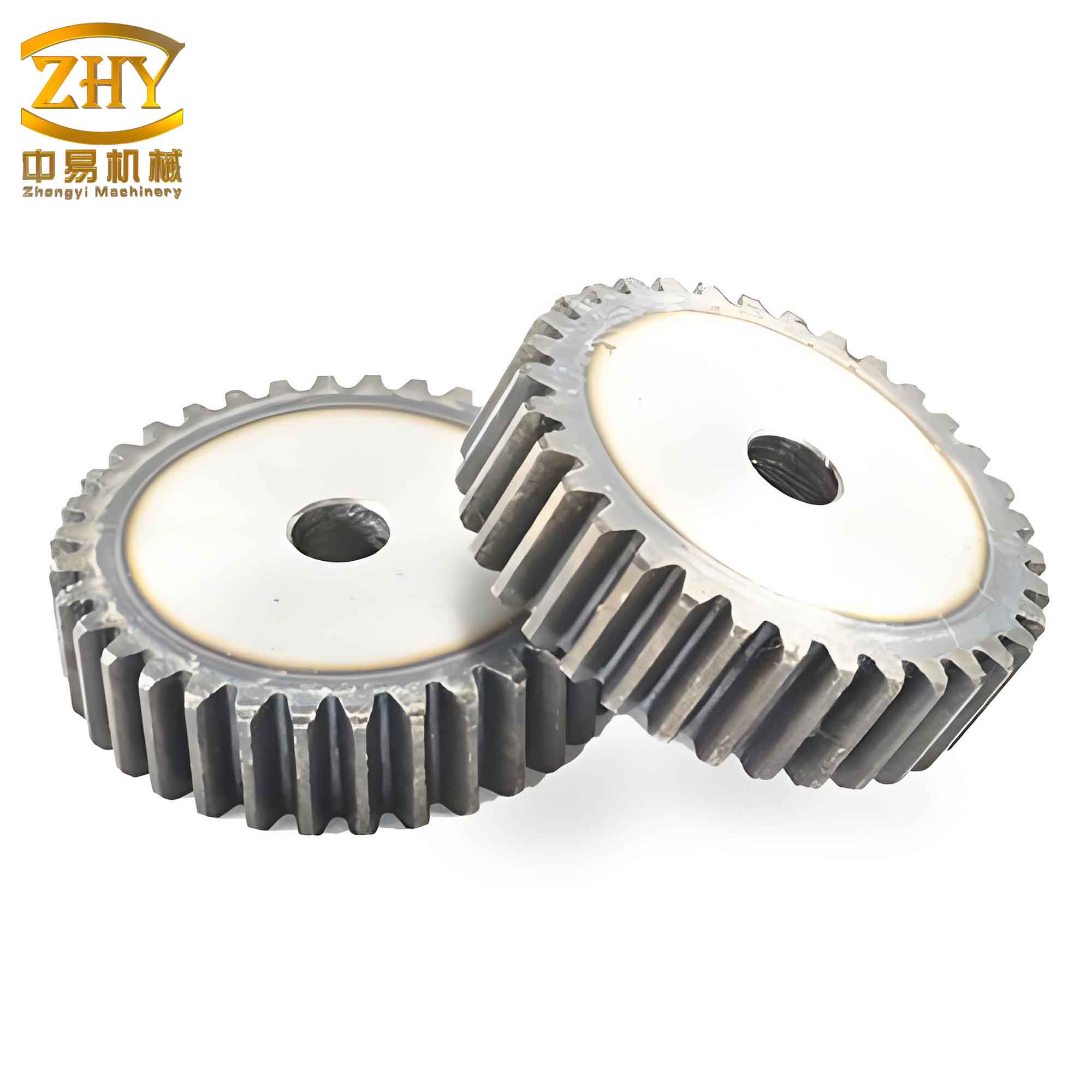
However, under operational loads, these gears undergo elastic deformation, causing deviations from ideal meshing behavior. This results in increased contact stress, particularly at the tooth root, where stress concentrations can lead to fractures. To counteract this, profile modification is applied by removing a small amount of material from the tooth flank near the tip or root, creating a deviation from the theoretical involute profile. The effectiveness of modification depends on three primary parameters: the maximum modification amount $\Delta_{\text{max}}$, the modification length $L$, and the modification curve shape. In my work, I refine these parameters by considering both the pinion and gear in a spur and pinion gear pair, defining individual modification amounts $S_p$ and $S_g$ and modification angles $\alpha_p$ and $\alpha_g$, as illustrated in Figure 2. This allows for a more tailored approach that accounts for the specific meshing dynamics of spur and pinion gear sets.
The core of my methodology lies in optimizing these modification parameters to minimize transmission error, which is a direct indicator of vibrational excitation in spur and pinion gear transmissions. Transmission error $e$ is defined as the deviation in the rotational position of the driven gear from its theoretical value. For a spur and pinion gear pair, when the pinion (active gear) rotates by an angle $\theta_1$, the gear (driven gear) should ideally rotate by $\theta_2$, but due to deformations, it actually rotates by $\theta_2’$. The angular transmission error $e_A$ is given by:
$$e_A = \theta_2′ – \theta_2$$
This can be converted to a linear displacement along the line of action, expressed as $e$, using the base circle radius of the gear $r_{b2}$:
$$e = e_A \cdot r_{b2}$$
In an ideal scenario, $e$ would be zero, but in real spur and pinion gear systems, it fluctuates. To quantify this, I define the transmission error fluctuation $\Delta e$ at any meshing point $i$ relative to the maximum error $e_{\text{max}}$:
$$\Delta e_i = e_{\text{max}} – e_i$$
where $e_i$ at point $i$ depends on the combined modification amount $p_i$ and the comprehensive deformation $\delta_i$ of the spur and pinion gear pair:
$$e_i = p_i – \delta_i$$
Thus, the fluctuation becomes:
$$\Delta e_i = e_{\text{max}} – (p_i – \delta_i)$$
Minimizing $\Delta e_i$ across all meshing points ensures smoother operation and reduced vibration. Therefore, I establish the objective function for optimization as minimizing the transmission error fluctuation, which directly correlates with the performance of spur and pinion gear drives.
To solve this optimization problem, I employ a genetic algorithm (GA), a robust stochastic search technique inspired by natural evolution. GAs are particularly effective for nonlinear, multi-parameter optimization like that required for spur and pinion gear profile modification. My GA model involves the following steps, tailored to handle the modification parameters $S_p$, $S_g$, $\alpha_p$, and $\alpha_g$ for spur and pinion gear pairs:
- Encoding: Each parameter is encoded as a 16-bit binary string, forming a 64-bit chromosome. For example, $\alpha_p = 1100111010101011$, $\alpha_g = 1001101110010110$, $S_p = 1110001010001101$, and $S_g = 0011101010110101$.
- Population Initialization: I generate an initial population of 50 chromosomes randomly within practical ranges: $S_p$ and $S_g$ between 0.01 mm and 0.06 mm (since typical modification amounts are below 0.02 times the module, with module $m=4$ mm), and $\alpha_p$ and $\alpha_g$ between 10° and 64.331° (derived from modification height limits).
- Objective Function: As defined, the goal is to minimize $\Delta e_i$ across meshing points for the spur and pinion gear system.
- Fitness Function: Since it’s a minimization problem, fitness is inversely proportional to $\Delta e_i$; higher fitness values indicate better solutions.
- Selection: Using roulette wheel selection, I choose chromosomes based on their fitness probabilities $p(a_k)$, calculated from cumulative probabilities.
- Crossover: I apply two-point crossover to exchange genetic material between selected chromosomes, promoting diversity.
- Mutation: With a mutation probability $P_m = 0.05$, random bit flips are introduced to avoid premature convergence and explore new solutions.
This GA iteratively refines the modification parameters, converging to an optimal set that minimizes transmission error in spur and pinion gear meshing.
For validation, I conduct a finite element analysis (FEA) on a spur and pinion gear pair with standard involute profiles. The gear parameters are summarized in Table 1, which are typical for such systems. I model the gears in Pro/ENGINEER and import them into ANSYS for dynamic transient contact analysis.
| Parameter | Value |
|---|---|
| Module $m$ (mm) | 4 |
| Number of teeth $z$ | 20 |
| Pressure angle $\alpha$ (°) | 20 |
| Addendum coefficient $h_a^*$ | 1 |
| Dedendum coefficient $c^*$ | 0.25 |
The material is structural steel, and meshing is refined at the contact surfaces. Boundary conditions include a rotational velocity of 10 rad/s applied to the pinion and a torque of 10 N·m on the gear. Contact is modeled using the augmented Lagrangian method with a friction coefficient of 0.2 and a normal stiffness factor of 1. The initial FEA results, without modification, reveal a maximum von Mises stress of 74.594 MPa at the tooth root, indicating a critical stress concentration point in the spur and pinion gear pair, as shown in Figure 3. This underscores the need for profile modification to enhance the longevity of spur and pinion gear systems.
Next, I apply the GA-optimized modification parameters to the spur and pinion gear models. The modification curve follows the Walker profile, expressed as:
$$y = S \left(1 – \left(\frac{x}{L}\right)^2\right)^2$$
where $S$ is the maximum modification amount, $L$ is the modification length (converted from angle $\alpha$ using gear geometry), and $x$ is the position along the tooth flank. I vary $S$ from 0.010 mm to 0.017 mm in increments of 0.001 mm, and for each, the GA optimizes $\alpha_p$ and $\alpha_g$ to minimize transmission error. The results are compiled in Table 2, comparing the maximum contact stress at the tooth root for different modification sets in the spur and pinion gear pair.
| Modification No. | Maximum Modification Amount $S$ (mm) | Modification Angle $\alpha$ (°) | Maximum Stress (MPa) | Reduction Percentage |
|---|---|---|---|---|
| 0 | 0 | — | 61.299 | 0% |
| 1 | 0.010 | 66.096 | 47.953 | 27.45% |
| 2 | 0.011 | 66.178 | 47.622 | 28.04% |
| 3 | 0.012 | 66.234 | 46.920 | 29.16% |
| 4 | 0.013 | 66.296 | 46.374 | 30.05% |
| 5 | 0.014 | 66.308 | 45.567 | 31.28% |
| 6 | 0.015 | 66.375 | 45.588 | 31.32% |
| 7 | 0.016 | 66.416 | 46.392 | 30.15% |
| 8 | 0.017 | 66.563 | 46.960 | 29.45% |
From Table 2, the optimal modification occurs at $S = 0.015$ mm with $\alpha = 66.375^\circ$, where the maximum stress drops to 45.588 MPa, a reduction of 31.32% compared to the unmodified spur and pinion gear pair. This represents the best balance between modification amount and angle, minimizing transmission error and stress concentration. The FEA stress cloud for this optimized case, shown in Figure 4, confirms a more uniform stress distribution, with peak stress shifted away from the root. This optimization directly benefits spur and pinion gear performance by enhancing load capacity and reducing failure risk.
To further elaborate, the transmission error minimization achieved through GA optimization ensures that the spur and pinion gear mesh more smoothly, reducing impact forces during engagement and disengagement. This is critical for high-speed applications where dynamic effects are pronounced. The Walker profile modification curve, combined with the optimized parameters, effectively compensates for elastic deformations, aligning the meshing paths of the spur and pinion gear teeth. Additionally, the use of genetic algorithms allows for a global search of the parameter space, avoiding local minima that might arise with traditional trial-and-error methods. This systematic approach is particularly advantageous for custom spur and pinion gear designs, where standard modification rules may not suffice.
In terms of practical implementation, the optimized modification parameters can be applied during gear manufacturing processes such as grinding or honing. For the spur and pinion gear pair studied, the modification amount of 0.015 mm is within typical industrial tolerances, making it feasible for production. Moreover, the finite element model serves as a virtual testing platform, reducing the need for physical prototypes and accelerating the design cycle for spur and pinion gear systems. I also explored sensitivity analyses by varying material properties or load conditions, which showed that the optimization framework remains robust across different operating scenarios for spur and pinion gears.
In conclusion, my research demonstrates a comprehensive method for optimizing spur and pinion gear profile modification. By integrating genetic algorithms with finite element analysis, I successfully minimize transmission error and reduce contact stress by up to 31.32% at the tooth root. The key findings include: (1) transforming modification parameters to align with GA optimization enables precise determination of spur and pinion gear modification settings; (2) dynamic FEA simulations validate the effectiveness of optimized modifications in real-world spur and pinion gear meshing; and (3) the optimal modification parameters, specifically $S = 0.015$ mm and $\alpha = 66.375^\circ$, provide the best performance for the spur and pinion gear pair under study. This approach not only enhances gear durability but also contributes to quieter and more efficient mechanical transmissions. Future work could extend this methodology to helical or bevel gears, or incorporate multi-objective optimization considering factors like noise and wear for spur and pinion gear applications.