
I have been deeply involved in the design and research of hydrostatic worm gears and worm rack transmission pairs for high-precision, heavy-duty applications. This type of transmission converts rotary motion into linear displacement with exceptional accuracy and stiffness. The fundamental principle relies on a highly rigid, vibration-damping oil film that separates the worm gears and the worm rack teeth. This oil film not only eliminates wear in the transmission pair but also ensures that each tooth of the worm gears meshes correctly with the corresponding tooth of the rack, thereby averaging out manufacturing errors. As a result, the influence of component fabrication inaccuracies on the overall transmission precision is significantly reduced, while efficiency is notably improved. Furthermore, this design provides excellent load-bearing stiffness and helps eliminate low-speed crawling phenomena, making it widely applicable in heavy-duty machine tools, CNC machines, high-precision machines, and other precision machinery.
1. Structure of Hydrostatic Worm Gears and Worm Rack Transmission
In my work, I have found that the hydrostatic worm gears and worm rack transmission exhibit very high rigidity. This is partly due to the appropriate selection of the tooth profile half-angles, which leads to minimal relative displacement under load. The working mechanism involves a pressure distribution between the left and right tooth flanks. When no external load is applied, the oil pressure in the chambers on both sides is equal, and the axial clearance between the worm gears and the worm rack is uniform on both sides. Under an axial load, the clearances on the loaded and unloaded sides change accordingly, creating a pressure difference that balances the applied load.
A critical aspect of the design is the oil distribution system. The hydrostatic worm gears and worm rack transmit load only within a specific meshing zone defined by an opening angle \( \alpha \). Therefore, the oil supply must be continuously provided to the load-bearing oil pockets within this meshing zone, while also ensuring that the inlet holes on the worm gears are pre-filled with oil and vented before entering the meshing zone. Additionally, radial unbalanced hydraulic forces must be addressed.
Based on the oil distribution method, I classify the transmission into radial and axial distribution types. According to the location of the oil pockets, the pockets can be machined either on the worm gears or on the worm rack. My experience shows that placing the oil pockets on the worm rack yields about 30% higher load capacity for the same meshing angle, because of a better effective bearing area utilization coefficient. Hence, I prefer to cut the pockets on the worm rack, despite the increased manufacturing complexity. The pockets are typically located at the pitch diameter of the rack, with a width of \( b = 0.3 \) to \( 0.4 \) times the tooth pitch and a depth of \( 0.5 \) to \( 1.0 \) mm. The ends of the pockets are not open to maintain sealing lands.
To minimize radial unbalanced forces and improve transmission accuracy, I commonly select tooth profile half-angles of \( 15^{\circ} \) or \( 20^{\circ} \) for the worm gears, and employ high-stiffness bearings to reduce radial deflection of the worm. The meshing zone opening angle \( \alpha \) is usually kept below \( 70^{\circ} \). To enhance sealing effectiveness, the tooth height of the worm gears is often taken as 1.2 to 1.5 times the tooth pitch. The number of worm gear starts generally does not exceed 6 to 8.
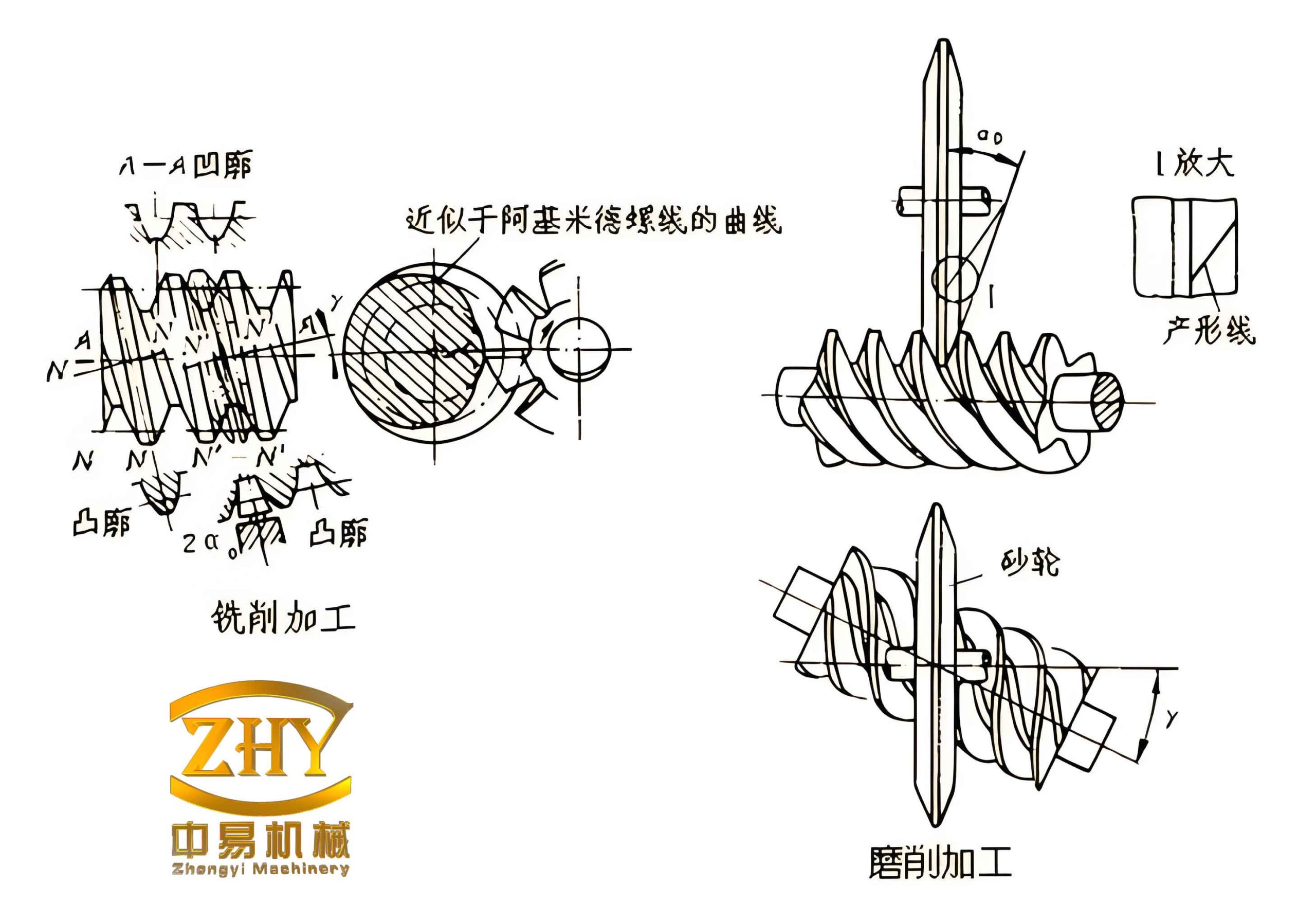
2. Precision Requirements for Hydrostatic Worm Gears and Worm Rack
During meshing, the tooth flanks of the hydrostatic worm gears and worm rack must not come into direct contact. The oil film thickness typically ranges from 20 to 40 μm. To maintain this film thickness over the entire meshing length without tooth contact, the single-pitch error must be limited to about 1/6 of the oil film thickness, and the cumulative pitch error to about 1/3 of the oil film thickness. However, manufacturing hydrostatic worm gears and worm racks is more challenging than producing ordinary worm gear pairs of the same grade, because the hydrostatic worm gears are longer than conventional ones. Even if each component meets standard tolerances, the cumulative relative error between the worm gears and the rack could be as high as the sum of their individual errors, which may exceed the allowed margin.
For example, suppose the allowed cumulative error for a component is \( \pm \Delta_0 L / P \), where \( P \) is the tooth pitch and \( L \) is the measurement length. If the worm gears have a cumulative error of \( +0.5 \Delta_0 L / P \) and the rack has a cumulative error of \( -0.5 \Delta_0 L / P \), their relative cumulative error becomes \( \Delta_0 L / P \), which is exactly twice the individual tolerance. This leaves no margin for a stable oil film. Hence, even if both parts achieve Grade 6 accuracy, tooth contact may still occur, preventing the formation of a proper hydrostatic film. Therefore, I impose stricter limits: the cumulative error of each part must not exceed 1/3 of the oil film thickness, and the direction of the error accumulation should be matched so that the difference between the two parts stays within the allowable range.
Similarly, the tooth profile angle error is restricted to \( \pm 2 \) to \( \pm 3 \) minutes of arc, which is much tighter than for ordinary worm gear pairs. Since a single machine tool may require many worm rack segments (sometimes dozens), the alignment and assembly accuracy must be high, and all racks in the same machine must have consistent fundamental parameters and precision levels.
3. Selection of Main Parameters for the Hydrostatic System
The hydraulic supply system for the hydrostatic worm gears and worm rack can be either constant-flow or constant-pressure. When using a constant-pressure system, appropriate flow restrictors such as capillary tubes, orifice plates, or double-diaphragm variable restrictors must be added. The effective bearing area \( A_{e} \) and the flow rate \( Q \) are calculated based on the geometry of the oil pockets and the oil film thickness.
Consider the simplified model shown schematically in many references. Under no load, the oil pressure in both left and right tooth flank pockets equals the supply pressure \( p_s \), and the clearances are equal to \( h_0 \). Under an axial load \( F_a \), the clearances become \( h_1 \) and \( h_2 \), and the pressure difference \( p_1 – p_2 \) balances the load. The effective area per tooth flank pocket can be expressed as:
$$ A_{e} = \frac{P^2}{2 \tan \beta} \left[ \frac{\sin(\alpha/2)}{(\alpha/2)} \right] $$
where \( P \) is the tooth pitch, \( \beta \) is the tooth profile half-angle, and \( \alpha \) is the meshing zone opening angle (in radians). The flow rate through each pocket is given by:
$$ Q = \frac{h^3}{12 \eta} \cdot \frac{P}{b} \cdot (p_s – p) $$
where \( h \) is the oil film thickness, \( \eta \) is the dynamic viscosity of the oil, \( b \) is the pocket width, and \( p \) is the pocket pressure.
For a system using a dual pump (two pumps with equal flow rates), the load capacity is limited by the maximum allowable pressure in the loaded pocket. The maximum load capacity is:
$$ F_{max} = A_{e} \, p_{max} $$
where \( p_{max} \) is the maximum working pressure of the pump. Due to the tooth profile half-angle, a radial force arises:
$$ F_r = F_a \tan \beta $$
This radial force causes a radial deflection of the worm relative to the rack. The radial displacement \( \delta_r \) is:
$$ \delta_r = \frac{F_r}{k_r} $$
where \( k_r \) is the radial stiffness of the worm support bearings. The oil film stiffness \( K \) is defined as:
$$ K = \frac{\partial F}{\partial h} $$
For a dual-pump system, the stiffness can be derived as:
$$ K = \frac{3 A_{e} p_s}{h_0} \left(1 – \frac{p_{max}}{p_s}\right) $$
3.1 Comparison of Supply Systems
I have evaluated several supply systems: dual-pump, flow divider (with a single pump and a diaphragm), fixed restrictors, and regulator systems. The table below summarizes the key characteristics.
| System Type | Oil Film Stiffness | Complexity | Stability | Typical Application |
|---|---|---|---|---|
| Dual pump (constant flow) | Moderate | Low (simple pumps) | Good | Heavy machinery |
| Flow divider (diaphragm) | Up to 2× higher than dual pump with reduced flow | Medium | Requires careful design to avoid self-excited vibration | High stiffness requirements |
| Fixed restrictor (capillary/orifice) | Sufficient for many applications | Low (simple) | Very stable | Heavy machine tools |
| Regulator (constant pressure with feedback) | Very high at small loads, but degrades at large loads | High (precision manufacture) | Prone to oscillation | Special high-precision cases |
3.1.1 Dual-Pump System
In the dual-pump system, two pumps with identical flow rates supply the left and right pockets separately. The load capacity depends on manufacturing precision and the maximum allowable pressure. For high-precision transmission pairs, the load capacity is only pressure-limited. The calculation is performed under the condition that the maximum change in oil film thickness \( \Delta h_{max} = h_0 – h_{min} \) is maintained within design limits. The load capacity at the limit is:
$$ F_{max} = \frac{A_{e} p_s}{2} \left[ 1 – \left(\frac{h_{min}}{h_0}\right)^3 \right] $$
Figure 2 (not shown) in the original document indicates that the oil film thickness variation under load closely matches theoretical predictions when bearing deflection and tooth deformation are accounted for. The actual stiffness is slightly lower than the pure oil film stiffness due to the radial squeezing of the worm in its bearings and the elastic deformation of the teeth themselves. Nevertheless, the calculated stiffness provides a good approximation.
3.1.2 Flow Divider System
The flow divider uses a single pump and a diaphragm-type flow divider valve. Under no load, the diaphragm is centered, supplying equal flow to both sides. Under load, the pressure in the loaded pocket increases, causing the diaphragm to deflect, thereby increasing flow to the loaded side and decreasing flow to the unloaded side. The load characteristic depends on a dimensionless parameter \( \lambda \) related to the diaphragm stiffness, nozzle diameter, and initial gap. I have found that by reducing the diaphragm stiffness (i.e., increasing the value of \( \lambda \)), the oil film stiffness can be increased up to twice that of the dual-pump system at lower flow rates. However, excessive reduction of diaphragm stiffness may lead to self-excited vibration. To avoid this, I ensure that:
$$ \lambda \leq 0.8 $$
The relationship between the relative change in oil film thickness \( \varepsilon = (h – h_0)/h_0 \) and the dimensionless load factor \( \overline{F} \) for a flow divider system is nonlinear. The performance curves show that for small loads, the displacement can actually be opposite to the load direction if the system is designed with certain parameters, which helps in compensating for other parts of the machine. But at high loads, the performance deteriorates.
3.1.3 Fixed Restrictor System
Fixed restrictors, such as capillary tubes or sharp-edged orifices, are the simplest and most reliable. They provide sufficient stiffness for most heavy machine tool applications. The calculation of effective area and flow follows the same formulas as above, with the restrictor providing a constant hydraulic resistance. The stiffness is given by:
$$ K = \frac{3 A_{e} p_s}{h_0} \cdot \frac{1}{1 + R} $$
where \( R \) is the ratio of restrictor resistance to pocket resistance at the design point. Typically, \( R \) is chosen between 1 and 2 to balance stiffness and flow.
3.1.4 Regulator System
The regulator system maintains constant pressure in the supply line and uses feedback to adjust the pocket pressures. In theory, it can achieve very high stiffness, especially at small loads. However, the regulator must be manufactured with great precision, and it is prone to instability (self-oscillation). The characteristic curve shows that at low loads, the oil film can actually allow displacement in the direction opposite to the load, which might compensate for other errors. But under high loads, the system performance becomes poor. Therefore, I recommend the regulator system only for specialized applications where the load range is narrow and precision requirements are extreme.
4. Design Calculations and Parameter Selection
I have developed a set of design steps for a typical hydrostatic worm gears and worm rack transmission. The main parameters to be determined include: tooth pitch \( P \), tooth profile half-angle \( \beta \), worm gear pitch diameter \( d_w \), number of starts \( z_1 \), meshing zone opening angle \( \alpha \), oil film thickness \( h_0 \), pocket dimensions, and supply pressure \( p_s \).
4.1 Gear Geometry
The worm gears are usually right-handed or left-handed cylindrical worms with a standard module \( m \). The tooth pitch is \( P = \pi m \). The worm gear pitch diameter is \( d_w = m z_1 / \tan \gamma \), where \( \gamma \) is the lead angle. For hydrostatic designs, the tooth height is often increased to 1.3\( P \) to improve sealing. The rack tooth form is conjugate to the worm gears.
4.2 Effective Area and Flow Rate
The effective area of a single pocket on one tooth flank of the rack is:
$$ A_{e} = \frac{P^2}{2 \tan \beta} \cdot \eta_a $$
where \( \eta_a \) is the angle factor \( \frac{\sin(\alpha/2)}{(\alpha/2)} \). The flow rate through one pocket at the design oil film thickness \( h_0 \) is:
$$ Q_0 = \frac{h_0^3}{12 \eta} \cdot \frac{P}{b} \cdot (p_s – p_0) $$
with \( p_0 \) being the pocket pressure at zero load, typically \( p_0 = p_s / 2 \) for a symmetric system. The total flow for the entire transmission is the sum over all engaging pockets within the meshing zone. Typically, the number of simultaneously meshing teeth is about \( \frac{\alpha}{2\pi} z_1 \).
4.3 Load Capacity and Stiffness
The maximum load capacity for a dual-pump system is:
$$ F_{max} = A_{e} \left( p_{max} – \frac{p_s}{2} \right) $$
where \( p_{max} \) is limited by the pump’s maximum pressure and also by the structural strength of the rack. The oil film stiffness at the design point is:
$$ K_{oil} = \frac{3 A_{e} p_s}{2 h_0} $$
When considering the total stiffness including the bearing and tooth deformation, the combined stiffness \( K_{total} \) can be approximated as:
$$ \frac{1}{K_{total}} = \frac{1}{K_{oil}} + \frac{1}{K_{bearing}} + \frac{1}{K_{tooth}} $$
Typical values for a well-designed system: \( h_0 = 25 \) μm, \( p_s = 5 \) MPa, \( A_{e} = 200 \) mm² per tooth, leading to \( K_{oil} \approx 120 \) kN per mm per tooth. With 5 teeth meshing simultaneously, the total oil film stiffness is about 600 kN/mm, which is very high.
4.4 Power Consumption
The hydraulic power consumed is \( Q_{total} \cdot p_s \). For a large machine tool, the flow rate might be 40 L/min at 5 MPa, giving about 3.3 kW of hydraulic power. This must be dissipated by the cooling system.
5. Summary of Design Recommendations
Based on my extensive research and practical experience, I recommend the following parameter ranges for hydrostatic worm gears and worm rack transmissions:
| Parameter | Symbol | Recommended Value | Remarks |
|---|---|---|---|
| Tooth profile half-angle | \(\beta\) | 15° or 20° | Reduces radial load |
| Meshing zone opening angle | \(\alpha\) | ≤ 70° | Ensures sealing |
| Tooth height factor | \(h_t / P\) | 1.2 – 1.5 | Improved sealing |
| Oil film thickness | \(h_0\) | 20 – 40 μm | Balance between stiffness and manufacturability |
| Pocket width factor | \(b / P\) | 0.3 – 0.4 | Keeps sufficient land |
| Pocket depth | \(t\) | 0.5 – 1.0 mm | Standard for machining |
| Supply pressure | \(p_s\) | 3 – 7 MPa | Limited by pump and strength |
| Single-pitch error tolerance | \(\Delta p\) | ≤ \(h_0/6\) | Typically 3 – 7 μm |
| Cumulative error tolerance | \(\Delta L\) | ≤ \(h_0/3\) | Typically 7 – 13 μm over 300 mm |
| Tooth profile angle error | \(\Delta \beta\) | ±2′ to ±3′ | Higher than standard worm gear pairs |
| Number of worm starts | \(z_1\) | ≤ 6 – 8 | Reduces radial load variations |
6. Conclusion
In this article, I have presented a comprehensive study of hydrostatic worm gears and worm rack transmission pairs, covering structure, precision, and the selection of main parameters. The key advantage is the elimination of wear and the high stiffness of the oil film, which improves positioning accuracy and eliminates crawling. I have detailed the design of oil pockets, the oil distribution system, and the precision requirements necessary to maintain a stable oil film. Furthermore, I have compared four types of hydraulic supply systems: dual-pump, flow divider, fixed restrictor, and regulator. Each has its strengths and weaknesses, and the choice depends on the specific application requirements such as load capacity, stiffness, complexity, and stability.
For heavy-duty machine tools, I generally recommend fixed restrictor systems because of their simplicity and reliability. For applications demanding ultra-high stiffness, a flow divider system with a carefully tuned diaphragm can double the stiffness at reduced flow. The regulator system, while promising in theory, is often impractical due to instability and manufacturing challenges. The calculations and formulas provided here serve as a practical guide for engineers designing hydrostatic worm gears and worm rack transmissions. With proper selection of parameters, these transmission pairs can achieve outstanding performance in terms of accuracy, stiffness, and longevity.