
The pursuit of efficient, material-conserving, and high-precision manufacturing methods for spur gears, fundamental components ubiquitous in mechanical systems, has been a long-standing industrial challenge. For many years, the primary production routes, especially within certain regional contexts, have involved machining for smaller gears and forging followed by machining for larger diameters. These methods, while established, are often characterized by significant material waste and limitations in production efficiency. Consequently, cold precision forging emerges as a highly promising alternative, offering the potential for near-net-shape production with superior mechanical properties and reduced post-processing.
This article presents a detailed, first-person investigation into the evolution of a novel forming process specifically designed for the cold precision forging of spur gears. The focus lies on a particular category: flat cylindrical gears where the height-to-diameter ratio (H/D) is typically less than 1/2. Forming such geometries presents a distinct challenge. Unlike taller gears suitable for forward extrusion, flat gears necessitate a radial flow of material into a complex, constricting tooth-profile cavity. This process, often referred to as extrusion-upsetting, requires substantial force, frequently pushing local stresses beyond the safe limits of conventional cold forging tool steels (often cited as 2500 MPa), leading to premature die failure and hindering industrial adoption.
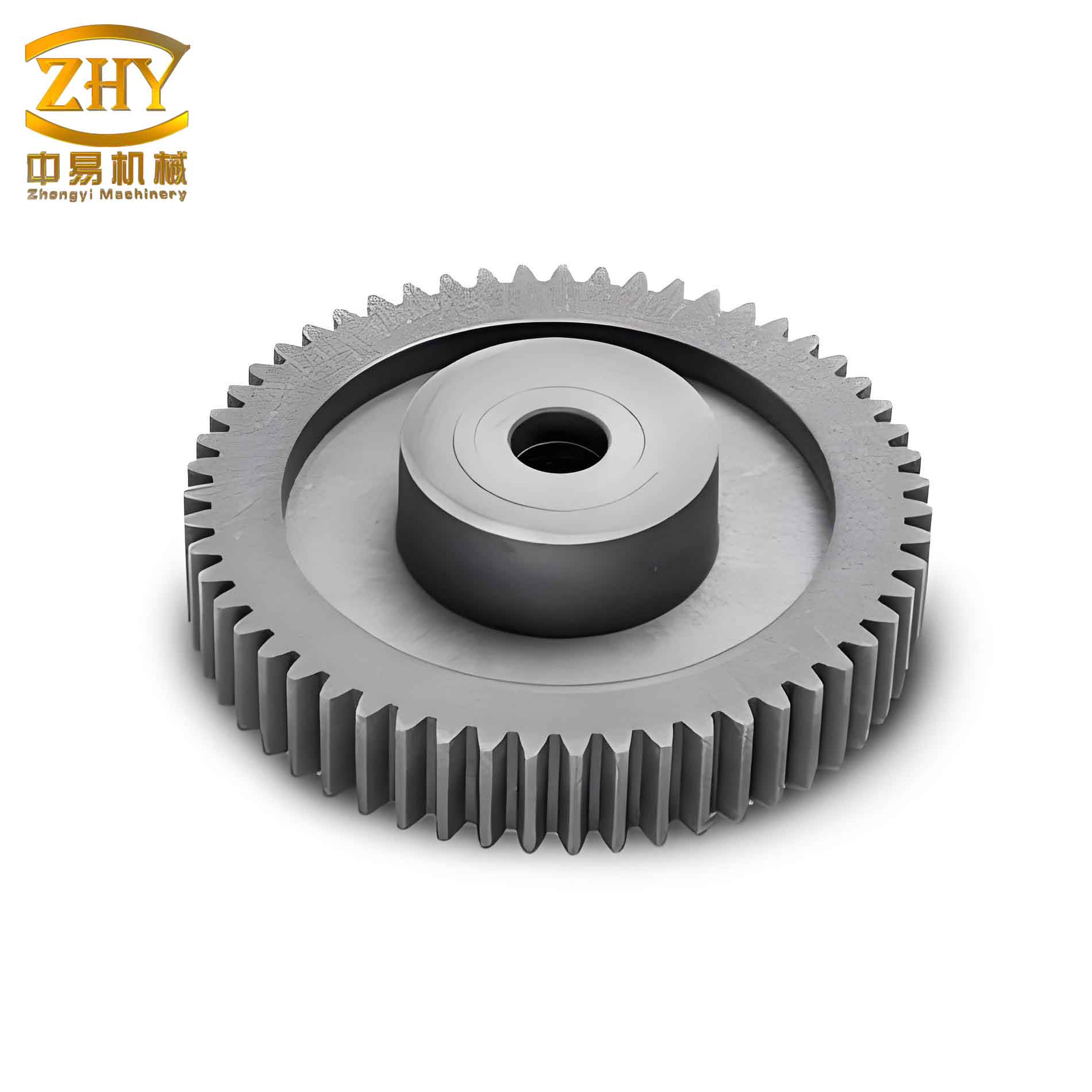
The core challenge in spur gear forming is twofold: firstly, to manage and drastically reduce the extreme forming pressures required to completely fill the intricate tooth cavities; and secondly, to ensure the uniform filling of these cavities to guarantee dimensional accuracy and structural integrity of the final spur and pinion gear. Traditional single-action forming, where a punch drives material into a stationary die, often results in non-uniform filling due to asymmetric frictional constraints, requiring disproportionately high forces for the final filling stages.
My research began with a systematic evaluation of existing and conceptual forming strategies for the spur and pinion gear. The objective was to understand metal flow characteristics and load requirements. Three primary process routes were identified and analyzed through a combination of physical experimentation and finite element method (FEM) numerical simulation:
| Process Route | Description | Key Observation from Initial Trials |
|---|---|---|
| One-Way Extrusion-Upsetting | A single upper punch forces a blank radially into a stationary die cavity. | Severe non-uniform filling; teeth fill near the punch first, leaving the opposite end underfilled. Forming loads approached critical levels. |
| Two-Way Extrusion-Upsetting | Upper and lower punches move synchronously towards the center, compressing the blank from both ends. | Significantly improved filling uniformity. Material flow appeared symmetric. |
| Two-Way with Central Relief Hole | Similar to two-way, but the blank contains a pre-formed axial hole to act as a material sink (“relief”). | Good filling, but requires an additional pre-forming step, complicating the process chain. |
The superiority of the two-way approach became immediately apparent. The fundamental reason lies in the manipulation of friction forces. In one-way forming, frictional forces between the billet and the die wall act unidirectionally, opposing the material flow from the stationary end. This creates a gradient in effective pressure, leading to the observed lopsided filling. The two-way process symmetrizes this system. The relative motion effectively utilizes friction to aid material flow from both ends towards the central cavity plane, promoting uniform radial expansion. This principle can be conceptualized by analyzing the mean forming pressure. For a simple upsetting operation, the pressure increase due to die wall friction can be approximated by:
$$ p = \bar{\sigma}_f \cdot e^{\frac{2\mu h}{d}} $$
where \( p \) is the required pressure, \( \bar{\sigma}_f \) is the material’s flow stress, \( \mu \) is the friction factor, \( h \) is the instantaneous height, and \( d \) is the diameter. In two-way action, the effective height \( h \) participating in frictional resistance is halved, leading to an exponential reduction in the pressure multiplier.
Numerical simulations provided profound insights into the flow patterns and load evolution. The comparative load-stroke curves for one-way versus two-way processes are stark. The final load required for complete cavity filling in the two-way process was consistently found to be approximately one-third lower than that of the one-way process. This reduction is not merely linear but becomes drastically more significant in the final filling stages where cavity geometry is most restrictive. The simulation also visually confirmed the uniform versus non-uniform filling patterns, as shown in the earlier physical trials.
A critical, and often overlooked, factor in such closed-die forging is the differential friction condition. Two key interfaces exist: between the punch face and the billet end (end-face friction, \( \mu_e \)), and between the billet cylindrical surface and the die wall (side-wall friction, \( \mu_s \)). The ratio \( \mu_e / \mu_s \) is paramount for controlling flow uniformity in a radial expansion process like spur and pinion gear forming. Our investigation revealed two distinct failure modes linked to this ratio:
| Failure Mode | Condition | Mechanism | Consequence for Spur Gear |
|---|---|---|---|
| “Barreling” Failure | \( \mu_e \gg \mu_s \) (High end-face friction) | Material flow is severely restrained at the punch interfaces. Deformation concentrates in the central free height, causing outward bulging. | Insufficient material reaches the tooth roots and tips. Cavities remain partially unfilled, especially at the gear’s mid-plane. |
| “Waisting” Failure | \( \mu_e \ll \mu_s \) (Low end-face friction) | Material slides easily against the punches but is gripped tightly by the die wall. Flow localizes near the punch faces. | Teeth fill prematurely at the top and bottom planes, but the central region of the tooth height is underfilled, creating a constricted “waist”. |
Therefore, the optimal condition for uniform filling is a balanced state where the material flows radially from the entire height simultaneously. This is achieved not by minimizing all friction, but by carefully controlling the tribological system—often by employing different lubricants or surface treatments on punch faces versus die walls—to promote this balanced flow. The governing equation for radial velocity \( v_r \) as a function of axial position \( z \) can be derived from plasticity theory, showing its dependence on the friction gradient:
$$ \frac{\partial v_r}{\partial z} \propto (\tau_s – \tau_e) $$
where \( \tau_s \) and \( \tau_e \) are the shear stresses at the side-wall and end-face, respectively. Uniform flow (\( \partial v_r/\partial z \approx 0 \)) requires \( \tau_s \approx \tau_e \).
Synthesizing these insights—the force reduction from two-way action and the flow control from balanced friction—led to the formulation of a refined, integrated process: the Two-Way Extrusion-Upsetting Single-Step Uniform Forming Process. This method is engineered to actively promote homogeneous deformation from the initial contact to final fill. The process sequence is:
1. A cylindrical billet is placed in a split die assembly featuring the negative tooth profile of the target spur and pinion gear.
2. Both the upper and lower punches advance synchronously at a controlled speed, compressing the billet axially.
3. The balanced friction conditions guide the material to flow radially outward with a uniform front along the entire height axis.
4. The material completely fills the progressively narrowing tooth cavities without localized stress peaks, after which the punches retract and the die splits to eject the finished gear.
The validation of this new spur gear process required dedicated tooling. A novel die and die-carrier system was designed and manufactured to withstand the pressures and enable the precise synchronous movement of the two punches. Experimental trials were conducted on gears of different module (m) and tooth number (z), using common gear steel (e.g., 20CrMnTi). The results were conclusive:
- Complete Cavity Fill: The tooth profiles were fully formed with sharp corners and accurate geometry.
- Drastically Reduced Forming Stress: The calculated unit pressure on the die cavity during complete filling was measured to be in the range of 1800 – 2100 MPa. This falls safely within the allowable stress limits for high-grade tool steels, making the process viable for serial production.
- Process Robustness: A batch production run of 5000 pieces was successfully completed. The gears exhibited consistent dimensional quality, and the tooling maintained its integrity and precision throughout the run, demonstrating exceptional durability.
The economic and technical implications are significant. A one-third reduction in forming load translates directly to the possibility of using smaller, less expensive forging presses. More importantly, the dramatic decrease in peak die stress is the primary factor enabling high-volume production, as it directly correlates to tool life. The quality of the produced spur and pinion gears, in terms of dimensional accuracy and surface finish, meets or exceeds the requirements for many power transmission applications, potentially eliminating secondary machining operations on the tooth flanks.
Looking forward, the principles established here—active control of deformation symmetry and tribological balance—open avenues for further optimization and application. The process window defined by the friction ratio \( \mu_e / \mu_s \) can be quantified for different gear geometries (e.g., pressure angle, module). The formula for optimal processing conditions could be expressed as a function of gear geometry:
$$ \left( \frac{\mu_e}{\mu_s} \right)_{opt} = f\left( \frac{H}{D}, \text{Pressure Angle}, \text{Number of Teeth} \right) $$
Further research can integrate this with advanced die design featuring controlled micro-relief or tailored coatings to achieve the exact friction conditions required. Furthermore, the concept is extendable to other complex, flat-shaped components requiring uniform radial flow.
In conclusion, the journey from analyzing traditional forming failures to developing a viable production-ready process for spur gears underscores the importance of fundamental process mechanics. The Two-Way Extrusion-Upsetting Single-Step Uniform Forming Process successfully addresses the twin challenges of high load and non-uniform filling by ingeniously harnessing friction and force symmetry. It represents a mature technological solution that bridges the gap between laboratory innovation and industrial manufacturing for high-precision spur and pinion gears, promising substantial gains in material utilization, energy efficiency, and production throughput.